


More news on this day
Air travel across Asia shifted into crisis mode this week as a wave of 709 flight cancellations and more than 10,000 delays rippled through major hubs from Taipei and Seoul to Manila, Hong Kong and Moscow, disrupting operations for carriers including Air China, Cathay Pacific, EVA Air and Jeju Air.
Get the latest news straight to your inbox!
Storm-Battered Skies over Taiwan and the Western Pacific
The sharpest disruption has centered on Taiwan, where Super Typhoon Bavi’s approach has prompted sweeping schedule changes. Publicly available information from Taiwan’s transport bulletins and regional broadcasters indicates that airlines have preemptively scrubbed large portions of domestic and international services into and out of Taipei and Kaohsiung as the storm moves northwest.
Taoyuan International Airport, the primary gateway to the island, has seen a significant share of cancellations as carriers consolidate flights or suspend operations on routes most exposed to deteriorating conditions. Data platforms tracking day-of-operations performance show a spike in grounded aircraft and late departures for services linking Taipei with Hong Kong, Seoul, multiple Japanese cities and Southeast Asia, adding to the regionwide tally of 709 cancellations and 10,449 delays.
Airlines based in Taiwan and Hong Kong have activated flexible rebooking policies to cope with the storm’s impact. Cathay Pacific, for example, has publicly outlined temporary fee waivers for tickets involving Taipei and Kaohsiung over the coming days, while Taiwan’s domestic operators have progressively stood down island-hopping and outlying-island flights as wind fields expand. The result is a rolling pattern of disruption that is likely to extend even after skies clear, as carriers work through aircraft and crew imbalances.
EVA Air and other Taiwan-based carriers face additional complexity because Taoyuan serves as a major transfer point between North America, Europe and destinations across Asia. Even a single day of severe weather can cascade through connecting banks of flights, leaving travelers to reroute through alternative hubs or accept overnight delays while aircraft are repositioned.
Seoul and Hong Kong Confront Regional Knock-on Effects
In South Korea and Hong Kong, airport boards have reflected a mix of weather-related changes and secondary effects from congestion elsewhere in the network. Flight-tracking dashboards show elevated cancellation and delay rates at Seoul Incheon and Hong Kong International, particularly on short-haul routes intersecting with Taiwan, eastern China and Japan, as carriers adjust schedules to avoid the worst of the typhoon conditions further south.
Jeju Air, along with other Korean low-cost and full-service airlines, has adjusted operations on routes to Taipei and other destinations in the typhoon’s projected path. Similar patterns are visible in Hong Kong, where Cathay Pacific and regional competitors have trimmed frequencies or retimed departures to and from Taiwan and select mainland Chinese cities. Even when local weather appears manageable, aircraft and crews scheduled to operate out of these hubs are often arriving late or not at all, magnifying disruption.
The wider impact extends beyond simple origin-and-destination traffic. Both Incheon and Hong Kong function as major transit points for travelers connecting between North America, Europe and Southeast Asia. When feeder flights into these hubs are delayed or cancelled, downstream long-haul services can be pushed back, consolidated or, in some cases, cancelled outright, further inflating the regional total of disrupted flights.
Operational data published by aviation analytics firms shows that today’s cancellation rate across parts of Northeast Asia is several times higher than typical seasonal norms. While most flights are still operating, the concentration of cancellations on high-density regional routes means that individual aircraft rotations and crew schedules are heavily compressed, placing additional strain on airline irregular-operations teams.
Philippines and Russia Feel the Ripple Across Networks
Farther south, airports in the Philippines are contending with their own share of knock-on disruption. Manila’s Ninoy Aquino International Airport has reported elevated levels of delays on flights to and from Taiwan, Hong Kong and South Korea, reflecting tight turnaround times and the challenge of reaccommodating passengers displaced by earlier cancellations at other hubs.
Philippines-based carriers and foreign airlines serving Manila have reshuffled schedules on select regional routes, often by merging lightly booked services or upgauging aircraft where possible. While absolute cancellation numbers in the Philippines remain lower than in Taiwan, the network effect is pronounced because Manila frequently functions as an onward connecting point to the country’s extensive domestic network of island destinations.
Russia, meanwhile, features in the disruption picture through long-haul and mid-haul services linking Moscow with key Asian hubs. Publicly available schedules show that some flights between Sheremetyevo and cities such as Hong Kong, Taipei and Seoul have been delayed or cancelled as Asian partners adjust their rotations. For passengers, the practical impact is similar: longer transit times, missed connections and, in some cases, last-minute reroutes via alternative European or Middle Eastern gateways.
Although Russia’s overall share of the 709 cancellations is limited compared with core Northeast Asian airports, the combination of lengthy sector distances and constrained spare capacity means that any disruption can take several days to unwind fully on these routes.
Impact on Major Carriers: Air China, Cathay Pacific, EVA, Jeju and Others
Across the affected region, flagship and low-cost airlines alike are grappling with operational headwinds. Air China has experienced schedule disruptions on flights touching Taiwan and other East Asian cities, with publicly accessible tracking data indicating a mixture of cancellations and extended delays on certain short-haul links. The carrier’s role as a connector between mainland Chinese cities and the wider region magnifies the downstream impact when a rotation is pulled from service.
Cathay Pacific, whose network deeply intertwines Hong Kong with Taiwan, Japan and Korea, has announced adjustments to multiple services as part of its storm-response planning. Published customer advisories highlight flexibility for travelers needing to change travel dates or routes on itineraries involving Taipei and Kaohsiung, while some Hong Kong to Taiwan flights have been fully cancelled during peak impact windows.
EVA Air, one of Taiwan’s largest international carriers, faces the dual challenge of safeguarding operations at its home hub and maintaining service integrity across an extensive long-haul network. Delays on regional feeder flights into Taoyuan can force gate changes, aircraft swaps or rolling departure holds on long-haul services, complicating crew duty-time management and ground handling.
Jeju Air and other Korean low-cost airlines, which rely heavily on high-frequency regional routes, are particularly exposed to weather-related distortions. Market data suggests that a portion of today’s cancellations and delays arises from carriers in this segment trimming rotations or temporarily suspending individual city pairs, choosing schedule reliability on remaining services over attempting to operate full timetables in volatile conditions.
What Travelers Are Experiencing at Affected Hubs
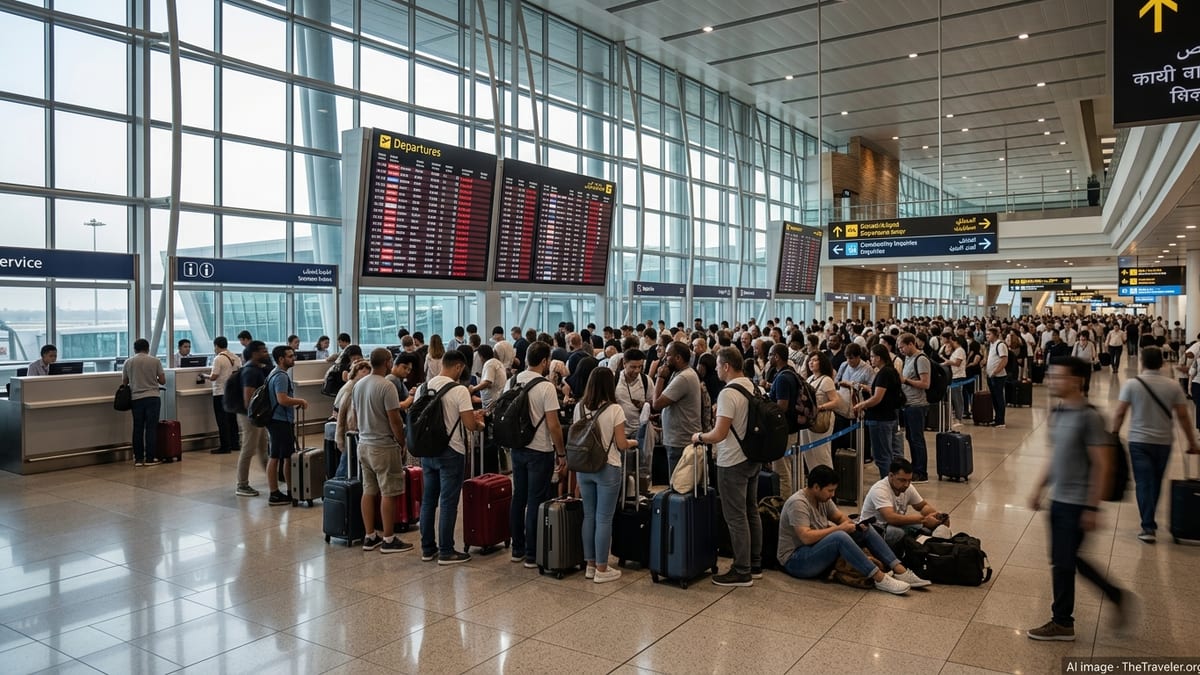
For travelers, the statistics translate into long lines at check-in counters, crowded transfer areas and extended waits for updated departure information. Passenger accounts shared across public forums and social media describe itineraries unraveling after a single cancelled sector into a major hub such as Taipei or Hong Kong, with rebookings often shifting journeys by 24 hours or more.
Airports and airlines across the region have deployed standard disruption protocols, including rebooking on later flights, arranging limited hotel accommodation where feasible and encouraging customers to use digital tools to manage changes. However, the sheer volume of affected passengers on peak travel days means that support channels can become congested, particularly when multiple carriers are hit simultaneously at the same airport.
Operational data indicates that on-time performance metrics have deteriorated noticeably across a wide swath of Asia today, even on routes outside the immediate storm path. Aircraft and crew rotations that originate or terminate at affected hubs are running behind schedule, and this drag on punctuality is likely to continue until weather patterns stabilize and airlines can restore regular aircraft positioning.
Travel advisories from several carriers emphasize the importance of checking flight status frequently, arriving at the airport earlier than usual and remaining flexible about routing and connection options. With Super Typhoon Bavi still influencing regional weather patterns and airspace flows, experts expect the legacy of today’s 709 cancellations and 10,449 delays to remain visible on departure boards for at least another cycle of flight rotations.