


More news on this day
Across the world’s rail networks, a quiet but significant shift is underway: from a mindset focused largely on preventing accidents to one that also assumes collisions will sometimes happen and designs trains, tracks and operations so that more people survive.
Get the latest news straight to your inbox!
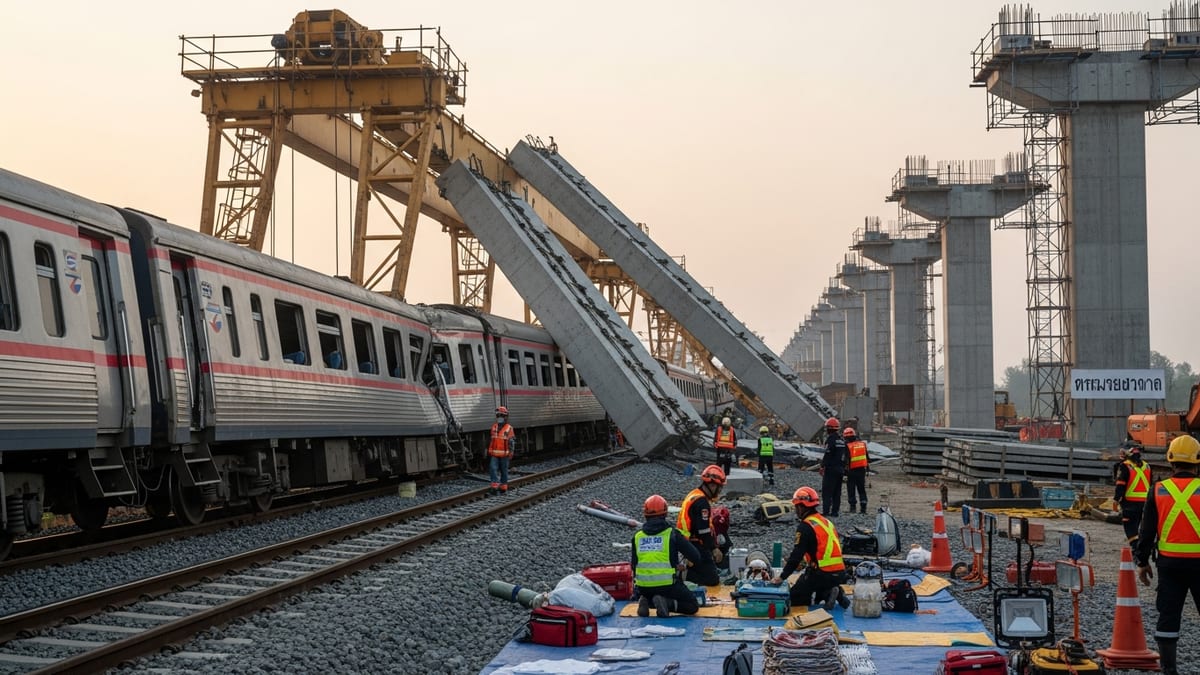
From Prevention to Survivability as a Design Principle
For much of the modern railway age, safety policy has centered on preventing accidents through rules, signalling and staff training. While these measures remain essential, recent derailments and collisions have highlighted an emerging consensus that prevention alone is not enough. A new “survivability era” is taking shape, in which the structure of rail vehicles, the interior layouts and even the way trains are operated are being redesigned to protect occupants when things go wrong.
Publicly available information from national safety agencies and research programs shows growing investment in train occupant protection. In the United States, the Federal Railroad Administration’s Train Occupant Protection Program has emphasized structural crashworthiness and interior safety features that preserve survival space, manage deceleration forces and reduce secondary injuries inside the car. Similar initiatives in Europe and Asia are pushing rail manufacturers to treat survivability as a core design objective rather than an afterthought.
This change in emphasis mirrors developments in automotive and aviation safety, where impact energy management and cabin integrity have long been central. Applied to rail, it is reshaping how manufacturers engineer train fronts, underframes and couplers, and how operators think about train formations, emergency egress and passenger information systems.
Crash Energy Management and Crumple Zones on Rails
One of the clearest indicators of the survivability era is the spread of crash energy management concepts into mainstream passenger rolling stock. Crash energy management, or CEM, is designed to control how a train absorbs and dissipates impact forces, using crush zones and deformable structures so that the energy of a collision is used up progressively before it reaches occupied spaces.
In the United States, federal regulations for passenger equipment incorporate crash energy management requirements, including controlled crush in designated zones and limits on deceleration levels transmitted to the passenger area. Research reports and full-scale impact tests have demonstrated that trains with well-designed crush zones can preserve interior survival space and keep decelerations within levels that occupants are more likely to withstand. These tests have influenced new intercity and commuter fleets ordered for higher speed corridors.
European rulemaking has followed a similar path. The EN 15227 standard on crashworthiness requirements for rail vehicle bodies, most recently updated with an amendment in 2024, defines reference collision scenarios and specifies minimum structural performance under those conditions. Manufacturers have responded with front-end designs that incorporate sacrificial elements, energy-absorbing couplers and anti-climbing features intended to keep vehicles aligned and upright, reducing the risk of telescoping and rollovers that historically produced high casualty counts.
Beyond the structure itself, survivability-focused design is increasingly visible inside the car. Research programs have explored how seats, tables and luggage racks behave in sudden decelerations, leading to recommendations on seat anchorage strength, energy-absorbing seat backs and layouts that reduce the risk of passengers striking hard surfaces or each other. These interior changes, while less visible than a streamlined cab, are part of the same shift toward managing crash consequences rather than merely hoping to avoid them.
Digital Control Systems and Real-Time Monitoring
Digital safety systems are also being reframed through a survivability lens. Positive Train Control in North America and comparable automatic train protection systems elsewhere were initially justified as tools to prevent collisions, overspeed derailments and incursions into work zones. With these systems now widely deployed on key passenger and freight corridors, attention is moving to how they are maintained, monitored and upgraded so that their performance remains reliable in real-world conditions.
Recent regulatory proposals in the United States, for example, focus on managing temporary periods when train control systems are not fully available due to failures or maintenance. Public documents describe efforts to clarify procedures during such outages, reflecting an understanding that resilience and graceful degradation are part of survivability. Rather than assuming technology will function perfectly, the new approach asks what happens when it does not and how backup protections can limit risk to people on board and along the line.
At the same time, wayside and onboard monitoring are moving beyond basic defect detection. Hot bearing detectors, acoustic monitoring, and track and catenary sensors generate continuous data about asset condition. Investigations into recent high-profile derailments have highlighted both the value of these systems and the consequences when alert thresholds, staffing or procedures do not keep pace. The survivability era is pushing operators to treat detection and response as a chain, where technology, human decision-making and emergency preparedness must all align.
Emerging research in automation and artificial intelligence for rail operations is also being framed by safety and survivability concerns. Academic work on formal methods, certified control and “safety shields” for AI-based train systems reflects early attempts to ensure that future driverless or highly automated railways maintain safety margins at least as strong as conventional networks, even as they exploit new capabilities in sensing and prediction.
Global Standards, Local Lessons and Passenger Expectations
While the broad direction is shared, the survivability era is unfolding differently across regions. In Europe, the rail safety and interoperability framework, under the oversight of the European Union Agency for Railways, encourages harmonized technical standards such as updated crashworthiness and braking norms. Recent reports on European rail safety portray a network that is generally safe compared with other modes, but where major incidents still drive incremental changes in equipment and operational rules.
In North America, long-distance freight movements, mixed-traffic corridors and hazardous materials transport complicate the survivability picture. Accident investigation reports involving freight trains hauling hazardous cargo, including derailments with significant environmental and community impacts, have pushed regulators to examine everything from detector spacing and alarm protocols to train make-up rules. Even when passenger trains are not directly involved, lessons from these events inform design assumptions for future mixed-use corridors and high-speed projects.
Elsewhere, densely populated countries investing heavily in new rail capacity are embedding survivability thinking into the earliest stages of design. New high-speed lines, metro extensions and regional rail projects increasingly reference modern crashworthiness standards, advanced signalling and tunnel and station evacuation provisions. Manufacturers marketing new fleets highlight features such as improved crash structures, fire safety systems and emergency access in their technical summaries.
Passengers themselves are becoming more aware of survivability, particularly when viral clips of crash tests or accident footage circulate on social media. While rail travel remains statistically safer than road transport in most regions, the visibility of rare but dramatic rail incidents has encouraged travellers to ask more questions about how trains are built and what happens in the unlikely event of a collision or derailment.
What the Survivability Era Means for Future Rail Travel
For travellers, the survivability era may be most noticeable in subtle design changes that are easy to overlook on a routine journey. Train fronts may appear slightly longer or more sculpted to accommodate energy absorbers. Interiors may feel more solid, with robustly anchored seats and fewer hard edges. Emergency signage, lighting and instructions may be more prominent, and passenger information systems more detailed during disruptions.
Behind the scenes, the shift is deeper. Operators are being encouraged by regulators, insurers and public scrutiny to treat crash energy management, digital control resilience and emergency response planning as connected disciplines. Research roadmaps published by transport departments highlight continuing work on crashworthiness, fire safety and evacuation modelling, suggesting that standards and practices will keep evolving as new data and technologies emerge.
For governments and infrastructure managers, the survivability era also raises questions about cost and prioritization. Advanced crashworthy trains, resilient signalling and continuous condition monitoring require sustained investment. Independent reviews and audit reports frequently note the challenge of funding upgrades while maintaining daily service, particularly for legacy networks with aging fleets and infrastructure. The direction of travel, however, appears clear: rail systems that not only work hard to avoid accidents, but are also explicitly engineered so that more people walk away when the unexpected happens.