


More news on this day
Travelers across the Middle East are facing fresh disruption as Saudia, its low cost arm flyadeal, Emirates and India based Akasa Air suspend dozens of flights and report more than one hundred delays on major routes linking Dubai, Riyadh and Jeddah, according to flight tracking data and regional aviation reports.
Get the latest news straight to your inbox!
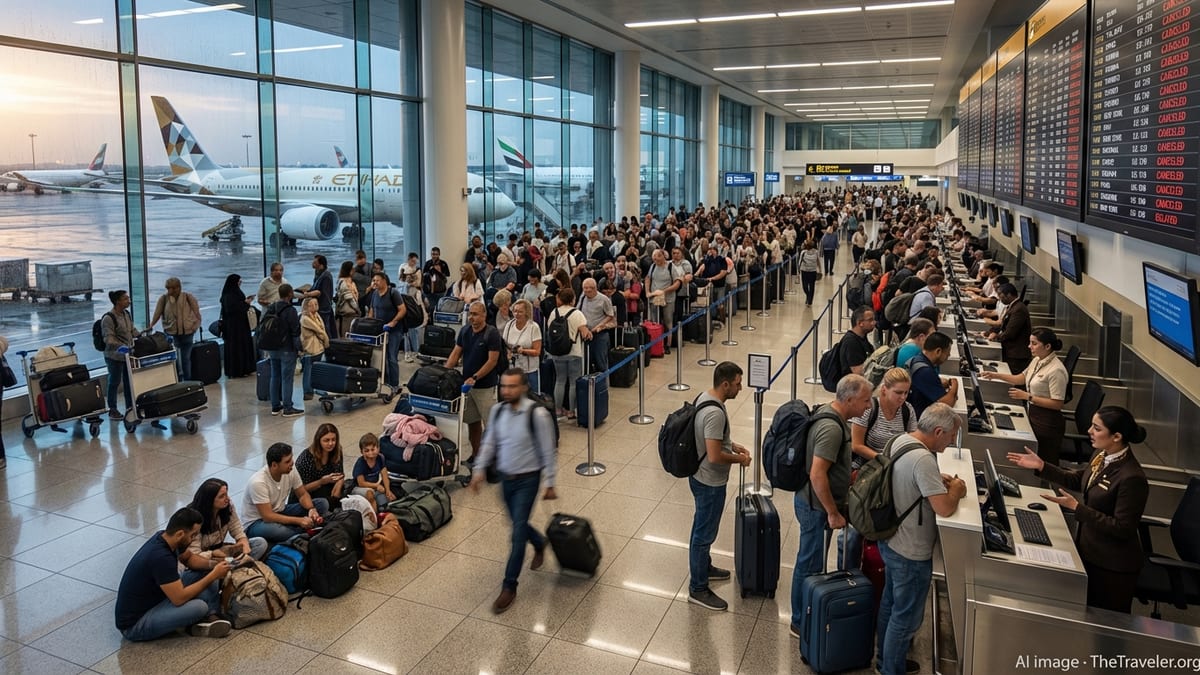
Wave of Cancellations Hits Dubai, Riyadh and Jeddah
Publicly available flight tracking information and regional media coverage indicate that at least 62 flights operated by Saudia, flyadeal, Emirates and Akasa Air on key Gulf corridors have been suspended over the past 24 to 48 hours, with well over one hundred additional services delayed. The heaviest disruption is concentrated on high frequency routes between Riyadh, Jeddah and Dubai, which normally serve as vital connection points between Asia, Europe and Africa.
Saudia and flyadeal, which jointly operate a dense shuttle style schedule between Riyadh, Jeddah and Dubai, appear to have scrubbed multiple rotations, particularly in the morning and late evening peaks. Individual flight status pages for services between the Saudi capital and Dubai show a pattern of cancellations interspersed with heavily delayed departures, illustrating how quickly capacity on these trunk routes has been reduced.
Emirates, the largest long haul carrier in the region, continues to run a reduced regional schedule following months of wider airspace disruptions in the Gulf. Its own travel updates describe an operation that has not fully returned to normal, and industry summaries of airline changes in the Middle East point to ongoing cuts and consolidations on Dubai, Riyadh and Jeddah sectors even as the carrier maintains a broad global network.
Akasa Air, which has expanded rapidly from India into the Gulf over the past two years, is also affected, with suspensions on services linking Indian cities to Jeddah and other Saudi gateways feeding into the regional bottleneck. The combination of reduced inbound capacity from India and cuts on intra Gulf flights has magnified the impact for connecting passengers relying on Dubai, Riyadh and Jeddah as transit hubs.
Geopolitical Tensions and Airspace Constraints Deepen Disruption
The latest wave of cancellations comes against the backdrop of a volatile regional security environment that has repeatedly reshaped airline schedules since early 2026. Analysis pieces on Middle East aviation note that conflict related airspace closures over parts of Iran, Iraq and the wider Gulf have forced both regional and international airlines to reroute or suspend services, with Dubai and other hubs periodically operating on a skeleton schedule.
Recent roundups of airline responses to the conflict describe a patchwork of suspensions, reduced frequencies and extended cutoffs to key Gulf destinations, including Dubai, Riyadh and Jeddah. In these reports, Emirates is listed among carriers running trimmed networks in and out of the United Arab Emirates, while foreign airlines such as Air France, KLM, Lufthansa and British Airways have temporarily halted or scaled back flights to Saudi and Emirati airports.
For Saudia and flyadeal, the challenge is compounded by their role as primary domestic and regional connectors within Saudi Arabia. Travel advisories published earlier this year already referenced a fluid operating environment across Saudi destinations, with some routes categorized as experiencing ongoing delays. When combined with intermittent restrictions on UAE airspace and capacity limits at Dubai International, this has created a fragile system prone to cascading disruption.
Akasa Air’s Middle East operations, still relatively new but strategically important for India to Gulf travel, have also been exposed to this volatility. The airline’s network to Saudi Arabia and the UAE includes routes feeding migrant workers, religious travelers and leisure passengers into Jeddah and beyond, meaning any suspension of flights on these sectors has an outsized effect on lower cost travel options.
Knock On Effects for Transit Passengers and Summer Travel Plans
The immediate consequence for travelers is a sharp reduction in available seats and reliable departure times on what are normally among the most frequent and competitively served city pairs in the region. Passengers connecting through Dubai from Europe or North America to onward destinations in Asia report that connections via Riyadh and Jeddah, often operated by Saudia or flyadeal under codeshare arrangements, are particularly vulnerable to last minute schedule changes.
Regional travel forums and social media posts from passengers in Riyadh and Jeddah describe clusters of Saudia flights to Dubai and Abu Dhabi showing as cancelled or significantly delayed on airport departure boards, sometimes with little advance notice beyond automated app alerts. Similar anecdotal accounts from Dubai highlight a pattern in which early morning departures are pushed back by several hours, only to be cancelled if slot or routing constraints worsen during the day.
The timing is especially difficult for travelers given that July is usually one of the busiest months for leisure traffic in and out of the Gulf, with families departing for school holidays and pilgrims routing through Jeddah for religious travel. Capacity reductions by Emirates and its regional competitors arrive just as demand for flights through Dubai and Saudi hubs typically climbs, raising the risk of prolonged backlogs and higher fares on the services that do operate.
Travel industry analysts note that the Middle East already faced constrained capacity following earlier rounds of cuts by European and Asian airlines wary of overflying conflict zones. The latest suspensions by Saudia, flyadeal, Emirates and Akasa Air on core Gulf corridors further tighten an already stretched system, limiting rerouting options for passengers whose original itineraries relied on multiple Gulf connections.
Advice for Affected Travelers Across the Middle East
Airlines are generally offering standard disruption options such as complimentary rebooking on alternative dates, refunds for cancelled sectors, or rerouting via different hubs where seats are available. However, given that multiple carriers are trimming Middle East services simultaneously, spare capacity on alternative flights is limited, especially within a few days of departure.
Travel advisories from aviation authorities and airport operators across the region consistently urge passengers not to proceed to the airport until they have confirmed that their flight is operating. For those booked with Saudia, flyadeal, Emirates or Akasa Air on routes touching Dubai, Riyadh or Jeddah, the most reliable information will come from real time flight status tools and airline apps rather than itinerary details issued weeks or months earlier.
Travel planners recommend allowing significantly longer connection windows if itineraries still rely on intra Gulf transfers, or, where possible, selecting routings that avoid multiple stops in the region. Some long haul passengers are opting to connect through secondary European or Asian hubs instead of Dubai or Riyadh in order to reduce exposure to further schedule changes, even when this involves longer travel times or higher fares.
For those who must travel in the coming days, experts suggest preparing for extended airport waits, keeping essential items and medications in carry on luggage, and securing flexible accommodation bookings in case of overnight delays. While airlines and regulators continue to monitor conditions and gradually restore services when feasible, the latest suspensions underline that travel through Dubai, Riyadh and Jeddah remains subject to rapid change and that contingency planning is now an essential part of flying in and out of the Middle East.