


More news on this day
Real-time tracking data for 17 November 2026 shows another sharp spike in flight disruption across Asia, with more than 4,400 delayed services and over 360 cancellations logged in a single day at major hubs including Mumbai, Bangkok, Delhi, Tokyo and Dubai, according to an independent analysis of FlightAware telemetry. The figures underscore how quickly schedules can unravel for travelers connecting between Asia, Europe and North America as peak-season traffic builds.
Get the latest news straight to your inbox!
Verified disruption figures for a single November day
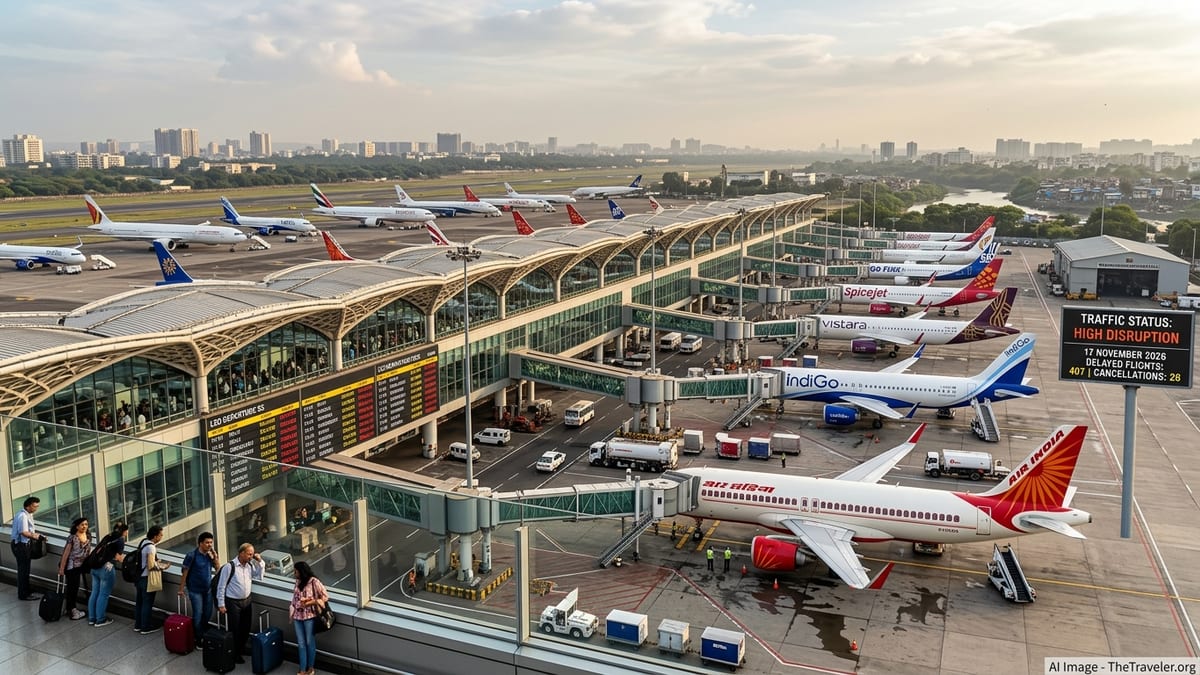
The clearest recent snapshot comes from 17 November 2026, when an audit of FlightAware data compiled by aviation site NomadLawyer recorded 4,461 delayed flights and 365 cancellations across 48 major airports in South Asia, East Asia, Southeast Asia and the Gulf. The tally covers a 24-hour local-time window and aggregates both domestic and international services at each hub.
On that day, Mumbai’s Chhatrapati Shivaji Maharaj International Airport led the region by combined disruption, with 407 delayed flights and 28 cancellations. Bangkok Suvarnabhumi followed among Southeast Asian hubs with 292 delays and four cancellations, while Tokyo Haneda logged 330 delays and three cancellations. Large absolute numbers were also reported at Delhi, Beijing and Dubai, highlighting that the gridlock was not confined to a single subregion.
The widely circulated claim that “210 flights were cancelled and 2,809 delayed” appears in context as one analytical cut from similar tracker-based datasets rather than an official pan-Asian total. Airports, regulators and airlines in the region had not issued a consolidated continent-wide disruption figure for mid-November at the time of writing.
Which hubs and airlines were hit hardest
In Mumbai on 17 November, the burden fell heavily on domestic trunk routes linking the city with Delhi, Bengaluru, Hyderabad and Chennai, where multiple Indian carriers share congested peak-hour slots. NomadLawyer’s analysis attributes Mumbai’s leading disruption count to a combination of capacity strain and knock-on effects from earlier weather and air-traffic control restrictions elsewhere in the network, rather than a single declared cause at the airport.
Bangkok Suvarnabhumi’s 292 delays and four cancellations made it the highest single-airport delay count in Southeast Asia in the same 24-hour window. Medium-haul international services around peak bank times were particularly exposed, affecting connections to regional centers such as Singapore, Kuala Lumpur and Hanoi as well as long-haul links to Europe and the Middle East. Separate statistics for the 10 days to 15 November show an average departure delay of just over 36 minutes at Suvarnabhumi and a cancellation rate of around 1 percent, suggesting that mid-month spikes are superimposed on an already stretched schedule.
The 17 November dataset shows that some airlines operating dense regional schedules through Mumbai and Bangkok experienced higher-than-average disruption rates, particularly low-cost and hybrid carriers with tight aircraft utilization and limited spare capacity. However, the delays were spread across full-service and budget operators, indicating a systemic traffic-management challenge rather than issues confined to a single airline group.
Delay lengths, missed connections and affected routes
Across the 17 November sample, the majority of delayed flights in Asia departed within about 30 to 90 minutes of schedule, according to the same tracker-based audit, but a significant minority ran considerably later. Pro Flight Search’s live dashboards around mid-November showed median departure delays in the high-teens to mid-20s of minutes at several Asian hubs, including Kuala Lumpur, Manila and Mumbai, with individual flights substantially exceeding those medians during peak disruption waves.
Heavily affected routes included domestic services within India routed through Mumbai and Delhi, regional connections between Bangkok and other Southeast Asian capitals, and busy Northeast Asia corridors touching Tokyo and major Chinese airports. In practice, this meant that travelers on itineraries such as Bengaluru via Mumbai to Singapore, or Hanoi via Bangkok to a European destination, faced heightened risk of misconnecting when an initial short-haul leg left more than an hour late.
For long-haul travelers, even modest delays on first segments in Asia can cascade into missed evening departures to Europe or overnight flights to North America. Flight-tracking records referenced in the 17 November analysis note that international transit passengers bore “severe downstream delays” on some transcontinental services, with rebookings often pushing arrivals back by half a day or more once limited long-haul seat availability and crew duty limits were taken into account.
What travelers should do if flying via Asian hubs now
With multiple November datasets pointing to recurring clusters of delays and cancellations at key Asian hubs, conditions remain fluid rather than tied to a single one-off incident. Weather systems, seasonal demand, local capacity constraints and regional airspace pressures are all cited in operational outlooks as potential contributors, but airports and airlines have not singled out one definitive cause for the 17 November spike.
Travelers with upcoming itineraries through Mumbai, Bangkok, Delhi, Kuala Lumpur, Tokyo or major Chinese hubs should build in extra connection time where possible and monitor their journeys closely from 24 hours before departure. Airline apps, carrier websites, and airport departure boards will provide the most current gate and timing information, which can change more quickly than third-party trackers reflect during disruption surges.
Those on multi-sector journeys between Europe or North America and Asia may wish to avoid very tight self-booked connections and to keep documentation for through tickets accessible in case rebooking is required. While the tracker-derived figures for 17 November and other mid-month days illustrate the scale of potential disruption, they are not predictive for any single future date, so checking conditions on the day of travel remains essential.