


More news on this day
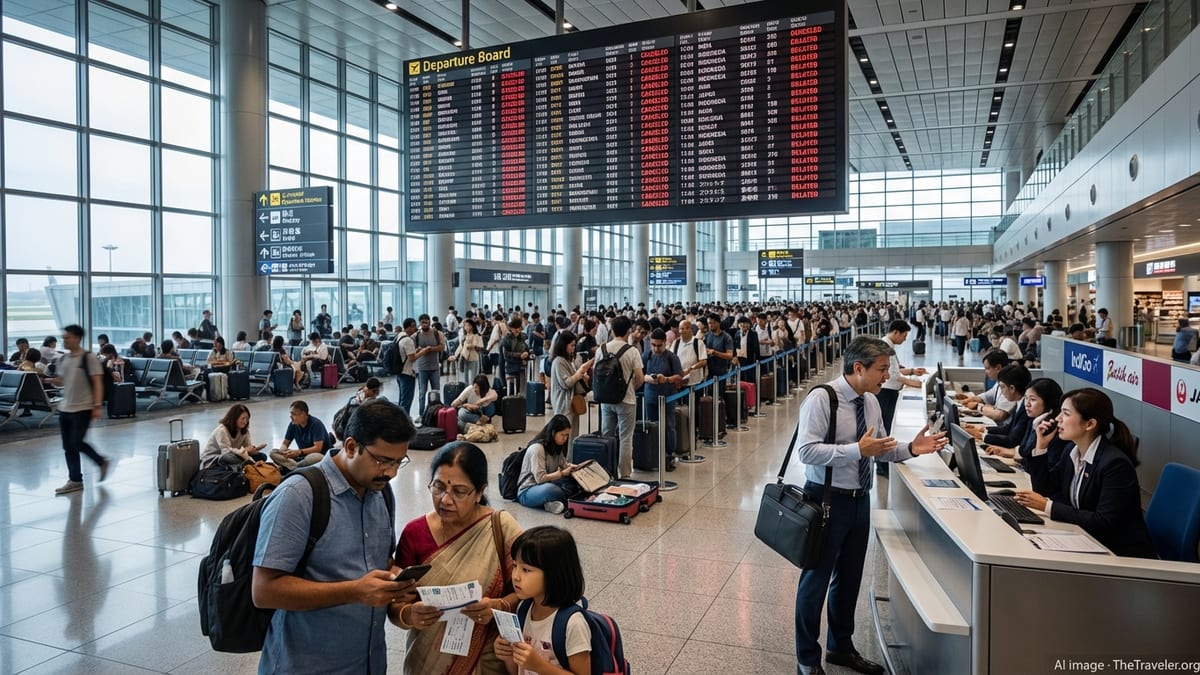
Air travel across Asia is facing another bruising day of disruption, with real-time aviation dashboards indicating 2,967 flight delays and 358 cancellations across dozens of major airports in a recent 24-hour window, unsettling plans for tens of thousands of passengers at the tail end of the region’s busy summer travel season.
Get the latest news straight to your inbox!
Fresh Wave of Disruptions Across Asian Hubs
Publicly available flight-tracking snapshots for early September indicate that Asia’s aviation network has logged 2,967 delayed departures and 358 cancellations in one 24-hour period, pointing to a concentrated wave of operational strain across the region’s largest hubs. These figures sit within a broader pattern of elevated disruption that has seen other recent days surpass 3,600 delays and roughly 470 cancellations across 39 Asian airports, according to compiled tracking data and industry coverage.
The latest numbers fit into a now-familiar pattern in which weather, congestion and airspace constraints combine to push already busy airports into significant schedule degradation. Reporting that draws on live dashboards has repeatedly highlighted Beijing, Shanghai, Guangzhou, Jakarta, Delhi and key Southeast Asian gateways among the hardest hit, with some hubs recording more than 200 delayed services and dozens of cancellations in a single day.
Analysts tracking the data note that while individual airport disruption levels fluctuate hour by hour, the regional picture over recent days has remained consistently elevated, with delay ratios well above typical off-peak norms. That environment leaves carriers with little slack to recover when storms, haze or rerouted airspace temporarily reduce capacity.
Weather, Haze and War-Related Airspace Changes Converge
Reports indicate that the latest 2,967 delays and 358 cancellations are not attributable to a single cause, but rather to a convergence of meteorological and geopolitical pressures. Seasonal convective storms have repeatedly swept across parts of East and Southeast Asia, while cross-border smoke haze linked to Indonesian forest fires has reduced visibility at several airports, forcing wider spacing between aircraft and occasional holding patterns.
In parallel, the continuing fallout from the 2026 Iran conflict has reshaped key long-haul corridors between Asia, the Middle East and Europe. Earlier this year, widespread airspace closures and strikes on major Gulf hubs forced thousands of cancellations and diversions, with ripple effects that are still influencing how airlines schedule and crew aircraft on Asia-bound routes. Even after some services resumed, capacity on certain trunk connections remains tighter and routings longer than before the war, according to regional aviation analyses and economic impact assessments.
These overlapping pressures mean that when storms or haze hit major Asian hubs, airlines have fewer options to reroute around localized problems. The knock-on effect is particularly acute for connecting passengers who rely on precisely timed interline and codeshare itineraries linking Asian airports with Gulf and European gateways.
Airports Struggle With Capacity and Recovery Windows
Airport-focused disruption indices published by aviation analytics providers show several large Asian gateways fluctuating between what are typically categorized as minor and moderate operational problems across peak travel hours. These indices synthesize the share of delayed flights, average delay duration and cancellation counts into composite scores, offering a snapshot of how strained any given hub may be at a particular moment.
Recent reporting drawing on such tools has emphasized how thin capacity buffers have become at many airports in the region. Traffic recovery in Asia Pacific has outpaced infrastructure upgrades at several large hubs, resulting in busy runway schedules, congested taxiways and terminals that operate close to their design limits for long stretches of the day. Under those conditions, even short-lived weather holds or technical issues can quickly propagate through departure banks, stretching into sustained disruption.
The current tally of 2,967 delays and 358 cancellations appears to reflect that dynamic. Once early-morning or midday waves suffer extended turnarounds, subsequent rotations fall behind, especially for narrowbody fleets tasked with operating multiple short-haul legs. For passengers, the result is often longer waits, missed connections and late-night arrivals, even when their own flights are not among the outright cancellations.
Regional Hotspots and Airline-Level Impacts
Within the wider Asia network, certain airports and carriers have repeatedly emerged as hotspots in recent disruption snapshots. Data compiled in the first days of September points to Jakarta’s Soekarno Hatta International as one of the most affected single airports, with previously reported days of more than 200 delayed departures and just over 50 cancellations. Large Chinese hubs including Guangzhou, Shanghai Pudong and Beijing Capital have also featured prominently, particularly during multi-day systems of heavy rain and thunderstorms tracked earlier in the summer.
At the airline level, both regional and intercontinental operators have absorbed the consequences of cascading delays. Low-cost carriers focused on dense intra-Asia networks are highly exposed because their aircraft often fly several segments per day; any delay early in the rotation can ripple through the schedule. Long-haul operators linking Asia with the Middle East and Europe, meanwhile, face added complexity from elongated routings around sensitive airspace and slot constraints at both origin and destination airports.
Previous data snapshots published by travel and consumer-rights organizations have highlighted occasions where severe weather alone disrupted nearly 7,000 flights over a multi-day period at major Asian hubs, with thousands of those categorized as delays rather than outright cancellations. Against that backdrop, a single-day burden of 2,967 delays and 358 cancellations slots into a broader year marked by unusually frequent and widespread schedule instability.
What Travelers Can Expect in the Coming Days
While delay and cancellation totals vary from day to day, aviation analytics groups and regional media coverage suggest that elevated disruption levels across Asia are likely to persist as long as seasonal storms, haze events and airspace constraints remain in play. Published outlooks for 2026 have repeatedly warned that structural pressures, including aircraft delivery delays, staffing constraints and tight airport capacity, leave networks more vulnerable to shocks than they were before the pandemic era.
Travel advisories and airport updates consistently emphasize that conditions can shift rapidly over the course of a single day, particularly during afternoon and evening peak banks when traffic density is highest. For passengers connecting between Asian hubs and long-haul flights via the Gulf or Europe, even modest upstream delays may be enough to jeopardize tight connections, leading to rebookings or overnight stays.
Consumer-focused resources that track real-time disruption also stress that headline numbers like 2,967 delays and 358 cancellations represent an aggregate snapshot rather than a fixed list; flights may move between on-time, delayed and cancelled categories as airlines adjust operations. For now, however, the volume and geographic spread of the disruptions underline that Asia’s aviation recovery is still contending with a volatile operating environment, in which even a single day’s data can translate into significant uncertainty for travelers across the region.
TheTraveler.org: Asia flight disruptions hit 39 airports