


More news on this day
Thousands of travelers across Asia faced sudden itinerary changes on July 11 as a powerful typhoon system and knock-on operational issues triggered more than 4,000 flight cancellations and thousands more delays, disrupting traffic at major hubs from Shanghai and Taipei to Tokyo, Bangkok and Dubai.
Get the latest news straight to your inbox!
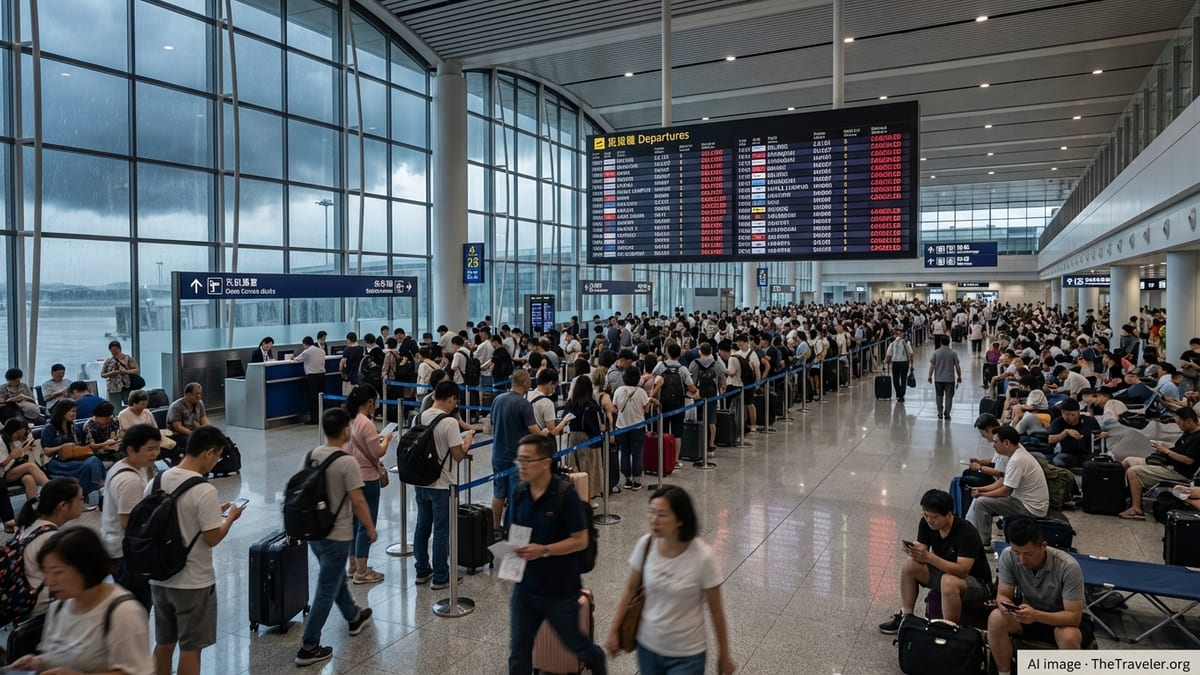
Typhoon Bavi Slams Northeast Asia and Shuts Down Key Routes
Publicly available weather and aviation data indicate that Super Typhoon Bavi, packing winds reported at over 200 kilometers an hour, has driven the bulk of the latest disruption across Northeast Asia. The storm swept past Japan’s Okinawa region on July 11 before tracking toward Taiwan and the Chinese mainland, pushing airlines across the region to pare back operations for safety reasons.
Coverage from regional outlets in Singapore and Taiwan describes widespread cancellations on routes linking Southeast Asia with cities such as Taipei, Shanghai and Tokyo as carriers preemptively reduced schedules. Several services from Singapore to North Asia, including flights to Taipei and Tokyo, were called off or retimed, with airlines advising passengers to monitor status pages closely as conditions evolved.
Tracking platforms show that services such as Thai Airways’ Bangkok to Taipei route and multiple intra‑Asia flights operated by Taiwanese and Japanese carriers were either canceled outright or significantly delayed on July 11. Data compilations from these sources indicate that across the broader region, at least 4,197 flights were canceled and more than 5,400 delayed as the storm’s outer bands spread heavy rain and strong winds over multiple aviation corridors.
Historical experience with similar storms in the western Pacific suggests that these figures may rise further as airlines adjust rotations and aircraft positioning in the days after landfall. Early indications from airline advisories point to rolling schedule changes into the start of next week as operations normalize.
Shanghai, Taipei and Tokyo Bear the Brunt of Disruptions
Among the hardest‑hit airports are major hubs in Greater China and Japan. Shanghai’s large international gateways, Pudong and Hongqiao, have seen waves of cancellations on services to and from Northeast and Southeast Asia as well as some long‑haul flights that rely on tight connection windows.
In Taiwan, publicly available information from local news and airport bulletins shows that domestic operators have suspended large portions of their schedules, particularly on island‑hopping routes and services linking Taipei with outlying destinations. Reports from Penghu and other regional airports describe entire days with no scheduled departures, contributing significantly to the regional cancellation tally.
Tokyo’s Haneda and Narita airports have also experienced notable disruption as the storm’s outer impact combined with congestion caused by diverted and retimed flights. Flight status data for carriers such as All Nippon Airways and other Japanese operators show clusters of cancellations and multi‑hour delays on routes to China, Taiwan, Korea and Southeast Asia.
The pattern reflects a familiar dynamic for the region’s aviation network. When a strong storm passes through the East China Sea, bottlenecks at a few critical hubs can quickly ripple across a web of connections, affecting airports as far away as Singapore, Seoul and Manila.
Multiple Airlines Cut Schedules Across Asia and the Gulf
The disruption has affected a broad range of carriers, from regional operators to long‑haul airlines based in the Gulf. Data from flight‑tracking platforms and airline advisories indicate that China Eastern, All Nippon Airways, Korean airlines, Thai Airways, Saudia and several low‑cost carriers have all curtailed flights touching the storm‑affected zone.
On the Chinese mainland, large state‑owned airlines have reduced frequencies on routes into Japan and Taiwan, while some services to Southeast Asia have been consolidated. Taiwanese carriers have implemented sweeping cancellations on domestic routes and scaled back selected international flights, citing the need to keep aircraft and crew out of severe weather.
Thai Airways and other Thailand‑based operators have trimmed services from Bangkok to North Asia, including flights to Taipei, Tokyo and Shanghai. At the same time, airlines in the United Arab Emirates, including services linking Dubai to Asian destinations, have made schedule adjustments where rotations or overflight paths intersect with the region affected by Bavi, adding another layer of complexity for travelers flying between Europe, the Middle East and Asia.
According to aggregated operational data, the combined impact across these networks has produced the reported figure of more than 4,000 canceled flights and thousands more delays throughout the wider Asian and transcontinental system.
Knock-on Effects Reach Dubai, Bangkok and Beyond
While the storm’s immediate footprint is concentrated around East Asia, the consequences are being felt much farther afield. Bangkok’s Suvarnabhumi and Don Mueang airports, both critical transfer points for regional and long‑haul traffic, have seen cancellations on flights to Taiwan, Japan and China as well as schedule reshuffles on onward connections.
In the Gulf, Dubai International Airport’s role as a major connecting hub means that any disruption to Asian arrivals can cascade into delays on Europe and Africa‑bound departures. Press reports and traveler accounts from the region note that some services from the United Arab Emirates to Asian cities in the storm’s path have been withdrawn or retimed, often at short notice.
These adjustments add strain to an already busy midsummer travel period. Many itineraries between Europe and Asia rely on carefully timed connections in Dubai or Bangkok, and when feeder flights from Northeast Asia are canceled, passengers can face lengthy rebookings or unplanned overnight stays. Travel forums and social media posts from July 11 highlight cases of travelers stranded in transit hubs as they search for alternative routings.
Operational data from earlier typhoon seasons suggest that these secondary impacts can last several days beyond the point when weather has cleared, as airlines work through backlogs and reposition aircraft to their usual bases.
Passengers Urged to Monitor Flights and Expect Continued Volatility
With aviation networks stretched by both weather and capacity constraints, travel experts and consumer advocates are emphasizing the importance of closely monitoring flight status and allowing extra time for connections. Airlines across the region have published general guidance urging passengers to check digital tools and mobile apps before leaving for the airport.
Publicly available airline notices show that many carriers are offering limited flexibility, including one‑time rebooking without change fees, for customers booked on affected dates and routes. However, the specifics vary by airline and ticket type, and some travelers have reported long waits to reach call centers as demand for assistance spikes.
Industry analysts note that Asia’s aviation sector has become increasingly vulnerable to weather‑related disruption as traffic rebounds and schedules run closer to capacity. Events such as Typhoon Bavi expose how quickly a single severe storm can cascade across multiple hubs and carriers, affecting travelers who may be thousands of kilometers from the eye of the system.
As of the evening of July 11, publicly reported figures indicate that more than 4,197 flights have been canceled and around 5,400 delayed across Asia and associated long‑haul networks. With the storm still influencing conditions in parts of China, Taiwan and Japan, further adjustments remain likely, keeping travelers and airlines on edge as they navigate a turbulent peak season weekend.