


More news on this day
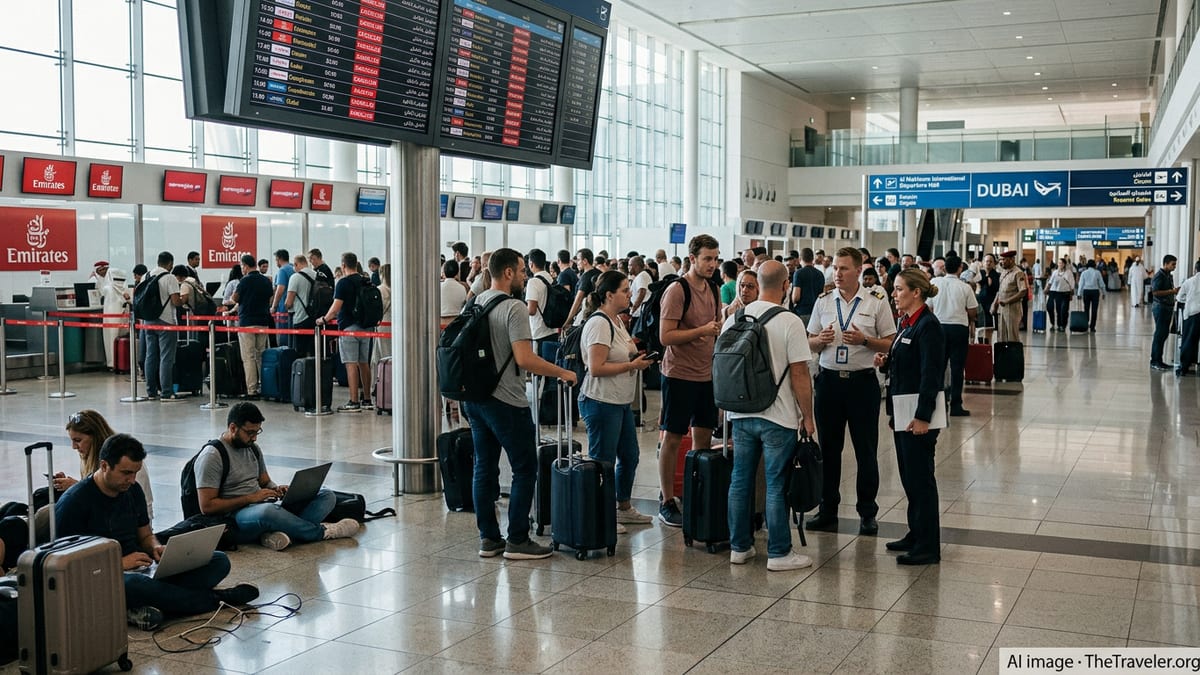
Thousands of passengers traveling through Dubai International Airport and Riyadh’s King Khalid International Airport have been hit by widespread disruption, with 174 flights delayed and 54 canceled across a range of major carriers serving the two Gulf hubs.
Get the latest news straight to your inbox!
Ripple Effects Across Gulf Mega-Hubs
Publicly available flight data and operational dashboards indicate that Dubai International and King Khalid International in Riyadh, two of the busiest transit points in the Middle East, have experienced a sharp spike in disruption, with a combined 174 delayed departures and arrivals and 54 outright cancellations over a short operating window. The irregular operations have affected both local and international airlines, stranding passengers in terminals and forcing last minute rebookings across already congested routes.
At Dubai International, which is regularly cited as the world’s busiest airport for international traffic, the impact is particularly visible because of its role as a global connection hub. Disruption to a single long haul bank of flights can cascade across multiple regions, affecting travelers bound for Europe, Asia, Africa and the Americas on the same day. In Riyadh, King Khalid International’s position as a key gateway for Saudi Arabia means schedule changes ripple quickly into domestic and regional networks.
Industry tracking services show that the pattern of delays includes both morning and evening peak periods, indicating that the disruption is not confined to a single weather cell or isolated operational issue. Instead, delays appear to be compounding as aircraft, crew and airport resources fall out of their planned rotations, putting additional pressure on ground handling, immigration and security processing at both airports.
While exact passenger counts are not yet available, the nature of the routes involved suggests that several tens of thousands of travelers may have been affected over the period in question, particularly during busy summer travel weeks when load factors are typically high on Gulf connecting flights.
Major Carriers Confront Cancellations and Long Delays
Emirates and flydubai, the two largest operators at Dubai International, feature prominently in the disruption statistics. Flight status tools and airline advisories show multiple delayed and canceled services, with some long haul departures pushed back by several hours and selected flights removed from the schedule. Passengers on disrupted itineraries have been urged through official channels to monitor their booking status online and avoid heading to the airport until they hold revalidated tickets.
In Riyadh, Saudia and low cost sister carrier Flynas have also recorded a cluster of delayed and canceled operations. Ontime performance reports for Saudi airports show that King Khalid International typically achieves high punctuality, so the current level of disruption stands out against its usual metrics. Where flights have been canceled, publicly available guidance points travelers toward rebooking on later departures or securing refunds through airline service channels.
Among international carriers, Qatar Airways, Air India, British Airways, Lufthansa and Turkish Airlines all operate dense schedules through Dubai and Riyadh or across neighboring Gulf airspace. Monitoring of airline networks and route adjustments over recent months shows that these carriers have periodically rerouted or trimmed services in response to wider regional challenges, so fresh cancellations and delays at the two hubs further complicate already sensitive schedules.
For some long haul passengers, disruption at Dubai or Riyadh has resulted in missed onward connections to destinations in Europe, North America and East Asia, forcing overnight stays or multi stop re-routings via alternative hubs such as Doha, Istanbul, Jeddah or major European gateways.
Operational Strain Adds to Existing Regional Pressures
The latest delays and cancellations come on top of a year in which Middle East aviation has already faced unusual operational strain. Recent months have seen temporary airspace restrictions and precautionary schedule reductions across several Gulf and Levant corridors, prompting major carriers to adjust frequencies, alter routings and consolidate capacity on trunk routes.
Information released by airlines and aviation data providers shows that carriers such as Emirates and Qatar Airways have on several occasions in 2026 operated below their planned schedules from Gulf hubs while gradually rebuilding networks. At the same time, European groups including Lufthansa and British Airways have at various points suspended or reduced certain Middle East services when routing options narrowed, making their networks more sensitive to additional shocks at key hubs.
Riyadh and Dubai are also managing strong underlying demand. Passenger numbers through both airports have rebounded significantly compared with the immediate post pandemic period, with airlines adding new destinations and increasing frequencies. This demand recovery means that when disruptions occur, there is often limited spare capacity on alternative flights, leaving fewer easy rebooking options for travelers trying to reach time sensitive events such as business meetings, religious travel or family gatherings.
Ground operations at large hubs can be particularly vulnerable when several carriers experience problems at once. Even short lived issues, such as weather cells or temporary runway constraints, can rapidly translate into boarding gate congestion, longer queues at transfer security and increased pressure on baggage systems as mis connected bags accumulate.
Impact on Passengers and What Travelers Can Do
Travelers caught up in the latest disruption at Dubai International and King Khalid International have reported a mix of extended terminal waits, last minute gate changes and uncertainty over onward connections, as is typical during major irregular operations. Airline advisories across affected carriers consistently encourage passengers to make use of digital self service options to track flight status, manage rebookings and update contact details so that notifications can be delivered quickly.
Publicly available guidance from several of the airlines involved highlights the importance of checking flight status before leaving for the airport and allowing extra time for transits when connecting through Gulf hubs. Some carriers operating long haul services via Dubai or Riyadh have reiterated policies for complimentary hotel accommodation, meals or ground transfers when minimum connection times are exceeded or when passengers are forced to stay overnight because of cancellations.
With multiple airlines affected at the same airports, industry observers note that competition for the remaining open seats can be intense during disruption windows. Travelers seeking to minimize delay often look beyond their original carrier to rival networks such as Turkish Airlines via Istanbul or European and Asian hubs, but these alternatives can sell out rapidly once widespread cancellations become visible in booking systems.
For future trips, travel planners recommend building more buffer time into itineraries that rely on single stop connections through the Gulf, particularly during peak holiday periods or in weeks when regional tensions or weather patterns raise the risk of short notice schedule changes.
Outlook for Operations at Dubai and Riyadh
Aviation data published in recent months suggests that airlines and airport operators in Dubai and Riyadh have been working to improve resilience by adjusting schedules, refining slot allocations and investing in additional ground handling capacity. However, the current spike in delays and cancellations underlines how vulnerable even mature hubs remain to sudden regional or operational shocks.
Analysts tracking airline performance in the Middle East expect carriers to continue fine tuning their networks, potentially smoothing peak banks of flights to reduce the knock on effects when disruptions occur. For hub airports such as Dubai International and King Khalid International, incremental gains in punctuality and baggage handling are likely to be key priorities as passenger flows continue to grow.
In the short term, travelers booked on Emirates, flydubai, Saudia, Flynas, Qatar Airways, Air India, British Airways, Lufthansa and Turkish are being advised through public channels to monitor their flights closely and be prepared for schedule adjustments. As operations stabilize, ontime performance data will indicate how quickly the two hubs are able to absorb the latest disruption and return to normal traffic levels.