


For many island travelers, the most stressful part of a Greek holiday is not the ferry crossing itself but the transfer from Athens International Airport to Piraeus Port. Schedules rarely line up perfectly, the port is vast and confusing on a first visit, and the clock starts ticking from the moment your plane’s wheels touch down. This guide focuses on real, current options for getting from Athens International Airport to Piraeus, comparing the metro, suburban rail, express bus, taxi, and private transfers so you can pick the route that matches your budget, luggage, and ferry time.
Get the latest updates straight to your inbox!
Understanding the Athens Airport to Piraeus Connection
Athens International Airport (Eleftherios Venizelos) sits about 45 kilometers east of Piraeus Port, Greece’s main gateway to the islands. Under normal traffic conditions, the journey takes roughly 50 to 70 minutes by rail or road, but it can stretch to 90 minutes or more during rush hour or if there are delays. Because many ferries depart early in the morning, timing your transfer is just as important as choosing the right route.
The good news is that Athens has invested heavily in airport links. Travelers can choose between a direct metro line, the suburban railway, a 24-hour express bus, and a regulated taxi and transfer system. There is no need to pre-book public transport tickets for any of these options. Tickets can be purchased on the spot from machines or staffed counters at the airport station or bus kiosk, usually within a few minutes.
For most visitors, choosing the right route depends on three questions: how much time you have before your ferry, how much luggage you are carrying, and what time of day you are traveling. A backpacker with four hours to spare at noon will likely make a different choice than a family of five landing at 01:30 with a 06:30 departure to Santorini.
As you weigh the options below, remember that Piraeus itself is a large, crescent-shaped port with multiple gates. From any arrival point, you may still need 10 to 20 minutes to find your pier on foot or by the free internal shuttle buses that run inside the port, especially for large ferries departing from gates E6 to E10.
Taking the Metro: Direct Blue Line Convenience
The most straightforward public transport option between the airport and Piraeus is the Athens Metro Line 3, the Blue Line. Trains run from the airport station directly to Piraeus, using the same platforms as the suburban railway but separate tracks. The direct metro service typically runs every 30 to 36 minutes, with a total journey time of up to about 55 to 60 minutes from end to end.
As of mid 2026, a standard one-way airport metro ticket costs just under 10 euros for adults, with discounted fares for youths and seniors, and slightly higher-priced return tickets valid for 30 days. These tickets cover the entire trip from the airport to Piraeus, including any intermediate segments where metro and suburban rail share tracks. You can buy tickets from blue-and-white vending machines at the airport station entrance or from the staffed ticket counter. Machines accept both cash and cards, though it is wise to have a few small notes or coins in case card payments are temporarily unavailable.
The metro is generally the best option for solo travelers or couples arriving in daytime or early evening with moderate luggage. For example, if you land from London at 13:00 and your ferry to Paros leaves at 18:00, catching the 13:45 or 14:15 Blue Line train gives you plenty of margin for passport control, baggage claim, and the one-hour rail ride to Piraeus. On arrival at Piraeus metro station, you emerge directly opposite the central ferry gates. Large blue signage in English and Greek helps you orient toward your specific gate.
The main drawbacks of the metro are frequency and crowding. A 30 to 36 minute interval means that just missing a train can cost you significant time. During peak commuting hours, especially on weekdays between 08:00 and 10:00 or 17:00 and 19:00, trains can be standing-room-only from central stations onward. If you are hauling large suitcases or traveling with small children during rush hour, you may prefer a taxi or private transfer even if it costs more.
Using the Suburban Railway: A Backup Rail Option
In addition to the metro, the Athens Suburban Railway (Proastiakos) connects the airport with the wider Attica region. On the shared section of track between the airport and Doukissis Plakentias, the suburban trains and the Blue Line use the same corridor, then branch off to different destinations. Over the years, there have been periods when suburban trains ran directly from the airport to Piraeus, but in recent timetables this through-service has often been limited or suspended in favor of connections via central Athens or key interchange stations.
For ferry travelers, this means the suburban railway is usually a secondary option rather than the primary choice. In practice, many visitors use a hybrid approach when necessary: taking whichever train, metro or suburban, leaves first from the airport and then changing at an interchange such as Doukissis Plakentias, Neratziotissa, or the central Athens station to continue toward Piraeus. This can make sense if, for example, you step off your plane at 09:10, clear immigration quickly, and find that the next direct metro is in 25 minutes but a suburban train to the city is due in five.
Tickets for the suburban railway on the sections that form part of the urban network are integrated with Athens transport fares, and the same airport-special tickets used for the metro are accepted on relevant suburban segments. This can be useful if there are temporary disruptions on the metro line and the airport staff advises you to use the suburban service instead. Live departure boards at the airport station show both metro and suburban departures, with clear labeling in English.
Because suburban services and their stopping patterns can change with timetable updates, it is important not to assume that a given connection that worked a few years ago will still exist today. If you are catching a high-stakes sailing, such as an overnight Blue Star ferry to Rhodes or a once-daily connection to a smaller island like Astypalaia, the safest strategy is usually to prefer the direct metro or a road option over a multi-change suburban itinerary.
Express Bus X96: 24-hour Safety Net on Wheels
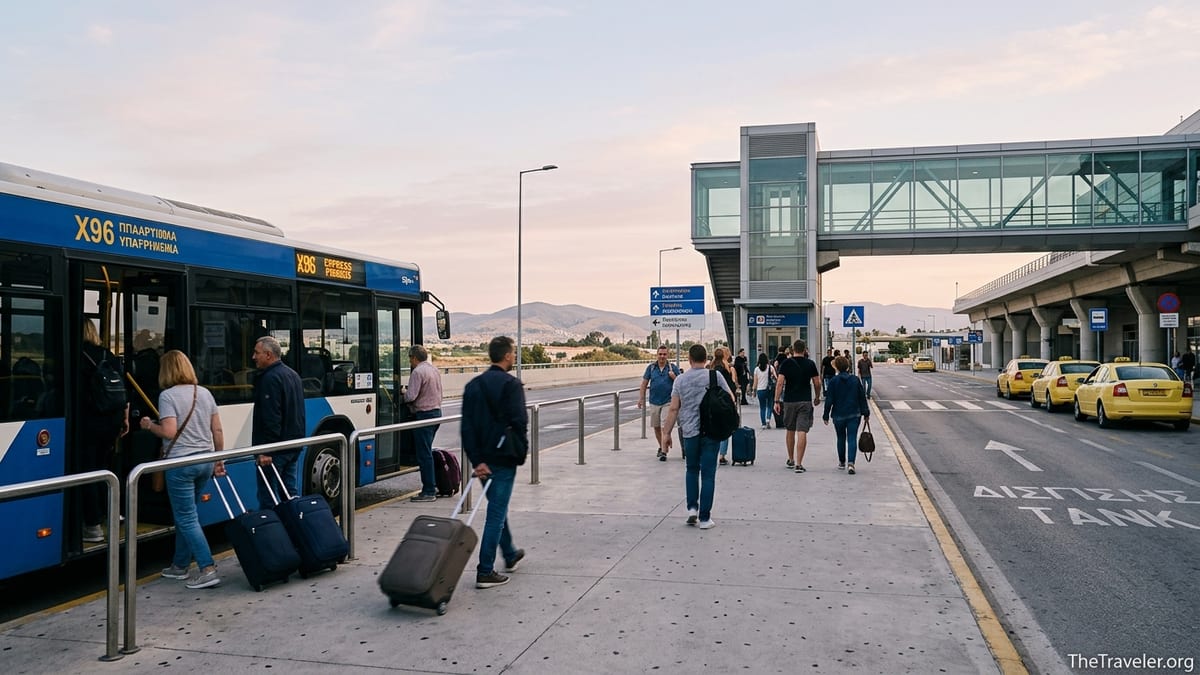
The workhorse of the airport to port connection is the X96 express bus. This line runs 24 hours a day between Athens International Airport and the heart of Piraeus, stopping at Platia Karaiskaki right by the port gates. At night, when the metro and most suburban rail services shut down, the X96 is often the only public transport option available apart from taxis and private transfers.
The X96 is also the cheapest way to reach Piraeus from the airport. As of recent fare tables, the ticket costs around 5 to 6 euros per person, significantly less than the metro. Tickets are sold at a dedicated airport bus kiosk just outside the arrivals hall, next to the bus stops, and also from machines on the island platforms. You must validate your ticket in the orange or blue validator machines as you board. The bus itself is a standard city coach with luggage racks inside and ample standing space.
Travel time on the X96 can vary widely. Overnight, when traffic is light, the run to Piraeus may take just over an hour. In daytime or evening traffic, especially if there are bottlenecks on the coastal highway through the southern suburbs, it can stretch closer to 90 minutes. For example, a traveler landing from New York at 22:30 for a 02:30 ferry to Chania might ride an almost empty X96 and reach Piraeus shortly after midnight. By contrast, someone leaving the airport at 17:00 on a weekday might find the bus slow-moving through Glyfada and Alimos, reaching the port closer to the 90 minute mark.
The X96 is best for budget-conscious travelers with a reasonable time cushion or those arriving in the small hours of the night. It is less ideal if you are anxious about securing deck space on a popular summer ferry, or if you are traveling with several heavy suitcases. Buses can be crowded in high season, and there is no guarantee of a seat. Once in Piraeus, the bus stops just outside the main port area, where you can either walk 5 to 15 minutes to your gate or hop on a free internal shuttle bus if your ship departs from one of the more distant berths.
Taxi from the Airport: Flat Fare and Door-to-Ship Convenience
For many island travelers, especially families and small groups with luggage, a taxi from the airport to Piraeus offers the best balance between cost, comfort, and peace of mind. Athens International Airport has an official taxi rank immediately outside the arrivals level. Yellow city taxis line up in a clearly marked lane, and an airport representative often helps direct passengers to the next available car.
As of 2026, regulated flat fares apply for transfers between the airport and central Athens, and most taxi operators publish approximate flat ranges for the airport to Piraeus route as well. In practice, daytime rides to Piraeus usually run in the range of 45 to 60 euros, including tolls and standard luggage within reasonable limits, with night-time supplements after midnight. It is a good idea to confirm the indicative fare with the driver before departure. Greek law requires official taxis to run meters and provide printed receipts, and licensed drivers will generally be transparent if you ask upfront.
In real terms, this means that two friends landing from Barcelona at 10:00 with a 13:30 ferry to Mykonos can be at their ship in about 50 minutes door to gangway. They wheel their luggage out of customs, follow the Taxi signs, and are soon in a yellow sedan heading around the Attiki Odos ring road toward the port. Instead of navigating ticket machines and platforms, they are dropped at the exact gate shown on their ferry ticket, such as E7 for a Blue Star ship or E9 for some Cyclades sailings, with time left for coffee.
Taxi is also the most forgiving option if your flight is significantly delayed. While the metro and suburban rail shut down around midnight and start again in the early hours, and the X96 bus can be crowded, taxis queue at the airport throughout the day and night. In peak summer weeks, there can be short waits at the rank during sudden surges of arrivals, but queues usually move steadily. For larger groups of four adults with luggage, the cost per person can be comparable to buying multiple metro tickets, especially if your accommodation is in Piraeus rather than central Athens.
Private Transfers and Ride Services: Stress-free but Pricey
Private transfers, whether booked through hotel reception, travel agencies, or online transfer platforms, cater to travelers who prioritize certainty and minimal hassle. A driver meets you at arrivals holding a sign with your name, helps with luggage, and escorts you directly to a waiting sedan, minivan, or minibus, depending on your group size. Pricing is usually a flat per-vehicle rate confirmed in advance, which can be similar to or slightly higher than a metered taxi fare.
In practical terms, a family of five with three large suitcases and two small children landing from Toronto at 06:00 might pay around the upper end of the taxi range for a pre-booked minivan from the airport to Piraeus. In return, they avoid splitting into two taxis, arguing over directions, or worrying whether there will be space for their luggage. Their driver tracks the flight, waits if there is a delay, and drops them as close as allowed by port security to their ferry gate.
Private transfers are particularly attractive if you are catching a once-daily ferry to a remote island, traveling with elderly relatives, or arriving very late or very early when you are likely to be tired and jet-lagged. Many cruise passengers also choose them when transferring from the airport to the Piraeus cruise terminals, where precise timing matters for check-in windows.
One thing to watch for is unlicensed drivers who approach passengers inside the terminal offering rides. Airport authorities and the Greek tourism ministry periodically warn travelers to ignore unsolicited offers and use either the official taxi queue or pre-arranged transfers booked through known operators. Legitimate transfer companies typically send drivers who wait at designated meeting points or just outside customs rather than actively soliciting in the arrivals hall.
Choosing the Right Route for Your Ferry Schedule
Matching your transfer to your ferry time is the single most important decision. As a rule of thumb, allow at least three hours between scheduled landing and ferry departure if you plan to use public transport at a normal time of day, and more if you arrive during the morning or evening peak. If you are traveling in July or August, or if your ferry is one of the last or only sailings to your island that day, adding an extra hour of buffer can save a lot of stress.
Consider a first-time visitor arriving from Paris at 11:20 with a 15:30 ferry to Naxos. They expect about 30 to 45 minutes for passport control and luggage, which puts them at the transport options by around 12:15. Using the metro, they might catch the 12:30 or 13:00 train, arrive in Piraeus around 13:30 to 14:00, and still have a generous cushion. In this scenario, the Blue Line is practical and economical. By contrast, a traveler landing from Frankfurt at 14:45 for a 17:00 sailing to Milos is cutting it much closer. For them, a taxi or pre-booked transfer offers far better odds of boarding calmly than waiting for the next metro or bus.
Night arrivals deserve special planning. Suppose you land at 01:15 for a 06:45 ferry to Syros. The metro and suburban rail will be closed until early morning, so your realistic choices are the X96 bus or a taxi/transfer. If your budget is tight and you are comfortable navigating at night, the X96 gives you a direct 24 hour link to the port, with enough time to spare even if the ride takes 90 minutes. If you are exhausted from a long-haul flight or nervous about night buses with luggage, budgeting for a taxi may be worth it for the extra security and comfort.
Also weigh your onward plan at Piraeus. If you expect to buy ferry tickets at the last minute from a ticket office near the port, or if you are unsure which gate your ship uses, build in extra time for those tasks. In high summer, queues at big-company ticket windows can be long, and walking from one end of the port to another with luggage is slow in midday heat. Arriving at least one hour before scheduled departure is wise even if you already have an e-ticket, and earlier if you need to collect paper tickets or are boarding a car ferry with a vehicle.
Practical Tips for a Smooth Airport to Port Transfer
A little preparation goes a long way in making the airport to Piraeus trip smoother. Before you fly, check your ferry booking for the exact gate, such as E3 for some ferries to Crete or E8 for certain Cyclades routes. Having that number written down or saved on your phone will help you choose the right exit and direction when you arrive at Piraeus station or the X96 stop.
At the airport, follow the clear signs for Trains or Buses as soon as you enter the arrivals hall. The train station is reached by an enclosed pedestrian bridge connected to the terminal. Look for the escalators and elevators that lead up to the bridge, then cross over the road to the station building where ticket machines and counters are located. For buses, exit directly to the sidewalk in front of arrivals; the express bus stops and ticket kiosk sit on the right-hand side as you face the roadway, clearly marked with line numbers like X95 and X96.
Have some euros in small denominations handy. While most ticket machines and taxi terminals accept cards, a few coins can speed things up or solve minor hiccups. Keep your ferry ticket and passport easily accessible in a safe pocket or money belt so you do not have to dig through luggage in a crowded bus or metro carriage. If you are traveling in the peak summer months, carrying a small bottle of water and a hat can make the wait for the X96 or the walk to your gate much more pleasant under the strong Attic sun.
Finally, remember that schedules and fares can change with little notice due to construction works, strikes, or seasonal adjustments. When you land, glance at the live information boards or ask airport staff which route they recommend that day for Piraeus. Local advice often reflects the latest conditions on the roads and rails better than any plan made weeks in advance.
FAQ
Q1. How long does it usually take to get from Athens Airport to Piraeus Port?
In normal conditions, expect about 50 to 60 minutes by metro or taxi and 60 to 90 minutes by the X96 bus, plus extra time to reach your specific ferry gate inside the port.
Q2. What is the cheapest way to travel from the airport to Piraeus?
The X96 express bus is usually the cheapest option, with a fare of roughly 5 to 6 euros per person. It runs 24 hours a day directly between the airport and Piraeus.
Q3. Is there a direct metro line from Athens Airport to Piraeus?
Yes. Athens Metro Line 3, the Blue Line, runs directly from the airport to Piraeus with trains roughly every 30 to 36 minutes. The journey takes around one hour.
Q4. Can I use the suburban railway instead of the metro to reach Piraeus?
You can use the suburban railway for parts of the journey, and some timetables include direct or connecting services to Piraeus, but for most ferry travelers the direct metro or road options are simpler and more predictable.
Q5. How much does a taxi from Athens Airport to Piraeus typically cost?
Licensed taxis from the airport to Piraeus usually cost in the region of 45 to 60 euros in daytime, with higher night fares. Always confirm the indicative price before starting the ride.
Q6. Are taxis and private transfers available late at night or very early in the morning?
Yes. The official airport taxi rank operates around the clock, and reputable private transfer companies schedule pickups for any arrival time, including very late or very early flights.
Q7. How early should I arrive at Piraeus before my ferry departure?
Plan to be at the port at least one hour before departure, and earlier during peak summer or if you still need to collect paper tickets or locate a distant gate inside the port.
Q8. Do I need to buy metro or bus tickets in advance?
No. You can buy tickets on arrival from machines or staffed counters at the airport metro and suburban station, or from the airport bus kiosk and machines near the X96 bus stop.
Q9. What should I do if my flight is delayed and I am worried about missing my ferry?
If your buffer becomes tight due to a delay, a taxi or pre-booked private transfer is usually the fastest and most flexible option. If the delay is severe, contact your ferry company or agent as soon as possible to discuss alternatives.
Q10. Is it safe to take the X96 bus or metro at night with luggage?
Many travelers use both the X96 and the metro at night without issues. As in any major city, keep your valuables close, watch your bags, and avoid displaying large amounts of cash or leaving items unattended.