


Athens International Airport, officially named Eleftherios Venizelos and known by its code ATH, is the main gateway to Greece and the wider Aegean. For many first-time visitors, it is where jet lag, excitement and a little confusion all meet at once. This guide walks you step by step through how the airport works, how to get into the city, and what to expect at every stage of your journey.
Get the latest updates straight to your inbox!
Orientation: Layout, Terminals and What to Expect
Athens International Airport sits about 33 kilometers east of central Athens and is relatively compact compared with other European hubs. The airport is organized around one Main Terminal Building and a Satellite Terminal, both connected airside so passengers do not need to exit security to move between them. Most flights, especially those on European carriers such as Aegean, Lufthansa, Air France or Ryanair, use the Main Terminal. The Satellite Terminal typically handles some seasonal and low-cost operations, with passengers reaching it through an underground walkway from the Main Terminal.
Arrivals and departures are clearly separated. Departures are on the upper level of the Main Terminal, with a long row of check-in islands divided by airline and alliance. Arrivals are on the ground level, where baggage claim and customs are located. If you arrive on a Schengen flight from another EU country, you will usually go straight to baggage claim. If you arrive from a non-Schengen country, you pass through passport control first, which can take extra time at busy periods.
For first-time travelers, a helpful reference point is the central atrium of the departures level. This open space, with cafes and duty-free nearby, effectively divides the building into two halves. One half primarily serves Aegean and Star Alliance partners, while the other half handles a mix of international and low-cost airlines. Information desks are located near this central area, and English is widely spoken, so do not hesitate to ask for directions if you feel disoriented.
The airport is modern and generally well signed in both Greek and English. Compared with larger hubs like Heathrow or Frankfurt, walking distances are manageable. Many passengers report being able to walk from security to their gate in under 10 minutes for Schengen flights, and 10 to 15 minutes for non-Schengen flights in the Satellite Terminal. Still, at busy summer peaks, lines at security and passport control can be long, so plan generous time even if the physical layout looks compact.
Arrivals: Immigration, Baggage and Meeting Points
Upon arrival, international passengers first pass through passport control. As of 2026, the European Union’s Entry/Exit System has been rolled out, meaning third-country nationals such as travelers from the United States, Canada, the United Kingdom and Australia may face longer queues as biometric checks are recorded on first entry. The airport itself advises arriving early for departures because of this, and arriving passengers should similarly be prepared for possible delays at the border in peak periods.
Once you clear passport control, you descend into the baggage claim hall. Carousels are grouped in a single space, and overhead monitors list flight numbers and belt assignments. Baggage delivery for medium-haul flights like London, Paris or Dubai generally takes between 15 and 30 minutes, though it can be slower in summer when charter flights are busy. While you wait, you will see ATMs from major Greek banks, as well as a few currency exchange booths. Rates at the airport are typically less favorable than in the city, so many travelers withdraw just enough euros here to cover initial expenses like bus tickets or a taxi.
After collecting your bags, you pass customs, which usually involves simply walking through the green “Nothing to Declare” channel. Immediately beyond the sliding doors, you step into the public arrivals hall. This is where you will find car-rental counters, hotel and tour representatives holding signs, and access to the airport’s transport options. If you are meeting friends or a driver, a common rendezvous point is near the exit doors opposite the taxi rank, or by the coffee shops that line the arrivals hall.
For families or groups, it can be helpful to agree a landmark in advance. For example, many travelers arrange to meet near the central information desk in arrivals or beside a specific café. Mobile data works well at the airport, and there is free Wi‑Fi, so sharing your exact location through a messaging app is usually straightforward. Just be prepared for the arrivals hall to feel crowded in July and August when island-bound flights converge at similar times.
Transport into Athens: Metro, Bus, Taxi and Transfers
One of the strengths of Athens International Airport is its range of transport options to the city. The airport is directly connected to the Athens Metro network via Line 3, also known as the Blue Line, which runs from the airport through central stations such as Syntagma and Monastiraki and continues to Piraeus. The metro is popular with solo travelers and couples, as it balances speed and cost. A standard one-way airport metro ticket for an adult typically costs under 10 euros, and the journey to Syntagma takes around 40 minutes, with trains usually departing every 30 minutes.
Express airport buses run 24 hours a day and are the most economical option for many travelers. The X95 bus links the airport directly with Syntagma Square in central Athens, while other routes connect to the port of Piraeus and key transport hubs. Tickets for the bus cost a little over 5 euros per person and can be bought from machines or kiosks just outside arrivals. For instance, a couple arriving late at night might spend around 11 euros total to reach Syntagma by bus instead of 70 to 80 euros on a night-time taxi.
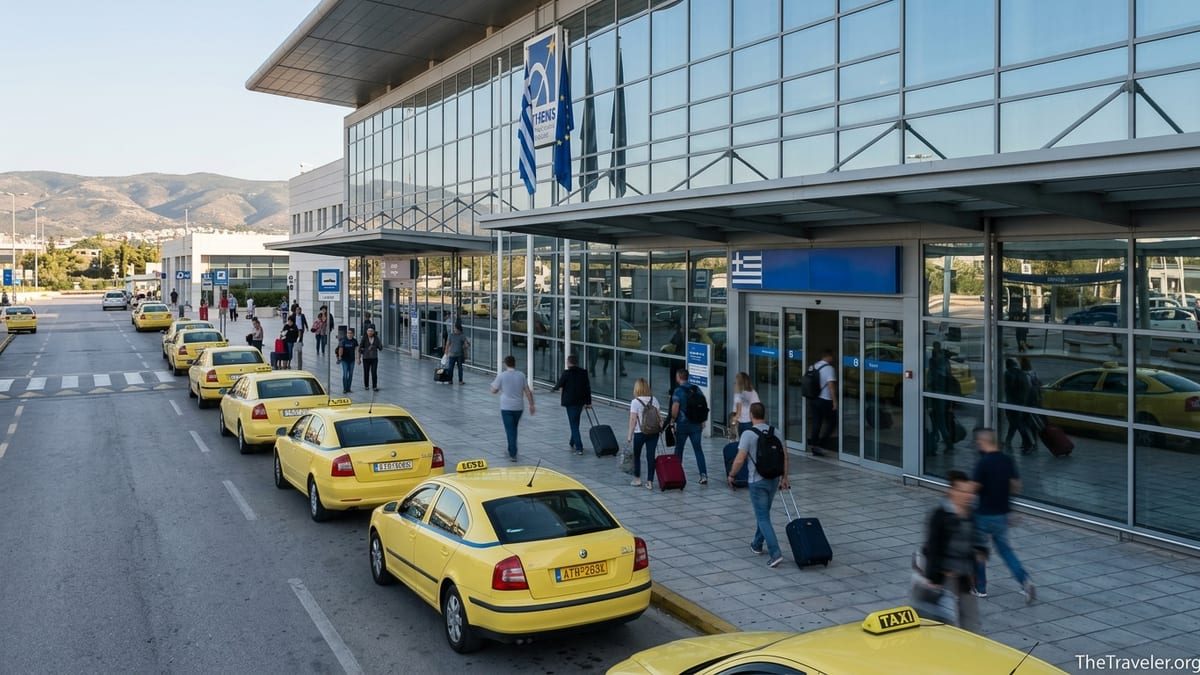
Taxis are available in a clearly marked rank outside the arrivals level, with yellow cabs queueing in a dedicated lane. There is a regulated flat fare between the airport and central Athens that varies between daytime and night hours. As a rough guide, travelers should expect to pay around 35 to 40 euros during the day and closer to 50 euros at night or in the very early morning. This flat rate includes tolls and luggage but not optional tips. For a group of three or four with large bags, the taxi can be better value than buying multiple metro tickets, while also giving door-to-door convenience.
Private transfers and ride-hailing apps are another option, particularly for those who prefer to have a driver waiting with a name sign. Local apps such as Beat work with licensed taxis and allow you to book in advance or call a car on arrival. Prices are usually comparable to standard taxis, though some companies charge a small premium for meet-and-greet services. For example, a family of four with young children and heavy luggage might prebook a van transfer for 60 to 70 euros, ensuring car seats and space for strollers without having to wait in the taxi line.
Departures: Check-in, Security and Boarding
For departing passengers, the main entry into the terminal is the departures level, accessible by ramp, escalators and elevators from the forecourt. Airlines are grouped into clearly signed check-in islands. Full-service carriers such as Aegean, Sky Express, Lufthansa or British Airways usually open check-in 2 to 3 hours before short-haul flights and up to 3 hours or more before long-haul services like New York, Atlanta or Dubai. Low-cost and charter airlines may open counters slightly later, so it is wise to check your booking details.
Recent changes to border procedures across the European Union mean longer processing times at passport control for some travelers, especially at peak hours. As a practical rule, economy passengers on non-Schengen flights should aim to arrive at the airport at least 2.5 to 3 hours before departure and earlier in July and August. For example, a 10:00 flight to London or Doha in high season might see long lines at both check-in and passport control between 7:30 and 9:00. Arriving by 7:00 gives you margin for delays, security, and a short break before boarding.
Security screening is generally efficient but can back up quickly when several departures converge. Liquids must be in containers of 100 milliliters or less and packed into a transparent bag, and larger electronics like laptops are usually removed from hand luggage. Families with strollers and passengers with reduced mobility have dedicated lanes, though they may still share scanners at busy times. Once through security, you either remain in the Schengen departures area or pass passport control to access the non-Schengen gates and the Satellite Terminal.
Boarding announcements are made in Greek and English, and gate information is displayed on screens throughout the airside area. Budget carriers often board from remote stands using buses, so allow time to reach your gate even if it appears nearby. Many passengers underestimate walking time to the Satellite Terminal, which involves taking an underground passage. If your boarding pass shows a gate in the A or B zones of the Satellite, plan to leave shops and cafés at least 20 minutes before the printed boarding time to avoid rushing.
Airlines, Lounges and On-site Services
Athens International Airport is a growing regional hub, with dozens of airlines serving destinations across Europe, the Middle East, North America and beyond. Aegean Airlines, Greece’s flag carrier and a Star Alliance member, is the largest operator, offering frequent flights to popular European cities such as Rome, Paris, Berlin and London, as well as to Greek islands including Santorini, Mykonos, Rhodes and Crete. International carriers like Emirates, Qatar Airways, Delta, United and American Airlines connect Athens with long-haul destinations such as Dubai, Doha, New York, Atlanta, Chicago and Boston.
Lounges at ATH cater to both premium and pay-per-use passengers. Star Alliance flyers in business class, along with eligible status holders, can use the Aegean Airlines lounges, which offer hot and cold snacks, drinks, Wi‑Fi and comfortable seating areas. Other full-service airlines host their own or partner lounges, while independent facilities welcome travelers for a fee. For instance, a pay-in lounge might charge around 35 to 45 euros for a three-hour stay, which can be worthwhile for a long layover if you want a quieter space and complimentary refreshments.
Beyond lounges, the airport offers a broad selection of shops and services. Duty-free stores sell Greek products such as olive oil, honey and wine, alongside international cosmetics and spirits. Fashion, electronics and souvenir outlets line the main departures hall. Many travelers pick up last-minute gifts here, from local masticha liqueur to Athenian designer accessories. Food options range from grab-and-go bakeries serving spanakopita and koulouri to sit-down restaurants offering Greek mezze, seafood and international dishes.
Practical amenities include pharmacies, baby-changing rooms, luggage-wrapping services and information points. There is free Wi‑Fi throughout the terminal, and charging stations are placed near many gate areas. Car rental desks are located landside in the arrivals hall, while several major international hotel chains maintain desks or courtesy phones for guests. For passengers with reduced mobility, designated meeting points and assistance services are available, although it is important to request support in advance via your airline whenever possible.
Parking, Nearby Hotels and Overnight Stays
If you are driving to the airport, there are several parking options with thousands of spaces spread across short-term and long-term lots. Short-term parking is directly opposite the terminal and is suited for drop-offs, pick-ups and stays of a few hours. Rates are higher but you are only a short walk from the building. Long-term parking sits a little farther from the terminal and is connected by shuttle or footpaths, depending on the specific lot. Travelers commonly use long-term parking when leaving their car while on a week-long island trip, as daily rates are more economical than short-term.
For travelers transiting overnight or catching an early morning flight, staying near the airport can be appealing. The most convenient option is the large international hotel located directly across from the terminal, linked by a short covered walkway. It often hosts airline crews and conference groups and offers amenities such as a pool, gym and full-service restaurant. Room prices vary by season, but in high summer a standard room can easily exceed 200 euros per night, so it is wise to book early if you want the convenience of walking to check-in.
More budget-friendly accommodations are available in nearby towns such as Spata, Artemida and Rafina. Many of these smaller hotels and guesthouses offer shuttle transfers to the airport for a fixed fee, for example 15 to 25 euros per room. A couple arriving late from a European flight might book a guesthouse in Artemida, enjoy a quick seaside dinner, and return to the airport by shuttle the next morning for a connecting domestic flight to an island. This approach can be more relaxing and less expensive than staying in the city for a single night.
If you plan to sleep at the airport itself, note that Athens International does not have large dedicated sleeping lounges for economy passengers. Some travelers rest on benches in the public landside area overnight, particularly when they have very early departures. Lighting remains bright and cleaning staff move around, so it is not as restful as a hotel. A more comfortable option can be booking a room in the airport hotel for part of the night or arranging a nearby guesthouse with late check-in and early shuttle service.
Tips for First-Time Travelers Using Athens Airport
First-time visitors to Athens Airport frequently underestimate how busy it can become in peak season and overestimate how complicated it is to navigate. The building is relatively straightforward, but processes such as passport control and security can add unexpected delays, especially after the introduction of new biometric checks for many non-EU nationals. A good general rule is to allow at least 2.5 hours for European flights and three hours or more for intercontinental departures, adding extra time if you need to check bags or return a rental car.
Choosing the right transport into the city can significantly shape your first impression of Athens. If you arrive during daytime with light luggage, the metro offers a predictable 40-minute journey right into central stations like Syntagma or Monastiraki for under 10 euros. If your flight lands after the last evening metro, the 24-hour X95 bus to Syntagma is a reliable and affordable alternative. For families with children, lots of luggage or mobility concerns, budgeting 40 to 50 euros for a taxi can remove stress and get you directly to your hotel door.
Another useful tip is to have some euros in small denominations before you leave the terminal, either withdrawn from an ATM or exchanged in small amounts. While you can pay for metro and bus tickets with cards at machines, smaller kiosks and cafés may find cash more convenient, and tipping taxi drivers a few euros in cash is customary but not obligatory. At the same time, avoid exchanging large sums at airport counters, as city-center rates are usually more favorable.
Finally, remember that Athens Airport is often your first contact with Greek hospitality. Staff in shops, cafés and at information desks are used to assisting international travelers and typically speak good English. If you are unsure about which bus to take, where to validate your ticket or how to reach a particular gate, asking politely will usually get you clear guidance and, often, a bit of local insight. Approaching your arrival with a flexible schedule and realistic expectations around queues will make the experience far smoother.
The Takeaway
Athens International Airport may be your first glimpse of Greece, but it does not need to be a source of stress. With a compact layout, clear bilingual signage and a wide choice of transport options into the city, it is a manageable hub even for those who rarely fly. The key is to build in extra time for modern border and security procedures, particularly if you are traveling in the busy summer months or connecting to an onward flight or ferry.
For many travelers, a simple plan works best: use the metro or express bus if you are cost-conscious and traveling light, or choose a regulated taxi or prebooked transfer if comfort and convenience matter more, especially late at night or with family. Consider an airport-area hotel if you have an early flight, and remember that central Athens is only around 40 minutes away by rail or road, so you can start exploring the city soon after landing.
By understanding how arrivals, departures, transport, services and nearby hotels fit together, you can step off the plane in Athens with confidence. Instead of worrying about queues and connections, you will be free to focus on the real reason you came: tracing ancient footsteps on the Acropolis, sipping coffee in a shaded square, and beginning your journey through Greece with a smooth and well-planned arrival.
FAQ
Q1. How long does it take to get from Athens Airport to the city center?
The journey usually takes about 40 minutes by metro or taxi and around 50 to 60 minutes by express bus, depending on traffic and time of day.
Q2. What is the cheapest way to reach central Athens from the airport?
The 24-hour express airport buses are typically the cheapest option, with tickets costing a little over 5 euros per person for routes such as the X95 to Syntagma Square.
Q3. Is the metro from the airport safe for solo travelers at night?
The metro is generally considered safe, but it does not operate all night. After the last evening departure, many solo travelers choose the 24-hour airport bus or a licensed taxi instead.
Q4. How early should I arrive at Athens Airport before my flight?
As a guideline, arrive at least 2.5 hours before a European flight and 3 hours or more before a long-haul flight, especially in summer when lines at security and passport control can be long.
Q5. Are there hotels within walking distance of Athens Airport?
Yes, there is a major international hotel directly opposite the terminal, connected by a short covered walkway, as well as numerous guesthouses and hotels in nearby towns reachable by shuttle or taxi.
Q6. Does Athens Airport have good Wi‑Fi and charging points?
There is free Wi‑Fi throughout the terminal and many seating areas near gates have power outlets or dedicated charging stations for phones and laptops.
Q7. Can I easily connect to Greek islands from Athens Airport?
Yes, airlines such as Aegean and Sky Express operate frequent domestic flights from Athens to popular islands including Santorini, Mykonos, Rhodes, Crete and many others, especially during summer.
Q8. Where can I buy tickets for the metro or bus at the airport?
You can buy metro and bus tickets from ticket machines or staffed counters located near the exits leading to the bus stops and the escalators down to the rail station, usually accepting cash and cards.
Q9. Is there luggage storage at Athens Airport?
Yes, a luggage storage service operates in the terminal area, allowing you to leave bags for several hours or days, which is useful if you have a long layover and want to visit the city without luggage.
Q10. Are taxis from the airport regulated and metered?
Yes, official yellow taxis at the airport are regulated and either operate on a fixed day or night rate to central Athens or use meters for other destinations, with fares set by local authorities.