


For many travelers heading straight from a flight into Athens to ferries for the Cyclades, Rafina is often the quickest way to reach islands like Andros, Tinos and Mykonos. Located closer to Athens International Airport than the main port of Piraeus, Rafina can turn a long transfer day into a relatively smooth hop from plane to ship. This guide walks you through the most practical ways to get from Athens International Airport to Rafina Port, how long each option takes, what it typically costs, and when Rafina is a better choice than Piraeus for your island itinerary.
Get the latest updates straight to your inbox!
Why Rafina Port Matters for Island Ferries
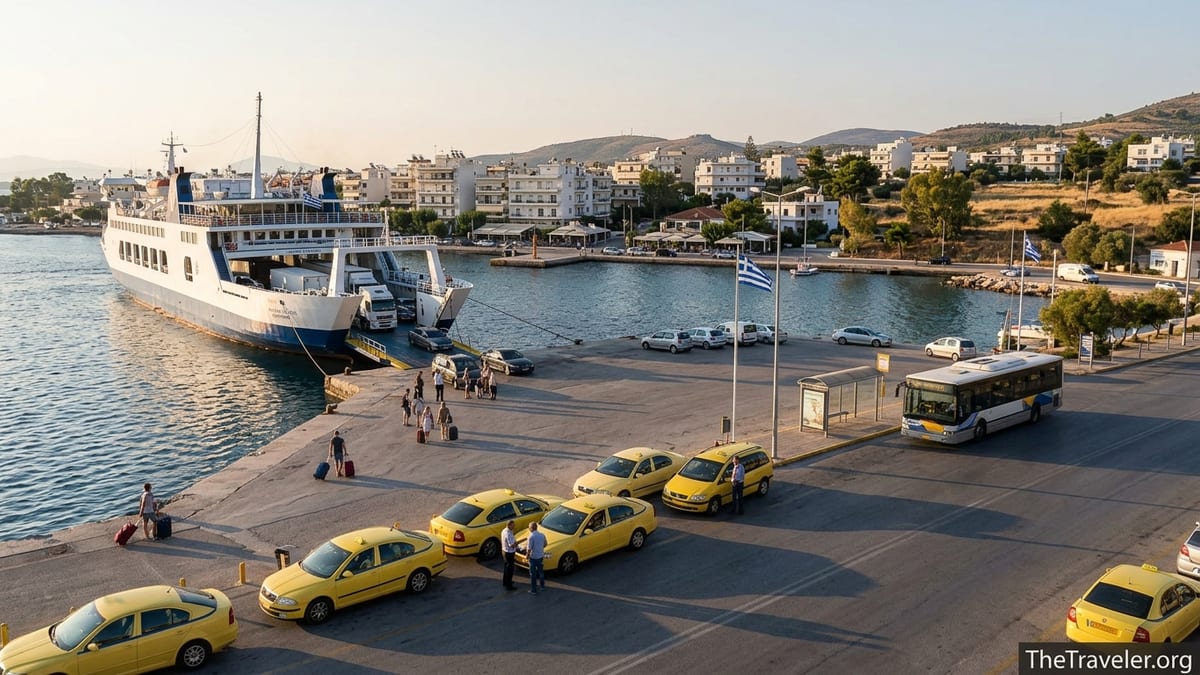
Rafina Port sits on the east coast of Attica, roughly 15 to 20 kilometers from Athens International Airport, depending on the route your driver takes. In regular daytime traffic, that usually means about a 20 to 30 minute drive from the arrivals curb to the harbor, which is significantly shorter than the one hour or more you should allow to reach Piraeus on the other side of the city. For travelers landing in Athens and connecting to Cyclades ferries on the same day, that extra time margin can be the difference between a relaxed transfer and a missed departure.
Rafina is a key departure point for the northern and central Cyclades. Conventional and high speed ferries from operators such as Fast Ferries, Golden Star Ferries and Seajets run frequent routes to Andros, Tinos and Mykonos in summer, with extended services to islands like Naxos and Paros in peak season. Crossing times are often shorter than equivalent routes from Piraeus. For example, a typical Rafina to Andros sailing can be around 1 to 1.5 hours, and Rafina to Mykonos around 2 to 2.5 hours, which works well with a mid-morning or early afternoon ferry after a morning flight.
Because Rafina is smaller than Piraeus, it generally feels more manageable for first-time visitors. The port area is compact, with cafés, bakeries and ticket offices clustered around the waterfront, and the walk from the bus stop or taxi drop-off to the ferry gates is short. This makes it especially appealing for travelers with luggage, families with children, or anyone connecting on limited sleep after an overnight flight.
There are trade-offs. Piraeus has far more sailings and serves a wider range of islands, especially further-flung destinations and the Dodecanese. But if your itinerary focuses on Andros, Tinos, Mykonos or nearby routes, and you are landing at Athens International Airport, Rafina often gives a faster and simpler airport-to-ferry connection.
Taxi from Athens Airport to Rafina Port
Catching a taxi is the most straightforward way to get from Athens International Airport to Rafina Port, especially if you are tired from a long flight or traveling with several bags. Official yellow taxis line up just outside the arrivals level. You simply join the queue and tell the dispatcher or driver that you are going to Rafina Port. In normal daytime conditions, the ride typically takes about 25 to 35 minutes, depending on traffic around the airport and on the coastal road into Rafina.
As of the 2026 season, typical fixed or indicative rates for the airport to Rafina route sit in the region of 45 euros during the day and around 55 euros at night and in the early hours, when higher night tariffs apply. Several local taxi companies and transfer services publish similar figures, and drivers at the airport are generally familiar with this route. It is sensible to confirm the approximate fare with the driver before you depart, especially if your arrival is late at night or on a holiday, when surcharges can push the final price higher.
A practical example: a couple arriving on a mid-morning flight from London with two checked bags could expect to clear passport control, collect luggage, step outside and reach the taxi stand within about 30 to 45 minutes of landing. From there, a 30-minute taxi ride would put them in Rafina in time for an early afternoon ferry to Andros or Tinos. The convenience of door-to-door travel is particularly noticeable if you are trying to catch one of the earlier sailings or if your schedule leaves little buffer for delays at immigration or baggage claim.
One point to keep in mind is that Athens airport has both classic street taxis and pre-booked transfer vehicles operating from the same general area. If you prebook a transfer, a driver will usually meet you in the arrivals hall holding a sign with your name. Prebooked cars may cost slightly more than a metered taxi, but you will have a guaranteed vehicle waiting even if your flight is delayed and you can lock in a fixed fare in advance, which some travelers prefer for peace of mind.
Private Transfers and Ride Services
Private airport transfers have become increasingly popular on the Athens to Rafina route, particularly among families, small groups and travelers landing very early or late. These services can be arranged through Greek transfer companies, local travel agencies or international platforms that specialize in airport pickups. They typically offer a flat rate quote at the time of booking, which may range from around 50 to 80 euros for a standard car or small van for the group, depending on the time of day and vehicle type.
The key advantage of a private transfer is predictability. Your driver monitors your flight, adjusts for delays and waits for you in the arrivals hall. If you are a family of four with bulky luggage or a group of friends carrying sports equipment such as windsurfing or diving gear, a prebooked van can be more comfortable than squeezing into two regular taxis. For example, a family arriving on a 06:00 flight from Paris with a 09:30 Rafina to Mykonos ferry might arrange a private minivan so that the driver can take them straight to their ferry gate, with time to pick up coffee and snacks on the way.
Another advantage is that some transfer operators are very familiar with ferry operations. During busy summer weekends or periods of strong winds, departure times can shift, boarding might open earlier than expected, or queues for vehicle loading can back up along the waterfront. A driver who runs airport to Rafina runs every day during the season knows where to drop you so that you avoid the worst of the congestion and walk directly to the correct quay for your vessel.
Ride-hailing apps operate in and around Athens, though availability at the airport for direct rides to Rafina can vary, especially at peak times. Even when app-based options are available, many travelers still prefer a classic taxi or prebooked transfer for this specific route, because the price difference is not huge and the certainty of a confirmed car after a long flight is often worth the small premium.
KTEL Bus from Athens Airport to Rafina
For budget-conscious travelers with time to spare, the regional KTEL Attikis bus from the airport to Rafina offers one of the cheapest ways to reach the port. These buses are distinct from the blue city buses and airport express services into central Athens. The Rafina buses depart from the arrivals level of the airport, between exits close to the main concourse, usually in the outer lane opposite the terminal buildings. Look for signs or ask at the information desk for the bus to Rafina, and confirm with the driver before boarding.
Fares for the Rafina bus are modest, typically under 5 euros per person one way, which makes them particularly attractive for solo travelers or backpackers. Journey times can vary but usually sit around 45 to 60 minutes, depending on intermediate stops and traffic conditions along the route. Buses carry luggage in underfloor compartments, which passengers often open and close themselves, and then settle into standard coach seating for the ride to Rafina’s small bus station near the harbor.
Timetables for the airport to Rafina bus can change seasonally and may feature more frequent departures in summer than in winter. Some schedules show early-morning services aimed at connecting with first ferries of the day, plus regular runs through the afternoon and evening. However, departures are not as frequent as city buses in central Athens and are not strictly aligned with every ferry. Travelers should check the latest published times shortly before their trip, and allow extra buffer time in case their flight is delayed or the bus fills up on a busy weekend.
An example scenario: a solo traveler arriving at 10:00 in the morning and booked on a 15:00 ferry to Tinos might choose the KTEL bus instead of a taxi. After collecting luggage and buying a snack, they could catch a late morning bus, ride for about an hour, and still arrive in Rafina with ample time to pick up ferry tickets, have a coffee on the waterfront and board calmly. The roomier schedule makes the slower bus ride a reasonable trade-off against the savings compared with a 45 euro taxi.
Travel Time, Schedules and How Much Buffer You Need
When planning an airport to Rafina connection, think in terms of total door-to-ship time rather than just the driving or bus duration. Even if the road journey is only 30 minutes by taxi, you will need time for passport control, baggage claim, buying snacks or tickets, walking to the bus stand or taxi rank, and checking in for your ferry. In the peak summer months of July and August, lines at immigration and the general bustle inside the airport can extend this process.
For daytime arrivals with checked luggage, a safe rule of thumb is to allow at least two and a half to three hours between your scheduled landing time and a Rafina ferry departure if you plan to use a taxi or private transfer, and closer to three and a half hours or more if you intend to use the KTEL bus. This allows for moderate delays at the airport and typical traffic to the port. At very busy times, such as Saturday mornings in August when many Athenians start their holidays, even more buffer can be wise.
Early morning and late night schedules require extra care. If your flight lands at 02:30 and your ferry is at 07:00, you may find taxi options straightforward, but bus timetables more limited. In such cases, prebooking a private transfer can offer peace of mind, and you might spend an hour or two at a café in Rafina once you arrive early. In shoulder seasons like April or late October, ferry schedules are often reduced compared with peak summer, which makes missing a departure more serious because the next boat may not be until the following day.
Weather can also influence travel time. Strong Meltemi winds in the Aegean sometimes lead to last-minute ferry delays or cancellations, especially for fast ferries. While the taxi or bus ride from the airport to Rafina is unlikely to be heavily affected, your planned connection margin may suddenly become unnecessary if the ferry is delayed, or conversely too tight if sailings are brought forward or boarding is extended to manage rough seas. Always check the latest ferry status via your operator or ticket agency on the day of travel and be prepared to adjust.
Which Islands Are Best Served from Rafina vs Piraeus
Rafina is particularly strong for the northern Cyclades. Regular services from operators such as Fast Ferries and Golden Star Ferries connect Rafina with Andros, Tinos and Mykonos, often with multiple sailings per day in high season. High speed vessels from Seajets and other companies add seasonal departures that continue from Mykonos down to islands like Paros and Naxos. Travel times are competitive, and for those islands the combination of short road transfer from the airport and relatively direct ferry routes can make Rafina the obvious choice.
Piraeus, by contrast, is the main maritime gateway to many more destinations, including large parts of the Cyclades, the Dodecanese, the Saronic Gulf and routes toward Crete. Ferries from Piraeus serve islands such as Santorini, Ios, Milos, Sifnos, Serifos, Syros, Paros, Naxos, Rhodes and many others. If your trip includes one of these islands that is not commonly served from Rafina, or if you are combining several islands on different lines, Piraeus often gives you more schedule flexibility and backup options if one sailing is full or canceled.
Consider a real-world comparison. If you are flying into Athens and heading directly to Andros, Rafina is almost always the better choice, since most Andros ferries depart from there and the port is close to the airport. For Mykonos, Rafina is still very competitive, especially if you land in the morning and catch a midday or early afternoon ferry. For destinations such as Santorini or Milos, Piraeus typically has more direct and frequent options, and while there may be occasional seasonal sailings from Rafina, travelers typically route through Piraeus for those islands.
An additional factor is how your broader itinerary evolves. Some travelers start on an island reachable from Rafina and return later via Piraeus, depending on which ferry they book for the final leg back to the mainland. Because Piraeus is well connected to central Athens, the Acropolis area and the main railway lines, it can be a more convenient return port if you plan to stay in the city after your island trip. In that case you might fly into Athens, go immediately from the airport to Rafina, sail out to Andros or Tinos, then return via Piraeus before flying home.
Athens Airport to Piraeus: When Piraeus May Be Better
Although this guide focuses on Rafina, many travelers still compare it with Piraeus when planning their transfer. Getting from Athens International Airport to Piraeus usually involves either the X96 airport express bus, a combination of the metro and suburban trains, or a taxi. The X96 bus is a dedicated airport to Piraeus service that operates around the clock, with tickets priced higher than regular urban bus fares but still cheaper than a taxi. Journey times often run around 60 to 90 minutes, depending on traffic and any temporary diversions in the city.
The metro option requires a change in central Athens, typically at Monastiraki or another interchange station, to connect Line 3 from the airport with Line 1 to Piraeus. This route is popular with travelers staying in the city before or after their ferry, but is less convenient if you are going straight from a long-haul flight to a ship with heavy luggage in tow. The total travel time, including transfers and waiting, commonly ends up in the 70 to 90 minute range, so you should allow a similar buffer as for the bus.
Where Piraeus shines is in its ferry capacity and range of routes. For example, if you are heading to Santorini in July, you might find several high-speed and conventional ferries per day from Piraeus, but only limited or no options from Rafina on your particular dates. In that case, the longer transfer across Athens is outweighed by the ability to choose a vessel and schedule that suits your timing and budget. Likewise, if you are island hopping to Milos, Sifnos, Serifos or the Dodecanese, Piraeus is usually the natural starting point.
As a rough guiding principle, Rafina tends to be best for Andros, Tinos, Mykonos and nearby Cyclades if your priority is a quick airport-to-ferry connection. Piraeus is better if your island is further south or east, or if you want the security of multiple daily sailings and larger ships. When in doubt, map your full route, including return legs, check which port offers more flexibility on your actual travel dates, and then choose your transfer plan accordingly.
Practical Tips for a Smooth Airport to Rafina Connection
Whichever transfer method you choose, a few simple habits make the journey from Athens International Airport to Rafina Port smoother. First, always double-check both your ferry ticket and the port of departure. Ferries to Mykonos, for example, can sail from either Rafina or Piraeus depending on the company and time, and it is easy to assume it must be one when your confirmation actually shows the other. Checking the port name on your ticket before booking your transfer saves stress and last-minute scrambles across Attica.
Second, build buffer time into your schedule. Aim to be at the port at least one hour before your ferry’s scheduled departure, and more if you are traveling with a vehicle or during the peak summer weekends. That means choosing a taxi or bus from the airport that realistically gets you there with extra time in hand, not one that leaves you hoping everything runs perfectly. Many travelers find that having 60 to 90 minutes to spare in Rafina is actually pleasant, as it gives them time for a coffee, a snack and a short walk along the harbor before boarding.
Third, keep small euro notes and coins handy. While taxis and some buses increasingly accept cards, cash still smooths many small transactions around the port, from a quick espresso at a bakery to luggage storage or a last-minute bottle of water before boarding. The airport has ATMs in the arrivals area, so you can withdraw some cash before heading out to the taxi or bus stands.
Finally, consider your energy levels and priorities. If you are landing after a long overnight flight with children or elderly family members, the extra 40 or 50 euros for a taxi or private transfer to Rafina can be a sensible investment in a calmer start to your holiday. If you are traveling light, on a flexible schedule and keen to minimize costs, the KTEL bus can work well. There is no single universally best option, only the best fit for your particular timing, budget and travel style.
The Takeaway
Athens International Airport and Rafina Port form one of the most efficient plane-to-ferry connections in Greece, especially for the northern Cyclades. With a typical taxi or private transfer taking around half an hour and a budget-friendly bus option available for those with more time, most travelers can shape a transfer that fits their priorities. The key is to align your flight arrival with a realistic buffer before your ferry, rather than trying to squeeze into the tightest possible window.
Rafina shines for islands like Andros, Tinos and Mykonos, where its shorter road transfer from the airport and direct ferry routes often trump the broader but more distant options from Piraeus. Piraeus remains the heavyweight choice for many other islands, so the first step is always to look at which port serves your specific destination and dates. Once you know that, deciding between taxi, private transfer or bus becomes a straightforward calculation of cost, comfort and risk tolerance.
In practical terms, if you are flying into Athens and heading straight to a Rafina-served island, a daytime taxi or prebooked transfer is usually the most balanced mix of speed and simplicity, with the KTEL bus as a solid budget alternative when schedules line up. By planning your buffer, double-checking your port and giving yourself a little time to breathe at the harbor, you can turn what might have been a stressful transfer into a smooth start to your Aegean island escape.
FAQ
Q1. How long does it take to get from Athens International Airport to Rafina Port?
The taxi or private transfer journey typically takes about 25 to 35 minutes in normal daytime traffic, while the KTEL bus usually takes around 45 to 60 minutes, depending on intermediate stops and road conditions.
Q2. How much does a taxi from Athens Airport to Rafina Port cost?
Typical fares in 2026 are in the region of 45 euros during the day and around 55 euros at night and early morning, with small variations depending on the taxi company, surcharges and traffic-related waiting time.
Q3. Where do I catch the bus from Athens Airport to Rafina?
The regional KTEL Attikis buses to Rafina depart from the arrivals level of the airport, usually between exits near the main concourse in the outer lane. Look for signage or ask airport staff for the Rafina bus, and always confirm the destination with the driver before boarding.
Q4. How often does the bus from the airport to Rafina run?
Frequency varies by season, with more departures in the summer months. There are usually several services spread through the day, but they do not run as often as city buses, so it is important to check the latest timetable before you travel and not rely on turning up without information.
Q5. Is Rafina or Piraeus better for ferries to Mykonos?
Both ports offer ferries to Mykonos. Rafina can be more convenient if you are coming directly from the airport because it is closer, and some sailings have shorter crossing times. Piraeus tends to have a wider range of departures and larger ships, which can be useful if you want more schedule options or are traveling outside peak season.
Q6. Which islands are best reached from Rafina Port?
Rafina is particularly well suited for Andros, Tinos and Mykonos, and in high season often has routes extending to islands such as Naxos and Paros. If your itinerary focuses on the northern and central Cyclades, Rafina is frequently the most efficient starting point from Athens Airport.
Q7. How much time should I allow between my flight arrival and my ferry from Rafina?
For a taxi or private transfer, plan at least two and a half to three hours between your scheduled landing time and the ferry departure. If you intend to use the KTEL bus, aim for three and a half hours or more, especially in summer or if you are checking luggage.
Q8. Can I prebook a transfer from Athens Airport to Rafina?
Yes. Numerous local transfer companies and agencies offer prebooked cars and minivans from the airport to Rafina with fixed prices. A driver will usually meet you in the arrivals hall, monitor your flight for delays and take you directly to the ferry area at the port.
Q9. Are there places to wait or eat near the ferries in Rafina?
Rafina has several cafés, bakeries and small restaurants clustered around the harbor, many of which open early during the ferry season. This makes it easy to get a coffee, snack or simple meal while you wait for boarding to begin.
Q10. What happens if my flight is delayed and I miss my Rafina ferry?
If a delay causes you to miss your planned sailing, contact your ferry company or ticket agency as soon as possible. Depending on availability and fare conditions, they may be able to move you to a later departure the same day or to a sailing on another date, sometimes with a change fee. In peak season, sailings can fill up, so same-day alternatives are not guaranteed and you may need to stay overnight near the port or return to Athens.