


For budget travelers landing at Athens International Airport, the blue-and-white express buses are one of the easiest ways to roll straight into the city. They run all night, stop at central points like Syntagma Square and Piraeus port, and cost a fraction of a taxi. With contactless payments now widely accepted and clear signage in English, using the airport buses is far less intimidating than it once was. This guide walks you through the key routes, current prices, late-night tips and how the buses compare to the metro, so you can choose what genuinely works best for your wallet, your luggage and your arrival time.
Get the latest updates straight to your inbox!
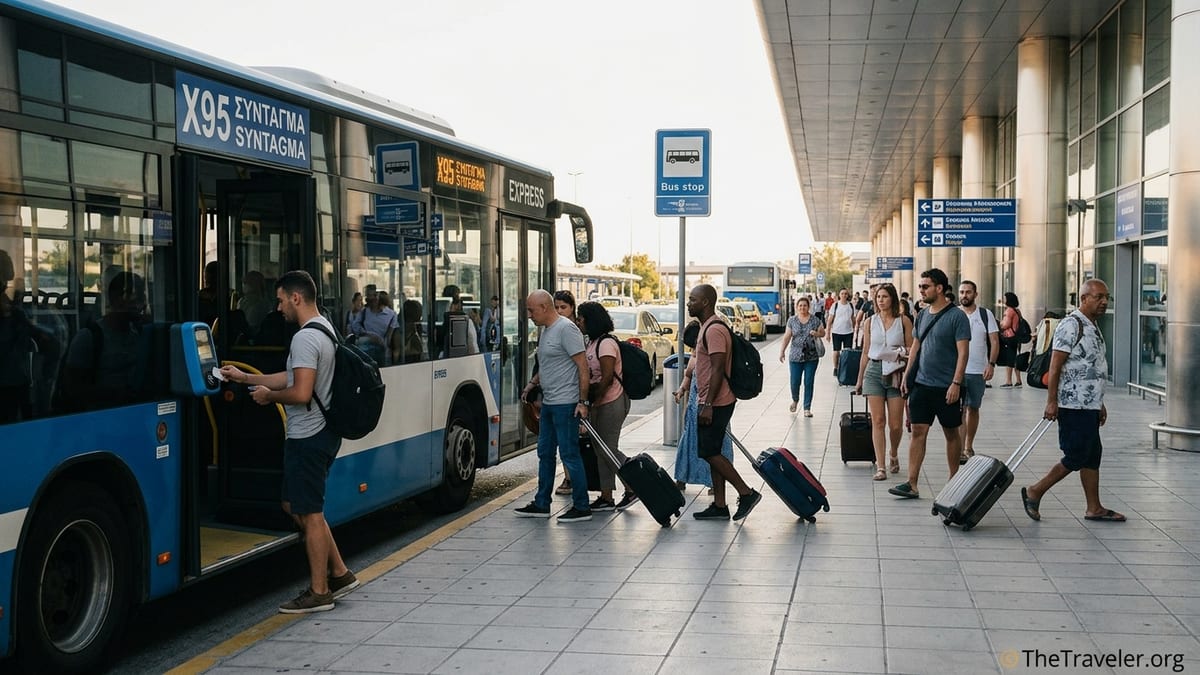
The Basics: Airport Express Buses at a Glance
Athens Eleftherios Venizelos Airport sits roughly 30 to 35 kilometres east of the historic centre, with four dedicated express bus lines linking the terminals to key spots around the city. These routes are numbered X93, X95, X96 and X97, and all operate 24 hours a day. The most useful for most visitors are X95, which runs between the airport and Syntagma Square in the heart of Athens, and X96, which connects the airport to the port of Piraeus for ferries to the Greek islands.
All airport express buses are run by the Athens public transport authority and use the same ticketing system as the metro, trams and city buses. You can pay by buying a paper-style ATH.ENA Ticket from the airport kiosk or machines, or by tapping a contactless bank card, phone or smartwatch directly on the blue validators by the bus door. The airport bus fare is a special flat price that covers a single journey between the airport and the city.
Journeys from the airport to central Athens on line X95 typically take about 45 to 60 minutes, depending on traffic. At quieter times, such as after midnight, it can be closer to 40 minutes, while in the late afternoon rush hour it may stretch beyond an hour. To Piraeus on X96, you should expect around 70 to 90 minutes, again depending on traffic on the coastal highway and around the port area.
The airport bus stations are easy to find. From arrivals, follow the signs for "Buses" to the covered area outside the terminal. Each route has a clearly marked stop and electronic displays showing the next departures. Drivers are used to tourists with luggage, and there is dedicated rack space inside the bus for large suitcases, with most travelers keeping smaller bags by their seats.
Key Routes: X95 to Syntagma and X96 to Piraeus
For most first-time visitors staying near the Acropolis, Plaka or Monastiraki, X95 is the workhorse route. It runs directly between the airport and Syntagma Square, which is the main central square of Athens, right in front of the Greek Parliament. From Syntagma, you can either walk to many central hotels or connect easily to metro lines 2 and 3 for onward travel to areas like Omonia, Metaxourgio, Gazi or the northern suburbs.
Imagine a late afternoon arrival from London at 17:00. After collecting your luggage, you exit arrivals, find the X95 stand and tap your bank card at the validator. The bus pulls out and takes the Attiki Odos motorway towards the city. In light traffic, you are stepping off at Syntagma before 18:30, with a short downhill walk to a hotel in Plaka. You have spent only slightly more than the price of a coffee in the city centre and avoided navigating the metro with suitcases during rush hour.
The X96 route is essential for travelers catching ferries to the islands from Piraeus. The bus runs from the airport down to the coast and along the shoreline to the port. It stops at several points around Piraeus, including near the main passenger ferry gates. For example, if you land at 21:00 with a ticket for an overnight ferry to Crete, you can ride X96 straight from the airport to the port area, walking the last few minutes to your gate. Even factoring in around 80 minutes of travel, you will usually arrive with time to spare.
The other two airport express routes are more specialized but still useful. X93 links the airport to Kifisos intercity bus terminal in the west of Athens, where long-distance KTEL coaches depart for destinations such as Patras, Delphi or the Peloponnese. Travelers heading straight out of Athens by coach often choose this line instead of going into the city centre first. X97 connects the airport with Elliniko metro station at the southern end of metro line 2, which can be handy if you are staying along the southern coastal suburbs between Glyfada and Elliniko.
Current Prices, Tickets and How to Pay
As of mid 2026, a standard full-fare airport express bus ticket costs around 5.50 to 6 euro per person. The fare is the same whether you are traveling on X95 to Syntagma, X96 to Piraeus or the other airport express lines. Children, students and certain reduced-fare groups may pay roughly half the price, but most visitors should assume they will pay the full adult fare. The price can change with official decisions, so it is wise to budget a small margin and check the fare on the ticket machine screen before paying.
You do not need to buy a regular 90-minute city ticket for the airport bus. The airport bus ticket is its own special product. At the airport, there is a staffed ticket kiosk near the bus stops, along with blue and grey ticket vending machines that have menus in English. If you prefer a physical ticket, you can buy a single airport bus ticket, load it onto an ATH.ENA Ticket and validate it once when boarding. The card is scanned against the blue contactless reader inside the bus to start your journey time.
Many visitors now find it easiest to skip the paper ticket altogether and pay via contactless. The Athens transport network has gradually rolled out pay-as-you-go bank card acceptance across metro gates and bus validators. On the airport buses, you simply tap your contactless card or device on the reader when you board. The screen will show that a bus airport fare has been charged. For example, an American traveler arriving from New York can tap a Visa debit card issued in the United States, ride to Syntagma and see the charge in euros on their bank statement later, converted at their card issuer’s rate.
It is important to remember that the airport bus ticket only covers a single journey between the airport and the city. It does not give you unlimited travel on other modes. Once you reach Syntagma or Piraeus and want to continue by metro or tram, you will need to buy a separate city ticket. A standard 90-minute city ticket costs a little over 1 euro and allows unlimited transfers on metro, tram, bus and trolleybus within the urban zone for 90 minutes from validation, but it is not valid to or from the airport. This is why many visitors combine one airport bus ticket with a small batch of 90-minute tickets for their days in Athens.
Late-Night & Early-Morning Travel: What Actually Works
One of the main advantages of the airport express buses over the metro is that they never stop running. The metro line 3, which connects the airport to the city, only operates roughly between early morning and around midnight, with the precise first and last train times varying slightly by day and season. By contrast, X95 and X96 keep moving through the small hours, with reduced but still regular frequencies, often every 30 to 40 minutes at night.
Consider a traveler whose flight from Paris lands at 00:15. By the time they clear passport control and collect luggage, it is close to 01:00 and the last metro towards the city has already departed. The taxi rank is doing brisk business and drivers are quoting the official night flat rate to central Athens, which is higher than the daytime fare. Instead, the traveler walks to the bus area, finds X95 loading up with a mix of night-shift workers and fellow tourists, taps a contactless card and rides into Syntagma for a fraction of the taxi price. The streets are quiet but not empty, and hotels around Plaka and Monastiraki are used to guests checking in after 02:00 when there are late arrivals.
The same logic works in reverse for early-morning departures. For a 07:00 flight, you are usually asked to be at the airport by around 05:00. On many days the metro will not be a realistic option that early, but X95 and X96 run through the night. Guests staying near Syntagma or in the Kolonaki area often walk or take a short taxi down to the Syntagma bus stop around 03:30 or 04:00, then ride X95 back to the airport. In practice, you will often see groups of backpackers, airline staff and night-shift workers sharing the same bus at these hours.
For safety, the airport buses are generally considered a solid option even at night. The routes are straightforward motorway and main avenues, the passengers are mostly travelers, and there is a clear driver presence at the front. Usual big-city common sense still applies: keep your valuables close, store luggage where you can see it and avoid flashing expensive electronics. Compared to wandering around an unfamiliar neighbourhood looking for a late-night taxi or ride-hail car, sitting on a well-lit public bus straight to Syntagma or Piraeus can actually feel more reassuring.
Bus vs Metro: Which Is Better for Your Trip?
The metro from the airport to the city centre is faster on paper. Line 3 takes around 40 minutes to run from the airport to Syntagma, compared to 45 to 60 minutes for X95 depending on traffic. The metro fare is also higher than the bus fare, usually a few euros more per person. The real question for most travelers is not speed alone, but the balance between time, cost, comfort and the location of their accommodation.
If you are staying directly on or very close to a metro line 3 station such as Syntagma, Monastiraki or Panepistimio, the metro can be very convenient during daytime and evening hours. You buy a dedicated airport metro ticket, walk across the pedestrian bridge from the terminal to the station and board a modern train with luggage racks and air conditioning. Once in the city, you may only need a short walk to your hotel. A couple checking into a boutique hotel off Monastiraki Square at 18:00 might find this the smoothest option, especially in good weather.
However, if you are landing late at night or leaving very early in the morning, the 24-hour airport buses usually win. They cost less, and when the metro is not running they may be the only practical public transport option. They are also simpler if you are traveling with bulky luggage or a family group and prefer to avoid escalators, platforms and station changes. For instance, a family of four with two large suitcases and a stroller arriving at 23:30 may find it much easier to roll everything onto an X95 bus than to navigate the metro.
Buses are also preferable when your final destination is closer to a bus stop than a metro station. Hotels around Syntagma, the upper half of Ermou Street and parts of Kolonaki are almost directly served by X95. Travelers staying in Piraeus or heading straight to a cruise ship or island ferry are best off using X96 instead of taking the metro into the city and then transferring again to trains or taxis. In all these scenarios, the slightly longer ride time is often offset by fewer changes and the convenience of being dropped closer to your front door.
Practical Tips for Using the Airport Buses on a Budget
A bit of planning can make the airport bus not just cheap, but genuinely efficient. First, know exactly which route you need before you land. X95 gets you to Syntagma in the centre, X96 goes to Piraeus port, X93 heads for the Kifisos intercity bus terminal and X97 connects to the southern suburb of Elliniko. Taking a moment on the plane to check which of these is closest to your accommodation can save you time and taxi fares later.
Second, be ready for the ticketing options. If you like physical proof in your hand, stop at the airport ticket kiosk or machine and buy an airport bus ticket loaded onto an ATH.ENA Ticket card. Keep it somewhere accessible, because you will need to validate it on the bus. If you are comfortable with contactless payments, you can walk straight to the bus and tap in as you board. This is especially handy if you arrive at a very late hour when the ticket counter has closed or there is a queue at the machines.
Third, position yourself smartly on the bus. Large luggage goes in the dedicated racks near the doors. Smaller bags and daypacks are better kept close by rather than overhead. If you are concerned about security, choose a seat where you can see both your luggage and the exit doors. Couples and friends often split roles, with one person sitting near the luggage racks and the other taking a seat further inside the bus.
Finally, think about onward connections. If you are staying in areas like Koukaki, Neos Kosmos or the western side of the centre, it might be worth combining the airport bus with the city metro or tram. For example, you can ride X95 to Syntagma and then use a cheap 90-minute ticket to travel two stops on line 2. Even with this extra connection, your total cost will still be well below that of a daytime taxi and you avoid the potential hassle of hailing a cab at the airport.
Real-World Scenarios: When the Bus Wins Over the Metro
To see how this plays out in practice, imagine three common itineraries. First, a solo backpacker arriving from Rome at 22:45 with a hostel booking in Monastiraki. The metro is still running but services are thinning out. By the time they clear arrivals it is nearly 23:30. They choose X95, which costs several euros less than the metro and still gets them to Syntagma within about an hour. From there, it is a ten-minute downhill walk past the illuminated Parliament and into the narrow streets of Monastiraki, where the hostel reception is used to late check-ins.
Second, a couple arriving at 00:30 with a ferry to Naxos at 07:25 from Piraeus. With the metro closed, they could take a taxi straight to the port for the official night fare or opt for X96. They buy two airport bus tickets from the machine, stash their luggage in the racks and nap lightly as the bus rolls down the empty motorways and along the Saronic Gulf. They step off close to Gate E7 in Piraeus, find a cafe for an early coffee and board their Blue Star ferry without feeling they have already blown half a day’s budget on transport.
Third, a family of five with two teenagers and a ten-year-old landing mid-morning with a pre-booked apartment in a residential part of Pangrati, a neighbourhood uphill from the stadium. The closest metro is a fair walk away and the parents do not fancy dragging suitcases and children through multiple station changes. Instead, they ride X95 to Syntagma and then take a short inner-city taxi up to their apartment. Even factoring in the short taxi ride, the total cost for five bus tickets and a local cab is still significantly lower than a single airport taxi large enough to seat them all with luggage.
These examples highlight the main strengths of the buses: lower cost compared with metro and taxi, 24-hour operation, direct service to Syntagma and Piraeus, and flexibility for groups or travelers with heavy luggage. Unless you are in a huge hurry or staying directly on a metro line, the bus will often offer the best balance between budget and convenience.
The Takeaway
Airport express buses are one of the simplest, most budget-friendly ways to travel between Athens International Airport and the city. With four routes running 24 hours a day, they connect directly to Syntagma Square, Piraeus port, the Kifisos intercity bus terminal and the southern suburbs. The fares are currently in the mid single digits in euros, and you can pay either with an ATH.ENA Ticket or by tapping a contactless card or device as you board.
For daytime arrivals when the metro is running and your hotel sits right on line 3, the train can be slightly faster. But if you are landing late at night, leaving before dawn, traveling with heavy luggage or heading straight for a ferry, the buses usually come out ahead. Realistically, many visitors end up using both: a bus for the airport legs and the cheaper 90-minute city tickets for getting around once they are settled in Athens.
As with any big city, a little preparation goes a long way. Decide which line you need, have your payment method ready and know where you will get off. Do that, and the airport bus stops being a source of stress and becomes just another easy, almost routine part of arriving in the Greek capital, leaving you free to focus on the more enjoyable question of what to eat and which ancient site to see first.
FAQ
Q1. How much does the Athens airport bus to the city centre cost?
The airport express bus fare is typically in the range of 5.50 to 6 euro per adult for a one-way journey between the airport and the city, with reduced fares for eligible groups. Prices can change, so always check the amount shown on the ticket machine or validator before paying.
Q2. Which bus do I take from Athens Airport to Syntagma Square?
For Syntagma Square and most central Athens hotels, you should take bus X95. It runs directly between the airport and Syntagma 24 hours a day, with daytime departures roughly every 15 to 20 minutes and slightly less often late at night.
Q3. How long does the X95 bus take from the airport to central Athens?
In typical conditions the X95 bus takes about 45 to 60 minutes between Athens Airport and Syntagma Square. Late at night with light traffic it can be closer to 40 minutes, while at peak rush hour it may take a little over an hour.
Q4. What is the best bus from Athens Airport to Piraeus port?
Bus X96 is the direct airport express service to Piraeus. It operates all day and night, running from the airport to various stops around the port area. Depending on traffic, the journey usually takes 70 to 90 minutes, so allow extra time if you are catching a ferry.
Q5. Can I use a regular 90-minute city ticket on the airport express buses?
No. The airport express buses use a special airport fare that is separate from the standard 90-minute city tickets. You need either a dedicated airport bus ticket or to tap a contactless bank card or device that will be charged the higher airport fare.
Q6. Do the airport buses run all night?
Yes. All four airport express lines, including X95 to Syntagma and X96 to Piraeus, operate 24 hours a day. Frequencies drop at night, often to every 30 to 40 minutes, but there is still continuous service, making them ideal for late-night arrivals or very early departures when the metro is not running.
Q7. Is it safe to take the Athens airport bus late at night?
In general the airport buses are considered a safe way to travel, even after midnight. Most passengers are fellow travelers or airport workers, and the routes follow well-lit main roads. As always, use basic precautions such as keeping your valuables close and keeping an eye on your luggage.
Q8. Can I pay for the airport bus with a contactless bank card or phone?
Yes. The validators on the airport express buses accept contactless payment from most major bank cards, as well as phones and smartwatches with NFC enabled. You simply tap once when boarding, and the airport bus fare is charged automatically in euros.
Q9. When is the metro a better option than the bus from Athens Airport?
The metro is often a better option during daytime and evening hours if your hotel is directly on line 3, for example near Syntagma or Monastiraki, and you prefer a slightly faster, traffic-free journey. It can also be more comfortable in very heavy traffic, but it costs more and does not run through the night.
Q10. Do I need to buy my Athens airport bus ticket in advance?
No advance purchase is necessary or possible for the airport buses. You simply buy a ticket from the airport kiosk or ticket machines when you arrive, or tap a contactless bank card or device when boarding. Seats are first come, first served, and even at busy times there is usually enough capacity.