


More news on this day
Athens has reached a pivotal milestone in its largest metro expansion project, with construction teams completing a five‑kilometer tunnel section on the future Line 4, a development expected to reshape everyday mobility, tourism flows and sustainable travel across the Greek capital.
Get the latest news straight to your inbox!
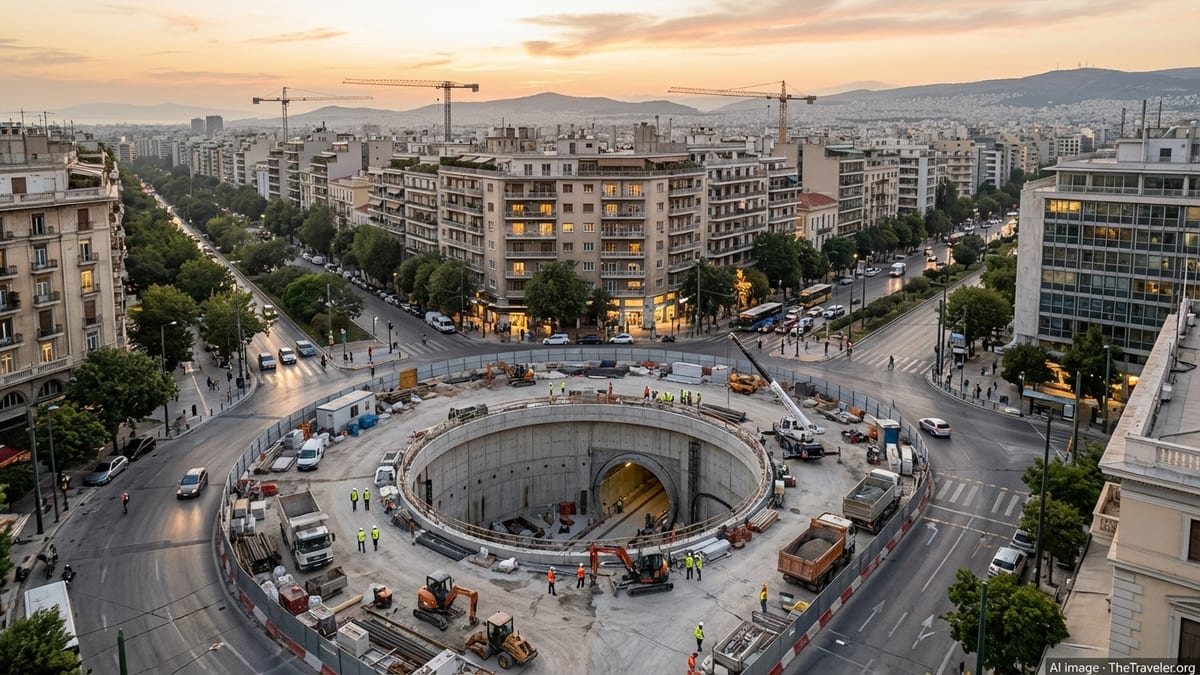
Key Milestone on Line 4’s Core Tunnel
According to publicly available technical updates, the tunnel‑boring machine known as “Athina” has now completed roughly 5.1 kilometers of underground tunnel between the Katehaki shaft and the future interchange at Evangelismos. This stretch forms a central part of Line 4’s Section A, which will ultimately connect Alsos Veikou in the north with Goudi in the east and add 15 new stations to the network.
Reports in Greek transport and infrastructure media describe the completed segment as the longest continuous metro tunnel ever driven under a single contract in Greece. The milestone positions Line 4 as one of the country’s most technically demanding urban rail projects, requiring simultaneous operation of two tunnel‑boring machines beneath densely built neighborhoods.
Project documentation and recent coverage indicate that overall tunneling progress on Section A is now well past the halfway mark, even as the full opening date for the line has been revised toward the early 2030s. The newly completed five‑kilometer section is seen as a structural backbone for the future line, creating the underground space in which track, systems and stations will be fitted out over the coming years.
Construction of Line 4 began in 2021 and extends beneath some of Athens’ busiest districts, including residential areas and institutional hubs near universities and hospitals. The completed Katehaki–Evangelismos tunnel reduces the remaining underground work for the first phase and is viewed by local observers as a turning point in the project’s delivery schedule.
Transforming Daily Mobility in Central Athens
Transport analyses published in Greece highlight that Line 4 is designed to act as a high‑capacity arc across central and northeastern Athens, intersecting existing Lines 2 and 3 and redistributing passenger loads away from chronically congested corridors. By threading through areas such as Kypseli, Exarchia and Kolonaki, the line is expected to bring metro access to districts that currently rely heavily on buses and private cars.
Modeling cited in recent planning documents suggests that, once operational, Line 4 could remove tens of thousands of daily car trips from the road network by offering faster, more predictable journey times between residential neighborhoods, major hospitals, university campuses and employment centers. The completed five‑kilometer tunnel between Katehaki and Evangelismos is a critical element in this vision, providing the underground link that will eventually host key interchange and destination stations.
Observers note that the project is unfolding at a time when Athens is grappling with rising congestion and air‑quality challenges, particularly in the inner ring of the city. Additional metro capacity along Line 4’s alignment is expected to ease pressure on overcrowded buses and existing metro lines, while also shortening transfer times between northwestern districts and the city’s eastern academic and medical clusters.
Publicly available information from operators and contractors indicates that advanced signaling, driverless train operation and modern safety systems are planned for the new line. The continuous tunnel now in place on a large section of the route provides the necessary space for those technologies, which are designed to support high frequencies and resilient operations during peak demand periods.
Boost for Tourism Access and Visitor Experience
Tourism specialists in Greece have long pointed to urban rail as a key factor in visitors’ perception of Athens as a city that is easy and enjoyable to explore. Line 4’s alignment, with its new connections to central districts and cultural hubs, is expected to further integrate major museums, historic neighborhoods and shopping areas into a coherent, rail‑based visitor network.
Published coverage on the project notes that interchange opportunities at stations such as Evangelismos will give travelers more direct rail access to key attractions, including established museum districts, central squares and leafy residential areas that have traditionally been less visible to short‑stay visitors. The completed five‑kilometer tunnel underpins these future interchange points, anchoring the route that will carry tourists between different parts of the city.
As visitor numbers to Athens continue to grow, tourism analysts anticipate that the expanded metro will help disperse footfall beyond the most famous sites near the Acropolis and Syntagma. New Line 4 stations in neighborhoods such as Kypseli and Exarchia are expected to improve access to local cafes, markets and cultural venues, potentially spreading tourism spending more evenly and alleviating pressure on already crowded central streets.
The enhanced connectivity is also likely to improve the experience of cruise and air travelers who already use the metro network to move between the port of Piraeus, central Athens and the international airport via existing lines. With Line 4 providing additional interchange options, visitors may be able to reach accommodation and attractions more quickly and with fewer transfers, reinforcing the capital’s reputation as a city that is navigable without a car.
Environmental Gains and Sustainable Travel Goals
Environmental impact assessments and official planning documents consistently present Line 4 as a major pillar of Athens’ climate and air‑quality strategy. The completion of a continuous five‑kilometer tunnel moves the project closer to delivering the additional rail capacity needed to cut reliance on private vehicles in the metropolitan area.
Analysts point out that the line is expected to operate entirely with electric rolling stock and regenerative braking, contributing to lower per‑passenger emissions compared with road‑based modes. Once the tunnel is fully equipped with track and systems, the line will be able to support high frequencies that make public transport a more attractive alternative to driving, particularly for commuters traveling between dense residential districts and central employment zones.
Urban planning research on Athens has emphasized the link between reliable mass transit and efforts to reclaim public space from cars. By drawing more journeys underground, Line 4 is projected to support initiatives for expanded pedestrian areas, bicycle infrastructure and urban greening in several districts along its alignment. The completed tunnel segment is a necessary physical foundation for those policy ambitions, enabling the city to move ahead with complementary surface‑level interventions.
Publicly available timelines indicate that, despite recent schedule adjustments that push full completion toward 2032, tunnel progress on sections like Katehaki–Evangelismos remains a central indicator of long‑term sustainability gains. Each additional kilometer finished and sealed brings the network closer to a configuration in which short urban trips can be made primarily by rail rather than car.
Long‑Term Network Expansion and Future Connectivity
Looking beyond the first phase, strategic transport plans for Athens envision Line 4 as the backbone of a wider set of extensions and new routes to be realized over the next two decades. Planning material and expert commentary describe potential future sections that would extend service toward western and northern suburbs, as well as enhanced interchanges with the existing three metro lines and suburban rail.
The successful completion of a five‑kilometer tunnel on the initial section is seen as an encouraging signal for this broader expansion program. Engineering firms involved in the project point to lessons learned in tunneling under complex geology and densely built environments that could streamline later phases, including any realignments needed to minimize disruption to historic neighborhoods and sensitive sites.
Network development scenarios circulating in Greek transport media suggest that, once all planned phases are realized, Athens could benefit from a metro system exceeding 140 kilometers in total length, with Line 4 and its offshoots playing a central integrating role. The new tunnel segment between Katehaki and Evangelismos foreshadows this future network geometry, forming part of a high‑capacity arc that will eventually intersect multiple radial lines and bus corridors.
For residents and visitors, the long‑term effect of the current milestone is likely to be felt not only in faster journeys but in a gradual reshaping of how people choose to move around the city. Each step forward on Line 4, beginning with the now‑completed five‑kilometer section, signals a shift toward a more rail‑centered, low‑emission model of urban mobility in Athens.