


More news on this day
Travelers at Hartsfield-Jackson Atlanta International Airport faced extensive disruptions as more than 430 flights were delayed and several canceled, creating cascading chaos across major U.S. airlines and busy domestic and international routes.
Get the latest news straight to your inbox!
Widespread Disruptions Across the World’s Busiest Hub
Publicly available flight-tracking data for Hartsfield-Jackson Atlanta International Airport shows a sharp spike in delays, with more than 430 flights affected and a smaller number canceled over the course of the day. The disruption has been significant for an airport that routinely ranks among the world’s busiest and typically handles thousands of daily movements with tight scheduling.
The knock-on effects are being felt across many of the largest U.S. carriers. Delta Air Lines, the dominant operator at Atlanta, has seen its extensive hub-and-spoke network squeezed as late departures and arrivals ripple through connecting banks. American Airlines, Southwest Airlines, United Airlines, and several smaller carriers have also experienced schedule disruptions as Atlanta’s congestion feeds into their broader national operations.
Although precise causes vary by flight, the scale of the disruption illustrates how sensitive a high-volume hub like Atlanta is to any period of reduced capacity. When departures and arrivals begin to stack up, aircraft, crews, and gate space quickly fall out of sync, resulting in rolling delays for passengers throughout the day.
Reports from airport and aviation data sources indicate that the irregular operations have persisted through multiple departure waves, extending the impact well beyond the initial triggering events and making recovery more complex for airlines managing tight turn times.
Key Routes to Major U.S. Cities Hit Hard
The chaos has been particularly visible on some of Atlanta’s most heavily traveled domestic routes. New York, Orlando, Dallas, Chicago, Los Angeles, and Miami, all of which depend on frequent daily service to and from Hartsfield-Jackson, have reported clusters of late-running flights.
Atlanta serves as a primary connecting gateway for passengers heading to these cities, meaning that delays are not limited to nonstop itineraries. Missed connections in Atlanta have led to longer journey times and, in some cases, unexpected overnight stays for travelers who could not be rebooked onto same-day departures.
According to available route and schedule data, Atlanta to New York and Atlanta to Orlando are among the busiest domestic links in the country in terms of frequency. When flights on such dense routes fall behind schedule, airlines often struggle to absorb the disruption, even when they deploy spare aircraft or adjust crew rotations.
Longer-haul services to cities such as Los Angeles and international connections beyond major hubs are particularly vulnerable when upstream feeder flights into Atlanta arrive late. In those cases, a delay in a single connecting bank can cascade into missed onward services for hundreds of passengers at a time.
Impact on Major Airlines and Their Networks
The disruption in Atlanta has undercut daily operations for carriers that rely on the airport as a central node in their networks. Delta Air Lines, which operates thousands of weekly departures from the hub, faces the most extensive operational challenge as delayed flights affect aircraft positioning and crew hours across multiple time zones.
American Airlines and United Airlines, which feed passengers through Atlanta to connect with their own hubs, have also reported schedule strain. Even a limited number of cancellations or rolling delays can force these carriers to reshuffle aircraft assignments, reduce operational buffers, and rebook passengers onto already full flights.
Low-cost and point-to-point carriers such as Southwest Airlines, which runs a substantial schedule through Atlanta, are not immune. Southwest’s high aircraft utilization model depends on quick turnarounds; when one leg is delayed, subsequent sectors along that aircraft’s routing often depart late as well, multiplying the effect.
Industry observers note that disruptions of this scale at Atlanta rarely remain isolated. Because the airport connects to hundreds of destinations across North America and beyond, irregular operations there often coincide with elevated delay statistics at other major airports that rely on Atlanta-originating or Atlanta-connecting traffic.
Passenger Experience: Long Lines, Missed Connections, and Uncertain Timelines
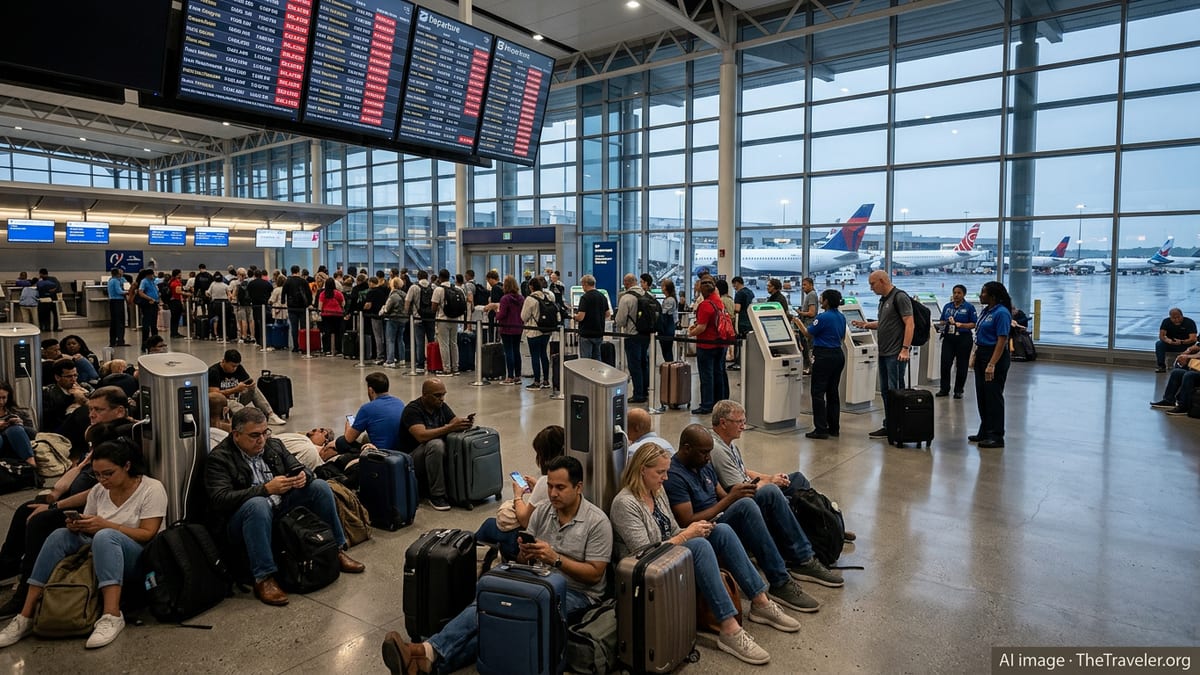
Travelers navigating Hartsfield-Jackson during the disruption have faced long lines at check-in counters, congested security lanes, and crowded gate areas, according to social media posts and anecdotal accounts. Screens across the terminals have displayed a dense pattern of delayed departures, contributing to a sense of uncertainty as departure times shift repeatedly.
Passengers with tight connections have been especially vulnerable. When inbound flights from cities such as Dallas, Chicago, or Miami arrive late, even short delays can erase the planned connection window for onward flights to New York, Los Angeles, or international destinations. In these circumstances, rebooked itineraries often involve multi-stop routings or next-day departures.
Consumer-rights guidance indicates that, in irregular operations, travelers are generally entitled to rebooking or refunds when flights are canceled, while compensation depends on the underlying cause of the disruption and the jurisdiction in which the ticket was purchased. In practice, however, long queues at service desks and heavy call volumes can make it difficult for passengers to quickly secure new arrangements.
Some travelers have sought alternatives such as driving to nearby airports, using ground transport for shorter regional journeys, or shifting itineraries to later in the week to avoid the immediate backlog. However, limited seat availability on peak routes has constrained these options for many.
Managing Recovery and What Travelers Can Expect Next
Operations at a major hub typically take hours or even days to fully stabilize after a period of severe disruption. Even once weather, staffing, or airspace constraints ease, airlines must work through aircraft repositioning, crew scheduling limitations, and accumulated passenger backlogs before flight banks return to normal cadence.
According to published operational plans and contingency guidance for Hartsfield-Jackson, recovery often involves a combination of schedule pruning, selective cancellations of lightly booked flights, and prioritization of key trunk routes to restore connectivity. Airlines may also employ larger aircraft on certain flights to accommodate rebooked passengers from earlier cancellations.
Travel advisories from aviation and travel-industry outlets consistently recommend that passengers monitor their flight status frequently, arrive at the airport earlier than usual during periods of disruption, and remain flexible regarding routing options. Where possible, travelers are encouraged to make use of airline apps and online tools to change bookings, rather than relying solely on airport counters.
Given Atlanta’s critical role in domestic and international air travel, further ripple effects across the U.S. network remain possible until the day’s schedule fully resets. Travelers with upcoming departures through Hartsfield-Jackson are being urged by public-facing travel resources to check for updates regularly and to plan for the possibility of extended journey times.