


More news on this day
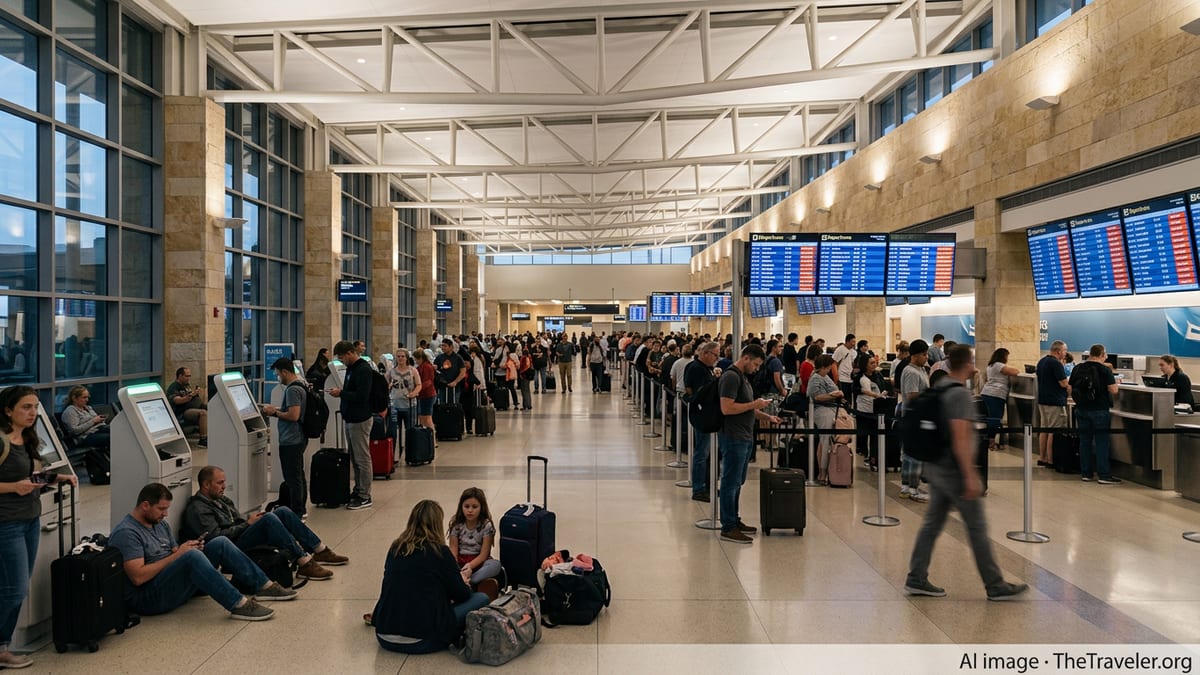
Travelers flying into Austin on Friday encountered widespread delays, with more than 100 flights affected as runway and taxiway construction at Austin-Bergstrom International Airport coincided with a Federal Aviation Administration ground delay program and unsettled Central Texas weather.
Get the latest news straight to your inbox!
Construction chokes key taxiways as FAA slows arrivals
Publicly available information indicates that Austin-Bergstrom International Airport is in the middle of a multiyear airfield expansion, including work on roughly two miles of new taxiways through the center of the airfield to support a future concourse. The layout and scope mean crews are working in close proximity to existing pavement used by arriving and departing aircraft.
On Friday, September 11, the Federal Aviation Administration activated a ground delay program for flights bound for Austin, according to national air traffic system advisories summarized in industry coverage. The program effectively limited the rate at which aircraft could depart for Austin from other airports, spacing inbound traffic while construction narrowed available taxi routes and runway access.
Reports from aviation tracking services and regional news outlets show that the program began late Friday morning and was initially scheduled to continue into the evening. As the day progressed, low clouds and developing storms over Central Texas further reduced the airport’s operational flexibility, reinforcing the need for tighter arrival controls.
Travel industry reporting indicates that the airfield work is part of Austin’s broader Journey With AUS program, a sequence of projects designed to add gates, improve passenger processing and expand airfield capacity over the next decade. In the near term, however, the same projects are temporarily constraining movements on the ground, making it harder to recover when disruptions occur.
More than 100 flights delayed as disruptions ripple across networks
Data compiled by flight-tracking services and summarized by travel news outlets show that by midday Friday, inbound flights to Austin were already averaging delays of more than half an hour, with some aircraft held for more than two hours. By early afternoon, average delays had grown toward an hour for many arrivals as the combination of airfield work, air traffic controls and weather converged.
According to published coverage focusing on Friday’s operations, the airport’s arrivals board displayed roughly 115 delayed flights through the early evening period, with the number rising as the ground delay program was extended. While cancellations remained limited, the high volume of late arrivals created knock-on effects for departures and connections throughout airline networks.
Because the FAA program controlled departures to Austin from the contiguous United States, some passengers experienced delays at their origin airports rather than while waiting on the ground in Central Texas. Others reported being held at gates or in holding patterns near Austin as controllers managed the reduced arrival rate.
The disruption landed at a time when Austin-Bergstrom is already handling record or near record monthly passenger volumes. Airport traffic reports from recent months show that the facility has repeatedly approached or exceeded the two million passenger mark in a single month, heightening the impact when a large portion of the schedule is pushed off time.
Long-running expansion reshapes airport experience
The Friday delays are the most visible example in recent days of the tradeoffs inherent in Austin’s rapid airport expansion. The Journey With AUS initiative is adding new processing space in the Barbara Jordan Terminal, additional security lanes, upgraded baggage systems and new parking garages, while long term plans call for expanded concourses and more than 60 gates.
City and airport planning documents outline how the airfield projects, including new taxiways and potential future runway improvements, are intended to support that growth by allowing more efficient aircraft movements and reducing chronic gate congestion. For now, however, sections of pavement are periodically closed or restricted, creating bottlenecks when traffic surges or weather reduces usable airspace.
Recent overviews of the program aimed at visitors highlight both terminal interior work and airfield construction as ongoing features of the passenger experience. Travelers are advised that construction-related changes in traffic patterns, parking availability and terminal circulation may appear with little notice as projects advance through different phases.
Friday’s airfield restrictions illustrate how those projects can interact with federal air traffic management tools. When key taxiways are unavailable, it can take longer for aircraft to vacate runways or reach gates, prompting the FAA to meter arrivals more conservatively in order to maintain safe separation and avoid gridlock on the ground.
What travelers flying to or from Austin should expect
In light of Friday’s events, publicly available guidance from the airport and travel industry suggests that passengers with upcoming Austin flights should plan for the possibility of rolling schedule adjustments while construction is active. The combination of seasonal storms, strong demand and constrained ground capacity increases the odds of departure and arrival times shifting throughout the day.
Travel advisories aimed at Austin-bound passengers consistently recommend arriving at the airport earlier than usual for departing flights, allowing extra time for parking, check in and security screening in a terminal that remains under construction. For arriving passengers, building in longer connection windows and flexible ground transportation plans can reduce the stress of unexpected delays.
Airline and airport communications also emphasize the importance of monitoring flight status frequently on travel days. During the Friday ground delay program, some flights were held at origin airports before pushback, while others departed close to schedule only to be slowed in the air or placed in holding patterns as conditions evolved in Central Texas.
With major portions of Austin-Bergstrom’s expansion scheduled to continue for years, aviation analysts expect periodic days like Friday, when construction activity intersects with weather and national air traffic controls to produce concentrated waves of delay. For travelers, that means staying alert to changing conditions while the airport builds the capacity intended to make future trips smoother.