


More news on this day
Israel is launching a coordinated series of repatriation flights from the United Arab Emirates to bring home thousands of passengers stranded after FlyDubai halted services to Tel Aviv in the wake of a violent cockpit attack on one of its jets.
Get the latest news straight to your inbox!
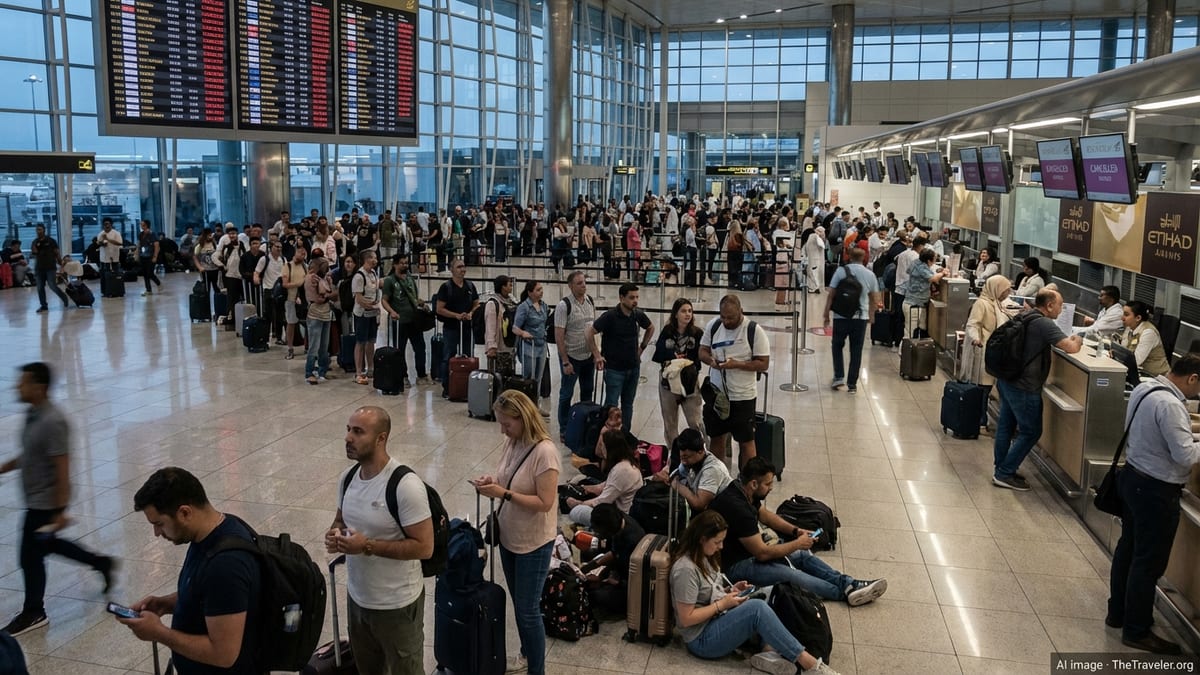
Emergency airlift after suspended Israel–UAE route
According to publicly available information from Israel’s Transportation Ministry and multiple airline statements, Israeli carriers El Al, Arkia and Israir have begun organizing one-way rescue services from Dubai and Abu Dhabi to Tel Aviv. The operation follows FlyDubai’s decision to suspend all flights to and from Israel while investigations continue into the attempted attack on flight FZ1073 from Dubai to Tel Aviv on September 30, 2026.
Reports indicate that Israel has approved repatriation capacity for roughly 1,800 passengers in an initial phase, with government-backed arrangements designed to help carriers operate aircraft that must fly empty to the UAE before returning with stranded travelers. Local coverage in Israel describes the effort as an emergency air bridge intended to stabilize a key tourism and business route created after normalization of relations with the UAE in 2020.
FlyDubai’s suspension has effectively severed one of the busiest direct links between Israel and the Gulf, leaving holidaymakers, business visitors and transit passengers looking for alternative ways home. With commercial schedules disrupted at short notice, repatriation flights are being added on top of limited existing services from other Gulf carriers, subject to regulatory and security clearances.
Some outlets in Israel and the region note that while a number of stranded passengers have already rerouted through other hubs, several thousand Israeli travelers were still believed to be in the UAE as of Friday, facing uncertainty over when they can return and how much it will cost.
What travelers can expect from the rescue flights
El Al has announced a series of special Dubai–Tel Aviv services priced from the equivalent of about 188 pounds sterling one way, as reported in regional business media, with fares set in coordination with Israel’s Transportation Ministry. Israir is preparing additional flights that, according to the same coverage, are expected to start from roughly 226 pounds sterling, while Arkia is working on weekend operations subject to final approvals from authorities in both countries.
Schedules published in Israeli and UAE travel reports show that the flights are planned as one-way services into Tel Aviv’s Ben Gurion Airport, with aircraft operating outbound to the UAE without passengers. This structure reflects the focus on repatriation rather than rebuilding the route’s regular commercial pattern, and it also underscores the financial strain on airlines that are being partially compensated by the Israeli government for the unusual operating conditions.
Publicly available information indicates that seats on the first departures are being prioritized for travelers whose original FlyDubai return tickets were canceled, particularly those with imminent needs to be back in Israel. Passengers are being advised in press reports to stay in close contact with their booking agents or airlines rather than going directly to airports in Dubai and Abu Dhabi without confirmed seats, as space on the earliest flights is limited.
Regional media coverage also notes that Israel’s Transportation Ministry has contacted Abu Dhabi-based Etihad Airways to explore boosting its Abu Dhabi–Tel Aviv services as another avenue for stranded visitors, although any additional flights depend on aircraft availability, crew scheduling and evolving security assessments.
The FlyDubai cockpit attack that triggered the crisis
The repatriation operation stems directly from a dramatic incident aboard FlyDubai flight FZ1073 on September 30, described in detail across international news coverage. Public reports state that shortly after departure from Dubai en route to Tel Aviv, the copilot allegedly attacked the captain in the cockpit, stabbing him and causing the Boeing 737 to enter a steep descent from cruising altitude.
Passengers later recounted in televised interviews and written accounts how several travelers forced their way into the cockpit, helped subdue the attacker and assisted the wounded captain. Flight-tracking data cited by aviation outlets shows the aircraft dropping rapidly from around 33,000 feet to approximately 17,000 feet in about a minute before the situation stabilized and the jet diverted to Tabuk in northwestern Saudi Arabia.
All 182 people on board, including 166 Israeli passengers and eight crew members, were eventually brought to Israel on a replacement FlyDubai aircraft after several hours on the ground in Saudi Arabia, according to published timelines from regional and international media. Separate investigative reports note that authorities in Israel, the UAE and Saudi Arabia have opened inquiries into the precise sequence of events and the attacker’s motives.
Coverage from Gulf and Israeli outlets indicates that FlyDubai subsequently announced a temporary suspension of its Israel operations while cooperating with investigators. The airline’s decision, combined with additional codeshare suspensions on the route, left thousands of travelers with unused tickets and no immediate direct flights between Dubai and Tel Aviv.
Security reviews and regional aviation implications
The cockpit attack has prompted fresh scrutiny of pilot screening, inflight security and cross-border aviation cooperation across the Middle East. Aviation experts quoted in regional analysis pieces point to questions around mental health monitoring, background checks, and cockpit access protocols, particularly on routes that cross multiple national airspaces and rely on security coordination between states with differing threat assessments.
Publicly available commentary in Israel and the UAE suggests that regulators and security services are now reviewing procedures for mixed-nationality flight crews operating on politically sensitive routes. Discussions reported in the Israeli press mention close coordination between the two countries to reassess risk criteria and oversight mechanisms before regular commercial services on the UAE–Israel corridor are fully restored.
The incident also highlights the strategic role that Gulf–Israel air links have come to play since 2020. Prior to the suspension, FlyDubai operated several daily flights between Dubai and Tel Aviv, often serving as a key connection for Israelis traveling onward to Asia, Africa and Australasia. With that link temporarily broken, travelers are turning to alternative routings through Europe, Jordan and Egypt, which can add travel time and increase fares during an already tense period in regional aviation.
Industry observers writing in regional business outlets note that the financial impact may be significant for both FlyDubai and Israeli carriers, but they stress that safety considerations are now the overriding priority. How quickly full schedules resume will likely depend on the outcome of investigations and the confidence of regulators, insurers and travelers themselves.
Practical guidance for stranded and future travelers
For those currently in the UAE, travel industry reports advise confirming whether an existing FlyDubai booking has been transferred to an Israeli carrier rescue flight or to another airline such as Etihad. Some passengers have been offered rebooking options via Abu Dhabi or through third-country hubs, but these arrangements vary by ticket type and travel agency, and not all travelers have received immediate alternatives.
Public notices from airlines and airport operators emphasize the importance of monitoring email and mobile notifications for schedule changes, as departure times for repatriation services may shift due to security coordination, crew availability and airspace constraints. Travelers are also being urged in local coverage to verify passport validity, visas and any transit requirements if they are re-routed via a different country on their way back to Israel.
For future trips between Israel and the UAE, analysts writing in regional travel media suggest allowing greater flexibility in itineraries, including the possibility of indirect routes via Abu Dhabi or other hubs if Dubai–Tel Aviv services remain reduced for an extended period. Trip planners are also recommending comprehensive travel insurance that explicitly covers carrier cancellations and route suspensions in volatile regions.
While authorities have not provided a firm timetable for the full restoration of FlyDubai’s Israel operations, the fast-tracked repatriation flights signal an effort by both countries to protect vital travel ties even as they respond to a serious aviation security incident. For travelers, the coming days will be marked by full flights, evolving schedules and heightened checks, but also by a concerted push to ensure that those stranded in the UAE can finally make it home.