


More news on this day
Bahrain International Airport in Manama is restoring regular passenger flights after the reopening of the kingdom’s airspace, a shift that is injecting fresh momentum into Middle East travel following weeks of severe disruption.
Get the latest news straight to your inbox!
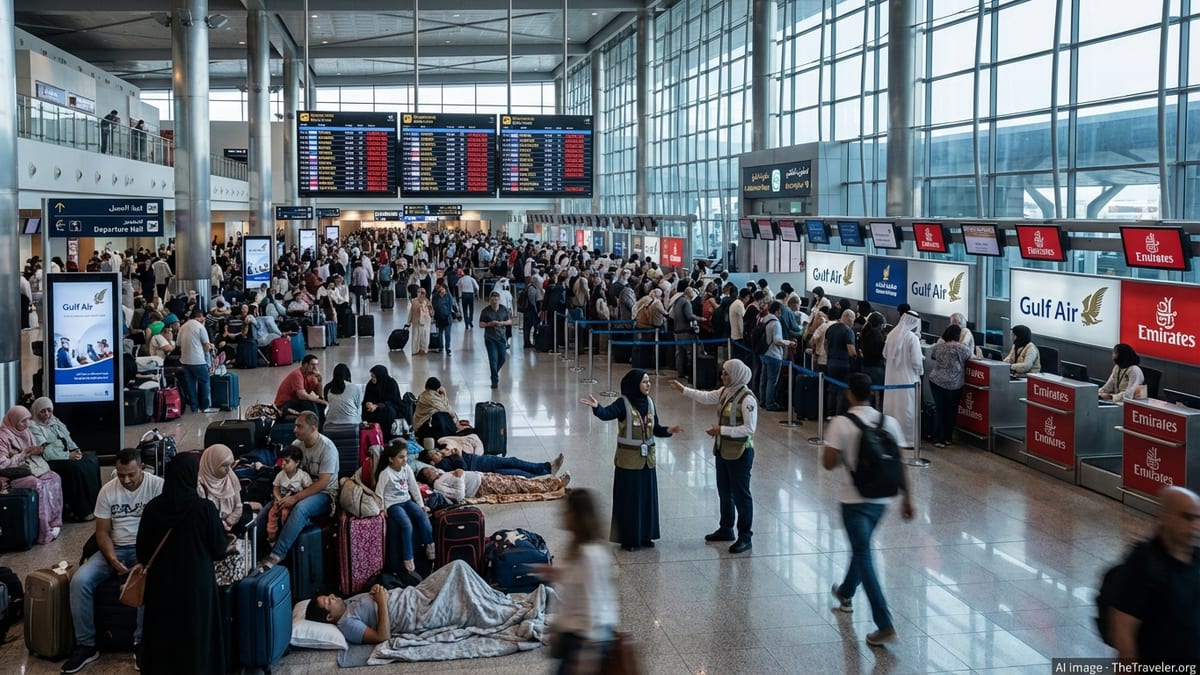
From Missile Strikes To Reopened Skies
The restart of flights at Bahrain International Airport follows a turbulent period that began in late February 2026, when Iranian missile and drone strikes across several Gulf states triggered widespread airspace closures. Bahrain’s skies were among those shut to routine civilian traffic, forcing airlines to divert or cancel services and stranding thousands of passengers across the region.
Publicly available information shows that Bahrain’s national carrier, Gulf Air, temporarily relocated much of its operation to King Fahd International Airport in Dammam, eastern Saudi Arabia, to maintain a limited network while Manama’s airport remained effectively off line. Regional travel advisories throughout March described Bahraini aviation as severely disrupted, with only emergency or special-purpose flights moving in and out of the country.
Reports indicate that a combination of security assessments and de-escalation efforts in the Gulf helped clear the way for a phased reopening in early April. By 9 April, aviation data and industry briefings were describing Bahrain’s airspace as open again for scheduled civilian operations, providing the foundation for airlines to return and for the airport operator to plan a systematic ramp-up of services.
The move aligns Bahrain with a broader, if uneven, normalization across the Gulf, where airports in Jordan, the United Arab Emirates and Qatar have also been adjusting flight schedules in response to changing airspace restrictions rather than total shutdowns.
Gulf Air Leads The Return To Manama
According to published airline updates, Gulf Air has taken a leading role in re-establishing Bahrain’s connectivity now that the airspace is open. The carrier has announced the resumption of flights through Bahrain International Airport and has outlined a returning network that reconnects the kingdom with major regional and long-haul destinations.
Initial routes highlighted in industry coverage include key trunk links to London Heathrow, Mumbai and Delhi, alongside important regional and South Asian markets such as Dubai, Jeddah, Riyadh, Hyderabad, Thiruvananthapuram, Lahore, Dhaka, Islamabad and Kochi. Travel-industry reports indicate that these services are being restored in stages across several days in mid-April rather than all at once, reflecting the need for careful operational planning after a prolonged closure.
At the same time, Gulf Air is keeping a temporary mini-hub in Dammam as a backup and to accommodate passengers already booked on itineraries that were re-routed during the crisis. This dual-node arrangement is expected to persist during the early normalization phase, giving the airline more flexibility should conditions in Bahrain’s airspace change again.
Other regional and international carriers are also assessing their timetables. Flight search data beginning in early April shows a gradual reappearance of Bahrain flights on booking platforms, with schedules updated from a default “suspended” status to specific departure and arrival times, a sign that airlines see the reopening as sustainable in the short term.
Airport Operations Move Back Toward Normal
On the ground in Manama, Bahrain Airport Company, which operates Bahrain International Airport, has been coordinating the restart of terminal and airside activities. Statements cited in regional travel media describe a focus on synchronizing efforts with airlines, ground-handling providers and government agencies to ensure that the return to normal operations does not compromise safety or security.
Industry commentary notes that the first commercial touchdown at Bahrain International Airport after more than a month of effective shutdown carried symbolic weight for the country’s aviation sector. The arrival signaled that crucial systems from air traffic control to baggage handling had been tested and were ready to support a gradual rise in traffic volumes.
Passenger-facing services are also scaling up again. Airport information channels show that check-in counters, security lanes, lounges and retail outlets are reopening in line with the flight schedule, though in some cases with reduced hours or limited capacity. Travelers are being advised by airlines and travel agents to monitor flight status closely, as same-day adjustments remain possible in a still-sensitive regional security climate.
While reports describe operations as “normal” relative to the full shutdown in March, aviation analysts caution that the airport is currently in a recovery phase rather than at pre-crisis activity levels. Load factors, aircraft rotations and crew planning are all being recalibrated, and operators are prepared to fine-tune schedules at short notice if demand patterns or risk assessments change.
Regional Travel Impact And Competitive Shifts
The reopening of Bahrain’s airspace and the return of flights at Manama are reshaping travel flows across the wider Middle East. During the closure, passengers bound for or transiting through Bahrain were rebooked onto alternative routings via hubs such as Dubai, Doha, Riyadh and Muscat, boosting traffic and connection banks at those airports even as some of them faced their own constraints.
Now, as Bahrain International Airport restores its role as Gulf Air’s primary hub, some of that traffic is expected to shift back, particularly for itineraries linking Europe and the Indian subcontinent. Airline schedule data suggests that Bahrain’s re-entry into the network map could slightly ease pressure on competing hubs that had absorbed diverted passengers, while reintroducing a familiar one-stop option for travelers heading between South Asia and Western destinations.
Business travel is another dimension. Corporate travel managers in the energy, finance and logistics sectors often rely on Bahrain’s strategic location for regional meetings and project work. The resumption of more predictable flight patterns into Manama is likely to support the gradual return of in-person engagements that were put on hold or moved online during the airspace shutdown.
Tourism flows may take longer to normalize. Travel advisories issued by governments and security consultancies in March and early April continue to emphasize that the underlying geopolitical tensions that led to the airspace closures have not fully dissipated. Leisure travelers may wait to see a sustained period of stability before committing to trips, even as airlines advertise restored connections and competitive fares.
What Travelers Should Expect In The Coming Weeks
For passengers with upcoming journeys involving Bahrain, the restart of flights at Manama represents an important step toward stability, but not an immediate return to the carefree travel conditions that existed before February’s escalation. Airlines are still operating in a highly dynamic environment, and timetable changes or aircraft swaps can occur with limited notice.
Travel experts recommend that passengers pay close attention to airline notifications and, where possible, use carrier apps or online tools to reconfirm flights in the 24 hours before departure. Because Gulf Air continues to operate a parallel network through Dammam, some itineraries originally sold as Bahrain connections may still be routed via Saudi Arabia, particularly during the transition period.
Passengers connecting through Manama should allow generous layover times while airport processes settle into a full routine and as security or air traffic measures are fine-tuned. Flexible booking options, including refundable tickets or no-fee change policies, remain advisable for trips that depend heavily on regional stability.
Despite these caveats, the reopening of Bahraini airspace and the resumption of operations at Bahrain International Airport mark a clear positive signal for Middle East aviation. After weeks in which closures in Bahrain contributed to a patchwork of disruptions across the region, the sight of regularly scheduled departures and arrivals in Manama again underscores the sector’s ability to adapt and restart, even in a challenging geopolitical landscape.