


On the western edge of the Bay of Naples, the Phlegraean Fields offer one of Italy’s most vivid combinations of volcanoes, Roman ruins and everyday coastal life. Two names come up again and again when travelers plan a visit: Baia, with its legendary underwater city, and Pozzuoli, the working port town that was once the Roman Empire’s gateway to the Mediterranean. Both are within minutes of each other. Both sit inside the same restless volcanic caldera. Yet they deliver very different kinds of trips. So which destination leaves the bigger impression on most visitors’ memories, Baia or Pozzuoli?
Get the latest updates straight to your inbox!
The Setting: Two Faces of the Phlegraean Fields
Baia and Pozzuoli sit less than 10 kilometers apart, but their personalities diverge sharply. Pozzuoli is the larger town and feels immediately lived-in: apartment blocks stepping down to the sea, a busy waterfront lined with bars and pizzerias, ferries backing out toward Ischia and Procida, and traffic funneled past Roman columns that are simply part of the landscape. You step off the Cumana commuter train and straight into a place where people are hurrying to work, buying fish for lunch and grabbing an espresso at the bar on the corner.
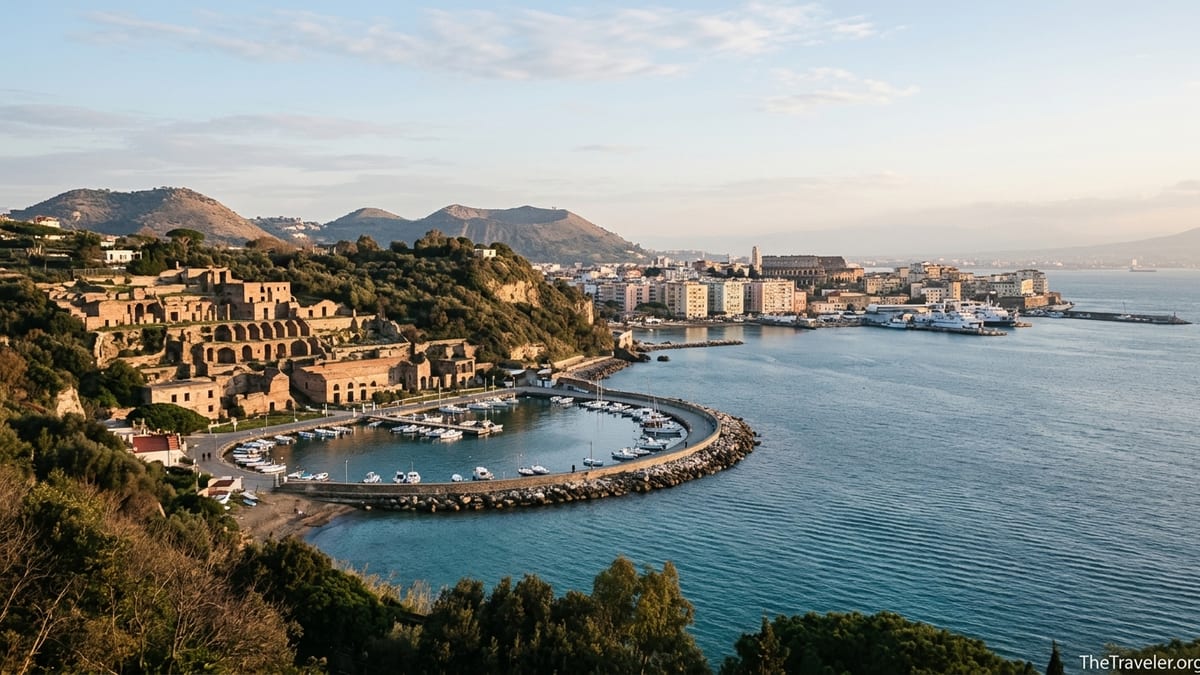
Baia, by contrast, feels more like a layered outdoor museum wrapped around a small harbor. Above the waterline, the archaeological park climbs a hillside with the ruins of vast Roman bath complexes and villas. Below the surface, the bay hides an extraordinary submerged city of mosaicked floors, columns and courtyards, accessible only by boat, mask or scuba gear. The modern marina, a cluster of seafood restaurants and dive centers, is compact enough that you can cross it in minutes.
For most travelers, Pozzuoli works better as a base and Baia as a targeted excursion. Pozzuoli has more hotel rooms and apartment rentals, more frequent trains toward Naples, and simple practicalities like supermarkets and pharmacies that stay open into the evening. Baia, though it has some accommodation, is still primarily a day-trip destination focused around archaeology and the marina.
If you are trying to decide where you will feel the place in your bones, it often comes down to this: Pozzuoli captures the experience of living on an active volcano in a real Italian town, while Baia offers one of the most surreal encounters with the Roman world you can have anywhere in the Mediterranean.
Roman History: Amphitheatres vs Sunken Villas
In Pozzuoli, history announces itself above ground, often at street level. The Flavian Amphitheatre, Italy’s third-largest after the Colosseum and Capua, sits beside a traffic circle. On a typical weekday morning, you might share its enormous underground corridors with only a handful of visitors. Ancient brick arches glow softly in the filtered light, and the remains of the lift systems that once raised animals and scenery into the arena are still clearly visible. It is an intensely tactile site: you walk the same sandy corridors that gladiators once used, without the crowd management barriers of the Colosseum in Rome.
A short stroll away, the Macellum, commonly called the Temple of Serapis, sits in a shallow depression where three slender columns stand surrounded by parked cars and apartment balconies. The pitted lower sections of the columns tell a story that goes beyond archaeology: over centuries, the land here has slowly risen and sunk due to bradyseism, the vertical movement caused by magma and gasses beneath the Phlegraean Fields. Shell marks show how the columns were once partially under water, and today the site doubles as an open-air gauge of the caldera’s restless behavior.
Baia’s Roman story is split between land and sea. The upper archaeological park preserves the remains of imperial thermal baths and terraced villas that cascaded down toward the bay. You wander through enormous domed halls, brick exedras and fragments of mosaic floors, with views over the glassy blue water. Interpretive panels explain how political power and pleasure once concentrated here, with emperors and senators building residences that rivaled any on the Bay of Naples.
But the real shock of Baia is offshore. The Parco Archeologico Sommerso di Baia protects an underwater city created when bradyseism gradually lowered parts of the Roman shoreline beneath the sea. On guided snorkeling or glass-bottom boat trips, you float above paved streets, marble courtyards and the outlines of porticoes at depths of just a few meters. Divers can get closer still: local centers offer guided dives that include features like the mosaic floors of the so-called Villa a Protiro and the remains of a nymphaeum attributed to the emperor Claudius. For many visitors, seeing intact Roman pavements blurred by swaying sea grass is the single most unforgettable image of their time in Campania.
Experiences: What You Actually Do in Each Place
In Pozzuoli, a typical day might start with a coffee at a waterfront bar along Via Napoli, watching commuters board buses and ferries under the silhouette of Vesuvius. From there, it is an easy walk up to the Flavian Amphitheatre for an hour or two of exploration. Entrance tickets are usually modestly priced compared with the big-name sites on the Amalfi Coast, and it is still common to find no queue at all at opening time, especially outside high summer.
In the afternoon, many travelers either head up to the volcanic crater of Solfatara, when it is open to visitors, or take a ferry across to Procida or Ischia for a few hours. Returning to Pozzuoli, the evening continues naturally into aperitivo on the harborfront, with locals crowding small tables for spritzes and plates of fried seafood. The town’s fish market, with stalls selling clams, mussels and locally caught anchovies, is both a photo opportunity and the source of many of the dishes on menus nearby.
In Baia, the day revolves around the archaeological sites and the water. Many people arrive in the morning by car or local train-and-bus connection, heading first to the terrestrial archaeological park. Visits typically last around two hours, long enough to wander the thermal complexes and take in wide views across the bay. After lunch at one of the harbor restaurants, where seafood risotto and grilled octopus are standard offerings, the focus shifts to the underwater park.
Dive centers and boat operators in Baia run scheduled glass-bottom boat tours, snorkeling trips and scuba dives in the marine park during the main season, usually from spring through autumn, with departures clustered in late morning and early afternoon. Prices vary but are often comparable to a guided boat dive elsewhere in Italy, with additional costs for full equipment rental if needed. For non-divers or families with children, the glass-bottom boat is the simplest and most accessible option, offering close views of walls, columns and statues without getting wet.
Atmosphere, Food and Nightlife
Atmosphere is where the two destinations feel most different in practice. Pozzuoli, particularly around its historic center and the seafront district, delivers a confident small-city energy. On Friday and Saturday nights, promenades fill with local couples and groups of friends doing the classic Italian passeggiata. Bars along the lungomare serve cocktails and craft beers, and it is easy to slip into a pizzeria where a marinara or margherita rarely costs more than what you would pay for a simple lunch in a more touristy corner of the region.
Baia’s energy is calmer and more concentrated. Outside peak summer weekends, evenings can be very quiet once day-trippers have left. The main action is at a handful of restaurants and wine bars along the marina, where boat owners and divers mingle over plates of spaghetti alle vongole and grilled fish. The mood feels more like a marina community than a town, and you are rarely more than a few steps from the sound of halyards tapping against masts.
For food lovers, both places offer excellent seafood, but Pozzuoli has the edge in variety. The town’s fish market supplies a cluster of informal trattorias near the port, where you might find simple dishes such as sautéed mussels, fried calamari and the local specialty of impepata di cozze, a peppery mussel stew. In Baia, menus lean heavily into classic coastal Campanian cooking, often with slightly higher prices reflecting the focus on visitors rather than residents.
Nightlife is also more developed in Pozzuoli. While you will not find cavernous nightclubs, there is a critical mass of wine bars and late-opening cafes that makes it easy to stay out past midnight without feeling like you are disturbing the neighbors. In Baia, most evenings wrap up earlier, and those seeking live music or a broader bar scene often drive or take a taxi back toward Pozzuoli or Naples.
Access, Transport and Practicalities
For travelers arriving without a car, Pozzuoli is significantly easier to reach and navigate. Two local rail lines connect it to Naples: the Cumana line runs from the Montesanto district straight to Pozzuoli station in roughly 30 minutes, while regional trains from Napoli Campi Flegrei station offer alternative options. From the station, it is a short walk down to the port and historic center. Ferries to Ischia and Procida depart from the main harbor, giving you island access without needing to stay in central Naples.
Baia is reachable by a combination of train and bus or by car. The nearest Cumana stop is usually Lucrino or Fusaro; from there, local buses or taxis cover the last few kilometers to the harbor and archaeological park. In practice, many visitors reach Baia on organized tours from Naples or Pozzuoli that bundle transport, a guide and in some cases a boat excursion into a single package. This can be convenient on busy summer days when parking near the marina is limited.
In terms of accommodation, Pozzuoli offers a spectrum from small boutique hotels and guesthouses in restored palazzi to modern business-style properties close to the port. Nightly rates are often lower than on the Amalfi Coast or in central Naples, especially outside August and major holidays, and you can often find comfortable mid-range rooms that include breakfast. Baia has fewer places to stay and less of a year-round hotel ecosystem, which can mean higher prices and reduced options outside the main season.
Both destinations sit inside a volcanic area that is closely monitored by Italian authorities. Periodic swarms of small earthquakes and minor ground uplift are part of life here, and civil protection agencies publish regular updates and emergency plans. Visitors occasionally notice small cracks repaired in pavements or read about temporary closures of specific areas as a precaution. For most travelers, this remains background context rather than a direct disruption, but it is something to be aware of when reading local news and planning hikes or crater visits.
Safety, Volcanic Activity and When to Go
The Phlegraean Fields are one of the most studied volcanic systems in the world. Both Baia and Pozzuoli have long histories of adapting to bradyseism and periodic volcanic unrest, and the authorities maintain active monitoring networks to track seismic activity and ground deformation. Alert levels and planning measures can change over time, and travelers should always check recent local guidance before visiting specific sites such as craters or fumarole fields.
Within the towns themselves, the main safety concerns are the same as in much of southern Italy: watching for traffic on narrow streets, taking normal precautions with valuables in crowded areas, and being mindful of uneven pavements and steps around archaeological remains. In Baia’s underwater park, operators typically require dive certification for scuba excursions, enforce depth limits and provide life jackets for glass-bottom boat trips. Water temperatures in spring and autumn can feel cool, so a wetsuit or shorty is standard even for relatively shallow dives.
In terms of timing, late April to early June and late September to October often provide the most comfortable balance of weather and crowd levels. Sea conditions in Baia are more likely to be calm, improving visibility for snorkeling and diving, while daytime temperatures in Pozzuoli are warm enough for long walks among the ruins without the intense heat of August. Winter can be atmospheric, with moody skies and fewer visitors, but boat excursions in Baia may run on reduced schedules or be canceled in poor weather.
Cost-wise, both destinations are generally more affordable than headline spots like Capri or Positano. Entrance fees to the main archaeological sites are broadly accessible, and public transport from Naples remains inexpensive compared with taxi or private driver options. The main additional expense to factor in is any underwater activity at Baia, where guided dives, snorkeling sessions or private boat charters can add a noticeable line to your budget, particularly for families or small groups.
So Which Leaves the Bigger Impression?
Choosing between Baia and Pozzuoli ultimately comes down to the kind of memory you want to carry home. If your idea of a powerful travel moment is drifting in sunlit water above Roman colonnades that have been underwater for centuries, Baia is hard to beat. The juxtaposition of ancient mosaic floors and schools of fish, of harbor buoys marking out a city that once was dry land, is something you are unlikely to find elsewhere on your itinerary. Even for non-divers, peering through the glass bottom of a boat at a submerged courtyard can feel like witnessing a slow-motion natural disaster frozen in time.
On the other hand, Pozzuoli delivers a different kind of emotional impact: the realization that tens of thousands of people live day-to-day lives in the middle of a giant volcano, surrounded by ruins that most of the world barely knows. Standing in the quiet corridors beneath the Flavian Amphitheatre, or looking at marine shell marks on the columns of the Macellum while local children kick a football nearby, you experience history not as a set of isolated monuments but as part of an ongoing urban story.
For many travelers, the most rewarding solution is not to choose at all. Base yourself in Pozzuoli, taking advantage of its transport links, restaurants and evening life, and dedicate a full day to Baia with both the hilltop baths and the underwater park. This combination lets you feel the breadth of the Phlegraean Fields: the subterranean tension of the caldera, the everyday life of a working port town, and the dreamlike spectacle of a sunken Roman resort.
If you must pick only one, consider your priorities. Limited time and a desire for accessible, crowd-free ruins and good food lean toward Pozzuoli. A passion for diving, underwater archaeology or singular experiences you cannot replicate elsewhere points you firmly toward Baia.
The Takeaway
Baia and Pozzuoli are two lenses onto the same remarkable landscape, and each magnifies different aspects of the Phlegraean Fields. Baia condenses imperial luxury, volcanic subsidence and modern underwater exploration into a tight circle of harbor, hillside ruins and marine park. Pozzuoli spreads its impact across amphitheatres, markets, ferry docks and everyday streets, showing how people have adapted for millennia to living with a volatile earth beneath their feet.
If you are assembling a wider itinerary that includes Naples, Pompeii and perhaps the Amalfi Coast, weaving in at least a day in this western corner of the bay can rebalance the narrative. Here, Rome’s legacy is not just frozen in ash or cordoned off behind turnstiles; it is partially submerged, partly lived-in and constantly framed by the knowledge that the ground itself is moving, however slowly.
Whether you find your most vivid moment slipping into Baia’s green-blue water over a submerged mosaic, or sipping coffee in a Pozzuoli bar while ferries nose past a skyline of Roman arches, the Phlegraean Fields tend to linger long after you leave. In the end, the destination that leaves the bigger impression is often the one that best matches the way you like to experience history: as a spectacle beneath the waves, as a texture of daily life, or, ideally, as both.
FAQ
Q1. Is Baia or Pozzuoli better as a base for several nights?
Pozzuoli usually works better as a base because it has more accommodation, easier rail connections to Naples, and regular ferries to nearby islands, while Baia is more focused on day visitors to its archaeological sites and marina.
Q2. Do I need to be a certified diver to see Baia’s underwater ruins?
No, you do not need dive certification to experience the underwater park: glass-bottom boat tours and guided snorkeling trips allow non-divers to see key areas of the sunken city.
Q3. How much time should I plan for Baia?
Most travelers find that a full day is ideal, with two or three hours for the hilltop archaeological park, time for lunch in the marina, and a boat, snorkeling or diving excursion in the afternoon.
Q4. Is Pozzuoli worth visiting if I have already seen Pompeii and Herculaneum?
Yes, Pozzuoli offers a different perspective, with the Flavian Amphitheatre’s intact underground corridors, the bradyseism-marked columns of the Macellum, and a stronger sense of a living town built around its ruins.
Q5. How do I get from Naples to Pozzuoli without a car?
You can take the Cumana rail line from the Montesanto area of central Naples, which reaches Pozzuoli in roughly half an hour, or regional trains from Napoli Campi Flegrei station, both of which are inexpensive and frequent.
Q6. Is visiting the Phlegraean Fields safe given the volcanic activity?
The area is closely monitored by Italian authorities, with alert levels, emergency plans and occasional precautions in place; visitors should check recent local guidance but, in normal conditions, tourism and daily life continue as usual.
Q7. When is the best time of year to visit Baia’s underwater park?
Late spring and early autumn generally offer the best combination of milder temperatures, calmer seas and fewer crowds, improving both visibility in the water and the chances that boat trips will run as scheduled.
Q8. Can I visit both Baia and Pozzuoli in one day?
It is possible but can feel rushed; combining the Flavian Amphitheatre and waterfront in Pozzuoli with at least part of Baia’s archaeological offering in a single day is feasible if you start early and plan transport carefully.
Q9. Are there good food options in both places?
Yes, both Baia and Pozzuoli serve excellent seafood, though Pozzuoli has a broader range of restaurants and price points thanks to its larger resident population and busy fish market.
Q10. Do I need a guided tour, or can I explore on my own?
You can comfortably explore the main ruins in both Baia and Pozzuoli independently, but guided tours can add valuable context, especially for understanding volcanic phenomena and the layout of the submerged city in Baia.