


I arrived in Baia expecting another set of Roman ruins. I left feeling as if I had brushed against the private lives of emperors and billionaires, suspended between volcanic cliffs and the sea. Nowhere else on my travels in Italy has altered my sense of ancient Roman luxury as completely as this crumbling resort town on the Bay of Pozzuoli, where half the story lies underwater.
Get the latest updates straight to your inbox!
Meeting the Roman Riviera I Had Never Heard Of
Until I started planning a trip around Naples, Baia barely registered as a footnote. Guidebooks devoted pages to Pompeii and Herculaneum, but Baia usually appeared as a brief suggestion, if it appeared at all. Yet in antiquity this was the place. Senators, generals, and emperors built sprawling villas here, facing the sun and the sea, along a coastline of thermal springs and easily defended headlands. Roman writers compared Baia to a perpetual holiday, a resort where work, politics, and even morality went on vacation.
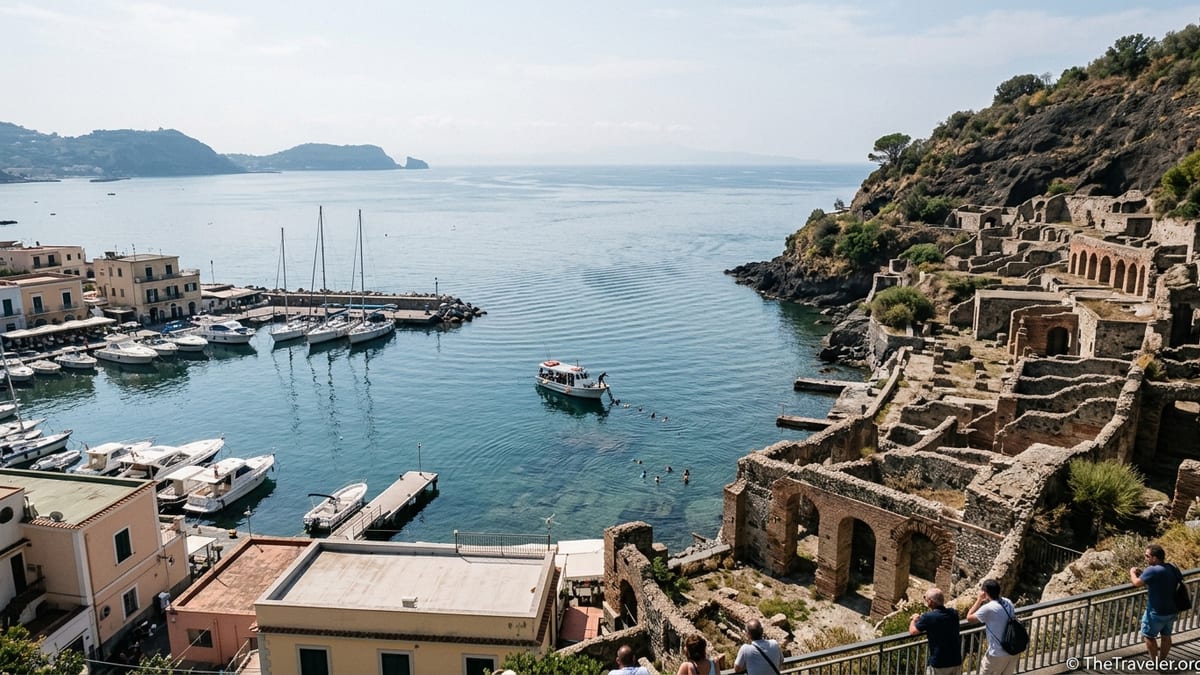
Driving out from central Naples, that history is not immediately obvious. You curve along the Campi Flegrei, a landscape of apartment blocks, craters ringed with houses, and the occasional glimpse of steam from volcanic vents. Then the road drops, the sea flashes into view, and you suddenly see why the Romans chose this spot: a natural amphitheater of dark cliffs, calm water, and a view that sweeps from Pozzuoli to Cape Miseno. The modern town of Baia clings to the slope above a small marina, but your eye is drawn to the layered ruins climbing the hillside and, beyond them, to the flat expanse of water that hides the rest.
The first surprise was how compact everything felt. Unlike Pompeii’s broad grid of streets, Baia is vertical. Terraces of brick and concrete stack one above the other, connected by ramps and stairs that now echo with the sound of visitors instead of servants. With an all-area ticket at about 5 euros for the Archaeological Park of the Terme di Baia, it felt less like paying to enter a museum and more like being handed a key to someone else’s private holiday compound.
Climbing Through Clifftop Baths and Private Worlds
The archaeological park on the hillside is the side of Baia that most visitors see first. It is officially part of the wider Phlegraean Fields Archaeological Park, but once you step inside, it feels like a self-contained world. You enter near the upper terraces and begin descending through what were once luxury bath complexes and residential wings, cut directly into the slope that dropped toward the ancient shoreline.
Here, Roman luxury reveals itself less in glitter and more in infrastructure. Long, barrel-vaulted corridors that once channeled steam and hot water from the volcanic springs are still accessible. You can stand where attendants once hurried with towels and oils, their movements timed to the rhythms of hot, warm, and cold baths. In certain chambers, fragments of colored marble still cling to the walls. In others, floors preserve traces of geometric mosaics that once framed shallow pools. It becomes clear that for the Roman elite, comfort began with a kind of invisible technical mastery: controlling heat, water, and light with a precision that feels remarkably modern.
On one terrace, I stepped into a circular hall with niches for statues and a central pool where water would have reflected marble faces and painted ceilings. The acoustics are still extraordinary. A whisper at one side travels clearly to the other, a reminder that these spaces were built not only for bathing but for conversation, performance, and politics. Luxury here meant more than indulgence. It meant engineering environments where power could be displayed and alliances shaped between glasses of wine and dips in the hot room.
Looking Down at a Lost Shoreline
From the upper terraces, metal walkways lead to viewpoints that look straight down onto the current shoreline. It takes a moment to realize that in Roman times, the sea stopped much farther out. Over centuries, volcanic activity has slowly lowered sections of the coast. The waterfront villas that once sat directly on the bay now lie several meters below the surface, in what is today the Underwater Archaeological Park of Baia.
Understanding that basic geological fact changed how I read the landscape in front of me. The line of modern restaurants and boat rentals along the marina marks only the latest version of a waterfront that has been rising and falling for millennia. Columns that were once part of porticoes now stand submerged, their capitals grazed by fish. Mosaic floors that supported dining couches now lie under seagrass. The cliffside ruins where I was standing were only half the picture. The rest continued invisibly under the calm, glittering water.
It is one thing to know, in theory, that an ancient city has partially sunk. It is another to realize that the distance between your feet and those submerged floors is measured not in centuries but in meters. That physical closeness makes Baia feel intimate in a way that few archaeological sites do. As I talked with a local guide at the viewpoint, she pointed out where specific villas were located under the bay and casually mentioned that snorkelers float above them almost every day in summer. The idea of tourists peering down at banquet halls where emperors once dined felt like the purest expression of time folding in on itself.
From Marble Halls to Mask and Snorkel
If the hillside ruins show the architecture of Roman luxury, the bay shows its atmosphere. Several local operators based around Baia and nearby Pozzuoli run small-boat trips into the underwater park, offering both snorkeling and scuba options. Many of these departures are from modest docks near Lucrino station or the marina at Baia, and prices vary from roughly 50 to 100 euros per person for a half-day experience, depending on whether you snorkel or dive, and whether equipment and lunch are included.
I joined a mid-morning snorkeling tour that left from a simple inflatable boat, shared with a handful of other travelers and a licensed guide. After a short safety briefing, we headed across the bay, the ruins of the thermal complex shrinking behind us. The guides described the sites we would see: a stretch of paved Roman road, the outlines of seaside villas, and, if visibility allowed, a mosaic floor in black and white geometric patterns. None of it sounded especially dramatic as we motored out, but the difference came once we dropped into the water.
Swimming above Baia’s ruins is not like plunging onto a coral reef. The water is shallow, usually around three to six meters deep over the archaeological zones, and on some days visibility is only fair. But as your eyes adjust, shapes emerge. Low walls, squared-off corners, and columns appear beneath you. The guide pointed to a section where rectangular rooms open off a corridor. Even from the surface, you can tell this was once a structured domestic space, not just a random scattering of stone.
The most affecting moment came when we hovered over a broad rectangular floor, clearly paved in small tiles. The guide, in scuba gear, swam down and brushed a section with his hand. A pattern of black-and-white lozenges flashed into view through the silt. It struck me that this mosaic was never meant to be seen from above like this. In Roman times, you would have walked across it in sandals, seeing only a strip at a time. Now, tourists hover weightless above it with masks and fins, admiring the design in a single glance. The way we consume luxury has changed, but the object itself has simply adapted to a new vantage point.
Luxury as Infrastructure, Not Ornament
Before visiting Baia, I tended to think of Roman luxury in terms of obvious symbols: gold jewelry in museum cases, marble statues, extravagant wall paintings. Baia reframed that. Walking through the hilltop thermal complex and floating over submerged villas, what stood out was how much effort went into making comfort feel effortless. The true display of wealth was not so much in objects as in systems that could be relied upon, silently, day after day.
The thermal structures illustrate this most clearly. Underneath the elegant bathing halls lie service corridors, furnace rooms, and precisely angled channels that carried hot air through hollow bricks to warm floors and walls. Above the waterline you see niches for statues and hints of painted stucco. Below it, quite literally in the foundations, are the ovens and conduits that kept the whole experience humming. The owners could invite guests to a banquet followed by a soak in a perfectly tempered pool, confident that the invisible machinery of comfort would work.
The underwater park tells a similar story. The villas there were carefully arranged to step down toward the sea, with private harbors, fish ponds, and seawater pools that blended tidal rhythms with architectural control. Today, those harbors are quiet rectangles on the seabed, but even in ruin you can read how water flowed in and out. For the elite who built here, luxury meant harnessing the forces of geology and tide into a personal playground. Thermal springs, shifting ground, and changing sea levels were not inconveniences. They were features to be domesticated.
Standing on the boat after our snorkel, wrapped in a towel and sipping a paper cup of espresso offered by the crew, I was struck by how familiar this felt. Modern high-end resorts in places like the Amalfi Coast or the Caribbean also hide enormous technical infrastructures behind their infinity pools and spa circuits. Climate control, desalination systems, underground service corridors: we rarely see them, yet they are what transform a beautiful setting into a predictable, curated experience. Baia, more than any other ancient site I have visited, made that continuity across millennia impossible to ignore.
Where Decadence Met Daily Life
Baia also challenged my assumptions about who participated in Roman luxury. It is easy to imagine these villas as isolated worlds of privilege, cut off from the lives of ordinary people. But the physical layout suggests a constant negotiation between public and private. The ancient shoreline hosted not only elite residences but also smaller commercial buildings, jetties, and service areas that are now underwater. Supplies arrived by boat. Servants moved up and down between kitchens near the water and dining rooms high on the cliffs. Local craftsmen and traders from nearby Pozzuoli and Lucrino would have been part of this ecosystem.
Even today, the proximity between the glamorous and the ordinary remains striking. After leaving the archaeological park, I walked a few minutes to a simple seafood trattoria overlooking the port. At lunch, while I ate grilled local fish and vegetables for a modest price, I could see tourists boarding boats for their underwater tours and local residents chatting on the quay. The boundary between the world of emperors and the world of modern commuter ferries felt paper thin. The same bay that reflected marble colonnades now reflects plastic kayaks and fishing skiffs.
That mix of scales is perhaps Baia’s most modern quality. Ancient luxury here did not exist in a vacuum. It relied on an entire region of labor, logistics, and expertise, from quarrying stone in the interior to managing complex hydraulic systems on the coast. When we talk about Baia as a Roman “Las Vegas” or “French Riviera,” it risks trivializing the sophistication of what actually happened here. Pleasure was the surface. Below it, literally and figuratively, lay layers of design and work that made the display possible.
For travelers, this means that a day in Baia offers more than just pretty ruins. It offers a way to think about how contemporary resorts and holiday destinations function, and how often we mistake visible sparkle for the deeper systems that sustain it. When you leave Baia and check into a modern hotel in Naples or Sorrento, it is difficult not to imagine the boiler rooms, water tanks, and service staircases humming behind the scenes.
Planning Your Own Encounter with Baia
Visiting Baia today is refreshingly straightforward, though it rewards a bit of advance planning. From central Naples, regular regional trains run to the Campi Flegrei and Torregaveta line, with stops such as Lucrino and Baia serving as practical gateways to the coast. From Lucrino station, for example, it is a short walk to several dive and snorkeling centers that operate in the underwater park during the warmer months, usually from late spring through early autumn.
The hillside Archaeological Park of the Terme di Baia typically keeps hours aligned with other Italian state sites, opening in the morning and closing in the late afternoon, with last entry roughly an hour before closing. Tickets are modestly priced, around the cost of a casual lunch, and can sometimes be combined with other nearby sites in the Phlegraean Fields, such as the Flavian Amphitheater in Pozzuoli or the ruins at Cuma. Schedules can change due to maintenance or cultural events, so it is wise to check current information through official cultural heritage channels or tourist information offices in Naples before you go.
For the underwater portion, most visitors choose between snorkeling and introductory scuba programs. Snorkeling requires basic swimming ability but no certification, and many tours provide all equipment, including wetsuits when the water is cooler in spring and autumn. Prices for group outings often include the boat ride, gear, guide, and sometimes a light snack on board. Introductory scuba experiences, aimed at beginners, generally stay shallow and emphasize safety, with instructors guiding you over the sites at an easy pace.
One practical detail that matters more here than at dry archaeological parks is weather. Wind and sea conditions can affect visibility and whether boats are allowed to operate in certain zones of the underwater park on a given day. Flexibility helps. If you are staying in Naples or Pozzuoli for several days, try to schedule Baia early in your stay so you can adjust dates if the sea is rough. On days when underwater excursions are not running, the hillside ruins, local seafood restaurants, and nearby attractions such as Lake Avernus and the amphitheater at Pozzuoli still make the area worth the trip.
The Takeaway
My day in Baia did not resemble the solemn, stone-dust experience that many people associate with Roman ruins. It felt, instead, like entering a layered resort whose guests had stepped out for a very long time, leaving behind a framework of pleasure and control that still hums with energy. In the terraced baths carved into the cliff, I felt the weight of engineering devoted entirely to human comfort. In the underwater park, watching a guide brush silt off an ancient mosaic, I saw how easily nature can reclaim and then preserve human ambition.
Most of all, Baia changed how I imagine ancient Roman luxury. It is not just a matter of precious objects in museum cases or dramatic frescoes on villa walls. It is the ability to bend geology and climate to your will, to make hot water appear in a marble basin high above the sea, to dine in a room perfectly cooled by hidden channels, to step from a bedroom terrace into a private harbor. Modern travelers may arrive with train tickets and snorkels instead of litters and attendants, but the desire for environments where everything is subtly taken care of has hardly faded.
For anyone willing to step a little off the standard Amalfi and Pompeii circuit, Baia offers something rare: a chance to stand where emperors once bathed, then float above their vanished beachfront properties in the same afternoon. It is here, on this unstable volcanic shoreline, that the ancient world feels most disarmingly contemporary, and where you may find your own ideas about comfort, status, and the good life quietly shifting with the tide.
FAQ
Q1. Where is Baia and how do I get there from Naples?
Baia is on the Bay of Pozzuoli in the Campi Flegrei area, northwest of central Naples. Most visitors take a regional train toward Torregaveta and get off at stations such as Lucrino or Baia, then continue on foot or by local taxi to the archaeological park and marina.
Q2. Do I need to be a certified diver to see the underwater ruins?
No. Snorkeling excursions, which do not require certification, allow you to see walls, columns, and some mosaics from the surface. Several operators also offer introductory scuba experiences for beginners, guided by instructors in shallow water.
Q3. How much time should I plan for a visit to Baia?
Plan at least a half day if you want to visit only the hillside archaeological park. If you also hope to join a snorkeling or diving trip in the underwater park, a full day is more realistic, especially in summer when schedules can be busy.
Q4. What does it typically cost to visit the sites in Baia?
The ticket for the Archaeological Park of the Terme di Baia is relatively inexpensive, around the price of a simple meal. Snorkeling tours and beginner-friendly dives cost more, often ranging from roughly 50 to 100 euros per person, depending on duration and what is included.
Q5. When is the best time of year to experience Baia?
Late spring through early autumn usually offers the best combination of warm weather and reliable sea conditions for boat trips. In high summer, book underwater excursions in advance and consider visiting the hillside ruins early in the morning to avoid heat.
Q6. Is Baia suitable for children and less experienced swimmers?
The hillside archaeological park is manageable for most visitors, though there are stairs and uneven surfaces. For the underwater park, many operators welcome families and provide life vests for snorkeling, but children and less confident swimmers should stay close to guides and follow safety instructions carefully.
Q7. Can I visit Baia as a day trip along with Pompeii or Naples?
Yes, but combining Baia with a major site like Pompeii in the same day can feel rushed. Many travelers choose to pair Baia with nearby Pozzuoli or other Campi Flegrei attractions instead, keeping the day focused on this volcanic region.
Q8. What should I bring for an underwater tour of Baia?
Bring a swimsuit, towel, sun protection, and any personal snorkel or mask if you prefer your own gear. Most operators supply basic equipment and sometimes wetsuits, but having your own water bottle and a dry change of clothes is useful.
Q9. Are there places to eat near the archaeological park and marina?
Yes. The modern town of Baia and nearby Lucrino and Pozzuoli offer a range of simple seafood trattorias, cafes, and bars. Many are within a short walk of the marina or a brief drive from the archaeological park, making it easy to combine sightseeing with a leisurely meal.
Q10. Is Baia a good alternative if I have already seen Pompeii and Herculaneum?
Absolutely. Baia complements those sites rather than duplicating them. Where Pompeii shows a whole city and Herculaneum reveals intact buildings, Baia adds the dimension of resort luxury and underwater archaeology, offering a more intimate look at how the Roman elite used the coast for pleasure and display.