


Standing on a Roman street that has slept for nearly two thousand years is unforgettable, whether that street lies under volcanic ash or beneath the surface of the sea. In the Bay of Naples, two extraordinary sites compete for travelers’ attention: the vast ruins of Pompeii and the eerie, partly submerged remains of Baiae Archaeological Park. Both promise time travel. Yet they leave very different impressions on the people who visit them.
Get the latest updates straight to your inbox!
The Big Question: What Kind of Impression Are You Seeking?
Choosing between Baiae and Pompeii starts with being honest about what you want to feel. Pompeii overwhelms by scale and tragedy: an entire Roman city, frozen in the moment of its destruction in 79 AD, spread across roughly 66 hectares of excavated streets, houses, temples and workshops. Many visitors walk away speaking of a slightly haunting, museum-like grandeur, especially after seeing plaster casts of people who died in the eruption.
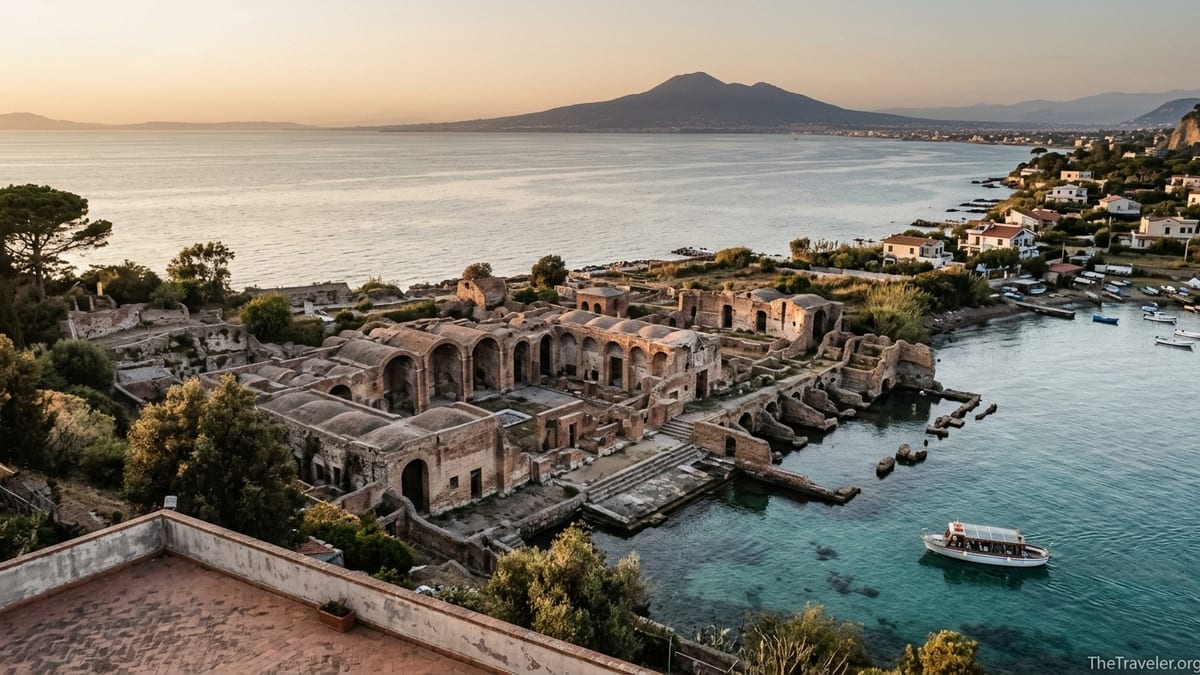
Baiae, in contrast, impresses on a more intimate and atmospheric level. This was the Roman Riviera, a decadent resort of emperors and elites that slowly sank due to ground movements known as bradyseism. Part of it is now the Submerged Archaeological Park of Baia, where villas, mosaics and columns lie a few meters below the surface of the sea, and part of it is on land at the Terme di Baia. Travelers here often remember the strangeness of gliding over marble floors by glass-bottom boat or snorkeling above villa courtyards, while modern fishing boats drift nearby.
In simple terms, Pompeii is the “complete Roman city” that most travelers grew up reading about. Baiae is the cult favorite that feels like a secret, mixing ruins, seascapes and hot springs. The bigger impression for you will depend on whether you prefer a monumental, once-in-a-lifetime checklist sight or a more niche, experiential encounter with the past.
Atmosphere: Frozen Catastrophe vs Sinking Pleasure Resort
Walking into Pompeii from the Porta Marina entrance, you are immediately struck by the urban grid: rutted basalt streets, shopfronts, taverns with marble counters, and the open expanse of the Forum framed by Vesuvius in the distance. It feels like a city that simply stopped. In quieter corners, especially early in the morning or late in the afternoon, you might wander almost alone past houses like the Villa of the Mysteries or the House of the Faun, where wall frescoes and floor mosaics survive in situ. That combination of everyday life detail and sudden death creates a very specific emotional charge.
Baiae’s mood is very different. The on-land archaeological park centers on sprawling thermal baths terraced above the sea, with domed halls, vaulted corridors and views across the Phlegraean Fields. Instead of volcanic catastrophe, the story here is relentless slow sinking. As you look down from the Aragonese castle and museum toward the Submerged Park, the coastline itself tells the tale: what were once waterfront villas now lie a few meters under water.
Under the surface, the atmosphere becomes almost dreamlike. On a standard snorkeling tour, a guide may tow a floating ring while small groups peer down through masks at black-and-white mosaic floors, statue bases and street outlines at around 3 to 5 meters depth. Divers descend a little deeper to swim among columns and walls softened by marine growth. The impression many report is of a city that is not dead, but half-absorbed into the sea, accompanied by the muffled sounds of your own breathing and the faint hum of boats above.
If Pompeii feels like an open-air history book, Baiae feels like a half-remembered story resurfacing through water and steam. For travelers sensitive to atmosphere and place, that difference can be decisive.
Scale, Sights and Storytelling Power
On sheer size and narrative completeness, Pompeii almost inevitably makes the bigger impression. You can spend five or six hours following a self-guided route and still see only a fraction of what is open on any given day. Visitors walk entire neighborhoods of modest houses, artisan workshops, bakeries with stone mills and ovens, taverns, brothels, public baths and temples. The amphitheater, large theater, and grand villas such as the House of the Vettii are not isolated showpieces, but part of an organic urban fabric.
That density of detail allows guides to weave vivid stories. A private guide, which typically costs in the range of 130 to 200 euros for a half day for a small group, might stop at electoral graffiti to explain local politics, then at the stepping stones in the streets to show how carts and pedestrians shared space in wet weather. Audio guides and the official app offer similar storytelling for a lower cost, and curated routes suggest three to five hour itineraries focused on highlights like the Forum, baths, theaters and a handful of famous houses.
Baiae’s story is more fragmented, but in some ways more surprising. On land, you explore several major bath complexes linked by walkways and staircases. Guides point out domed rooms that once trapped steam, pools fed by hot springs, and vantage points where wealthy Romans could look across the bay toward Puteoli and Misenum. The narrative leans into luxury, intrigue and the reputations of figures such as Nero and Hadrian, who are associated with the area’s villas and resorts.
Out at sea, the storytelling power of Baiae comes from juxtaposition. On a glass-bottom boat tour, which often lasts around an hour, you might start by circling buoyed-off zones, while the crew explains how bradyseism slowly lowered the city. Then, as you peer down through windows, you see a slice of Roman street under green water: column bases, sections of wall, maybe a reconstructed statue standing where the original once stood. The scene is not as complete as a walk down Pompeii’s main street, but the marine context makes each visible wall or floor feel precious and uncanny.
Practicalities: Access, Logistics and Time Commitment
From a base in central Naples, Pompeii is logistically straightforward. Frequent trains on the Circumvesuviana line connect Napoli Garibaldi to Pompei Scavi – Villa dei Misteri station in roughly 30 to 40 minutes. From the station it is a short walk to the main Porta Marina entrance. Official tickets can be purchased online in advance for timed entry or at the park ticket offices, and on busy spring and autumn days prebooking is strongly recommended to avoid lines and caps on visitor numbers.
Most independent travelers budget at least half a day at Pompeii, with many choosing a full day. A common pattern is to arrive at opening time, follow a route of major sites in the cooler morning hours, break for a simple lunch at the onsite cafeteria or nearby cafes outside the gates, then spend a final hour or two in a quieter corner of the site before returning to Naples. Those continuing on to climb Vesuvius often find the combined day rushed, and report that the volcano hike can dilute the emotional impact of Pompeii.
Reaching Baiae is more involved, but still manageable. Travelers typically take the Cumana railway from central Naples toward Baia or nearby Bacoli in around an hour, then walk or take a short local bus or taxi to the marina and the archaeological areas. Others opt for organized day trips or private drivers, especially when combining Baiae with other Phlegraean Fields sites like Cumae or the Flavian Amphitheater in Pozzuoli. Because boat and snorkeling tours depend on weather and sea conditions, some flexibility in planning is wise.
Baiae visits tend to be shorter but multi-layered. A realistic half-day might include an hour or so exploring the Terme di Baia on land, followed by a one to two hour glass-bottom boat or snorkeling experience in the Submerged Park. If you add a leisurely seafood lunch on the waterfront and perhaps a stop at the Archaeological Museum housed in the Aragonese castle above, the excursion easily becomes a full day. For travelers tight on time, this extra complexity can be a deciding factor in favor of Pompeii.
Crowds, Comfort and Accessibility
On crowd levels, the contrast between the two sites is striking. Pompeii receives several million visitors per year and, particularly between April and October, some key areas can feel congested. Around the Forum, the Lupanar, and a few famous houses, you may find yourself moving with tour groups or waiting for a chance to enter. In high season, timed tickets, separate entrance lines and security checks aim to manage the flow, but those seeking solitude need to deliberately steer toward less popular side streets and back neighborhoods.
That said, Pompeii is more developed in terms of visitor facilities. There are shaded rest areas, drinking fountains, basic dining options and marked routes, including a dedicated barrier-reduced itinerary known as “Pompeii for All” that offers a long accessible path through significant parts of the site. Even so, the original paving stones, curbs and gradients mean that wheelchairs and buggies can face challenges away from the adapted sections, and comfortable walking shoes are essential for everyone.
Baiae, by contrast, tends to attract far fewer people at any one time. On many days you may share the underwater areas with just a handful of small groups on different boats, giving the experience a more exclusive feel. The on-land baths are seldom packed to the same degree as central Pompeii, so it is easier to pause in silence inside a domed hall or on a terrace overlooking the bay.
However, the very nature of Baiae introduces its own comfort and accessibility issues. For the underwater component, visitors need to be comfortable on small boats and, for snorkeling, in the sea with a mask and tube. Visibility can be reduced by plankton or weather conditions, and water temperatures outside peak summer may feel cool, even with a short wetsuit provided by operators. Those with limited mobility or who dislike boats may find Baiae’s signature element less appealing, in which case the on-land baths and castle museum take center stage, but the overall impression shifts.
Which Site Feels More Intimate, and Which Feels More Iconic?
If you measure “bigger impression” in terms of global significance and iconic imagery, Pompeii clearly wins. It is a UNESCO World Heritage Site often described as the only ancient Roman city where an entire urban layout survives in such detail. Many visitors have dreamed of seeing it since school, and the first glimpse of Vesuvius rising behind the ruins delivers exactly the postcard moment they expect. The emotional impact often peaks when people stand before the plaster casts of victims or walk through houses that still show frescoes of mythological scenes and garden views.
Yet intimacy can be harder to find in a place that famous. While early morning or winter visits can feel contemplative, in peak months you may need to consciously tune out the hum of tour commentary and smartphone shutters to connect with the site on a personal level. Guided tours help by offering narrative focus, but they also set a brisk rhythm that leaves little room for quiet wandering.
Baiae is where many archaeology enthusiasts and repeat visitors to Campania go to feel closer to the remains themselves. On a calm day, floating above a mosaic in shallow water, you might be the only snorkeler in sight. The guide points out where a villa’s courtyard once opened toward the sea, and fish dart across what was once a dining room floor. It is not as comprehensively preserved as Pompeii, but the direct sensation of water, sunlight and ancient stone, with almost no barrier between you and the ruins, can be deeply affecting.
On land at Baiae’s thermal complex, stairways and terraces lead you through spaces whose original ceilings and wall heights are sometimes better preserved than many domestic buildings in Pompeii. Standing alone in a large, echoing hall, with openings framing the bay and the castle above, can produce a very personal sense of connection to the Roman elite who once soaked in the same pools fed by natural hot springs still active in the region today.
Cost, Value and How Each Site Fits into a Wider Itinerary
In terms of cost, the basic outlay for each site is in a similar range when adjusted for what you actually experience. Standard adult tickets for Pompeii are typically under 25 euros, with some seasonal passes and combined tickets including other Vesuvian sites available. Add in a return train fare from Naples that is usually under 10 euros and you have a major day of world-class sightseeing at a relatively modest base price. The main variables are guided tours, which can range widely from budget group tours at the gate to more tailored experiences booked in advance.
Baiae’s land archaeological park admission is generally modest, comparable to many regional sites. The greater cost comes with accessing the underwater area. Glass-bottom boat tours aimed at non-divers often price out somewhere in the region of what you might pay for a mid-range half-day excursion in southern Italy, while snorkeling sessions with equipment and guide add a bit more. Certified scuba divers joining organized dives can expect to pay the kind of rates typical for guided Mediterranean dives, factoring in tanks, weights and sometimes wetsuits. Given that most travelers will also pay for a meal and local transport out to the Phlegraean Fields, Baiae is often more of a splurge day.
How each site fits into a broader itinerary also matters. For many first-time visitors to Italy, Pompeii is a cornerstone, often paired with Naples and Amalfi Coast destinations. It offers a dense, educational experience that connects directly with what you will see in the Naples National Archaeological Museum, where many of the finest frescoes and artifacts from Pompeii and Herculaneum are preserved. Baiae, by contrast, slots naturally into a more niche or repeat-visitor itinerary focused on the Phlegraean Fields: Cumae, Pozzuoli’s amphitheater, Solfatara’s volcanic landscape, lakes Avernus and Lucrinus, and small seaside towns.
If you have a single extra day from Naples and want the highest “impact per hour” with minimal logistical friction, Pompeii still tends to be the better-value choice. If you have time to dig deeper into the region, or if you already know and love Roman history, Baiae can feel like a special bonus chapter that reframes what a Roman site can be.
The Takeaway
So which ancient Roman site leaves a bigger impression: Baiae Archaeological Park or Pompeii? For most travelers, especially first-time visitors to Campania, Pompeii still has the edge. Its scale, state of preservation and emotional narrative of sudden destruction are hard to match. Walking a whole Roman city, from amphitheater to modest bakeries, and then seeing the plaster forms of those who died in 79 AD, leaves a mark that many describe as one of the defining experiences of a trip to Italy.
Yet Baiae offers something Pompeii cannot: the sensation of a Roman resort dissolving into the sea. The combination of on-land thermal ruins, an atmospheric castle museum and the chance to look directly down on mosaics and walls through clear water makes Baiae uniquely memorable. For travelers willing to wrestle a bit with timetables, boat bookings and sea conditions, the reward is an encounter with the ancient world that feels fresh, surprising and intensely personal.
If you must choose, and you have never seen either, Pompeii is the more essential visit. If you can manage both, consider beginning with Pompeii to ground yourself in Roman daily life, then venturing to Baiae for an almost dreamlike coda: the same civilization, not frozen in ash this time, but slowly slipping beneath the waves.
FAQ
Q1. If I only have one day from Naples, should I choose Pompeii or Baiae?
If you have just one extra day, Pompeii is usually the better choice because it is easier to reach by train, offers more extensive ruins and facilities, and delivers a fuller picture of a Roman city in a single visit. Baiae is rewarding but logistically more complex and best when you have time for a slower, more specialized excursion.
Q2. Can I realistically visit both Pompeii and Baiae in the same day?
It is technically possible with a private car or tour, but not recommended. Each site deserves several hours, and you would spend much of the day in transit. Most travelers find it more satisfying to dedicate one full day to Pompeii and another half or full day to Baiae and the surrounding Phlegraean Fields.
Q3. Is Baiae suitable for non-swimmers or people who do not want to snorkel?
Yes. Non-swimmers can still experience the Submerged Archaeological Park on glass-bottom boat tours, where you view the ruins through underwater windows while remaining on deck. You can also focus on the on-land Terme di Baia and the castle museum above without going on the water at all.
Q4. How physically demanding is a visit to Pompeii?
A typical visit to Pompeii involves several hours of walking on uneven stone streets with steps, curbs and occasional slopes. Visitors in good health usually cope well with sturdy shoes, water and sun protection. There is a long accessible route designed for visitors with reduced mobility, but some areas remain challenging for wheelchairs, strollers or anyone with balance issues.
Q5. What time of year offers the best experience at Baiae?
Late spring to early autumn usually provides the best balance of warm air and fair sea conditions for boat and snorkeling activities. In cooler months, the underwater visibility can vary and water temperatures may feel brisk, even with a wetsuit. On very windy or rough days, operators may cancel or modify outings, so some flexibility in scheduling is useful.
Q6. Is either site better for families with children?
Both can work well for families, but in different ways. Pompeii offers broad streets to explore, impressive theaters and plenty of space for children to run, though the historical story can be heavy for very young kids. Baiae may feel more like an adventure for older children and teens who enjoy boats and snorkeling. Families with small children or non-swimmers may find Pompeii simpler and more predictable.
Q7. Do I need a guided tour to appreciate Pompeii or Baiae?
Guides are not mandatory but often enhance both experiences. In Pompeii, a good guide can bring structure to a huge site and highlight details you might miss on your own. At Baiae, licensed guides and boat crews explain the submerged structures and their history as you pass above them, which is difficult to grasp without commentary. Independent travelers can supplement or replace tours with guidebooks and audio guides if they prefer more flexibility.
Q8. How do the two sites compare for photography?
Pompeii offers endless opportunities for classic ruin photography: long perspectives down stone streets, Vesuvius framed behind colonnades, and well-preserved frescoes in shaded interiors. Baiae is more challenging but potentially more atmospheric. Underwater shots depend on visibility and your comfort with a waterproof camera or action camera, while on land the views across the bay and the play of light in domed bath halls can be striking.
Q9. Is it necessary to book Baiae underwater visits in advance?
Advance booking is strongly recommended, especially in the main season. Operators running snorkeling, diving and glass-bottom boat tours work with quotas and sea conditions, so reserving ahead helps secure a spot and allows you to be informed about any schedule changes due to weather or visibility.
Q10. Which site is better if I am particularly interested in Roman daily life?
If your primary interest is seeing how ordinary Romans lived, worked and moved through their city, Pompeii is the stronger choice. Its preserved street grid, houses, shops, bakeries, taverns and public spaces create a remarkably complete picture of daily life. Baiae focuses more on elite leisure, thermal baths and seaside villas, and while fascinating, it represents a narrower slice of Roman society.