


Most travelers arrive in Saint Jean Cap Ferrat with a ticket to Villa Ephrussi de Rothschild in hand and a few photos of pastel mansions on their wish list. They come for the famous villas and manicured gardens, then hurry back to Nice or Monaco. Yet the real magic of this peninsula lies outside the museum gates: on its windswept paths, in tiny coves you can only reach on foot, and around a working port that still hums with everyday life. Spend a full day or two here and Cap Ferrat starts to feel less like a postcard and more like a small, lived-in Mediterranean world.
Get the latest updates straight to your inbox!
Why Cap Ferrat Deserves More Than a Villa Stop
Cap Ferrat sits between Nice and Monaco, a slim finger of rock edged by pine forests and water the color of blown glass. It is often reduced to a backdrop for the grand estates of Villa Ephrussi de Rothschild and the private Villa des Cèdres, but the peninsula is far more accessible and down to earth than its image suggests. Regular bus services from Nice, Beaulieu sur Mer and Villefranche sur Mer, along with a compact village core, make it easy to explore on foot without a car or a luxury hotel booking.
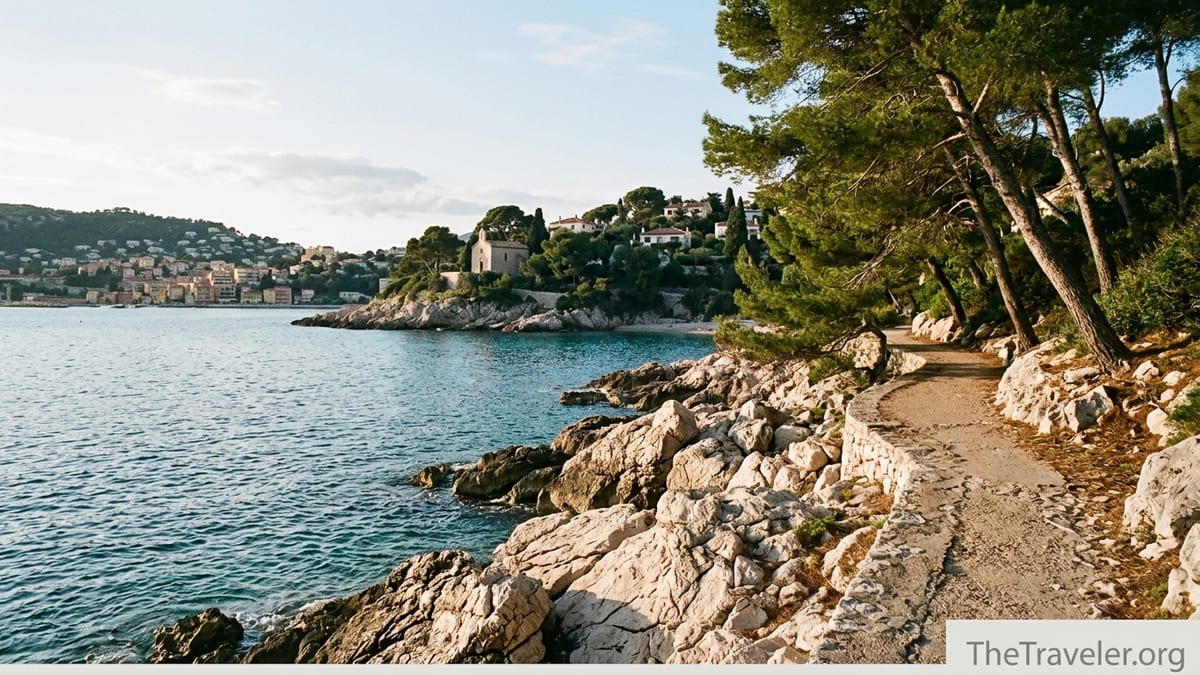
Once visitors have queued at the villa café and posed in front of the formal gardens, many simply leave. That is a pity, because the municipal coastal paths nearly encircle the headland, threading past low cliffs, tide pools and relics of the area’s fishing past. The local tourist office publishes free maps of these walks, and the town maintains clear signposting around the port and beaches so that even first time visitors can find the trailheads in minutes.
Staying a few hours longer also reveals a softer side to the peninsula’s reputation for wealth. Prices at port side cafés and village bakeries are often only slightly higher than in Nice. An espresso on the quay might cost around 2.50 to 3 euros, while a takeaway slice of pissaladière or socca from a simple snack bar will usually run under 5 euros. You will still see superyachts moored in the bay, but you can enjoy the same sunset from a simple public bench along the waterfront promenade.
By thinking of Cap Ferrat as a lived in coastal village with hiking trails rather than a gated enclave of villas, you start to notice the quieter experiences that most day trippers miss entirely.
Walking the Littoral Paths Few People Finish
The single experience that most visitors overlook is also the simplest and cheapest: walking the full network of coastal paths known locally as the sentiers du littoral. These public trails hug the edge of the peninsula, often just a few meters above the sea. The main loop around Cap Ferrat is roughly 6 to 7 kilometers, depending on the exact route you follow, and can be completed in about three hours of steady but relaxed walking.
There are three main sections. The flat promenade between Beaulieu sur Mer and the entrance to Cap Ferrat offers easy access and views back to the belle époque façade of the Royal Riviera hotel and the Baie des Fourmis. The Saint Hospice section curves around the smaller eastern peninsula, with its low cliffs and open sea views toward Villefranche sur Mer. The wilder southern stretch, often called the Chemin des Douaniers after the old customs officers, traces the exposed seaward side of the cape, passing anonymous pine shaded mansions perched high above on private land.
In practice, many visitors only stroll a short distance from Paloma Beach or Passable Beach before turning back. Those who commit to walking at least a full section discover a surprisingly varied coastline. One minute you are on a smooth paved path suitable for walking sandals; a few minutes later you are stepping along uneven rock, feeling spray drift up from the waves below. It is rarely technical, but some parts involve stairs, rough stones and low railings, so good trainers or closed shoes are sensible.
The best time for the full loop is early morning or late afternoon outside high summer. In July and August, plan a shorter section combined with a swim and bring more water than you think you need. There are no kiosks along most of the path, and only basic beach showers at Paloma or Passable if the seasonal restaurants are not yet open. In shoulder seasons like May or late September, you may walk long stretches hearing only cicadas, the sea and the occasional clink of cutlery from a hidden terrace above.
Hidden Coves and Wild Swimming Beyond the Beach Clubs
Cap Ferrat has two famous named beaches that appear in almost every guide: Paloma Beach on the sheltered eastern side facing the colorful houses of Villefranche, and Passable Beach looking west toward the Bay of Villefranche and Cap de Nice. Both offer sunbeds, umbrellas and restaurant service in season, with loungers often priced from around 30 to 50 euros per day, depending on the row and month. These are pleasant spots if you want food and facilities at hand, but they are not the only places to swim.
Walk 10 to 15 minutes in either direction along the coastal path and you will find a necklace of unnamed coves where locals slip into the sea before or after work. Some are tiny shingle inlets with just enough level rock to spread a towel. Others are flat shelves of limestone with cut steps leading directly into deep water, ideal for confident swimmers who like to float with a mask and snorkel. On calm days you may share these spots with a handful of people; in the off season you might have them entirely to yourself.
For a gentle taste of this wilder side, start at the public Plage des Fossettes on the eastern shore. From here an underwater snorkeling trail extends a few hundred meters parallel to the beach, marked by buoys that in high season sometimes feature simple information panels about local marine life. Even without reading every sign, you can float over patches of seagrass and rocky outcrops, spotting small wrasse and bream in water that remains startlingly clear compared with many urban beaches along the Riviera.
On the southern coast, near the midpoint of the Chemin des Douaniers, low paths lead down to flat rocks where waves slap the stone. There are no lifeguards, and on days with wind or swell it is better to admire the scenery from above, but in settled weather these natural platforms become open air sea pools. Pack light neoprene shoes or sturdy sandals if you plan to use them, as the rock can be sharp and sea urchins hide in crevices. A simple supermarket mask bought in Nice or Beaulieu for around 10 to 15 euros unlocks an entirely different view of Cap Ferrat.
Chapels, Cemeteries and Traces of an Older Peninsula
Beyond the grand villas, Cap Ferrat keeps quieter traces of its history scattered around the headland. One of the easiest to reach is the chapel at Saint Hospice, a small sanctuary perched on a rise above the eastern littoral path. From the port, a well signposted trail climbs gently past Paloma Beach before looping around the Saint Hospice peninsula. A short detour up stone steps leads to the chapel and an adjoining cemetery, where white crosses look out to sea.
This site has roots reaching back to medieval times, when sailors and fishermen sought protection from the often violent weather of the Mediterranean. Inside the chapel you can sometimes see ex voto offerings, small tokens left in thanks for answered prayers or safe voyages. Even if the door is closed, the hillside setting is deeply atmospheric. It is an oddly quiet place given that, just below, the main coastal path sees a steady trickle of walkers in high season.
Elsewhere on the peninsula, you can still find reminders of Cap Ferrat’s days as a simple fishing village. Around the Port de Saint Jean, look out for old stone houses and modest single storey buildings tucked between newer apartment blocks. In narrow lanes one or two small boatyards continue to repair wooden hulls and paint dinghies used to reach moorings in the bay. Early in the morning, before the first sightseeing groups arrive, you may see fishermen unloading small catches directly onto the quay for local restaurants.
Those who are willing to look beyond manicured gardens will also notice how the public coastal paths themselves preserve access to the sea. Even where private estates back directly onto the cliffs, French law protects a ribbon of passage for walkers. That is why it is possible to stand on the exposed Chemin des Douaniers, waves rumbling below, while knowing that just a few meters above, behind pine trees and stone walls, some of the most expensive real estate in Europe remains largely hidden from view.
Village Life Around the Port and Plage du Cros deï Pin
Most villa visitors arrive by coach, walk through the gardens and then leave without ever seeing the main village around the port. This small area, however, is where Cap Ferrat feels like an actual community rather than an open air museum of wealth. The port basin is lined with simple fishing boats, modest sailing yachts and a few larger motor vessels. Along the quay you will find a mix of brasseries, ice cream parlors and more contemporary bistros with terraces that spill onto the pedestrian zone.
Prices reflect the setting but are not uniformly extravagant. A set lunch menu at a mid range port restaurant might start around 25 to 30 euros, often including a starter and main course such as grilled dorade or a Niçoise salad. Glasses of local Provence rosé are commonly priced from 6 to 8 euros. If that still feels steep, you can simply buy a takeaway pan bagnat, the region’s classic tuna, olive and vegetable sandwich, from a bakery or small grocery near the port for under 8 euros and eat it on a public bench facing the boats.
Just north of the port lies Plage du Cros deï Pin, the peninsula’s most practical local beach. Backed by a small park with shade trees and a playground, this east facing cove has fine gravel rather than large pebbles, making it more comfortable for families. Because it sits a short walk from the bus stop and village shops, it is popular with residents as much as tourists. Even in summer you will hear French spoken all around you, a reminder that Cap Ferrat is not purely a resort bubble.
In the early evening, when the sun dips behind the hills of Beaulieu, the promenade at Cros deï Pin fills with joggers and dog walkers. Children cycle along the flat path while older residents stop to chat on benches. You will still see visitors dressed for dinner at the Four Seasons Grand Hotel du Cap Ferrat further along the coast, but here the atmosphere is casual. A scoop of gelato from a small stand behind the beach, usually around 3 euros, feels just as luxurious as a cocktail at a five star bar when you are watching the last golden light on the water.
Understated Food Experiences Beyond Fine Dining
Cap Ferrat is home to celebrated hotel restaurants where tasting menus can easily pass 150 euros per person with wine pairings, particularly in peak season. For many travelers, that level of spending is unrealistic or simply not how they want to eat on holiday. Fortunately, the peninsula’s everyday food culture offers quieter pleasures that most visitors skip while chasing reservations at haute cuisine addresses in nearby Nice or Monaco.
Start in the morning at a simple village bakery. A croissant or pain au chocolat will usually cost under 2 euros, while a flaky pissaladière topped with slow cooked onions and anchovies might be around 3 to 4 euros. Take your breakfast to a bench overlooking the port instead of paying hotel buffet prices, and you will begin your day feeling more like a local commuter than a guest. On market days in nearby Beaulieu sur Mer or Villefranche sur Mer, a short bus ride away, you can stock up on fruit, cheese and cured meats to bring back for a picnic on the rocks.
At lunchtime, avoid only following the glossy brochures that highlight beach clubs. Look for modest bistros a street or two inland from the port, where daily chalkboard menus change with what is available. Dishes like stuffed vegetables Niçoise style, simple grilled sardines, or a soupe de poisson with rouille and croutons often cost roughly half what you might pay for more elaborate seafood platters. Ask for a carafe of house wine instead of branded bottles; in many French coastal restaurants the table wine is perfectly drinkable and far better value.
In the evening, Cap Ferrat can feel quiet compared with Nice, especially outside July and August. This is an advantage if you are willing to embrace slower rhythms. Rather than a long sit down meal every night, join locals for an early evening apéritif. Bars and cafés around the port commonly serve small complimentary snacks with drinks, such as olives or crisps. Sharing a few plates of socca or charcuterie with friends can be as satisfying as a restaurant main course and keeps your budget for the trip in balance.
For those staying in self catering accommodation, local supermarkets and small fishmongers in nearby Beaulieu or Villefranche allow you to cook simple seafood at home. Grilling a piece of local sea bream on a rented apartment balcony, with the windows open to the scent of pine and sea salt, is one of the most memorable ways to taste Cap Ferrat, and it costs a fraction of a hotel dining room bill.
Planning Practicalities: Getting There, Timing and Costs
Reaching Cap Ferrat without a car is straightforward from Nice, which is why it works well as a day trip or a base for a few quiet nights. Buses from Nice’s port area typically take about 30 minutes to reach the village center of Saint Jean Cap Ferrat, with tickets usually costing just a few euros each way. From Beaulieu sur Mer, a local bus or a 20 to 25 minute walk along the sea brings you to the peninsula entrance, where you can pick up the coastal path near the Royal Riviera hotel.
For most travelers, one long day or two slower days are ideal. If you have only a single day, it is tempting to schedule both Villa Ephrussi and a complete coastal loop, but that often leads to rushing and skipping swims or quiet moments. A more satisfying plan might pair the villa gardens with the Saint Hospice path and time at Paloma Beach, or combine a relaxed village lunch with the wilder southern Chemin des Douaniers and a late afternoon dip near Passable.
In terms of costs, Cap Ferrat is not inexpensive but it is less extreme than its reputation suggests, especially if you avoid peak season sunbed rentals and high end hotel bars. A realistic daily budget for a visitor who walks the coastal paths, uses public beaches and eats at modest restaurants or picnics might be 50 to 90 euros per person, excluding accommodation. Those who prefer loungers at beach clubs, cocktails at luxury hotels and taxis instead of buses will easily spend double or more.
Weather and sea conditions matter when planning walks. The coastal paths can be temporarily closed in storms or strong wind, especially the more exposed southern portions. Before setting out in shoulder seasons or on days with big swell, check notices at the Saint Jean Cap Ferrat tourist office or ask at your accommodation. Even in perfect weather, bring sturdy shoes, sun protection and sufficient water, particularly if you are walking with children or older relatives. There are long stretches of trail with little shade and no access to taps.
The Takeaway
Cap Ferrat’s reputation is built on grand houses and discreet luxury, but the peninsula’s real character emerges when you step away from the villas. Walk the full littoral path and you will see how the coastline shifts from sheltered bays and small beaches to rugged rock terraces where the open Mediterranean feels close enough to touch. Swim from quiet coves with nothing but seagrass and stone under your feet, then climb back to a trail that has linked fishing communities for generations.
Spend an unhurried hour watching boats in the modest Port de Saint Jean, or share a simple picnic on the promenade at Plage du Cros deï Pin, and the area stops feeling like a backdrop for other people’s wealth. It becomes a place you inhabit, if only briefly. The chapel at Saint Hospice, the early morning bustle of bakers and fishmongers in neighboring villages, the low murmur of French spoken on the bus back to Nice: these are the small details that most villa visitors never notice.
If you treat Cap Ferrat as more than a photo stop between Nice and Monaco, you discover a peninsula that is surprisingly democratic. Its most beautiful experiences are often free or inexpensive: a public footpath at sunrise, a swim in clear water, a paper wrapped sandwich eaten on the quay. The famous villas will always draw crowds, but the Cap beyond their walls still belongs to anyone willing to lace up their shoes and keep walking a little farther along the coast.
FAQ
Q1. How much time should I plan to spend in Cap Ferrat beyond visiting the villas?
Most travelers will be satisfied with one full day if they combine a villa visit with at least one section of the coastal path and time for a swim or meal in the village. If you enjoy walking and quiet evenings, two days allows you to explore both the Saint Hospice and southern paths without rushing.
Q2. Is the Cap Ferrat coastal path suitable for children and older travelers?
Large parts of the path are relatively easy, but some sections include uneven rocks, stairs and low railings above the sea. Families with small children or travelers with limited mobility may prefer the flatter promenade near Beaulieu and the segment between the port and Paloma Beach, and skip the more exposed southern stretch.
Q3. Do I need special equipment to enjoy the hidden coves and snorkeling areas?
You do not need technical gear, but sturdy sandals or water shoes and a basic mask and snorkel make a big difference. The rocks can be sharp, and having simple equipment bought from a supermarket or sports shop allows you to explore the shallow seagrass beds more comfortably.
Q4. Are there places to buy food and water along the coastal paths?
There are no regular kiosks along most of the trails. In season, beach restaurants at Paloma and Passable may be open, but you should not rely on them. It is best to stock up in the village or at the port before starting and carry more water than you think you need, especially in summer.
Q5. What is the best time of year to explore Cap Ferrat beyond the villas?
Late spring and early autumn are ideal, when temperatures are warm but not overwhelming and the paths are less crowded. In July and August, it is still enjoyable, but you should start early or walk later in the afternoon to avoid the heat and midday crowds on the main beaches.
Q6. Can I enjoy Cap Ferrat on a moderate budget, or is it only for luxury travelers?
You can experience much of what makes Cap Ferrat special on a moderate budget by using public transport, walking the free coastal paths, swimming from public beaches and choosing picnics or simple bistros over hotel restaurants. The main costs to avoid if you are watching your budget are lounger rentals and high end bars.
Q7. How do I reach the less known parts of the peninsula without a car?
Regular buses connect Nice and nearby towns to the village of Saint Jean Cap Ferrat. From the central bus stop and port, trail markers lead quickly to the coastal paths. You can also walk from Beaulieu sur Mer along the sea to join the sentier du littoral, making it easy to reach quiet coves and viewpoints entirely on foot.
Q8. Is it safe to swim from the rocky coves instead of the main beaches?
On calm days, many locals prefer the rocky coves for their clear water and quieter atmosphere. However, there are no lifeguards, and conditions can change quickly. Avoid swimming from rocks in strong wind or swell, check your exit points before jumping in, and consider sticking to lifeguarded beaches if you are not a confident swimmer.
Q9. Are there any cultural sites besides Villa Ephrussi worth visiting?
Yes. The small chapel at Saint Hospice and its adjoining cemetery offer a glimpse into Cap Ferrat’s maritime and religious history. Around the port, older stone houses and modest boatyards hint at the village’s fishing past. These sites are simple but atmospheric and pair well with time on the coastal paths.
Q10. Can I combine Cap Ferrat with other nearby destinations in one day?
It is possible to pair a short visit to Cap Ferrat with nearby Villefranche sur Mer or Beaulieu sur Mer in a single day, especially if you focus on walking and swimming rather than detailed sightseeing. However, if you want to enjoy the coastal paths, hidden coves and a relaxed meal in the village, dedicating a full day solely to Cap Ferrat is usually more rewarding.