


On the quiet northern curve of the Bay of Naples, Baiae Archaeological Park preserves what was once the most fashionable resort of imperial Rome. Terraced thermal complexes, sweeping sea views and even a submerged Roman neighborhood make it one of southern Italy’s most atmospheric archaeological stops. With a bit of planning, you can see the key sectors in a single visit without feeling rushed, even if you are coming from central Naples for the day.
Get the latest updates straight to your inbox!
Understanding Baiae: What You Are Really Coming to See
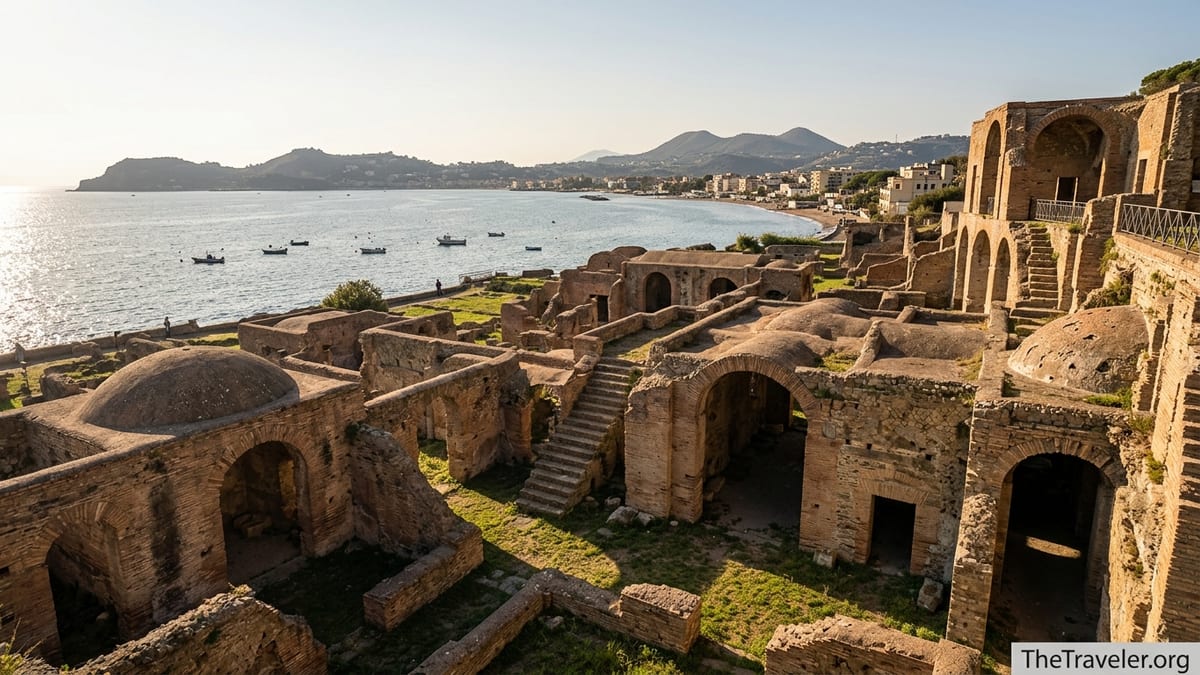
Baiae Archaeological Park, or Parco Archeologico delle Terme di Baia, sits in the town of Bacoli, about 25 kilometers west of Naples. It is part of the wider Parco Archeologico dei Campi Flegrei, which also includes sites such as Cumae and the Flavian Amphitheatre at Pozzuoli. The Baiae complex climbs a hillside directly above the modern marina, and most first-time visitors underestimate both its size and its verticality. The site is really a series of monumental bath and villa terraces stacked one above the other, each with its own plan, atmosphere and best vantage points.
When people talk about “Baiae,” they tend to mean two overlapping experiences. The first is the hillside archaeological park with its massive brick-built domes, staircases and exposed hypocaust systems that once powered elaborate thermal rituals for the imperial elite. The second is the Submerged Archaeological Park of Baiae offshore, where parts of the ancient resort now lie under several meters of water due to bradyseism, the gradual rising and sinking of the land. You can visit the former on foot with a standard ticket and the latter only with an authorized boat, snorkeling or diving operator.
Because most trips allow only half a day here, the trick is to be realistic about your priorities. A traveler interested in Roman engineering might focus on the best-preserved bath complexes and their heating systems. A photography-minded visitor may care more about terraces with wide sea views and late-afternoon light. Divers will want to leave extra time around their immersion, as check-in, gear fitting and boat transfers can easily turn a three-hour excursion into the backbone of an entire day.
Thinking through what you most want to experience before you arrive will determine not only how long you need on site, but also the order in which you should tackle Baiae’s main sectors so you do not miss one stairway or side path that leads to a signature view.
Getting There Without Wasting Time on Transport
Most visitors come from Naples, and the main goal is to avoid the kind of fragmented routes that string together two trains, a bus and a long walk. The simplest public option at the time of writing is the Cumana railway, which runs along the coast from Montesanto station in central Naples toward the Campi Flegrei. Services typically stop at Baia station, a short ride beyond Lucrino and Fusaro. From Baia station, you walk down toward the waterfront and then follow the coastal road a few minutes to reach the base of the archaeological park and the main square of Baia.
In practice, you should allow at least an hour from central Naples to the park entrance, including time to navigate metro transfers to Montesanto and the short but sometimes confusing walk from Baia station to the site. Travelers uncomfortable with switching modes of transport or those visiting on a very tight schedule often opt instead for a taxi or rideshare from central Naples, which, in light traffic, might take 35 to 45 minutes. The fare varies with traffic conditions, but for planning purposes many travelers budget an amount similar to a taxi ride to Pompeii, then adjust when they get a quote locally.
There are also EAV buses that connect Pozzuoli, Baia and Bacoli. If you are already in Pozzuoli, for example after visiting the Flavian Amphitheatre or the seafront, a local bus such as the 901 line is a practical choice to reach Baia without returning to Naples. This combination is popular with travelers who want to devote a full day to the volcanic landscapes and Roman remains of the Campi Flegrei, splitting their time between Pozzuoli in the morning and Baia in the afternoon.
Whichever route you choose, build in a buffer. Trains on the Cumana line can be crowded at peak commuter times, and signage around Baia station and the marina is not always obvious. A printed or offline map that clearly shows the station, the park entrance on the hillside and the harbor below will make the last ten minutes of your approach much smoother.
Tickets, Opening Hours and Smart Timing
Baiae Archaeological Park is managed by the Parco Archeologico dei Campi Flegrei, and its opening hours generally follow a seasonal pattern linked to daylight. As of mid 2026 the park typically opens in the morning and closes roughly one hour before sunset, which means longer visiting windows in late spring and summer and shorter ones in winter. The ticket office in Baia usually operates from around 9:00 in the morning into the early evening, but closing times can vary by month and special event. It is prudent to confirm current hours on the official site shortly before your visit and to avoid arriving in the final hour of the day if you hope to explore the upper terraces without rushing.
Standard admission to the Terme di Baia on its own is modest compared to large sites like Pompeii. Recent official materials quote a base ticket price in the region of 5 euros, while combined or cumulative tickets for multiple Campi Flegrei sites can cost more but offer better overall value if you plan to visit Cumae, the Archaeological Museum in the Aragonese Castle above Baia or other nearby monuments on the same or following days. Holders of regional passes such as the Campania Artecard can often access Baia, but they usually must still reserve a time slot through the official “Musei Italiani” app or platform so that staff can manage visitor flows.
Online booking is strongly recommended, and for groups of more than ten or school visits it is effectively compulsory. Booking ahead reduces queuing and ensures that you are not turned away in the rare case of capacity limits or partial closures for maintenance and conservation. When choosing a time slot, consider that midday sun on the exposed terraces can be intense in high summer. Many independent travelers aim for mid-morning arrival, around 10:00 or 10:30, or, in cooler seasons, a late afternoon slot when the light is softer and the Gulf of Naples begins to glow.
A realistic minimum for a focused visit to the hillside park is around two hours, but if you want to stop for repeated photographs, read interpretive panels carefully and pause at the viewpoints, three hours feels much more comfortable. If you are also booked on a snorkeling or diving excursion in the Submerged Archaeological Park, avoid stacking the two activities back-to-back without a break. A common pattern is to explore the land park in the late morning, have a simple lunch in Baia or Bacoli, then head to the diving center for an afternoon immersion.
The Essential Route Through the Hillside Ruins
The hillside part of Baiae Archaeological Park is arranged as an ascending sequence of terraces, each corresponding to different thermal and residential sectors. The modern entrance brings you in near the lower levels, from which stairways and sloping paths lead upwards. To avoid zig-zagging or missing a major sector, it helps to follow a roughly clockwise route that works from bottom to top and then back down along a slightly different path.
Start by orienting yourself on the plan displayed near the entrance, noting the main named sectors such as the so-called Temple of Venus, Temple of Diana, Temple of Mercury and the Sosandra complex. These “temple” labels are misleading; in reality most of them were parts of luxurious bath complexes or nymphaea with impressive domes and semi-domes. A good first objective is the sector associated with Mercury, where you can see an enormous circular hall traditionally linked to a thermal natatio or pool. Even if some parts of this sector are occasionally fenced off for safety, the visible brickwork and the way light enters through the oculus give a striking sense of scale.
From there, follow the main path upwards to the terraces tied to the so-called Temple of Venus. Here, you will find semicircular exedras, fragments of marble flooring and sweeping views down to the harbor. On a clear day you can look across the bay toward Cape Miseno and, further in the distance, the islands of Procida and Ischia. This is one of the best spots to pause for wide-angle photographs, as the angles let you capture both ruins and the glittering sea in a single frame. Continuing higher, the Sosandra sector preserves long ambulatories and staircases that give a tangible sense of how guests once circulated through different temperature rooms and social spaces.
As you move between sectors, pay attention to the details that can be easy to overlook if you rush. Sections of raised floors reveal the hypocaust pillars that once carried hot air, and in some rooms you can still see terracotta pipework embedded in the walls. Simple interpretive panels in Italian and English help you understand how each space functioned, and in certain areas, digital reconstructions shown on signage or QR codes allow you to compare today’s brick shells with their marble-clad ancient appearance. Even a traveler who has already visited other thermal sites like Caracalla in Rome or the Stabian Baths in Pompeii will likely find Baia’s layout distinctive because of its steep slope and the way it seems to cascade toward the sea.
Once you reach the upper levels, do not rush straight back down the way you came. Instead, follow any signed paths that loop behind the visible structures to secondary viewpoints. These quieter corners often provide some of the most atmospheric moments: glimpses of the modern fishing village below framed by Roman arches, or views across the Campi Flegrei crater landscape that put the region’s volcanic context into perspective.
Key Highlights You Should Not Miss
Several features at Baiae stand out as must-see highlights, and it is worth keeping a short mental checklist so you do not inadvertently walk past them. One of the most impressive is the large domed hall associated with the so-called Temple of Mercury. Although access inside the central space can be restricted depending on ongoing conservation, even viewing it from the perimeter lets you appreciate what is often described as one of the largest surviving Roman domes, predating even the Pantheon in construction techniques. The way the dome rises from a ring of arches gives a vivid three-dimensional sense of ancient Roman architectural ambition.
Another essential stop is any terrace that preserves fragments of mosaic floors. While many of Baia’s finest artworks have been moved to museums for protection, including the Campi Flegrei Archaeological Museum in the Aragonese Castle above, the in situ remains tell their own story. Look for black-and-white geometric mosaics that once lined bath halls and colorful pieces that hint at richer decorative schemes in private rooms. Seeing these patterns with the sea as a backdrop makes it easier to imagine imperial guests walking barefoot across the same designs between hot and cold pools.
For photographers and anyone who simply values a memorable “sense of place” image, do not miss the side terraces that open directly toward the Gulf of Naples. On many visits, the most striking views are found not at the official panoramas but along slightly offset staircases or landings where the ruins frame the water at an angle. If your schedule allows, time at least one of these viewpoints for late afternoon, when the light softens and the color of the brick and tufa warms visibly.
Finally, remember that part of Baia’s story now lies in the sea. Even if you are not planning to dive, pausing at a high vantage point where you can look down toward the marina helps you connect the hillside ruins with the submerged quarter offshore. Knowing that entire streets, villas and bath complexes now sit below the surface will deepen your appreciation of the geological forces that have shaped the Campi Flegrei since antiquity.
Exploring the Submerged Archaeological Park
The underwater portion of Baiae is a protected marine area where visitors can see sunken Roman structures, mosaic floors and statue replicas by joining organized excursions. Access is strictly regulated; you cannot simply swim out on your own. Instead, you must book with an authorized local operator based in Baia or nearby Bacoli. Well-established diving centers in the harbor area typically offer both scuba and snorkeling experiences, often marketed as single-immersion three-hour outings that include a short boat ride to buoyed-off archaeological routes, time in the water and the return sail.
Snorkeling tours are popular with families and travelers who have little or no diving experience. A typical family snorkeling itinerary begins with check-in and briefing at the dive shop, where you are fitted with mask, snorkel, fins and, depending on water temperature, a wetsuit. After a 5 to 10 minute boat ride, you arrive at a protected buoy inside the underwater park. From the surface, you can float above visible elements such as column stubs, wall lines and mosaic outlines. Ages for participation vary slightly by operator, but many publish a minimum around 7 or 8 years for snorkeling in calm conditions.
Certified divers have a more immersive experience, descending to shallow depths of around 5 to 8 meters where they can linger directly above mosaics and architectural remains. Reviews from recent seasons describe routes that pass over sections of paved streets, thermal pools and courtyards. Because the dives are relatively shallow and physically undemanding, they are often recommended even for newcomers who have only a few logged dives. Water temperatures and visibility change with the season: travelers who dove in early autumn reported water around 16 to 18 degrees Celsius and sometimes reduced clarity after rain, while summer visits bring warmer, clearer conditions but also more boat traffic.
Prices vary by operator and season, but a single snorkeling excursion in Baia’s underwater park typically costs in the range of what you might pay for a guided boat-based snorkeling trip elsewhere in the Mediterranean, while a full scuba dive with equipment rental commands a higher fee. Because departures are tied to time slots regulated by the marine park, it is wise to book ahead, especially in July and August. When comparing operators, look beyond headline price to details such as group size, language of the briefing, availability of showers and changing rooms on return, and whether underwater photos are included or can be purchased afterward.
Combining Baiae With Other Campi Flegrei Sights
It is entirely feasible to build a full day in the Campi Flegrei around Baiae Archaeological Park, either by adding another site in the morning or evening or by exploring the surrounding coastal landscape. A natural pairing is the Archaeological Museum of the Campi Flegrei in the Aragonese Castle, which stands on a headland directly above Baia. From the terraces of the castle you can look down on the entire bay, spotting the terraces of the thermal complex you just walked through and the sheltered waters of the submerged park offshore. Inside, displays of statuary, reliefs and inscriptions from Baia and nearby sites help you visualize how the brick shells in the park once looked when fully decorated.
Another option is to visit Cumae, the ancient Greek and Roman city a short drive further along the coast. Here, you can walk through the famous so-called Cave of the Cumaean Sibyl and climb to an acropolis with sweeping views back toward Baia and the volcanic lakes of Averno and Lucrino. Travelers with a strong interest in Roman entertainment architecture sometimes combine Baia with the Flavian Amphitheatre in Pozzuoli, which rivals many better-known arenas in scale. Doing all three in a single day from Naples is ambitious but possible with a car and firm time discipline; on public transport it is more realistic to choose Baia plus one other site.
If you prefer to slow the pace, consider simply staying in Baia or Bacoli after your visit to the park. The waterfront offers simple seafood restaurants where you can order local fish and a glass of Campi Flegrei white wine while watching small fishing boats return. The combination of archaeological exploration and an unhurried early evening meal by the water can feel like a welcome counterpoint to the intensity of Naples itself.
When planning these combinations, keep an eye on individual opening hours. Smaller sites in the Campi Flegrei sometimes close one day a week or shut midday for a lunch break, especially outside high season. Checking the official park information page shortly before your trip and, if necessary, phoning a local tourist office in Bacoli or Pozzuoli can prevent disappointment.
Practical Tips to Make the Most of Your Visit
The most frequent mistake at Baiae Archaeological Park is underestimating both the stairs and the sun. The terraces are connected by long flights of steps and sloping paths, and in many sectors there is little shade. Good walking shoes, a hat and sunscreen are not optional in summer. Even in spring and autumn, the stone surfaces can reflect a surprising amount of light and heat. Carry water, especially if you are traveling with children or older relatives who may want to rest more frequently on the ascent.
Photography enthusiasts should consider bringing a lens versatile enough to handle both wide landscapes and architectural details. On a typical mirrorless or DSLR camera, a zoom in the 24 to 70 millimeter range allows you to capture broad views of terraces stepping down to the sea as well as tighter shots of brick patterns, hypocaust pillars and surviving fresco fragments. On a smartphone, use the ultrawide setting judiciously to avoid distortion, and look for natural frames such as archways and doorways to give depth to your images.
As with many Italian archaeological sites, information panels at Baia are concise rather than exhaustive. If you want deeper context during your visit, consider downloading an audio guide app or bringing a concise printed guide to the Campi Flegrei that covers Baia in a dedicated chapter. Some independent guides based in Naples and Pozzuoli offer private or small-group tours of Baiae Archaeological Park, often combining it with the Aragonese Castle museum. If archaeology is a main focus of your trip and your budget allows, a half-day with a specialist guide can transform your understanding of what you are seeing.
Finally, keep logistics flexible. Local transport schedules can shift, and temporary closures of individual sectors of the park for restoration work are not uncommon. Having a backup plan, such as a visit to the castle museum if a terrace is temporarily inaccessible, will ensure that your day in Baia remains memorable for the right reasons.
The Takeaway
Baiae Archaeological Park rewards visitors who arrive with a clear plan but are willing to let the place breathe. By understanding that you are dealing with both a monumental hillside thermal complex and an offshore submerged quarter, you can structure your day around the elements that matter most to you. A thoughtful route from the lower terraces to the upper viewpoints ensures that you see the signature domes, mosaics and sea panoramas without retracing your steps or missing a hidden stairway.
With sensible timing, good transport choices and realistic expectations about how much you can comfortably cover, Baia becomes not just a side trip from Naples but a highlight in its own right. Whether you leave with memories of standing under vast Roman domes, floating above sunken streets or simply watching the late sun sink over the Campi Flegrei from a quiet terrace, you will have tapped into a corner of the Bay of Naples where history, geology and everyday coastal life still intertwine.
FAQ
Q1. How much time do I need to visit Baiae Archaeological Park properly?
For the hillside archaeological park alone, plan at least two hours, with three hours more comfortable if you like to take photos and read interpretive panels. If you add a snorkeling or diving excursion in the Submerged Archaeological Park, expect that activity to take about three hours door to door, turning the overall visit into a full day.
Q2. Can I visit Baia as a day trip from central Naples using public transport?
Yes. Most visitors use the Cumana railway from Naples Montesanto to Baia station and then walk down to the coastal road and park entrance, allowing about an hour door to door. Alternatively, you can combine local trains and EAV buses via Pozzuoli, or hire a taxi from Naples for a faster but more expensive trip.
Q3. Do I need to book tickets to Baiae Archaeological Park in advance?
Advance booking is strongly recommended, especially in high season and on weekends. Individual travelers can usually reserve a time slot online through the official channels, while groups and school visits are often required to book in advance. Booking ahead minimizes queuing and ensures access at your preferred time.
Q4. Is Baiae Archaeological Park suitable for children and less mobile travelers?
The site involves many stairs and sloping paths, so it can be challenging for visitors with limited mobility. Children who enjoy exploring ruins often find the terraces and domes engaging, but you should bring sun protection, water and be prepared for frequent breaks. If mobility is a concern, focus on the more accessible lower terraces and discuss options with staff on arrival.
Q5. What should I wear and bring for a visit to Baia?
Wear comfortable walking shoes with good grip, as some paths and steps are uneven. In warm months, a hat, sunglasses, sunscreen and a refillable water bottle are important. If you are joining a snorkeling or diving excursion, your operator will usually provide equipment, but you may want to bring a swimsuit, towel and light layers for after you come out of the water.
Q6. Can I visit the underwater ruins without being a certified diver?
Yes. Several authorized centers in Baia and Bacoli offer snorkeling trips over the submerged archaeological park, suitable for beginners who are comfortable in the water. Certified divers can opt for shallow scuba dives that allow longer, closer viewing of mosaics and structures on the seabed.
Q7. Are there guided tours available at Baiae Archaeological Park?
Yes. You can book independent licensed guides who offer private or small-group tours, often starting from Naples or Pozzuoli and combining Baia with nearby sites. Some organized tours of the Campi Flegrei include Baiae Archaeological Park as one of several stops, while certain diving centers provide archaeological commentary as part of their underwater excursions.
Q8. Is Baia a good alternative to Pompeii if I have limited time?
Baia is smaller and more focused than Pompeii and has a very different character, centered on luxury baths and villas rather than a complete city. If you have already visited Pompeii or prefer a less crowded, more intimate site with dramatic sea views, Baia is an excellent choice. If you only have time for one major site and want the broadest snapshot of Roman urban life, Pompeii remains the more comprehensive option.
Q9. What is the best time of year and day to visit Baia?
Spring and autumn generally offer the most pleasant combination of temperatures and light, with fewer crowds than peak summer. Within the day, mid-morning and late afternoon are often ideal, as midday can be very hot on the terraces. For underwater excursions, summer and early autumn usually provide the warmest water and best visibility.
Q10. Can I combine Baiae Archaeological Park with other nearby attractions in one day?
Yes. Many travelers pair Baia with the Archaeological Museum in the Aragonese Castle above the town, Cumae a short drive away, or the Flavian Amphitheatre in Pozzuoli. With a car and careful timing, you can visit Baia plus one of these in a single day from Naples; on public transport it is more realistic to choose Baia and one additional site rather than trying to see everything.