


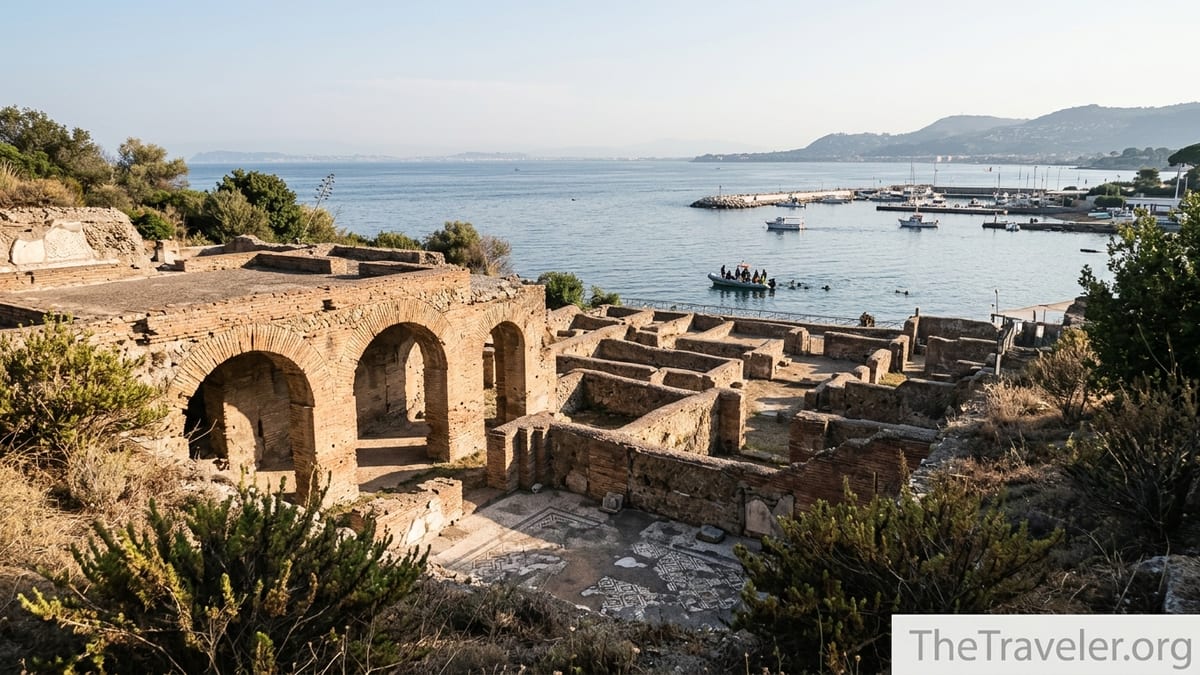
On the volcanic coast west of Naples, Baiae Archaeological Park combines a hillside complex of Roman villas and baths with one of the world’s most remarkable sites: a submerged archaeological park where mosaics, streets and sculptures lie a few meters under the sea. It can be an unforgettable day trip, but many visitors arrive unprepared and end up wasting time, money or seeing only a fraction of what Baiae offers. Understanding the most common mistakes people make here will help you plan a smoother, safer and far more rewarding visit.
Get the latest updates straight to your inbox!
Misunderstanding What “Baiae Archaeological Park” Actually Includes
One of the biggest sources of confusion is that “Baiae Archaeological Park” is not a single, compact attraction but a cluster of sites spread around the Phlegraean Fields: the hillside Parco Archeologico delle Terme di Baia, the Submerged Archaeological Park of Baia offshore, and nearby sites such as Cuma and the underwater remains of Portus Julius. Many visitors book a snorkeling session at the submerged park assuming it automatically includes entry to the land-based ruins above, only to discover on arrival that they are separate experiences run under different rules and with different tickets. It is entirely possible to come to Baiae, spend half a day on the boat over the underwater ruins, and leave without ever stepping into the monumental terraced baths rising above the modern marina.
Another frequent mistake is assuming that every tour or ticket labeled “Baia” or “Baiae” covers the same area. A glass-bottom boat excursion departing from the small marina might show you mosaics and column bases but never set foot in the official marine protected area, while a full scuba package with a local operator such as Subaia or one of the Campi Flegrei diving centers focuses only on a defined underwater itinerary like the Terme del Lacus. First-time visitors sometimes discover too late that they could have combined a morning underwater with an afternoon at the hillside complex for only a small extra cost in transport and tickets.
To avoid disappointment, treat Baiae as a small region rather than a single site. Before you book anything, decide explicitly whether you want: a land visit among thermal terraces and imperial villas, an in-water visit with snorkeling or diving, a dry glass-bottom boat or RIB tour, or a combination of these. Then check carefully which part each tour or ticket truly covers. This simple clarification prevents the all-too-common complaint of “we thought we were seeing the famous underwater city, but it was just a short boat ride over one corner of it.”
Underestimating Logistics and Travel Time from Naples
On the map, Baiae looks tempting for a quick hop from central Naples. In reality, visitors often underestimate how fragmented local transport can be and how much time they lose in transfers. The most common budget route is the Cumana railway from Montesanto station in Naples toward Baia and Torregaveta. Even with the recently reopened Baia stop, you should still allow around 40 to 60 minutes door to door from the historic center, accounting for buying tickets, train frequency, and short delays. Travellers who assume Baiae is “about 20 minutes away” routinely arrive late to pre-booked boat or dive departures and either lose their slot or have their time on the water cut short.
Another pitfall is not checking how to bridge the last few minutes from the train stop or bus drop-off to the marina or hillside gate. Some diving centers request you to meet directly at their premises near the harbor at a fixed time, often 30 minutes before the boat leaves to sort paperwork and equipment. Arriving with heavy gear or luggage and discovering the walk is uphill in summer heat can add unnecessary stress. Taxis exist but are not always waiting outside the station, especially in shoulder season or on weekdays.
Travelers with rental cars make different mistakes. Parking around the marina and the entrance to the Parco Archeologico delle Terme di Baia can be tight on sunny weekends and during Italian holidays. Many drivers roll in around midday expecting plentiful free spaces, then spend half an hour circling the hill, losing the cooler morning window when the upper terraces are in shade. Others forget that the broader Campi Flegrei area is subject to bradyseism-related monitoring and occasional roadworks, which can slow traffic without much advance warning. Building at least a 30-minute buffer into your schedule gives you some protection from missed start times and rushed visits.
Ignoring Opening Hours, Closures and Seasonal Conditions
Although Baiae is open most of the year, many visitors are caught out by partial closures, staggered last-entry times and seasonal changes in conditions. The hillside archaeological park usually closes well before sunset, often with last admission in the mid to late afternoon and mandatory exit about an hour later. Travellers who take a leisurely lunch on the waterfront and wander up at 5 pm on a spring or autumn day sometimes find the gates already closed or are allowed in with too little time to climb through the terraces and enjoy the views over the bay.
The underwater park is even more sensitive to conditions. Dive and snorkel operators must respect the rules of the marine protected area, local harbor authorities and the weather. Summer winds, reduced visibility after storms, or temporary restrictions can all lead to last-minute route changes or cancellations. Visitors who schedule Baiae as their only chance to snorkel Roman ruins and who are in the area for just one day risk going home disappointed if the sea turns choppy. On very busy August weekends, some slots sell out, while in cooler months only morning departures may run, catching out those who assumed they could simply show up for an afternoon excursion.
Another seasonal issue is the broader volcanic context of Campi Flegrei. Uplift and seismic swarms occasionally prompt authorities to review safety plans for the wider area. While the impact on daily tourism at Baiae has so far been limited, you should stay alert to any official notices if you plan your visit months in advance. Choosing a flexible day within your itinerary or pairing Baiae with a more easily rescheduled Naples activity, such as a museum visit, can reduce the risk that a sudden closure or reduced capacity will derail your plans.
Arriving Without Reservations or the Right Type of Booking
Spontaneity may work for grabbing an espresso on Via Toledo, but it is a frequent mistake at Baiae, especially for the underwater park. The marine area limits the number of people in the water at any one time and applies a guide-to-visitor ratio for both scuba diving and snorkeling. Local operators typically schedule fixed departures and must communicate numbers in advance to site managers. Turning up at the harbor on a busy Saturday in July without a reservation and expecting to join a dive can leave you standing on the quay watching fully booked boats depart.
Even when spaces are technically available, showing up late or with the wrong understanding of what you booked causes problems. Many operators offer a range of products under similar names, from “Discover Scuba Diving in Baia” for beginners to full double-dive packages for certified divers, plus separate surface or glass-bottom boat tours. It is easy to click the wrong option when you are browsing on your phone the night before. Travelers sometimes arrive expecting to snorkel over mosaic floors and instead discover they reserved a dry viewing tour with no in-water component, or vice versa. Sorting this out on the day can be difficult if staff are juggling tight schedules and strict entry slots to the marine park.
On the land side, people often assume that tickets for major sites across the Bay of Naples are interchangeable. Passes that include Pompeii, Oplontis or Stabiae generally do not cover Baiae unless clearly stated, and separate tickets are commonly required for Cuma or the nearby archaeological museum in the area. Queueing to buy a ticket on site usually is not a major ordeal outside peak weeks, but it can eat into your time if you arrive in a tour-bus wave. Whenever possible, secure the specific product you want a few days ahead, and read the fine print: does it include equipment, wetsuits, or transfers from Naples, or will you need to arrange and pay for those separately?
Wearing the Wrong Clothing and Underestimating the Terrain
Visitors who have just wandered flat streets in central Naples often underestimate how physical Baiae can feel, particularly under strong sun. The hillside Parco Archeologico delle Terme di Baia rises in terraces from near sea level to panoramic viewpoints overlooking the bay. Paths can be uneven, with ancient stone steps, gravel and exposed rock. Arriving in smooth-soled city sneakers or flimsy sandals makes slips more likely, especially when descending after a hot climb. One common regret expressed by travelers is not having treated Baiae like a moderate outdoor hike, complete with breathable clothing, a hat and at least a small bottle of water bought in Bacoli or near the marina before entering.
Out on or in the water, poor clothing choices create different issues. Snorkeling and dive sites in the submerged park are shallow, typically just a few meters deep, which tempts some visitors to think of the experience as akin to a casual beach swim. However, time on the boat, wind on wet skin and long periods with your face in the water can make even a warm day feel surprisingly chilly. Those who arrive in only a swimsuit and thin towel sometimes shiver through the ride back to shore. Packing a light windbreaker or a long-sleeved top that can get a splash or two will make a big difference to your comfort.
Footwear is another overlooked detail. While operators generally provide fins and appropriate water gear, you will still need to walk on the pier and possibly along rough steps or docks. Cheap flip-flops can break or slip, and some visitors end up barefoot on hot concrete or rough surfaces. Closed-toe water shoes or secure sandals you can quickly remove before donning fins are more practical. Remember that you might be climbing a ladder back onto the boat with wet feet and gear; having something with grip to put on immediately once you are back on deck helps prevent minor falls that could spoil the rest of your trip.
Overlooking Safety Briefings and Rules in the Underwater Park
The Submerged Archaeological Park of Baia is not a free-for-all snorkel spot but a strictly regulated marine protected area. It exists to preserve delicate archaeological remains as much as to entertain visitors. One of the most damaging mistakes is treating it like a generic coastal swim, ignoring the detailed briefings that dive guides give at the harbor or on the boat. These briefings typically cover how close you may approach mosaics, statues and low walls, where you can and cannot stand, and how to manage your buoyancy so fins do not kick up sediment that can both damage surfaces and cloud visibility for the entire group.
Some visitors, especially confident swimmers new to archaeology-focused snorkeling, are tempted to break away from the group or dive down to touch columns or flooring. This not only threatens fragile remains but can breach local regulations and put guides in a difficult position with park authorities. In extreme cases, operators may cut a tour short if guests repeatedly ignore instructions, which means everyone on the boat loses precious time over the ruins. Even accidental contact, such as standing on a seemingly random patch of sand that actually hides a buried floor, can have long-term consequences for preservation.
Basic safety issues matter just as much as archaeological rules. The shallow depths and calm summer seas can make visitors complacent, but the marine area is still subject to boat traffic, variable currents and changing visibility. Guides set specific swimming patterns for good reasons, and snorkeling vests or wetsuits are recommended for those not completely comfortable in open water. Failing to disclose medical conditions, seasickness susceptibility or anxiety about masks and regulators during the pre-dive or pre-snorkel questionnaire is another frequent oversight. Being candid at this stage allows staff to adjust the plan, suggest a glass-bottom boat instead, or provide extra attention, rather than having a panic attack in the water that disrupts the entire group.
Rushing the Land Site and Missing Context
Many travellers prioritize the underwater park, viewing the hillside Terme di Baia as an optional add-on rather than a central part of the experience. As a result, they squeeze the land visit into an hour before or after a boat departure, rush straight to the top terrace for the view, and leave with only a faint impression of vaulted rooms and broken walls. What they have actually walked through are some of the most significant thermal complexes of the Roman world, built on multiple levels to exploit hot springs, sea views and sophisticated engineering in the heart of Campi Flegrei. Without context, it can feel like just another ruin; with it, the above-water site completes the story you glimpsed underwater.
Another mistake is not preparing even a minimal sense of Roman Baiae’s history before arrival. A short overview of how the coastline has risen and fallen over time because of bradyseism, causing whole neighborhoods to submerge, will transform how you see both the hill and the water. Knowing that emperors like Nero and Hadrian favored this shoreline, and that submerged villa mosaics once connected seamlessly to structures now stranded on terraces above, makes the physical layout far more intelligible. Visitors who skip any background often find they are staring at impressive brickwork without understanding what function each space served.
If you travel independently without a formal guide, it is worth budgeting time at the small on-site panels and, if available, any temporary exhibits or models. Bringing a downloaded map or reputable guidebook excerpt that labels key features will help you link them to what you saw from the boat: a bath building here, a private villa courtyard there, and the former shoreline tracing a line between them. Allowing at least two unhurried hours for the land site, ideally in gentler morning or late-afternoon light, turns it from a quick photo stop into a deeply memorable counterpart to the submerged park.
The Takeaway
Baiae Archaeological Park rewards visitors who approach it not as a single Instagram stop but as a layered landscape of villas, baths and submerged streets shaped by both Roman ambition and restless geology. The most common mistakes here are rarely dramatic; they are quiet miscalculations of time, logistics, weather and expectations that gradually erode the quality of your day. Underestimating the journey from Naples, assuming any “Baia” tour includes every attraction, skimping on reservations, or treating the underwater park like a casual beach swim all lead to rushed schedules and missed opportunities.
With a bit of forethought, you can avoid these pitfalls. Decide early whether you want to combine the hillside ruins with an underwater or surface tour, and book specific products that match your interests and abilities. Build generous buffers around transport and opening hours, dress for uneven terrain and time at sea, and give the same respect to safety briefings that you would at any major dive destination. Most importantly, allow space in your itinerary to absorb the story Baiae tells: of a resort city slowly sinking and rising again, of emperors at leisure and of a coastline that continues to change beneath modern feet and fins. If you do, your visit will feel less like a box ticked and more like a day spent inside one of the Mediterranean’s most unusual conversations between land, sea and history.
FAQ
Q1. Do I need to be a certified diver to see the submerged ruins at Baiae?
Certification is only required for full scuba dives. Non-divers can still see mosaics and structures through guided snorkeling tours or glass-bottom boat excursions that stay on the surface.
Q2. How much time should I plan for Baiae if I am coming from Naples?
For a relaxed visit that includes either snorkeling or a boat tour plus the hillside archaeological park, plan a full day from Naples, roughly 8 to 9 hours including transport and breaks.
Q3. Is it possible to visit Baiae and Pompeii on the same day?
It is technically possible but usually feels rushed. Each site deserves several hours, and the combined travel time and summer heat make pairing them in one day tiring for most visitors.
Q4. What should I wear for a visit that includes both the land site and an underwater tour?
Wear breathable clothes, a hat and sturdy walking shoes for the terraces, and bring a swimsuit, quick-drying towel and a light windproof layer for the boat and in-water portion.
Q5. Can I just show up at the marina and book a snorkeling tour on the spot?
Outside peak season this might be possible, but spaces are limited by park regulations. To avoid disappointment, especially in summer or on weekends, it is safer to reserve in advance.
Q6. Are there age or fitness restrictions for visiting the submerged park?
Each operator sets its own limits, but children and less confident swimmers are often better suited to surface or glass-bottom boat tours, while scuba diving requires good basic health and mobility.
Q7. Is Baiae safe to visit given the volcanic activity in Campi Flegrei?
The area is closely monitored by Italian authorities. Any significant change in volcanic or seismic risk would trigger official measures; visitors should simply keep informed of current guidance before travel.
Q8. Can I use the same ticket for Baiae and other archaeological sites around Naples?
Some regional passes include multiple sites, but Baiae is not always part of those combinations. Check the exact list of covered locations rather than assuming your pass is valid everywhere.
Q9. Will I get seasick on the boat to the underwater park?
The trips are usually short and stay near the coast, but motion can still bother some people. If you are prone to seasickness, consider medication or choose a day with calmer conditions when possible.
Q10. Is Baiae overcrowded like some other famous Italian sites?
Baiae can be busy in high summer, especially on weekends, but it is generally less crowded than major draws like Pompeii. Booking timed activities and arriving early helps keep your visit pleasantly uncrowded.