


Some places arrive in your imagination long before you set foot there. Baie des Anges in Nice was one of those for me. I had seen the postcards, the film backdrops, the carefully framed shots of palm trees and turquoise water. I thought I knew exactly how it would feel to meet this famous curve of the Mediterranean at last. I was wrong. My first real view of the bay was not just beautiful. It was startling, visceral, and far more overwhelming than anything I had prepared myself for.
Get the latest updates straight to your inbox!
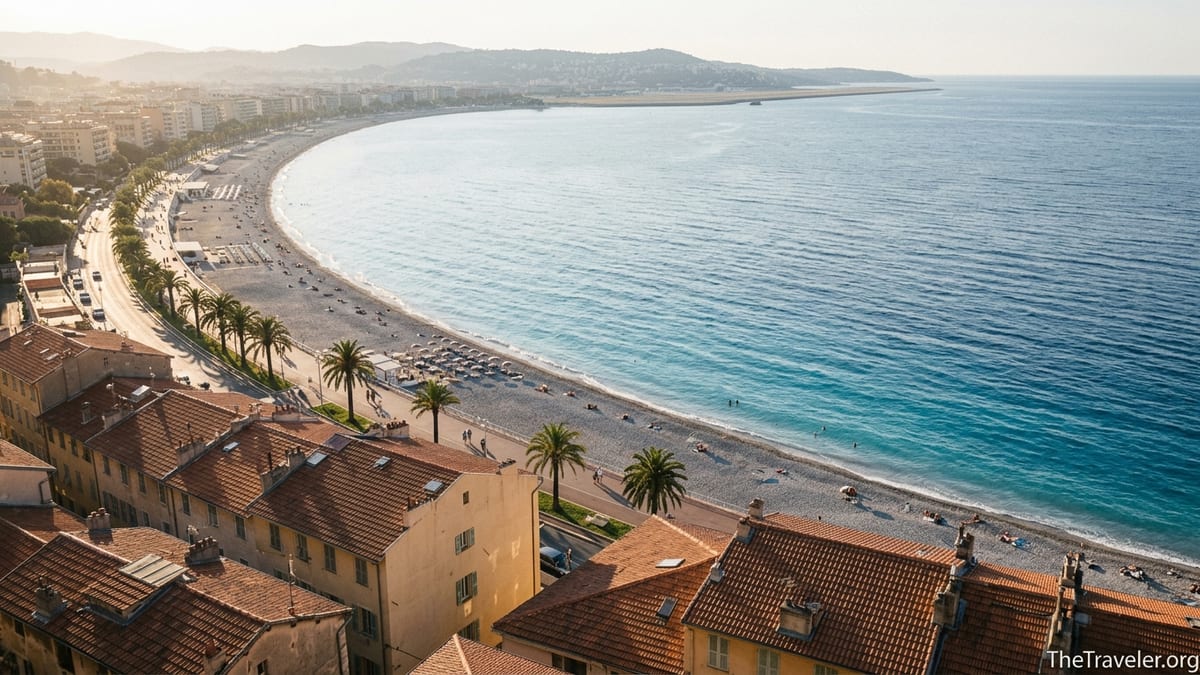
First Glimpse: The Bay From the Sky
The surprise began before I even landed. Flying into Nice Côte d’Azur Airport, the approach brings the plane low over the Mediterranean, skimming parallel to the curve of Baie des Anges. Looking down through the oval window, I saw what looked almost unreal: a clean sweep of deep blue turning suddenly, sharply, into a band of luminous turquoise that hugged the shore from Nice toward Antibes. The seven-kilometre strip of Promenade des Anglais ran like a silver pencil line between sea and city, dotted with palm trees and pale Belle Époque façades. It was the first time on the trip that I instinctively held my breath.
This aerial view gives a sense of the bay’s scale that you never quite grasp from ground level. You see how the city is cradled between the sea and the hills, with Castle Hill and Mont Boron at one end, and the airport perched almost in the water at the other. On a clear day, the Alps are faint but visible behind Nice, a reminder that this coastline really is a meeting point of mountains and sea. It is a view that business travellers catch every day, yet when you are seeing the bay for the first time, that descent feels like a private introduction.
By the time the wheels touched the runway, I had already revised my expectations. The Baie des Anges I had imagined was pretty and genteel. The one I had just flown over felt immense, graphic and almost cinematic in its contrasts of colour and shape, but with the unmistakable texture of a lived-in city wrapped around it.
Stepping Onto the Promenade des Anglais
My first ground-level encounter came less than an hour later. From the airport tram, I stepped out near the central stretch of Promenade des Anglais, the broad waterfront boulevard that follows Baie des Anges. In photos it always looks serene and almost minimal, a simple ribbon of pavement beside the sea. In reality, it is more complex, more human and far livelier.
The promenade itself is wide, with a dedicated bike lane, pockets of gardens, and clusters of the city’s famous blue chairs angled toward the water. On a typical afternoon you might see office workers in shirtsleeves eating takeaway salads on those chairs, rollerbladers weaving around them, and families with strollers stopping so children can watch the waves attack the pebbles. The traffic on the inland side of the promenade, which rarely appears in photos, is constant: buses gliding past, scooters darting between lanes, the occasional red Ferrari or vintage convertible edging along with the same slow rhythm as the pedestrians by the sea.
Closer to the water, the postcard image returns. Below the promenade, a long staircase leads down to the deep pebble beach for which Nice is both loved and occasionally cursed. The stones are large enough that first-time visitors in flip-flops often wobble theatrically on their way to the water. Yet that same shingle is what gives the bay its particular shade. The light bounces from sky to sea to polished stone and back again, creating bands of colour that seem to re-arrange themselves with every passing cloud. Standing there, with the first warm wave pushing cold foam over my ankles, I realised that no photograph I had seen had ever captured the sound: the distinctive rustle and clatter of the pebbles as each wave pulls back.
Castle Hill: The View That Changes Everything
It was not until I climbed Castle Hill that the bay finally revealed itself in a way that felt truly complete. The hill, a public park on the eastern end of the old town, rises steeply above the curve of Baie des Anges. You can reach it by elevator from the seafront, or by walking up shaded stairways that slice between ochre buildings. Either way, at the top you emerge into a series of terraces and viewpoints where the entire bay spreads out below like a living, moving map of the French Riviera.
From the Bellanda Tower terrace, a favourite among locals and recent travel writers alike, the sweep of the bay looks almost impossibly perfect. To the right, the airport juts out into the sea; to the left, the curve bends toward the Port of Nice and the darker headland beyond. Between them, the Promenade des Anglais traces the shoreline, and the city’s red-tiled roofs crowd up to its inland edge. Tour groups pause here, selfie sticks raised, but it is just as common to see solitary runners in lycra stopping to catch their breath, or an older Niçois sitting quietly on a bench, watching the water as if it were an old friend.
Higher still, from the grassy viewpoints above the artificial waterfall, the perspective shifts again. The bay feels further away, calmer, almost like a painting. I arrived one late afternoon just as the sun began to tilt toward the Maritime Alps. The water, which had been a fierce, sharp blue at midday, softened into layered tones of teal, silver and violet. Aircraft took off one by one, their shadows skating briefly over the sea before disappearing into the haze. It was at that moment, with the strange hush that often falls over busy places at the end of the day, that I realised Baie des Anges was not only more beautiful than I expected but more changeable, more moody, more alive.
Life Along the Curve: Beaches, Plages Privées and Real People
One of the quickest ways to understand Baie des Anges beyond its surface glamour is to spend a full day moving slowly along its length. In high season, the public beaches quickly fill with a mix of locals and visitors. Students spread towels directly on the pebbles; older residents arrive with thick foam mats they have been using for years. Families bring umbrellas, plastic buckets and armfuls of baguettes. Around them, a series of private beach clubs offers a very different experience, with neat lines of sunbeds under cream or striped parasols, waiter service and changing cabins.
Prices at these private plages vary, but on a summer weekday you might pay the equivalent of a modest restaurant lunch for a full-day sunbed and umbrella, slightly more on weekends or in peak weeks. Some, like the long-established beach in front of the grandest seafront hotels, lean into Riviera elegance with white tablecloths and carefully plated sea bream for lunch. Others feel more relaxed, with burgers, salads and ice-cold rosé served at low tables where guests sit in damp swimsuits and bare feet. For travellers on a budget, a good compromise is to claim a free spot on the public beach between two private concessions, and then wander up to a snack bar for a coffee or a scoop of pistachio gelato when the sun becomes too intense.
The bay’s personality also changes as you walk away from central Nice. Toward the airport, around the neighbourhood of Saint-Laurent-du-Var, you find a slightly more low-key atmosphere, with locals jogging in the early morning and fishermen casting lines from rocky outcrops. To the east, past the official “I Love Nice” sign at Rauba Capeu, the promenade narrows and the coastline becomes rougher, with stone platforms and small coves facing a deeper, darker blue sea. Here, the view back toward Baie des Anges is one of the city itself: the arc of the bay framed by terracotta roofs and the curve of the main beach, often backed by a line of pale high clouds that seem to hover just for the photograph you are about to take.
Seasons of the Bay: How Baie des Anges Changes Through the Year
Many travellers arrive in Nice in July or August and assume this is what Baie des Anges is always like: crowded, noisy and soaked in a relentless, baking sun. Spend time here in different months, though, and another side of the bay reveals itself. In late April, when I first visited, the water already looked summery, but the air still carried a light, cool edge. Locals were out in numbers, their winter coats traded for linen jackets, but most were walking rather than swimming. Café terraces along the promenade served morning espresso and fresh orange juice to a steady flow of regulars, and hotel staff were still in the final stages of repainting shutters and freshening up façades after winter.
By June the social temperature rises noticeably. Beach clubs operate at full capacity, and the first waves of European summer holidaymakers arrive with wheeled suitcases and broad-brimmed hats. Even then, there are quieter hours. An early-morning walk at 7 a.m. can mean sharing the promenade mostly with joggers and dog walkers, the bay a glassy sheet of steel-blue under a soft, colourless sky. At midday, that same stretch explodes into high colour as the sun climbs directly overhead and the sea turns a flat, electric turquoise that makes people reach automatically for their phones.
In October or November the bay is almost unrecognisable compared with high season, yet no less compelling. The light shifts lower, lengthening the shadows of palm trunks on the promenade. Occasional storms roughen the surface of the usually calm water, bringing dramatic cloudscapes and waves that crash against the pebbles with enough force to send spray up to the edge of the road. Hotel rates tend to soften, cafés swap spritzes for hot chocolate and vin chaud, and the Promenade des Anglais feels briefly reclaimed by residents. It is in these shoulder seasons that you can best feel the bay as part of a working city rather than a holiday postcard.
Staying by the Bay: Waking Up to Baie des Anges
Choosing where to stay in Nice shapes how you experience Baie des Anges. A room directly overlooking the promenade delivers the most dramatic sea views, but also comes with passing traffic and the steady background hum of a busy coastal road. Some of the city’s landmark seafront hotels, including grande-dame addresses with Belle Époque façades, have made a selling point of their balconies perched almost above the water. Step outside, and the bay is a full-width panorama, from the curve of the beach to the outlines of planes lifting off in the distance.
At these properties, a bay-view room is often the premium category, priced higher than those facing the courtyard or city. For travellers willing to trade absolute seafront for a slightly more local feel, there are smaller boutique hotels and apartments set a block or two back from the water. Many still offer angled glimpses of the bay from higher floors, especially along side streets close to the iconic palm-lined stretches of the promenade. Here, you wake not only to the shimmer of sea but to the everyday soundtrack of Nice: church bells from the old town, scooters revving, the clink of cups as the first cafés open their doors.
Those on tighter budgets can find good value further along the bay toward the railway line and the airport, particularly in Saint-Laurent-du-Var and Cagnes-sur-Mer. These areas have pebble and sand beaches facing the same turquoise water, with frequent local trains running back to Nice’s central station in under fifteen minutes. Many locals consider this western side of the bay especially appealing in late afternoon, when the sun sets behind the distant Esterel hills and paints the water in muted golds and pinks.
Tastes of the Riviera: Eating and Drinking With a View
Food is one of the easiest ways to turn a beautiful view into a full sensory memory, and Baie des Anges offers plenty of occasions to do exactly that. Along the promenade and on the streets just behind it, cafés and brasseries serve morning croissants and café crèmes to a mix of visitors and Niçois who have been coming to the same counter for decades. Sitting at a tiny round table with a still-warm croissant, watching joggers and dog walkers pass in front of the shimmering bay, you start to understand why so many people return to Nice every year.
Later in the day, attention shifts to the beach restaurants that stretch out over the pebbles themselves. Here, menus often mirror the colours of the bay: salads of bright local tomatoes, grilled fish with lemon, bowls of pale green niçoise olives and carafes of chilled rosé almost the same blush tone as the late-afternoon sky. A simple lunch of socca, the local chickpea pancake, eaten at a wooden table while the sea throws light patterns against the underside of the deck, can fix itself in your memory as firmly as any fine-dining experience.
For a higher vantage point, several hotels close to the water have rooftop bars and restaurants facing Baie des Anges. Arrive just before sunset and you may find a small crowd of photographers and couples positioning themselves at the railings. As the sun drops, the streetlights along Promenade des Anglais slowly ignite in a chain, and the bay changes character yet again, becoming a broad, dark mirror pricked with reflections from hotel façades and passing cars. It is a view that makes even a modest glass of wine feel like part of a special occasion.
The Takeaway
Before I saw Baie des Anges for myself, I assumed it would be one of those places that feel almost too familiar from photographs to deliver much surprise. Instead, each new vantage point made the bay feel larger, more layered and more emotionally charged than I had imagined. The sight of Nice wrapped around that curve of water from the plane window, the first tactile encounter with its pebbled shore, the layered perspectives from Castle Hill and the quieter stretches beyond the city all combined into something far richer than a postcard.
What struck me most was how Baie des Anges shifts character hour by hour and season by season. At dawn it is soft and introspective, by midday it blazes with hard Mediterranean light, and at night it becomes almost abstract, a line of reflected colour under a dark sky. It belongs just as much to the runners and commuters who pass it daily as to the visitors seeing it for the first time. If you arrive expecting only beauty, you will certainly find that. But if you give yourself time to walk, climb and sit with the bay from different angles, you may find, as I did, that the real surprise is not its looks but its complexity and the way it quietly gets under your skin.
FAQ
Q1. Where exactly is Baie des Anges?
Baie des Anges is a large bay on the Mediterranean Sea in the Alpes-Maritimes department of southeastern France. It stretches roughly between the city of Nice on its eastern side and Antibes to the west, with several coastal towns and beaches along its curve.
Q2. Is the water at Baie des Anges really as blue as it looks in photos?
On clear days the water can appear strikingly blue and turquoise, especially around midday when the sun is high. The colour is influenced by the clarity of the Mediterranean, the light-coloured seabed close to shore, and the reflection from the sky and pale pebbles on the beaches.
Q3. Are the beaches along Baie des Anges sandy or pebbly?
Most beaches in central Nice along Baie des Anges are pebble beaches, with smooth grey stones that can be uncomfortable in bare feet. Further along the bay, especially toward Cagnes-sur-Mer and Antibes, you will find a mix of pebbly stretches and some sandy or sand-and-pebble beaches.
Q4. Do I need to pay to access the beach in Nice?
There is a mix of free public beaches and paid private beach clubs along Baie des Anges. The public areas are completely free to use, while private plages charge for sunbeds, umbrellas and services such as showers and towel rental. You can always swim in the sea itself without charge.
Q5. What is the best place to get a panoramic view of Baie des Anges?
Castle Hill above Nice, known locally as Colline du Château, offers some of the best elevated views of Baie des Anges. From its terraces you can see the entire curve of the bay, the Promenade des Anglais and the red-tiled roofs of the old town laid out below.
Q6. When is the best time of year to visit Baie des Anges?
Baie des Anges is attractive year-round, but many travellers prefer the shoulder seasons of late April to early June and September to October. During these periods, the weather is usually pleasant, the sea can be warm enough for swimming, and the promenade and beaches are generally less crowded than in the peak summer months.
Q7. Is it safe to swim in Baie des Anges?
Swimming is common and generally considered safe in designated areas along Baie des Anges, especially where lifeguards are present in high season. As always, you should pay attention to local flags, posted notices and the advice of lifeguards, particularly when the sea is rough or after storms.
Q8. How can I get from Nice Airport to the promenade and the bay?
Nice Côte d’Azur Airport sits at the western end of Baie des Anges. A frequent tram line connects the terminals to the city centre in around half an hour, stopping within a short walk of the Promenade des Anglais and the main beachfront areas.
Q9. Can I walk the length of Baie des Anges?
You can comfortably walk the main seafront section of Baie des Anges in Nice along the Promenade des Anglais, which runs for several kilometres. Reaching the full length of the bay between Nice and Antibes on foot is possible for fit walkers but takes several hours; many people prefer to combine shorter walks with local trains or buses.
Q10. Are there good viewpoints of Baie des Anges outside Nice?
Yes. In addition to Castle Hill, you can find beautiful views from headlands and hills around the bay, such as the coastal paths near Cap de Nice and the seafront promenades in neighbouring towns like Saint-Laurent-du-Var, Cagnes-sur-Mer and Antibes, each offering its own angle on the bay’s curve.