


Landing at Bandaranaike International Airport outside Colombo, most travelers want one thing before anything else: a reliable local connection for maps, ride‑hailing, messaging and email. Sri Lanka’s main airport makes it relatively easy to get online quickly, but knowing where to go, what to buy and when an eSIM might be better will save you time and money the moment you walk into the arrivals hall.
Get the latest updates straight to your inbox!
Getting Connected on Arrival at Bandaranaike International Airport
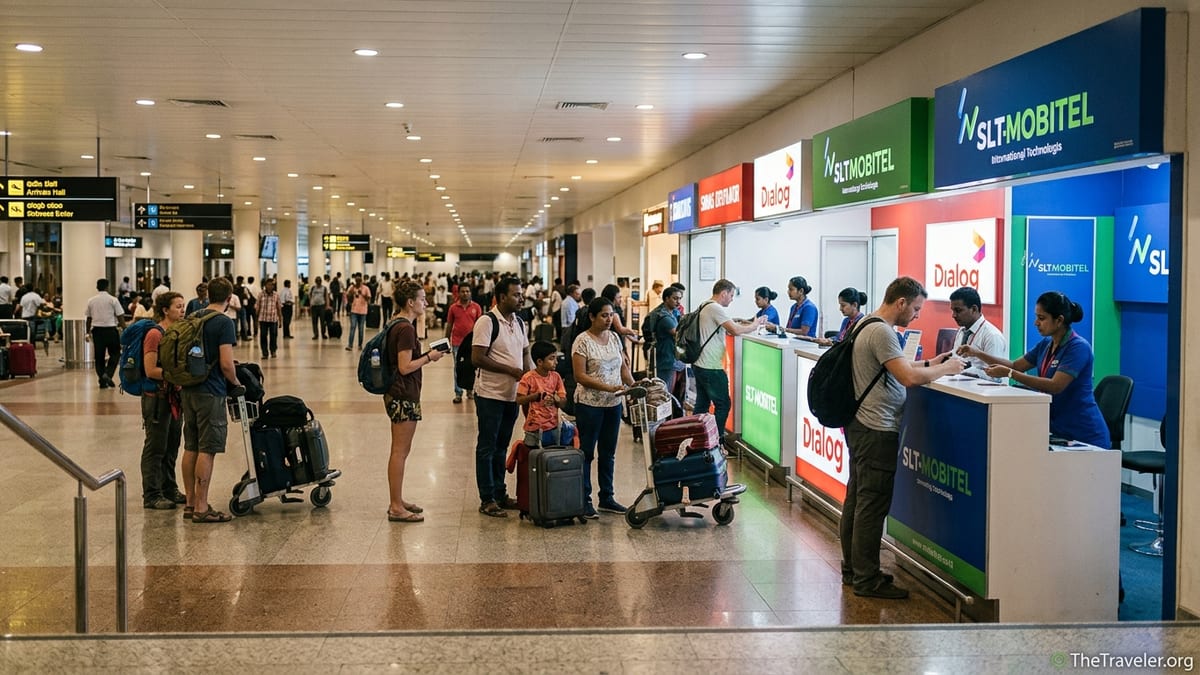
Bandaranaike International Airport, often just called Colombo Airport or CMB, is the main international gateway to Sri Lanka. After immigration and baggage claim, you walk into the public arrivals hall where several mobile operators run dedicated desks for new arrivals. The two you will notice first are usually Dialog and SLT‑Mobitel, the country’s biggest operators by coverage and subscriber numbers, along with Hutch in some time slots.
The airport desks feel designed for tired travelers: signs are in English, staff are used to foreign passports and tourist questions, and packages are preconfigured with data plus some voice and SMS. A typical interaction takes less than 10 minutes if there is no queue. You hand over your passport, choose a plan, pay in Sri Lankan rupees by cash or card, and the staffer will insert and activate the SIM for you on the spot, including setting up mobile data and checking that you can browse or message before you walk away.
Arriving late at night or very early in the morning, most visitors still find at least one of the major operators open, although counters sometimes work shorter hours in the very small hours. If you land on a busy evening with several long‑haul flights arriving together, it is common to see a short queue of backpackers and families at the counters, so be prepared to wait 10 to 20 minutes at peak times such as late evening arrivals from Europe or the Middle East.
Buying at the airport is usually the most convenient option for first‑time visitors, especially if you plan to use ride‑hailing or online taxi booking to reach Colombo, Negombo or the south coast. With a local data connection in hand, you can compare taxi apps against walk‑up counters and negotiate better fares, which in practice often saves more money than you might pay in any small “tourist premium” on the SIM price.
Where Exactly to Find SIM Card Counters at CMB
Once you exit customs and step into the main arrivals area at Bandaranaike, you will see a row of service counters along the walls. The mobile operators are among the first or second cluster you encounter, normally before the bank currency exchange booths and travel desks. Look for large branded signs with logos for Dialog and SLT‑Mobitel, often with “Tourist SIM” or “Roaming & Prepaid” written clearly in English.
The Dialog counter usually stands out with prominent red branding and posters advertising tourist packages such as fixed‑price data bundles for one or two weeks. Next to or nearby, SLT‑Mobitel typically uses green and blue branding, with its own set of package boards. Hutch appears in orange branding when present. Desks are walk‑up style with a small waiting area in front; there is no need to take a ticket or book in advance.
In practice, most travelers choose a SIM at the first counter that looks quiet and offers a package that suits their trip length. For example, a couple arriving from Dubai might see a small queue at Dialog but no one at Mobitel and simply go to Mobitel first. If you care about coverage in remote areas or have friends in Sri Lanka who recommend a particular network, you can walk up and down the line of counters, quickly asking each one what tourist plans are currently available and at what price.
Even if you plan to rely on an eSIM, it can be worth walking past the counters to check current physical SIM pricing and any airport‑only offers. This gives you a real‑world benchmark to compare with international eSIM apps, which can sometimes charge a noticeable premium for the convenience of setting everything up before you land.
Dialog, SLT‑Mobitel and Hutch: How the Main Options Compare
Dialog is widely regarded as the operator with the broadest 4G coverage in Sri Lanka, particularly along major roads, in most towns and throughout key tourist areas such as the south and east coasts and the hill country. For a typical short stay, many travelers pick Dialog simply because it is the biggest and best‑known name for mobile data, and airport staff are very familiar with activating tourist SIMs on a wide range of foreign phones.
SLT‑Mobitel, sometimes branded simply as Mobitel, is usually considered the second major option in terms of national coverage. Its tourist packages are broadly similar to Dialog in structure, combining a fixed amount of anytime data with some local call minutes and messaging. Anecdotally, some visitors feel Mobitel performs slightly better in certain neighborhoods or less touristy towns, while being comparable or slightly cheaper than Dialog in headline price, though differences at the tourist‑SIM level are often small.
Hutch positions itself more on value, which can appeal to budget travelers or digital nomads planning a longer stay in urban areas. Its data‑heavy plans can sometimes be cheaper per gigabyte than the big two, but its coverage is generally more limited in remote and rural regions compared with Dialog and Mobitel. A traveler spending two weeks mostly in Colombo, Galle and the southern beaches might be perfectly happy with Hutch, while someone heading deep into the hill country or to more remote national parks will typically be better served by Dialog or Mobitel.
In practice, you will see real‑world behavior that reflects these trade‑offs. For example, a surf traveler planning to stay in Weligama for a month may ask local guesthouse owners which operator gives the best signal on that particular street and choose accordingly, while a couple doing a loop from Colombo to Sigiriya, Kandy and Ella might accept paying a little more for a Dialog tourist SIM to maximize their chances of coverage on intercity bus routes and mountain roads.
Tourist SIM Packages, Prices and Validity
Tourist SIM packages at Bandaranaike Airport are designed to be simple. Each operator typically offers a handful of clearly labeled options such as 7‑day, 14‑day or 30‑day validity, bundling a block of data with some local call minutes. Exact prices fluctuate with currency and promotions, but as a broad indication, you might see entry‑level tourist packs in the lower thousands of Sri Lankan rupees for a week with moderate data, rising to mid‑range packs in the higher thousands of rupees for 30 days with larger data allowances.
One commonly advertised pattern is something like a 7‑day package with roughly 15 to 20 GB of data and a generous block of local voice minutes, which is usually more than enough for typical short trips focused on messaging, maps, social media and occasional video calls on Wi‑Fi. For longer stays, a 30‑day tourist SIM with a significantly higher data allowance is often available, catering to visitors who expect to use navigation constantly, upload photos and videos from beaches or safaris, or work remotely from guesthouses.
Unlike some countries where airport SIMs are dramatically more expensive than in the city, the difference at CMB is usually modest. You might be able to save some money by going to a branded high‑street shop in Colombo or Kandy, but that requires navigating into town without local data or relying on hotel Wi‑Fi first. Many arrivals decide that paying a slightly higher price at the airport, if any, is a reasonable trade‑off for immediate connectivity, especially when arriving jet‑lagged or traveling with children.
If you underestimate your data needs, topping up is straightforward. You can add credit in supermarkets, small kiosks and operator shops across the country, or purchase additional data bundles using the operator’s app once you are online. For example, a traveler who buys a 14‑day pack and then realizes they are streaming more video than expected can simply activate an extra data bundle from their phone, without needing to visit another physical shop.
eSIM Options for Sri Lanka: Local and International
For travelers with newer smartphones that support eSIM, Sri Lanka now offers two main paths: local operator eSIMs and international travel eSIM providers. SLT‑Mobitel promotes tourist eSIM offerings that mirror its physical tourist SIM packs, letting you scan a QR code and activate a local profile without inserting any plastic card. This can be attractive if your phone has only one physical SIM tray that you need to preserve for your home number.
Dialog and other operators have been rolling out eSIM support for certain postpaid and high‑end accounts, and availability for walk‑up tourist eSIMs at the airport can vary over time. Even when not advertised prominently at the counter, it is worth asking whether a given operator can issue a prepaid eSIM to a tourist passport. If available, the staff will typically print a QR code, verify your passport, and help you activate the plan on your device in the same way as a physical SIM, just without changing the tray.
International eSIM apps have become a popular alternative for tech‑savvy travelers who prefer to land with data already working. These services typically resell access on one of the local networks, offering country or regional passes with fixed data volumes for a set number of days. Prices per gigabyte are often higher than buying a local SIM at CMB, but the trade‑off is convenience: you purchase and install the eSIM at home, test that it connects, and step off the plane already online, which can be reassuring if you are arriving very late or need to coordinate a pre‑booked driver.
A hybrid approach also works well. Some visitors use an international eSIM for the first 24 hours as a safety net, then buy a local SIM or eSIM at Bandaranaike once they have cleared immigration and had a chance to compare prices at the physical counters. This ensures immediate connectivity for time‑sensitive tasks such as meeting a driver or confirming hotel check‑in, while still benefiting from the competitive pricing and strong coverage of the local operators for the bulk of the trip.
Passport Registration and SIM Card Rules
Sri Lanka requires SIM cards to be registered to an individual’s identity for security and regulatory reasons. As a foreign visitor, that means presenting your original passport when you buy a new SIM or tourist eSIM, whether at the airport counters or in a city‑center shop. Staff will usually scan or photograph the passport page showing your name and photo, and input your details into the operator’s system before the SIM is activated.
This process is straightforward for travelers and is built into the airport sales routine. You hand over your passport, the staff member checks your details, sometimes takes a small photo of you at the counter if required under updated regulations, and then links the new SIM to your identity. There is no separate fee for registration itself beyond the cost of the SIM package, and activation is usually completed within a few minutes.
Because the SIM is formally registered to your passport, it is important not to hand it over or resell it to someone else while in Sri Lanka. In the event of misuse or fraudulent activity, authorities would treat the registered passport holder as responsible. If you lose your phone or SIM, report it to the operator’s customer service as soon as possible so they can block the line and, if needed, reissue a replacement SIM tied to your passport details.
For practical purposes, you should keep your passport accessible when you reach the arrivals hall. Many travelers put it away after immigration and then have to dig through their hand luggage again at the SIM counter. Having it ready speeds things up. If several people in your group want their own SIM, each person will normally need to present their passport, although staff sometimes allow one member of a family to handle the entire transaction with multiple lines under their name, depending on current policies.
Should You Buy at the Airport or Wait Until Colombo?
Whether to buy at Bandaranaike or wait for a city shop is one of the most common questions among budget‑conscious travelers. Buying in Colombo, Negombo or another city sometimes offers marginally better prices or a wider choice of plans, particularly if you visit a flagship store that can configure more complex packages for long stays. However, the savings are often modest compared with the convenience of walking out of customs already connected.
A simple real‑world example illustrates this trade‑off. A solo traveler arriving at 10 p.m. might face a 45‑minute taxi or ride‑hailing journey into central Colombo. With a local SIM purchased at the airport, they can check live traffic, compare app‑based taxi fares with the fixed‑price desks in the arrivals hall, and message their guesthouse if they are delayed. The cost of being offline might be paying more for a taxi from a single provider or struggling to find the correct hotel entrance in a new city.
On the other hand, someone arriving at midday who is being picked up by a local friend might reasonably skip the airport counters and visit a nearby operator shop the next morning, with their friend helping translate and compare detailed plans. In this scenario, the lack of immediate data is less of a problem, and the traveler can take the time to choose between more nuanced packages or even set up a postpaid account if they plan to stay for several months.
In practice, for most short‑term visitors staying from a few days up to a few weeks, the airport tourist SIMs from Dialog or SLT‑Mobitel offer a good balance of price, simplicity and coverage. Unless you are on a very tight budget or have special plan requirements, buying at CMB is usually the easiest and most sensible choice, especially if you value a stress‑free arrival and reliable navigation from the moment you leave the terminal.
Practical Tips for a Smooth Setup
There are a few small steps you can take before landing to make the SIM or eSIM process at Bandaranaike smoother. First, ensure your phone is unlocked for use with other carriers; many postpaid phones from Europe, North America and Australia are already unlocked, but some budget models can still be tied to a home network. Checking this before departure avoids the awkward surprise of a new SIM not working when you insert it at the counter.
Second, bring your device out of airplane mode before you reach the counter so the staff can test data and calls immediately after activation. They will often send a test message, make a quick local call, or ask you to open a web page or map to confirm everything works. If you are traveling with two phones, it can be helpful to install the SIM in the one you plan to carry most often when out and about, since coverage and battery life can vary between devices.
Third, think about your data needs realistically. If you are a light user who checks maps occasionally, messages on WhatsApp and uploads a few photos on Wi‑Fi, a modest data bundle is likely enough. If you expect to stream music on long bus rides, upload large numbers of high‑resolution photos to cloud storage, or join frequent video calls, choose a larger data allowance from the start. Many travelers underestimate how much data mapping and social media can consume when used throughout a full day of sightseeing.
Finally, keep the SIM packaging, any printed plan details and the small plastic card with your new number in a safe place. These details are helpful if you need to contact customer support, register for an app or top up your credit later in the trip. Some travelers take a quick photo of the SIM card and receipt, saving it in a notes app, so they can retrieve their Sri Lankan number or plan details even if they misplace the physical paperwork.
The Takeaway
Bandaranaike International Airport offers a traveler‑friendly way to get connected the moment you arrive in Sri Lanka. With clearly signed counters from major operators like Dialog and SLT‑Mobitel in the arrivals hall, you can pick up a tourist SIM or, where available, a local eSIM in less than 10 minutes, using your passport for straightforward registration and leaving the terminal with working data and calls.
For most short‑term visitors, buying at the airport is the most practical option, even if dedicated city shops might shave a little off the price. Local tourist packages are generally good value by international standards, and the peace of mind of having maps, messaging and ride‑hailing ready to go usually outweighs any small savings from waiting until later.
Travelers with eSIM‑compatible phones can choose between local operator eSIMs and international travel eSIM apps, or combine them for maximum flexibility. Regardless of which route you choose, thinking through your data needs, confirming your phone is unlocked, and keeping passport and payment method handy will make the entire process at Bandaranaike smooth and efficient.
With a local connection sorted, you are better equipped to navigate Sri Lanka’s busy roads, communicate with hotels and guides, and share your journey from the beaches, tea hills and ancient cities that await beyond the airport exit.
FAQ
Q1. Can I buy a SIM card directly at Bandaranaike International Airport?
You can buy a SIM card immediately after customs in the arrivals hall, where operators such as Dialog and SLT‑Mobitel run staffed counters for new arrivals.
Q2. Do I need my passport to get a Sri Lankan SIM card?
Yes. Your SIM must be registered to your identity, so you need to show your original passport, which staff will scan or photograph during activation.
Q3. Are the airport SIM prices much higher than in Colombo city?
Airport tourist SIMs may be slightly more expensive than some in‑city options, but the difference is usually modest and many travelers find the convenience worth it.
Q4. Which operator is best for overall coverage in Sri Lanka?
Dialog generally has the broadest 4G coverage, with SLT‑Mobitel close behind. Hutch can be cheaper but may have more limited signal in some rural or remote areas.
Q5. Can I get an eSIM instead of a physical SIM at the airport?
SLT‑Mobitel offers tourist eSIM options, and other operators may support eSIM for certain plans, so it is worth asking at the counter if your phone is compatible.
Q6. How much data do I need for a one‑week trip?
Many visitors find that roughly 15 to 20 GB is comfortable for a week of maps, messaging, social media and occasional video calls, assuming heavier uploads happen on Wi‑Fi.
Q7. Can I top up or extend my tourist SIM later?
You can top up at shops and supermarkets across Sri Lanka or through the operator’s app, adding extra data or extending validity if you stay longer than planned.
Q8. Is it better to rely on an international roaming plan from my home provider?
International roaming can work but is often more expensive per gigabyte. A local SIM or eSIM typically offers far better value for regular data use in Sri Lanka.
Q9. What happens if I lose my phone or SIM while in Sri Lanka?
Contact the operator’s customer service as soon as possible to block the line and, if needed, arrange a replacement SIM linked to your passport details.
Q10. Should I buy a SIM for each person in my group or share one connection?
Groups often give one member a local SIM and let others use hotspot sharing, but if people separate frequently, it is more practical for each person to have their own SIM.