


At the southern tip of Manhattan, Battery Park is both a historic green space and one of New York City’s busiest departure points for harbor ferries. Travelers come here for front‑row views of the Statue of Liberty, direct access to Ellis Island, and a surprisingly calm lawn where office workers eat lunch with the harbor as their backdrop. This guide walks you through the essentials: what to see in the park, how to navigate the official ferries, what things really cost, and the small local tips that make the difference between a rushed outing and a relaxed day by the water.
Get the latest updates straight to your inbox!
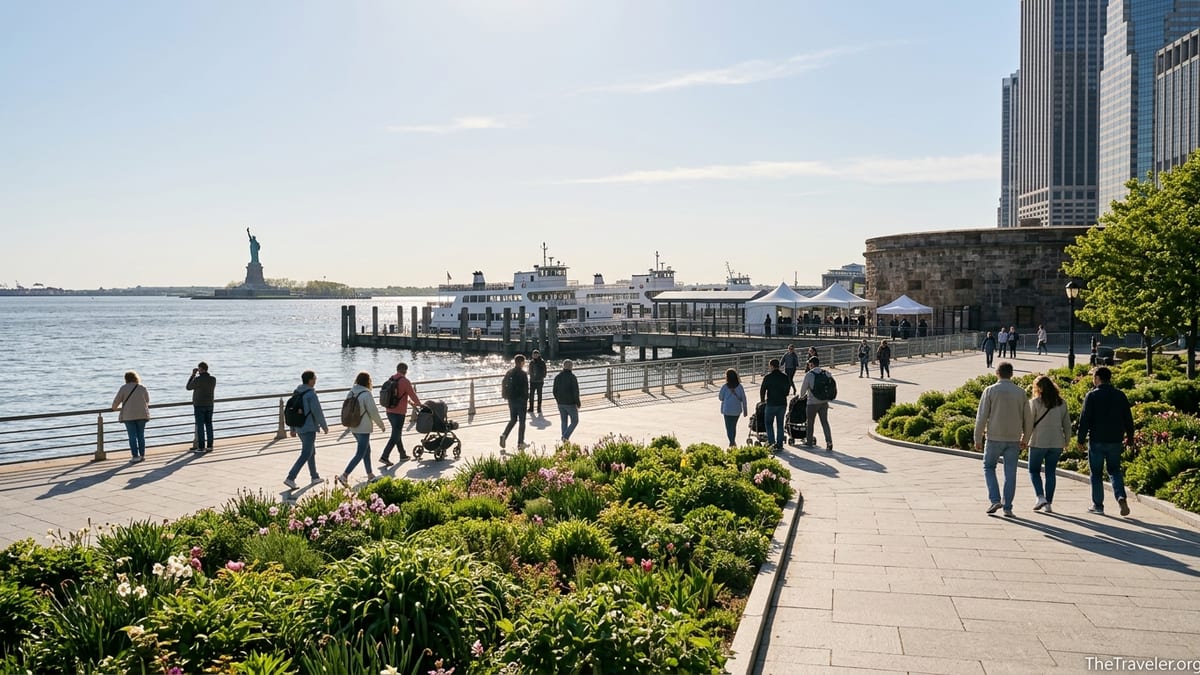
Getting Oriented: What Battery Park Actually Is
Battery Park, often shortened simply to “The Battery,” is a roughly 25‑acre public park at the very southernmost edge of Manhattan. If you stand on its waterfront promenade you face New York Harbor, with the Statue of Liberty and Ellis Island off to the southwest. Turn around and the canyons of the Financial District rise behind you. Many first‑time visitors know the name because of the ferries, but the park itself is worth at least an hour of wandering, whether or not you sail out to the islands.
The park is flat and easy to navigate. Anchoring the center is Castle Clinton, a circular 19th‑century fort made of brown stone where you will find the official ferry ticket windows and a small exhibit. To the west, lawns and gardens open toward the Hudson River and the pier where ferries depart for Liberty and Ellis Islands. To the east, you are a short walk from the Staten Island Ferry terminal and multiple subway exits. Signage in the park points clearly to the Statue of Liberty ferry entrance, the SeaGlass Carousel, and the main exits toward Broadway and Bowling Green.
Battery Park is busy most days from about 9 a.m. until mid‑afternoon, with peak crowding in spring, summer and around major holidays. Commuters cross the park on their way to nearby office towers, school groups queue for ferries, and street vendors operate near the paths leading to the waterfront. Even so, it remains one of the easiest places in Lower Manhattan to find a bench with a harbor view if you need a quick reset from the city’s pace.
Because the name “Battery Park” is attached to subway stations, a tunnel, and the park itself, it can confuse first‑time visitors checking maps on their phones. As you plan, remember that “The Battery” and “Battery Park” generally refer to the same green space, and the Statue of Liberty/Ellis Island ferries leave from the waterfront side of this park, not from a separate terminal.
Top Attractions Inside Battery Park
Even if you are mainly here for the Statue of Liberty, set aside time to explore a few of Battery Park’s own attractions. The most visible is Castle Clinton National Monument, the low circular fort near the center of the park. Today it serves primarily as the official ticketing hub and an exhibit space, but historically it guarded New York Harbor and later processed millions of immigrants before Ellis Island opened. Stepping inside gives you a short, free glimpse of the city’s 19th‑century waterfront history before you join the ferry line.
Families and design lovers should not miss the SeaGlass Carousel, near State Street and Battery Place. Rather than traditional horses, this indoor ride features large, translucent fish lit from within, which gently rotate and sway to music. Tickets are around 6 dollars per person, with discounted bundles for groups, and you buy them at the small booth next to the pavilion. On summer evenings, when the carousel stays open later, it can be a memorable stop after a late‑afternoon ferry return, especially for kids who have been walking all day.
Across the park, you will find several gardens and lawns that feel surprisingly lush for such a dense part of the city. The perennial plantings, designed by renowned garden designer Piet Oudolf, shift with the seasons. In May and June you might sit among flowering grasses and perennials; in late September the tones are more bronze and rust, but the beds are still full. Many locals use these garden paths as their daily walking route to work, so they are well maintained and generally clean.
Battery Park is also dotted with memorials and public art, including the Korean War Veterans Memorial, the Sphere sculpture that once stood at the World Trade Center, and the East Coast Memorial honoring American servicemembers lost in the Atlantic during World War II. None of these require tickets or reservations, and you can easily incorporate them into a slow loop around the park while you wait for your ferry time slot.
How to Take the Ferry to the Statue of Liberty and Ellis Island
The most important detail for any traveler: ferries to Liberty Island and Ellis Island from Manhattan leave only from the official operator, Statue City Cruises, which departs inside Battery Park. A standard adult ticket typically costs in the mid‑20‑dollar range and includes round‑trip ferry service plus access to both Liberty Island and Ellis Island. Children and seniors pay slightly less. Prices can shift over time, so think of these numbers as a general guide and check them again when you purchase.
You can buy tickets online in advance or in person at the Statue City Cruises windows inside Castle Clinton. On busy spring and summer weekends, advance online purchase is strongly recommended, especially if you want pedestal or crown access at the statue, which often sells out weeks ahead. If you buy on the day, plan to arrive early in the morning and be prepared for your preferred departure time to be full, meaning you may be assigned a later ferry.
Once you have your ticket, you will proceed from Castle Clinton toward the waterfront security area. Before boarding, all visitors pass through airport‑style screening, including metal detectors and bag checks. The security queue is where most of the waiting happens. On a quiet winter weekday you might clear it in 15 to 25 minutes; during peak summer mornings the line can stretch well over an hour. A practical approach is to book the first available ferry of the day, usually sometime between 8:30 and 9:30 a.m., then arrive 30 to 45 minutes before that time so you clear security before crowds peak.
The ferry route from Battery Park almost always goes to Liberty Island first, then continues to Ellis Island, and finally returns to Manhattan. You can ride the same ticket between the islands as long as you do not return to Battery Park first. Most visitors spend about 1.5 to 2 hours on Liberty Island, especially if they visit the museum beneath the statue, then another hour or two at the Ellis Island National Museum of Immigration. It is wise to avoid boarding the very last afternoon ferry from Battery Park if you plan to see both islands, as delays or long lines on the islands can compress your visit.
Subway, Ferry & Walking: Getting To and Around Battery Park
Battery Park is one of the easiest places to reach by public transit in New York City. Three subway complexes form a rough ring around the park: Bowling Green for the 4 and 5 trains to the north, South Ferry for the 1 train at the southeast corner, and Whitehall St–South Ferry for the R and W lines just east of the park. From any of these stations, it is a two to five minute walk to the park entrances and less than 10 minutes to the Statue of Liberty ferry security area at the waterfront.
Many visitors arrive from Midtown or Brooklyn on the subway. For example, from Times Square you can take the downtown 1 train straight to South Ferry without changing. From the East Side, the 4 or 5 express from Grand Central or 86th Street to Bowling Green is usually the quickest option. If you prefer to arrive by bus, the M15 and M20 both terminate near the Staten Island Ferry terminal just east of the park, and from there it is a short signed walk into the Battery.
To the immediate east of Battery Park, the Staten Island Ferry offers a free 25‑minute crossing between Manhattan and Staten Island. Many budget travelers pair a morning Statue of Liberty visit with an evening round‑trip on the Staten Island Ferry, using its open decks to photograph the skyline and harbor. It is important to understand, however, that this city‑run ferry does not land at Liberty Island or Ellis Island. It simply passes them at a distance. If you want to set foot on the islands or enter the statue’s pedestal, you must use the separate Statue City Cruises service from within Battery Park.
Within the park itself, everything is walkable. From the subway exit at Bowling Green to the ferry security line is roughly a quarter mile over flat paths. Strollers and wheelchairs can move through the park, though crowds around the ferry area can make the final stretch slower. If you are coming with luggage, note that large rolling bags are not allowed through ferry security and there is no official luggage storage in the park, so leave big suitcases at your hotel or a dedicated luggage storage facility elsewhere in the city.
Ferry Logistics, Timing and What It Really Feels Like
For many travelers, the most stressful part of visiting Battery Park is not the boat ride itself but the choreography of ticketing, security and timing. A realistic schedule for a standard trip from Battery Park might look like this: arrive at the park by 8:15 a.m., walk to Castle Clinton to pick up or confirm your tickets, join the security line around 8:30 a.m., board a mid‑morning ferry, spend late morning on Liberty Island and early afternoon on Ellis Island, and return to Manhattan by mid‑afternoon.
The ferries are double‑deck vessels with both indoor and outdoor seating. Crossing time from Battery Park to Liberty Island is usually 15 to 20 minutes. On clear days passengers fan out to the open decks and railings to take photos as the skyline recedes. Many locals recommend heading to the right‑hand side (starboard) as you leave Manhattan for the best views of the Statue as the boat approaches Liberty Island. On windy autumn days, the ride can feel chilly even if the sun is bright, so bring a light jacket or scarf, especially if you want to be outside for photos.
One factor many visitors underestimate is how much standing is involved. Between ticket lines, security, waiting on the pier and exploring the islands, it is common to be on your feet for several hours. Wear comfortable shoes you can stand and walk in, and bring a refillable water bottle that you can carry empty through security and refill at fountains on the islands. Small snacks like granola bars are easy to carry and can smooth over delays; larger picnic foods are allowed in most areas, but you will need to pass them through security screening.
On the return leg, you can board ferries back to Manhattan from either Liberty or Ellis Island. Digital signs and staff at each dock indicate which boat is headed to which departure point. Pay attention at Ellis Island, where separate lines often form: one for ferries back to Battery Park and another for ferries to Liberty State Park in New Jersey. If you boarded in Manhattan, make sure you are queuing for the New York‑bound boat to avoid an unplanned detour.
Local Safety, Scams and Practical Tips
Battery Park itself is generally considered safe during operating hours, with a constant presence of visitors, office workers, and park staff. The main safety issues to watch for are the same as in other major tourist zones: pickpockets in crowded queues, aggressive unofficial vendors, and occasional confusion around tickets. Keeping wallets tucked inside zipped bags and avoiding open phones hanging out of back pockets will go a long way toward staying comfortable in the crowds.
The most persistent problem in and around Battery Park is unauthorized ticket sellers marketing “Statue of Liberty tours” on the sidewalks near the park entrances and subway exits. They may wear branded vests and carry laminated badges, and some will tell visitors that access to the park or the official ferries is limited or sold out. In reality, the only authorized operator for ferries to Liberty and Ellis Islands is Statue City Cruises, and the only official ticket booths in Battery Park are inside or immediately next to Castle Clinton. A simple rule of thumb locals often share: if someone approaches you on the sidewalk to sell you a ticket, they are not the official seller.
Some of these unofficial tours cost roughly the same as the real ferry ticket but only provide a boat ride that circles near the Statue of Liberty without allowing you to disembark. Others bundle a bus ride to a distant pier with a private cruise. While those experiences can be enjoyable in their own right, many visitors feel misled when they realize they never set foot on Liberty Island or Ellis Island. To avoid disappointment, ignore all ticket offers outside the Castle Clinton area, walk directly into the park, and either show your pre‑purchased online ticket or buy from the official windows inside the monument.
Beyond ticket issues, a few other practical tips can make your visit smoother. Restrooms in Battery Park are located near Castle Clinton and in a couple of additional park buildings; lines build quickly on busy days, so use them before joining the long security queue. Food options in and around the park range from simple snack kiosks selling pretzels and drinks to sit‑down restaurants just across Battery Place. Prices near the waterfront tend to be higher than in nearby neighborhoods, so if you are budget‑conscious you might pick up a sandwich near Bowling Green or in the Financial District before walking into the park.
When to Visit and How to Combine Battery Park With Nearby Sights
From a crowd perspective, the best time to visit Battery Park and catch a ferry is usually on weekday mornings outside of major school holidays. Arriving at the park before 9 a.m. on a Tuesday in late April, for example, will almost always mean shorter lines than arriving at noon on a Saturday in July. Winter days can be pleasantly quiet, but very cold, especially on the open ferry decks. Summer brings long daylight hours and warmer harbor breezes, but also the longest queues and higher humidity.
If you are primarily interested in the park itself and harbor views rather than the islands, late afternoon and early evening can be ideal. Office workers begin to trickle away, the light softens on the skyline and water, and you can walk the promenade with fewer crowds. In June and July, it is common to see people stretched out on the lawns after work with takeout from nearby restaurants, while children run through the playgrounds and line up for the SeaGlass Carousel’s last rides of the day.
Battery Park also works well as the anchor for a full day in Lower Manhattan. A popular pattern is to book an early ferry, return by mid‑afternoon, then walk north to the Charging Bull statue and the New York Stock Exchange, continue to the 9/11 Memorial & Museum at the World Trade Center, and finish the evening with dinner in Tribeca or Chinatown. Another option is to combine a morning in Battery Park with an afternoon trip to Governors Island, which has its own seasonal ferry service from a nearby terminal and offers car‑free biking, art installations and huge river views.
Weather is a practical concern because much of your time here is spent outdoors. On hot July or August days, consider an early start to avoid midday heat on the open ferry decks and the paved areas of the islands. In winter, hats and gloves make a large difference on the breezy harbor crossings. If the forecast calls for steady rain or heavy fog, you may still enjoy the museums on Liberty and Ellis Islands, but the classic skyline views will be muted, so some visitors choose to reschedule for a clearer day when possible.
The Takeaway
Battery Park is far more than a transit point at the end of the subway map. It is a historic harborfront with its own attractions, gardens and memorials, as well as the most direct Manhattan gateway to two of the country’s most significant landmarks: the Statue of Liberty and Ellis Island. Arriving with clear expectations about ticketing, security and timing helps you trade anxiety for anticipation as you walk toward the water.
By buying only from the official operator inside Castle Clinton, arriving early for your chosen ferry, and wearing comfortable shoes for several hours on your feet, you can turn what might have been a rushed, confusing excursion into an easy highlight of your New York trip. Pair a morning on the islands with a quiet hour in the park’s gardens or a spin on the SeaGlass Carousel, and you will experience both the monumental and the intimate sides of New York Harbor in a single day.
FAQ
Q1. Where do I buy official Statue of Liberty ferry tickets in Battery Park?
Tickets for the official ferries to Liberty Island and Ellis Island are sold by Statue City Cruises at their windows inside or immediately next to Castle Clinton in the middle of Battery Park. Ignore anyone trying to sell you tickets on the sidewalks outside the park or near the subway exits.
Q2. How much time should I budget for a visit to Liberty Island and Ellis Island from Battery Park?
A typical visit takes about 5 to 6 hours door to door. That includes arriving early for security, a ferry ride out, 1.5 to 2 hours on Liberty Island, another 1 to 2 hours at the Ellis Island museum, and the return ferry to Manhattan.
Q3. What is the best time of day to take the ferry from Battery Park?
Early morning departures are usually best. Booking the first or second ferry of the day, and arriving 30 to 45 minutes before your time slot, helps you avoid the longest security lines and leaves more flexible time on the islands.
Q4. Can I use the Staten Island Ferry instead of paying for the Statue of Liberty ferry?
The Staten Island Ferry is free and offers good harbor and skyline views, but it does not stop at Liberty Island or Ellis Island. It passes at a distance. To set foot on either island or enter the statue’s pedestal or museum, you need a separate paid ticket on the official Statue City Cruises ferries from Battery Park.
Q5. Are there food and restrooms available in Battery Park and on the islands?
Yes. Battery Park has public restrooms near Castle Clinton and kiosks selling snacks and drinks. Both Liberty Island and Ellis Island also have restrooms and cafeterias or cafes where you can buy simple meals, though prices are typically higher than in nearby neighborhoods.
Q6. Is Battery Park accessible for visitors with limited mobility or strollers?
The park’s main paths are flat and paved, and the area from the subway exits to the ferry is generally accessible. The ferries and the museums on Liberty and Ellis Islands offer ramps and elevators. That said, crowds and security lines can be tiring, so visitors with limited mobility may want to plan extra time and consider visiting on a quieter weekday morning.
Q7. What should I wear and bring for a visit starting at Battery Park?
Comfortable walking shoes are essential, as you will likely be on your feet for several hours. Dress in layers so you can handle cooler breezes on the open ferry decks and warmer temperatures in the sun. A refillable water bottle, small snacks and a hat or light jacket, depending on the season, will make the day more comfortable.
Q8. Is Battery Park safe for solo travelers and families?
During daylight and early evening hours, Battery Park is generally safe and busy with a mix of tourists and locals. Use normal big‑city precautions: keep valuables close, be cautious in crowded lines and avoid engaging with aggressive unofficial vendors. Families with children will find plenty of open space and playgrounds, but should hold hands near the ferry queues and waterfront.
Q9. Can I just enjoy Battery Park without taking any ferries?
Absolutely. Many New Yorkers come to Battery Park solely for the harbor views, the lawns, the gardens and attractions like the SeaGlass Carousel. You can easily spend an hour or two strolling the promenade, visiting memorials, and watching boats come and go without ever boarding a ferry.
Q10. How far in advance should I book Statue of Liberty pedestal or crown access from Battery Park?
Pedestal access often sells out several days or weeks ahead during busy seasons, and crown tickets can disappear months in advance. If visiting during spring, summer, or major holiday periods, it is wise to book as early as your travel dates are confirmed to secure your preferred time and level of access.