


For many visitors, Battery Park is simply the jumping-off point for the Statue of Liberty and Ellis Island ferries. But if you rush straight from the subway to the security line, you miss one of New York City’s most atmospheric waterfront parks. Recently revitalized and now officially known as The Battery, this 25-acre green space at the southern tip of Manhattan rewards anyone who lingers with immersive gardens, thoughtful memorials, family-friendly attractions, and easy access to compelling museums and waterfront views. Here is how to make the most of Battery Park beyond catching the ferry.
Get the latest updates straight to your inbox!
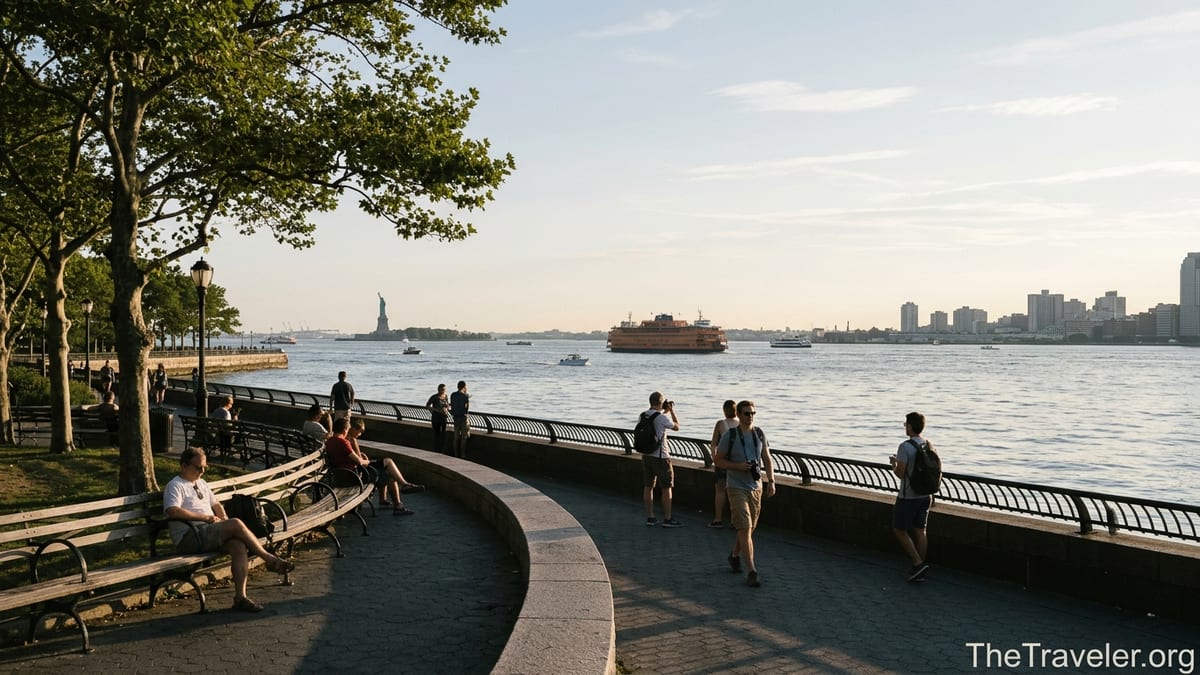
Stroll The Battery’s Waterfront and Historic Promenade
The easiest way to appreciate Battery Park beyond the ferry is simply to slow down and walk its curving waterfront paths. The park arcs around the very bottom of Manhattan, facing New York Harbor, so almost every bench offers views of the Statue of Liberty in the distance, ferries coming and going, and the glassy skyline of Jersey City across the water. On a clear day you can see helicopters lifting off from nearby pads, Staten Island Ferries sliding past in a bright orange blur, and sailboats catching the afternoon breeze.
If you arrive early for a later ferry slot, resist the urge to queue immediately and instead follow the Esplanade west toward Battery Place. The path is generally flat and paved, suitable for strollers and wheelchairs, and lined with mature trees that create pockets of shade in summer. Local office workers often eat lunch on the stone benches here, and you will spot joggers looping past on their way toward Battery Park City and the Hudson River Greenway. This is one of the best places downtown to feel the contrast between the city’s skyscrapers and the open water.
Just inland from the waterfront, look for clusters of food carts and kiosks that set up seasonally, especially from late spring through early fall. Offerings change from year to year, but you can often find coffee stands, pretzel and hot dog vendors, and small stalls selling soft-serve ice cream or fresh lemonade. Prices are typically a few dollars higher than in more residential neighborhoods, but still reasonable by Manhattan standards and convenient if you are between museum visits or just finished a long walk.
Early morning and golden hour are the most photogenic times on the promenade. In the first couple of hours after sunrise, the harbor is often calmer and the light softer, making it easier to capture sharp photos of the skyline. Late in the afternoon, the sun sinks behind New Jersey, turning the water a muted silver and silhouetting the ferries. Even if you never set foot on a boat, the waterfront loop alone can justify a trip down to Battery Park.
Experience the SeaGlass Carousel and Immersive Gardens
One of the most distinctive attractions in Battery Park is the SeaGlass Carousel, a shimmering glass pavilion set within the park’s southern lawns. Conceived by The Battery Conservancy as a nod to the park’s history as the original home of the New York Aquarium, the carousel replaces traditional horses with translucent fiberglass fish that glow with soft, changing colors. Riders sit inside the fish rather than on top of them, and the entire room slowly rotates as individual sea creatures glide up and down, creating a gentle, underwater effect.
The SeaGlass Carousel operates seasonally, with extended hours in warmer months and shorter schedules in winter, and tickets are typically just a few dollars per ride, purchased from a small booth or vending machines nearby. Lines are usually shorter on weekday mornings and non-holiday evenings, while weekends and school holidays can be much busier. Even if you are not traveling with children, it is worth stepping inside to see the choreography of light and movement. Photographers often linger around the pavilion at dusk, when the glowing fish contrast dramatically with the darkening park.
Surrounding the carousel are some of the city’s most thoughtfully planted perennial gardens. The Battery has more than an acre of perennial beds designed by Dutch garden designer Piet Oudolf, known for his naturalistic plantings on Manhattan’s High Line. Here, he worked with a palette of grasses, coneflowers, echinacea, and other hardy species that change character throughout the seasons. In late spring and early summer, the borders burst with color, while autumn highlights tawny grasses and seed heads that look beautiful even after the first frost. Benches tucked among the beds make this a surprisingly peaceful place to read or people-watch, even on busy days.
Families can easily combine a spin on the SeaGlass Carousel with a relaxed hour in the gardens. Pick up a snack from a nearby kiosk, find a bench within sight of the carousel, and let kids burn off energy in the open lawns. If you are waiting for a timed entry to a nearby museum, this area works well as an outdoor “waiting room” that does not feel like a compromise.
Visit Nearby Museums: Jewish Heritage and Skyscraper Stories
Just beyond the western edge of Battery Park, along Battery Place, two compact but memorable museums make excellent add-ons to a harbor visit. The Museum of Jewish Heritage: A Living Memorial to the Holocaust stands at 36 Battery Place on Edmond J. Safra Plaza, in a six-sided building with a tiered roof that symbolically evokes both the Star of David and the six million Jews murdered during the Holocaust. Inside, the museum presents rotating exhibitions on Jewish life before, during, and after the Holocaust, with artifacts, personal testimonies, and multimedia installations.
Exhibitions change regularly, but recent programming has included shows on Jewish resistance during World War II, Jewish communities in New York, and contemporary reflections on memory and identity. Expect to spend at least 90 minutes to two hours inside if you want to move beyond a cursory visit. The museum typically charges an admission fee, though reduced or free hours are sometimes offered on specific evenings, so checking the latest schedule before arriving is sensible. For travelers already contemplating the Statue of Liberty and Ellis Island immigration stories, a stop here deepens the broader narrative of 20th century migration and persecution.
A few minutes’ walk away at 39 Battery Place, the Skyscraper Museum focuses on the history and future of tall buildings, with particular attention to New York’s skyline. Founded in the 1990s and now housed in a compact ground-floor space, the museum showcases scale models, historic photographs, and digital exhibits that trace the evolution from early Manhattan towers to global supertalls. Architecture enthusiasts, students, and anyone fascinated by city planning will find this a rewarding detour.
Because both museums are relatively small, they are manageable even on a tight itinerary. A common pattern for visitors is to take a morning ferry to Liberty and Ellis Islands, then return to Battery Park for a late lunch before visiting one of the museums in the afternoon. Alternatively, if ferry tickets are sold out or the lines feel overwhelming, you can pivot to a museum visit instead and still feel that you have made good use of your time downtown.
Explore Castle Clinton and Battery Park’s Monuments
In the heart of Battery Park sits Castle Clinton National Monument, a circular sandstone fort that predates many of New York’s more famous landmarks. Originally built in the early 19th century as a coastal defense structure, it has served variously as a performance space, immigration depot, and aquarium before becoming a national monument. Today, many visitors only see Castle Clinton as the place where Statue of Liberty tickets are checked, but it is worth walking its low ramparts and interior courtyard even if you are not boarding a boat.
Inside, interpretive panels outline the fort’s layered history and explain how the shoreline itself has shifted as Lower Manhattan was extended with landfill. On quieter days, park rangers are available to answer questions about the fort’s role in harbor defense and immigration processing. Because the structure is largely open-air, visits are quick and easy, and there are no additional tickets required simply to step inside and look around. Photographers often use the fort’s arched openings to frame views of the harbor or the glass-and-steel skyline beyond.
Battery Park also contains several notable memorials that resonate strongly in the context of global migration. Near the waterfront, the East Coast Memorial honors American servicemen who died in the Atlantic during World War II, with soaring granite slabs engraved with thousands of names and a bronze eagle sculpture facing the harbor. A short walk away, another sculpture depicts a group of immigrants in various poses of hope and exhaustion, evoking those who arrived in New York by ship in the late 19th and early 20th centuries.
Exploring these monuments on foot adds a layer of meaning to the harbor panorama. Standing beside the eagle of the East Coast Memorial while ferries weave through the harbor, it is easy to imagine the convoys that once crossed this same water under threat of attack. Likewise, the immigrant sculpture provides a vivid counterpoint to the modern cruise ships and leisure boats docking nearby, reminding visitors that the harbor was once a first glimpse of safety for people with no guarantee of what waited beyond customs.
Relax, Dine, and People-Watch on the Waterfront
Battery Park is not only about history and museums; it also offers several comfortable places to linger over a drink or a casual meal while soaking up the harbor atmosphere. Operators and tenants in and around the park change over time, but you can generally expect to find seasonal outdoor cafes and small bars that set up with plastic or metal tables facing the water. Menus skew toward accessible fare: think draft beer, simple cocktails, wine by the glass, and basic food like burgers, salads, and seafood appetizers.
Prices tend to reflect the prime location rather than being true neighborhood bargains, but the premium often feels justified when you factor in the open-air seating and unobstructed views. Many travelers treat a drink on the waterfront as part of the experience, for example stopping for a glass of wine or an iced coffee after returning from Ellis Island, while they wait for their phone batteries to recharge and their legs to recover. Solo travelers in particular may appreciate that these venues feel casual and safe, with a constant flow of tourists, local office workers, and families passing by.
If you prefer to bring your own food, the park’s broad lawns and scattered benches make ideal picnic spots. Just inside the park from the harbor, The Battery Oval is a wide expanse of grass used for events and everyday lounging. On sunny days, you will see groups of friends stretched out with supermarket snacks, travelers pairing takeaway dumplings or pizza slices with a harbor view, and nearby residents walking their dogs along the edge of the lawn. As always in New York, be discreet with alcohol, dispose of trash properly, and avoid feeding the pigeons, which quickly become aggressive when food appears.
Even without a formal meal, the simple act of people-watching can be a highlight here. Battery Park draws an unusually international crowd, from tour groups speaking half a dozen languages to commuters hurrying to the Staten Island Ferry, cyclists heading toward the Brooklyn Bridge, and street performers juggling or playing instruments near the main walkways. If you only see Lower Manhattan as a canyon of financial towers, an hour on a park bench at The Battery provides a much softer, human-scale perspective on the neighborhood.
Combine Battery Park With Lower Manhattan Walks
One of the advantages of spending more time in Battery Park is how easily it connects to the rest of Lower Manhattan on foot. From the park’s northern edge near Bowling Green, you can stroll up Broadway toward the Charging Bull statue and the New York Stock Exchange, continue to Trinity Church and its historic graveyard, and then reach the entrance to the Brooklyn Bridge pedestrian path in 20 to 30 minutes. For visitors who enjoy urban walking, this makes it possible to design a full day that starts with harbor views, continues through the Financial District, and culminates in a late-afternoon crossing to Brooklyn.
Another rewarding loop leads west into Battery Park City, a planned neighborhood built on landfill along the Hudson River. From the park, follow the signs for the Esplanade and you will quickly reach landscaped paths lined with apartment buildings, playgrounds, and public art. The Battery Park City waterfront promenade is quieter than the more touristy sections of The Battery itself, with more local joggers and families and fewer crowds. Benches along the Hudson offer front-row views of sunset behind the New Jersey skyline, and in warmer months you will often see kayakers and sailboats out on the river.
Travelers with an interest in modern history and remembrance can also head north and east from Battery Park toward the National September 11 Memorial & Museum at the World Trade Center site. The walk typically takes around 15 to 20 minutes at a moderate pace. Paired with a morning in The Battery’s gardens and ferries, an afternoon visit to the 9/11 Memorial creates a powerful, if emotionally intense, overview of New York’s resilience and renewal along its waterfront.
Whichever route you choose, comfortable walking shoes and a flexible schedule are key. Street-level distances downtown are shorter than they look on a subway map, but frequent traffic lights, construction detours, and photo stops can make progress slow. Treat Battery Park as your anchor and build short exploratory walks outward, rather than feeling you must “cover” every sight in Lower Manhattan in one attempt.
Stay Street-Smart: Ferries, Tickets, and Crowds
Spending time in Battery Park beyond the Statue of Liberty ferry also gives you a chance to navigate the area more confidently and avoid common pitfalls. In recent years, visitors have repeatedly reported aggressive, unofficial ticket sellers in and around the park, some steering people toward more expensive boat tours that do not actually land on Liberty or Ellis Islands. Official Statue of Liberty and Ellis Island ferries depart from the waterfront at The Battery and from Liberty State Park in New Jersey, and tickets are sold through the National Park Service’s authorized operator. If someone approaches you on the sidewalk trying to sell “last-minute” or “VIP” tickets, it is safer to decline and follow the clearly marked signs to the official ticket windows or buy online in advance.
Crowd levels vary dramatically by season and time of day. Summer weekends, school holidays, and sunny days during peak tourist season can see security lines for the ferries stretching across parts of the park. If you already hold timed-entry tickets, consider arriving a little early and using any buffer time to explore the gardens, monuments, or waterfront benches rather than hovering anxiously near the security tent. In cooler months, especially from November through March, lines are often shorter, and the park atmosphere feels calmer, though wind off the harbor can be biting, so warm layers and hats are highly recommended.
Restrooms, security, and general services are comparable to other major New York parks, but planning ahead helps. Restroom facilities can become busy immediately after large ferries dock, when hundreds of passengers return at once, so try to use the facilities during quieter intervals. Drinking fountains and occasional bottle-filling stations are scattered near major paths, but many visitors find it more reliable to carry water purchased from nearby delis in the Financial District, where prices are typically lower than at kiosks in the park itself.
Finally, remember that Battery Park is part of a living city, not a theme park. Construction projects, seasonal closures, and changing concession contracts can temporarily affect specific attractions or dining options. Checking opening hours for the SeaGlass Carousel and nearby museums shortly before your visit, and then remaining open to small improvisations once you arrive, will help you get the best out of the park without feeling thrown off by minor surprises.
The Takeaway
Battery Park is far more than the gateway to the Statue of Liberty. It is a layered landscape where harbor views, historic fortifications, gardens, carousels, and museums all coexist within an easy walk of each other. By dedicating a few extra hours to the park itself, you can turn what might have been a hurried transit stop into a rounded Lower Manhattan experience.
Whether you are riding a glowing fish on the SeaGlass Carousel, tracing names at the East Coast Memorial, reflecting inside the Museum of Jewish Heritage, or simply watching ferries drift across the water from a park bench, The Battery rewards those who linger. Plan your day so the ferry is just one chapter, not the whole story, and you will come away with a much richer sense of New York’s relationship with its harbor and its history.
FAQ
Q1. Is Battery Park worth visiting if I am not taking the Statue of Liberty ferry?
Yes. The park offers harbor views, gardens, the SeaGlass Carousel, historic Castle Clinton, and easy access to nearby museums, making it a worthwhile destination on its own.
Q2. How much time should I plan to spend in Battery Park beyond the ferry?
Allow at least 1.5 to 3 hours if you want to stroll the waterfront, ride the SeaGlass Carousel, relax in the gardens, and briefly see Castle Clinton or a nearby museum.
Q3. When is the best time of day to visit Battery Park for views and photos?
Early morning and late afternoon generally offer the softest light and more comfortable temperatures, with fewer crowds than midday during peak tourist season.
Q4. Are the SeaGlass Carousel and gardens open year-round?
The gardens are accessible year-round, though they are most colorful from spring through fall. The SeaGlass Carousel operates seasonally, with reduced hours in colder months, so check current schedules before you go.
Q5. Are there good food options in or near Battery Park?
Yes. You will find seasonal outdoor cafes, food carts, and kiosks in the park, plus a wide range of restaurants and delis in the surrounding Financial District within a short walk.
Q6. Is Battery Park a good place to visit with children?
It is very family-friendly. Kids typically enjoy the SeaGlass Carousel, open lawns for running around, watching boats on the harbor, and short walks to nearby playgrounds in Battery Park City.
Q7. How do I avoid ticket scams around Battery Park?
Only buy Statue of Liberty and Ellis Island tickets from official National Park Service channels or the clearly signed ticket windows inside the park, and ignore anyone selling tickets on nearby sidewalks.
Q8. Are there free things to do in Battery Park?
Yes. Walking the waterfront, exploring the gardens, visiting the monuments, and stepping inside Castle Clinton’s courtyard are free. You pay only for optional attractions like the carousel or museums.
Q9. Is Battery Park accessible for visitors with limited mobility?
Most main paths are paved and relatively flat, and benches are frequent. However, some older sections and crowded areas can be uneven, so allow extra time and consider visiting during less busy hours.
Q10. Can I combine a visit to Battery Park with other Lower Manhattan sights in one day?
Yes. Many travelers pair Battery Park with the Financial District, the 9/11 Memorial, or a walk into Battery Park City or over the Brooklyn Bridge, creating a full but manageable day on foot.