


The Bay of Kotor in Montenegro looks like a fjord, feels like a Mediterranean harbor town and is small enough that you can cross it by boat in under an hour. Deciding how to explore it is less straightforward. Do you stay on the water and hop between villages by speedboat, or drive the narrow coastal road and climb to sweeping viewpoints high above the bay? This guide pulls together current local options, prices and practical tips so you can design a visit that combines boat trips, pretty stone villages such as Perast, Dobrota and Prčanj, dramatic viewpoints and easy swimming stops.
Get the latest updates straight to your inbox!
Understanding the Bay of Kotor Layout
The Bay of Kotor, often called Boka Bay, is a series of connected inlets that cut deep into Montenegro’s coastline. The main town of Kotor sits at the far end of the innermost bay, backed by steep limestone mountains. As you head northwest, the bay opens out toward Perast and the strait of Verige, then again toward Tivat and the open Adriatic. On a map, it resembles a butterfly with folded wings, and that geography explains why boats are often faster than cars.
Driving from Kotor to Perast, for example, means following a slow, single coastal road for about 12 kilometers. In light traffic this might take 20 minutes, but in July and August it can easily double because of tour buses, parked cars and pedestrians. A small boat can cover the same distance in roughly 10 minutes while giving you uninterrupted views of church towers, stone palaces and the islands off Perast. Understanding these basic geography and traffic patterns will help you decide when a boat is worth paying for and when a car or bus makes more sense.
Kotor’s old town is the main base for visitors, including cruise passengers, with the marina and boat-tour kiosks lined up just outside the city walls. Many tours radiate from here, running a loop out past Dobrota and Prčanj toward the outer bay, or in the opposite direction via Muo and Prčanj. If you base yourself in the quieter villages of Dobrota or Prčanj, you will still be within a short taxi or bus ride of Kotor, but much closer to low-key swimming spots and waterfront guesthouses.
Another factor to appreciate is that the Bay of Kotor is now connected to Lovćen National Park by the Kotor–Lovćen cable car, which runs from the coastal area near Kotor up to Kuk on the Lovćen massif in about 11 minutes. From the upper station, you see the full double-bay layout from above, with Kotor behind you and the outer bay stretching toward Tivat. This bird’s-eye view is a useful complement to any boat trip because it helps you visualize how the various villages and inlets fit together.
Boat Trips: Blue Cave, Our Lady of the Rocks and Classic Bay Cruises
Boat tours are the signature experience in the Bay of Kotor, and competition among operators keeps prices relatively consistent. From Kotor’s waterfront, shared speedboat tours that include Perast, Our Lady of the Rocks and the Blue Cave on the open sea side typically start around 35 to 60 euros per person, depending on duration and inclusions. A common option is a three-hour Blue Cave speedboat loop that visits the artificial island of Our Lady of the Rocks, glides past the old submarine tunnels from the Yugoslav era and continues out of the bay to the Blue Cave for a quick swim stop.
Private speedboat charters are widely available and usually quoted per boat rather than per person. Recent listings show small speedboats for Blue Cave and bay circuits starting from roughly 240 to 320 euros for a three-hour private tour, often with fuel and skipper included and capacity for six to eight passengers. For a group of friends or a family, this can work out close in price to joining a shared tour while giving you control over how long you linger in Perast, where you swim, and whether you skip the more crowded stops in high season.
If you are more interested in the fjord-like inner bay than the open-sea Blue Cave, look for shorter “Boka Bay” or “Our Lady of the Rocks and Perast” cruises lasting 1.5 to 2.5 hours. These typically cost less, sometimes around 25 to 40 euros per person in a shared boat, and concentrate on the calmest parts of the bay. Families with younger children or anyone prone to seasickness often prefer these shorter inner-bay cruises that avoid the choppier water near the cave. They still include highlights such as gliding past Dobrota’s waterfront palaces and pausing off Prčanj to photograph its massive baroque church facade from the water.
Booking is straightforward. In summer you can walk the promenade by Kotor’s old town and compare offers at physical kiosks, where departure boards list times almost every hour in the morning and afternoon. Many operators also accept online bookings, which can be useful on days with cruise-ship calls when demand spikes and the most popular mid-morning slots fill up quickly. Whatever you choose, check whether the tour includes a swimming stop, how long you actually spend at Perast and Our Lady of the Rocks, and whether drinks or shade are provided on board.
Perast and Our Lady of the Rocks: Icons of the Inner Bay
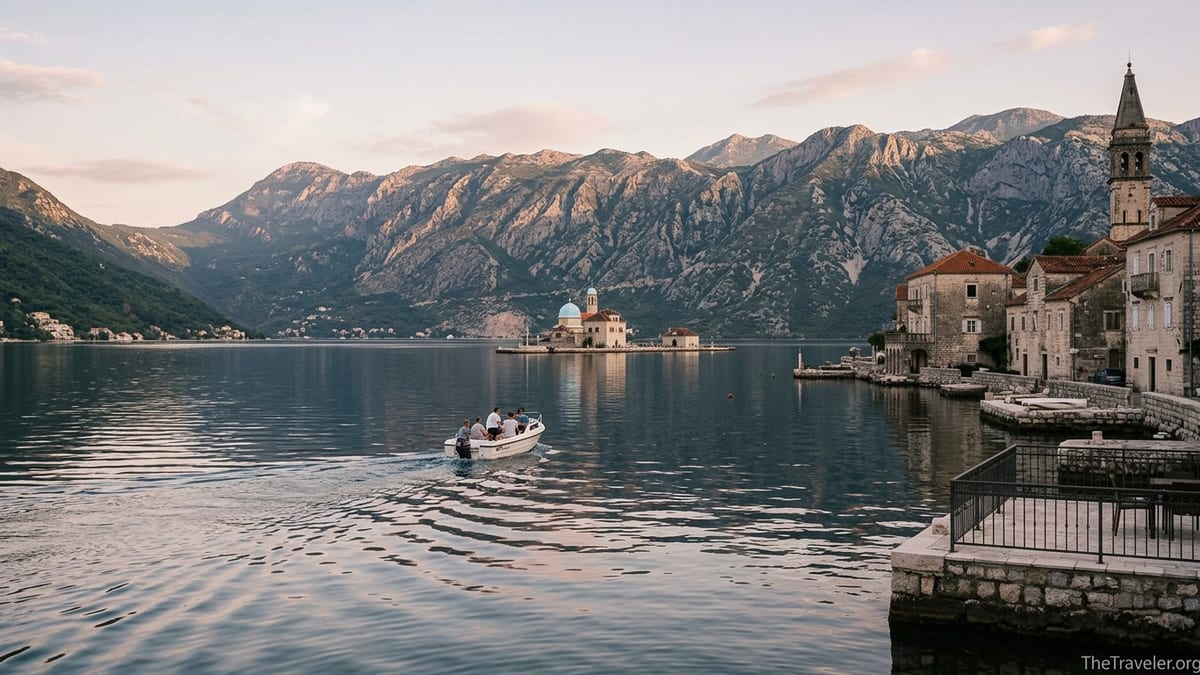
Perast is the postcard village of the Bay of Kotor, a string of baroque palaces and bell towers facing directly onto the narrowest part of the bay. Vehicles are restricted from most of its waterfront in summer, so even if you drive you will need to park in the designated lots at either end and walk in. This car-light environment is part of the charm: children stroll along the stone quay with gelato, and diners sit almost at water level at restaurant terraces. The village itself is small enough to explore in an hour, but most visitors come for the twin islands just offshore.
Our Lady of the Rocks is the better-known of the two islets, an artificial island created over centuries by local sailors dropping stones and even scuttled ships into the water after safe voyages. Today it holds a church and a tiny museum with votive paintings and maritime artifacts. Boats shuttle back and forth from Perast’s waterfront in summer, and a simple return ride to the island often costs in the region of 5 to 10 euros per person, arranged directly with small local skippers operating from the main pier. Most bay and Blue Cave tours also include a 20 to 30 minute stop here, enough time to circle the island and look back at Perast’s skyline framed by mountains.
The neighboring island of Sveti Đorđe, by contrast, is a natural island topped by a Benedictine monastery and a cypress-shaded graveyard. It is generally not open for casual visits, but you can photograph it easily from the perimeter of Our Lady of the Rocks or from the waterfront in Perast. For many visitors, the classic view is the two islands side by side at golden hour, when the light softens and mountains fall into shadow. Evening boats from Kotor or Perast can be particularly atmospheric in early and late summer when the bay is quieter but the water is still warm.
Perast is also a practical stop for a swim or lunch break during a coastal drive. Several small hotels and taverns line the shore, serving grilled fish, seafood risotto and Montenegrin staples such as black risotto with cuttlefish ink. Most have ladders or steps down into the water so you can take a dip between courses. Water shoes are helpful because the shoreline is mostly stone and concrete rather than sandy beach, and the water becomes deep quickly a few meters from shore.
Dobrota, Prčanj and Quiet Swimming Spots
Northwest of Kotor’s old town, the waterfront gradually shifts into the long village of Dobrota, known for its historic stone captain’s houses and quieter atmosphere. Many guesthouses and boutique hotels are converted from these old palaces, with private jetties where you can step directly into the bay. For independent travelers who want to swim several times a day without leaving town, staying in Dobrota is often more appealing than staying inside Kotor’s walled old town, where you must walk to the waterfront for a dip.
Swimming in Dobrota usually means entering the water from stone pontoons rather than sandy beaches. Local families spread towels on the concrete jetties, and small ladders provide access to the surprisingly clear water. The bay here is sheltered, which keeps waves small but also means the water can feel warmer and less refreshed in mid-summer. Early morning or late afternoon swims are particularly pleasant, with the sun hitting the opposite mountains and Dobrota’s waterfront staying shaded and cool.
Across the bay, the village of Prčanj stretches along another narrow strip of shore, backed by olive trees and terraces. Its dominating landmark is the Church of the Nativity of the Blessed Virgin Mary, a large baroque church that you will recognize by its wide staircase and classical columns. From the water on a boat tour, the church facade looks almost oversized compared to the village around it and makes for one of the most photogenic stops between Kotor and the outer bay. On land, Prčanj offers a handful of small pebble and stone swimming areas, several of them near cafes or beach bars where you can rent sunbeds.
For simple, local-feeling swim stops away from big groups, watch for informal bathing spots along the coastal road between Kotor, Dobrota and Prčanj. These might be just a couple of steps and a ladder down to the water, often used by residents in the early morning. If you stay nearby, ask your accommodation to point out their favorite places to swim. As a rule of thumb, avoid entry points right next to busy road bends or where parked cars line the quay, and keep an eye on passing boat traffic, especially near small piers used for transfers to Our Lady of the Rocks.
Viewpoints and Scenic Roads: From Serpentine Bends to Lovćen
For all the joy of being on the water, some of the Bay of Kotor’s most memorable moments happen far above it. One classic excursion is the old Kotor–Njeguši road, a mountain route famous for its tight series of numbered hairpin bends. On a clear day, drivers and cyclists who brave this road are rewarded with layered views of the bay, with the walled town of Kotor directly below and multiple inlets stretching away behind it. The bends are physically marked, and travelers often talk about pausing around the mid-twenties for the best photo angles over the bay.
The road is narrow, with sharp switchbacks and occasional tour buses, so it is most enjoyable if you are comfortable with mountain driving. Many visitors prefer to join an organized tour or hire a local driver rather than tackling the route in a rental car, especially in peak season when oncoming traffic can force tricky reversing on the bends. A more relaxed alternative is to use the modern Kotor–Lovćen cable car, which starts near the bay and rises to the Lovćen plateau in around 11 minutes. From the top station, you can walk to panoramic viewpoints and look down on the full outline of the bay and, on very clear days, even catch a glimpse of the Adriatic beyond the outer bays.
Beyond the famous serpentine road, simple drives along the bay’s edge can be scenic in their own right. The stretch from Kotor through Dobrota to Ljuta offers constant water views and passes old stone churches and palaces at close range. In the opposite direction, the coastal road through Muo and Prčanj leads eventually toward the narrow Verige strait and the turnoffs for the ferry across to Lepetane, which allows you to loop back toward Herceg Novi and the outer bay. These roads are best tackled in the early morning or later in the evening when traffic is lighter and the light is softer for photography.
Whichever route you choose, build in time for unplanned stops. A small lay-by with two parked cars may hide one of the best panoramic pullouts over Kotor, while a roadside cafe terrace can deliver unexpectedly broad views across to Perast and the island churches. Driving here is not about covering long distances but about allowing the bay to reveal itself from different levels and angles.
Driving vs Boating: Choosing How to Explore
The Bay of Kotor rewards both perspectives: water-level and high-level. The right balance between boat and car (or bus and taxi) depends on your priorities and time. If you have only one full day, a common pattern is to book a half-day boat tour from Kotor in the morning that includes Perast and Our Lady of the Rocks, then spend the afternoon exploring Kotor’s old town and perhaps taking the cable car for a sunset view. This approach gives you the feeling of being out on the bay without needing to rent a car at all.
For trips of two or three days or more, renting a car or using taxis opens up quieter corners and flexible timing. With a vehicle, you can stay in Dobrota or Prčanj, visit Perast early in the morning before tour groups arrive, drive the serpentine road toward Njeguši for a viewpoint, and stop at small waterfront taverns away from the densest clusters of visitors. Parking can be challenging in high season, particularly around Kotor and Perast, so factor in the cost of paid lots and the possibility of walking in from the edge of town.
Boats have some clear advantages. Distances across the bay are much shorter than the equivalent road distances, so you avoid traffic and tight parking. From the water you also appreciate the amphitheater-like shape of the mountains and the way each village faces the sun differently through the day. Multi-stop tours bundle several highlights into a single outing, which can be efficient if you are short on time. The trade-offs are cost, exposure to sun and wind and less control over your schedule when you join group tours.
A hybrid strategy works well for many visitors: use a boat for the outward leg of a day, then return by road or vice versa. For example, you might cruise from Kotor to Perast in the morning, spend a few hours wandering and swimming, then catch a local taxi or bus back along the coast in the late afternoon. Thinking of the bay as a loop rather than an out-and-back route helps you experience more without retracing your steps too often.
Practical Tips: Weather, Seasons, Costs and Safety
Weather is a major factor in how enjoyable your time on the bay will be. In late spring and early autumn, air temperatures are warm but not extreme, and boat trips often feel comfortable all day. In July and August, midday heat and reflected glare off the water can make midday boat rides intense, so many travelers aim for morning or late-afternoon departures. Occasional afternoon thunderstorms can roll off the mountains in summer; reputable operators will cancel or shorten trips if conditions deteriorate, so providing a local phone number or checking in at the kiosk a couple of hours before departure is sensible.
On the cost side, budget for at least one organized boat trip if your finances allow. A shared half-day Blue Cave and bay tour for a couple can easily use up 70 to 120 euros once you add a light lunch and drinks on shore, while a private charter will cost more but can be split between multiple people. Public buses between Kotor and nearby villages such as Perast are generally inexpensive compared to taxis, but schedules may shift year to year and information is not always well publicized, so many visitors combine one or two bus rides with occasional taxis booked through local companies or their accommodation.
Safety on the water is mostly a matter of common sense. Bring sun protection, secure hats and phones against wind, and follow crew instructions when moving on a bouncing speedboat. Life jackets should be available on all licensed vessels; do not hesitate to ask where they are kept. If you plan to swim at the Blue Cave or off a boat anywhere in the bay, be honest with yourself about your swimming ability. Water near the cave can be surprisingly deep and boat traffic around the entrance can be busy in high season, so staying close to the boat ladder and in sight of the skipper is wise.
On land, the main hazards relate to traffic on narrow roads and limited pavements in villages. When strolling along the waterfront in Dobrota, Prčanj or Perast, keep to the bay side of the road where possible and expect cars rounding bends with limited visibility. Good walking sandals or trainers are more practical than thin flip-flops, both for stepping on uneven stone quays and for climbing Kotor’s city walls or staircases to church viewpoints. Tap water in Montenegro is generally considered safe to drink in urban areas, and most visitors rely on it to refill bottles rather than buying plastic water daily.
The Takeaway
The Bay of Kotor is compact but layered, and the most satisfying visits tend to mix time on the water with time on the road and at elevation. Boats unlock the fjord-like perspectives, shorten journeys between villages and bring you up close to icons such as Our Lady of the Rocks and the Blue Cave. Driving or joining road-based excursions reveals how the bay folds into the mountains and gives you flexibility to linger at viewpoints, swim from quiet jetties and sample low-key waterfront restaurants in Dobrota, Prčanj and beyond.
Rather than asking whether you should explore by boat or car, think about which experiences matter most to you: the feel of wind and spray as you cross the bay, the slow rhythm of village promenades, the thrill of seeing the entire double bay from above, or the simple pleasure of stepping off your guesthouse jetty for a pre-breakfast swim. With a little planning and awareness of current boat options, seasonal traffic and realistic costs, you can string these moments together into a route that does justice to one of the Adriatic’s most distinctive landscapes.
FAQ
Q1. Is it better to stay in Kotor old town or in villages like Dobrota or Prčanj?
Kotor old town is atmospheric and convenient for restaurants and boat tours, but it can be noisy and crowded in peak season. Dobrota and Prčanj are quieter, often right on the water with easier swimming access, though you will rely more on taxis or buses to reach Kotor’s old town in the evening.
Q2. How much should I expect to pay for a standard boat tour on the Bay of Kotor?
Shared speedboat tours that include Perast, Our Lady of the Rocks and the Blue Cave commonly cost in the range of 35 to 60 euros per person, depending on the duration and inclusions. Shorter inner-bay cruises without the Blue Cave are usually a bit cheaper.
Q3. Do I need to book boat tours in advance?
In July and August or on days with large cruise ships, advance booking is sensible, especially for mid-morning departures and popular Blue Cave itineraries. In shoulder seasons you can often book the day before or even walk up to kiosks along Kotor’s waterfront and find same-day availability.
Q4. Can I visit Our Lady of the Rocks directly from Perast without joining a big tour?
Yes. In season, small local boats run frequent shuttles from Perast’s waterfront to Our Lady of the Rocks, typically charging a modest return fare per person. You simply pay at the pier and arrange with the skipper when to be picked up for the ride back.
Q5. Is driving the serpentine road above Kotor safe for visitors?
The old Kotor–Njeguši road is narrow with many tight hairpins and can feel demanding for drivers unused to mountain roads. It is safest in good weather, during daylight and when taken slowly. If you are unsure, consider booking a local driver or a small-group tour so that you can enjoy the views without worrying about traffic.
Q6. When is the best time of year to explore the Bay of Kotor by boat?
Late May, June, September and early October offer a good balance of warm weather and less crowding. In high summer, early morning and late afternoon departures are more comfortable than midday, when sun and heat are at their strongest.
Q7. Are there sandy beaches in the Bay of Kotor?
Most swimming spots inside the bay are stone quays, concrete jetties or small pebble areas rather than long sandy beaches. If you want classic sandy stretches, you may prefer day trips to the open Adriatic coast near Budva or farther south, using the bay mainly for its scenery and village atmosphere.
Q8. Do I need cash, or can I pay for tours and restaurants by card?
Many established tour operators, hotels and restaurants accept cards, but smaller boat shuttles, kiosk snacks and some family-run cafes may prefer or require cash. Carrying a mix of card and euros is practical, especially for small purchases and local boat rides.
Q9. Is it easy to get around the bay without renting a car?
It is possible to combine organized boat tours, occasional taxis and regional buses to reach most highlights, particularly if you base in Kotor or Dobrota. However, a car or hired driver gives you more flexibility for early or late visits to Perast, spontaneous viewpoint stops and trips up to Lovćen.
Q10. Can children and less confident swimmers enjoy boat trips here?
Yes, provided you choose calmer inner-bay cruises and avoid the rougher open-sea sections on windy days. Look for shorter tours that stay inside the bay, ensure life jackets are available, and let the crew know if anyone in your group is nervous about waves or swimming so they can suggest the gentlest options.