


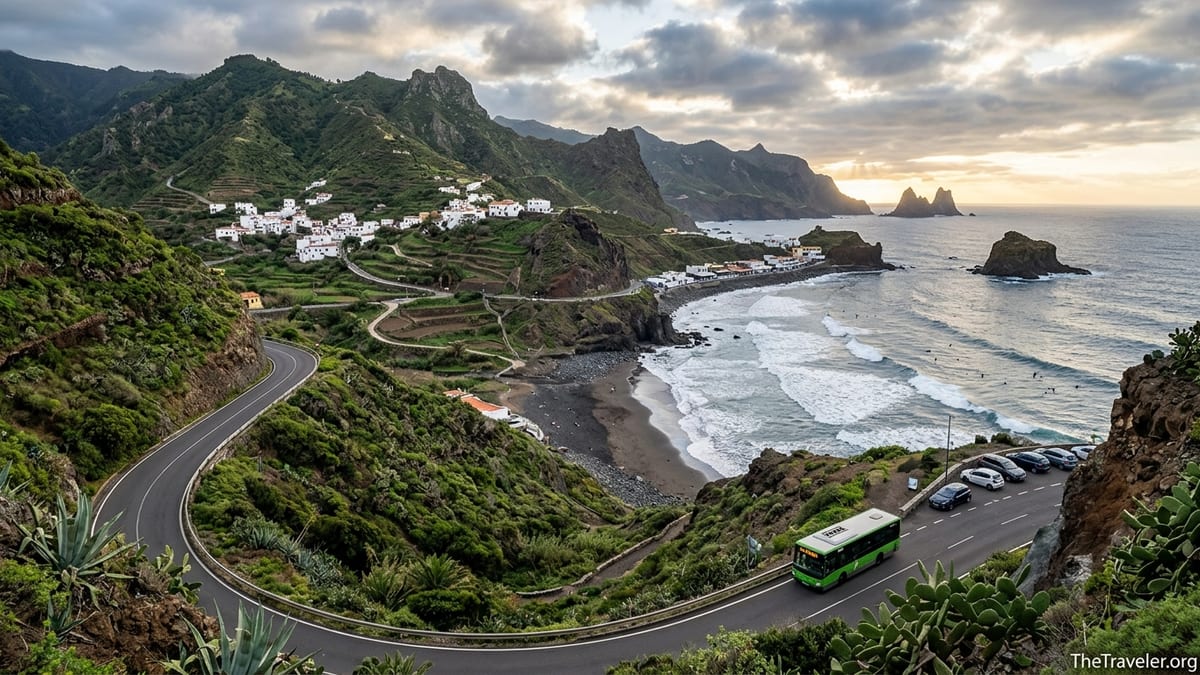
The north coast of Tenerife around Taganana offers some of the island’s wildest coastal scenery, but it is very different from the sheltered resort beaches in the south. Taganana itself is a historic village set back in a steep ravine, a few kilometres inland from the shoreline. The main beaches lie along the coastal road below, running east from the hamlet of Roque de las Bodegas to Almáciga and on towards the headland above Benijo. This guide focuses on those beaches for travellers who value dramatic landscapes and direct contact with the Atlantic more than sun loungers and resort-style facilities.
Get the latest updates straight to your inbox!
Understanding Taganana and the Anaga Coastline
Taganana sits in the Anaga Rural Park, a rugged corner of northeast Tenerife where steep green slopes plunge directly into the ocean. Although many maps label “Taganana beach,” the village itself is not on the sand. To reach the shore, you follow the winding TF-134 coastal road that drops from the village towards Roque de las Bodegas and then continues to Almáciga. A little further along the coast, paths once descended to Playa de Benijo, now subject to access restrictions after rockfalls.
This geography shapes everything about a beach day here. The coastline faces north and is fully exposed to the Atlantic, so waves and currents are often strong. The beaches themselves are narrow strips of dark volcanic sand or pebbles at the foot of cliffs. There are few large buildings and no all-inclusive resorts, only small hamlets with houses and simple places to eat. Visitors should arrive expecting raw nature, changeable conditions and limited shelter, rather than the kind of tamed beachfront seen in larger tourist areas.
Access is part of the experience. The TF-134 is twisty but paved, and TITSA bus line 946 links Santa Cruz de Tenerife with Taganana and on to Almáciga. Recent schedules confirm that several buses a day stop at Taganana, Playa Roque de las Bodegas and Almáciga, but timetables and any temporary route changes should be checked shortly before travel, especially while roadworks continue around San Andrés. Roadside parking exists near each beach but fills quickly on weekends and holidays, and police do ticket or tow vehicles that block the narrow road or driveways.
Because of the exposure to winter storms, conditions can shift from one week to the next. Heavy seas can strip sand away, expose more rock and occasionally lead to temporary access closures along this coast. Before committing to a full-day trip, it is worth checking the latest local news or municipality notices for road closures, landslides and any specific warnings about these beaches.
Playa de Almáciga: Surf Break and Dark Volcanic Sand
Playa de Almáciga lies at the eastern end of the road beyond the hamlet of Almáciga, backed by dramatic cliffs and terraced slopes. The beach is mainly dark volcanic sand with some pebbly areas, and at lower tide it can feel long and spacious, curving gently in a bay that still faces directly out to the Atlantic. On clear days there are wide views west along the coast to Roque de las Bodegas and, in the other direction, towards the rocky headland that separates Almáciga from Benijo.
The beach is popular with surfers and bodyboarders thanks to consistent swell. Several surf schools based elsewhere on the island occasionally use Almáciga when conditions suit, but there is no large built-up surf infrastructure on the sand itself. You may find a couple of small bars and cafes in the hamlet and near the roadside above the beach, and some reports mention basic facilities such as public toilets or outdoor showers at times. These services can change and sometimes operate only in busier seasons, so visitors should not rely on them and are advised to bring water, snacks and sun protection.
Lifeguard cover at Playa de Almáciga is not permanent. At the time of writing, there is no consistent year-round lifeguard service advertised by the municipality for this beach. In high summer or on particularly busy days there may be local arrangements or temporary surveillance, but travellers should plan on the basis that swimming here is essentially unsupervised. If a flag system is in place during your visit, respect it: a red flag means no bathing, a yellow flag warns of hazardous conditions and recommends staying close to shore, while a green flag indicates relatively safer water but not a guarantee.
Given the strong surf, Almáciga is best suited to experienced swimmers and surfers who are comfortable in powerful waves and rip currents. Casual visitors and families may prefer to limit themselves to playing at the water’s edge when conditions are calm, watching the surfers and enjoying the scenery. Wearing sturdy sandals or water shoes helps when entering or exiting the sea over uneven patches. Dogs are sometimes seen on this stretch of coast, but local bylaws evolve and seasonal restrictions are occasionally enforced, so owners should confirm current rules with the municipality and always keep animals under control.
Roque de las Bodegas: A Small Bay with Restaurants and Easier Access
Roque de las Bodegas sits closer to Taganana where the ravine opens to a small bay. The hamlet clings to the base of the slopes and is named after the offshore rock that rises directly in front of the beach. Here the shoreline is a mix of dark sand and large pebbles, with sections that are more gently sloping than at Almáciga. In many conditions, particularly when swell arrives from certain directions, this bay can feel slightly more sheltered than its neighbours, which is why it is often described locally as the most family-friendly beach in the Taganana area.
One of Roque de las Bodegas’ main attractions is its string of small seaside restaurants and bars along the road behind the beach. These simple establishments specialise in local fish, seafood and Canarian dishes, and several operate throughout the year, although opening hours can be shorter on weekdays or in low season. It is common to combine a few hours by the water with a lunch of grilled fish or octopus here, then linger over coffee as afternoon light begins to soften. Because of the limited number of tables, reservations or early arrivals are wise on sunny weekends and holiday periods.
Access to the beach itself is straightforward. The TF-134 runs directly alongside the bay and there are several small roadside parking pockets. Spaces are limited and competition is intense on peak days, so arriving early in the morning or late afternoon usually gives the best chance of finding a legal spot. TITSA bus 946 stops at “Playa Roque las Bodegas,” within a short walk of the sand, making this the easiest beach to reach by public transport from both Santa Cruz and Taganana village.
Although Roque de las Bodegas is more sheltered than Almáciga and Benijo, the ocean here is still the open Atlantic. Currents and powerful sets can appear suddenly, especially around higher tides or during winter swells. Information from local tourism and transport resources continues to warn that unexpected waves are common. Lifeguard presence is not guaranteed, and when it exists it is usually seasonal. Visitors should look for and obey any flag system or municipal notice on the day, and treat the water with caution. For families, staying in the shallows, exploring rock pools at low tide and keeping children away from the waterline when waves are large are sensible strategies.
Playa de Benijo: Iconic Views, Restricted Access
Playa de Benijo, a little further west beyond Almáciga and the headland, is one of Tenerife’s most photographed wild beaches. It is known for its black sand, striking offshore rock stacks and sunsets when the sky and sea often glow orange and red behind the jagged silhouettes. Historically, visitors reached the beach via steep stairways and paths descending from the small hamlet on the cliff above. The setting remains visually spectacular from the road and viewpoints, even if direct access to the sand is currently affected by safety concerns.
In July 2024, Santa Cruz de Tenerife’s city council issued a precautionary order closing public access routes to Benijo after rockfalls were detected near the main path and stairway. That closure was still reported as active through mid and late 2026 in local media and dedicated Benijo information sites, and no official reopening date had been announced. Emergency works and stabilization efforts have been discussed, but until a new municipal resolution clearly reopens the access, visitors must assume that going down to the beach is prohibited.
This has significant practical implications. Travellers can still drive the coastal road to viewpoints and restaurants overlooking the Benijo area, but must respect any fences, barriers and signs that mark closed trails or steps. Ignoring the closure not only risks fines, but also personal safety, as the rockfall risk that prompted the restriction remains under assessment. Anyone planning a visit should verify the latest status with local tourism offices or the municipality shortly before travelling, since future stabilization works could change the situation.
When access is officially closed, the beach is no longer a place for swimming or sunbathing, but it remains highly rewarding for photographers and landscape lovers from higher vantage points. Sunset light, stormy seas and the interplay of clouds over the rock stacks create dramatic scenes that can be appreciated from the roadside and nearby viewpoints. Even when or if access eventually reopens, the same ocean safety principles apply here as at Almáciga and Roque de las Bodegas: strong surf, shifting currents, limited or seasonal lifeguard coverage and a clear need to respect any flag system or warning notices on the sand.
Getting There: Driving, Bus Line 946 and Parking
Most visitors reach these beaches from Santa Cruz de Tenerife, following the coastal road to San Andrés and then climbing into the Anaga mountains before dropping down towards Taganana. The drive to Taganana takes roughly an hour in light traffic, but tight bends and scenic viewpoints encourage slower speeds. From Taganana, the TF-134 continues downhill to Roque de las Bodegas in a few minutes, then eastwards to Almáciga and the viewpoints towards Benijo. Weather can influence driving conditions, particularly in winter when heavy rain may trigger rockfalls or temporary road closures, so forecasts and local advisories should be checked in advance.
Public transport is a realistic option for independent travellers. TITSA line 946 connects the Santa Cruz bus interchange with San Andrés, Taganana, Playa Roque de las Bodegas and Almáciga. Updated route information confirms that the bus serves dedicated stops for both Roque de las Bodegas and Almáciga, and journey times from Santa Cruz are typically around one hour. Schedules vary between weekdays and weekends, and recent works on the San Andrés bridge have required short connection arrangements, so it is essential to confirm exact departure times and any temporary changes shortly before your trip.
Parking is a consistent pressure point along this coastline. None of the beaches has a large dedicated car park; instead there are small laybys and roadside spaces that fill up quickly on sunny days, school holidays and long weekends. Arriving early in the morning or later in the afternoon is the most reliable way to find a legal space close to the sand. Parking on narrow shoulders, in front of driveways or in signed no-parking zones is both unsafe and subject to enforcement, and emergency vehicles need clear access along the TF-134 at all times.
For those staying in Taganana village itself, it is possible to combine walking and bus travel with beach time. Footpaths and minor roads link the village to the coast, but gradients are steep and the descent is long, so this is more of a hike than a casual stroll and requires fitness, suitable footwear and allowance for the return climb or a timed bus back. Hikers using the beaches as start or end points for Anaga trails should also plan around the bus schedule and daylight hours, since the last services back to Santa Cruz do not run late into the night.
Safety in the Atlantic: Waves, Currents and Changing Conditions
The north coast of Tenerife around Taganana is beautiful but unforgiving. Open exposure to the Atlantic means powerful swell, strong rip currents and rapidly changing conditions, particularly in winter and during storms. Even on apparently calm days, sets of larger waves can arrive without warning, surging much higher up the beach than earlier waves and potentially knocking people from their feet. Rock platforms and boulders can also be slippery, with sudden drop-offs and hidden holes under the water.
Lifeguard services on this stretch of coast are limited and, where present, usually seasonal or restricted to peak hours. Before entering the sea at Almáciga or Roque de las Bodegas, visitors should look carefully for any lifeguard posts, information boards or coloured flags and follow their instructions. In the absence of clear supervision, a conservative approach is essential: if the waves look rough or currents appear strong, it is safer not to swim at all and instead enjoy the beach from the shore.
Families with children should be particularly cautious. None of these beaches offers the kind of shallow, enclosed lagoon found in sheltered resort areas. For younger travellers, this coastline is better suited to paddling at the very edge of the water on calm days, exploring the wet sand and rock pools at low tide and playing well back from the shoreline when waves increase. Inflatable toys and airbeds are discouraged in surf conditions, as they can be quickly dragged out to sea.
Even experienced surfers and strong swimmers should respect local knowledge. Speaking to restaurant staff, surfers already in the water or residents can give an extra sense of where rip currents tend to form and which sections are safest under current conditions. Regardless of ability, no one should swim alone, and alcohol and heavy surf never mix well. Winter storms in particular can dramatically reshape these beaches, eroding sand, exposing rocks and temporarily affecting the safety of existing paths and stairways, which is why up-to-date information is so important.
Services, Facilities and Practical Tips
Compared with southern Tenerife’s resort beaches, services along the Taganana coast are minimal. There are no large-scale rental operations for sun loungers or umbrellas, and no beachfront hotels. At Almáciga and Roque de las Bodegas, small bars and restaurants provide meals, drinks and basic restroom access for customers, but visitors should not expect continuous lifeguard stations, staffed information desks or large public toilet blocks open all day. Seasonal variations are significant, with more services operating during local and European holiday periods than in quieter months.
Practical preparation makes a big difference. Travellers should bring sufficient drinking water, snacks, high-factor sunscreen, hats and some form of shade such as a small beach tent or umbrella, especially in summer when the sun is intense and natural shade is scarce. The dark volcanic sand can become very hot underfoot, so sandals or aqua shoes are recommended, both for the heat and for navigating any rocky or uneven sections near the shoreline.
Nudity has historically been tolerated in parts of the Anaga coast, including remote sections near Benijo, but norms and enforcement can vary and are influenced by the current access situation. With Benijo’s access routes officially closed and Almáciga and Roque de las Bodegas being more family oriented, visitors should expect predominantly conventional swimwear at these main beaches unless clearly signed otherwise or directed by local guidance. As for dogs, regulations are set by the municipality and can change; at present there is no strong promotion of these beaches as dedicated dog areas, so owners should confirm current rules and avoid assuming that dogs are welcome on the sand at all times.
Waste management is another shared responsibility. Bins are limited, and occasionally overflowing on very busy days, so bringing a small bag to carry rubbish back to accommodation or to larger collection points is advisable. Preserving the fragile coastal ecosystem of Anaga, which is recognised for its biodiversity and cultural landscapes, depends in part on individual visitors leaving as little trace as possible.
Eating by the Sea and Linking Hikes with Beach Time
One of the great pleasures of this stretch of coast is combining time near the waves with simple, satisfying meals in the small hamlets. Roque de las Bodegas in particular has several long-running restaurants facing the sea, many specialising in fried or grilled fish, seafood stews and classic Canarian side dishes such as papas arrugadas with mojo sauce. These venues typically open for lunch and early dinner, though exact days and hours can change with the season, so checking locally or phoning ahead once on the island is sensible.
Almáciga has its own small selection of bars and cafes, often family run, where surfers, locals and hikers gather after time on the beach. The atmosphere is low-key and informal, with plastic chairs on terraces and simple interiors rather than elaborate décor. Prices are generally moderate compared with Tenerife’s major resorts, but menus can be shorter and focused on daily availability from local suppliers, especially for fresh fish.
The beaches and hamlets also serve as gateways to hikes in the Anaga mountains. Marked trails connect viewpoints, ridgelines and ravines with access points in Taganana, Roque de las Bodegas and Almáciga, including route variants that descend from higher passes to finish near the sea. Hikers often plan a loop that ends with a late lunch or a short rest on the sand before catching bus 946 back towards Santa Cruz. Given the steep gradients, humid laurel forests and often hot coastal sun, carrying enough water and allowing plenty of time for ascents and descents is as important for walkers as for beachgoers.
Because route conditions in Anaga can change after storms or landslides, anyone combining hiking with beach visits should check recent trail information with local authorities or visitor centres. Some paths may be temporarily closed or diverted, just as vehicle access to parts of the coast can be affected by weather. Flexibility in planning and respect for closures help ensure that both the environment and visitors remain safe.
Which Beach Is Right for You
Although Almáciga, Roque de las Bodegas and Benijo occupy the same short stretch of coastline, each suits a different kind of traveller. Playa de Almáciga appeals most to experienced surfers and strong swimmers looking for powerful Atlantic conditions and a relatively open sandy bay with minimal development. It is a place to feel the force of the ocean, not to expect calm, shallow water for floating or snorkelling.
Roque de las Bodegas suits visitors who prioritise easier access, the presence of nearby restaurants and a somewhat more sheltered shoreline. Families who are comfortable managing children close to energetic surf often gravitate here, as do travellers relying on bus 946 who appreciate a short walk from the stop to both the sand and places to eat. It is still a wild north-coast beach, but with the convenience of facilities close at hand.
Benijo, as long as its beach access remains officially closed due to rockfall risk, is a destination mainly for photographers, sightseers and landscape lovers who are content to admire the view from above. When or if safe access is restored in future, it will again attract travellers seeking a remote, dramatic setting for walks along the sand at low tide and for sunset photography. Until then, the responsible choice is to enjoy the panorama from viewpoints and respect all access restrictions.
For anyone heading to Taganana primarily for scenery and ocean access, the common thread is preparation and realism. These are not manicured resort beaches, but raw Atlantic shores that reward early arrivals, careful planning around bus times and weather, and a cautious approach to the sea itself. Treated with respect, Almáciga and Roque de las Bodegas in particular offer some of Tenerife’s most memorable encounters with the island’s wild north coast.