


Choosing between half-board and all-inclusive is one of the biggest money questions in modern resort travel. The difference is not just a buffet lunch or a few poolside cocktails. It can add several hundred euros to a week in Tenerife, Mallorca, Antalya, Hurghada or the Greek islands, and whether that premium produces genuine savings depends on how you actually spend your days.
Get the latest updates straight to your inbox!
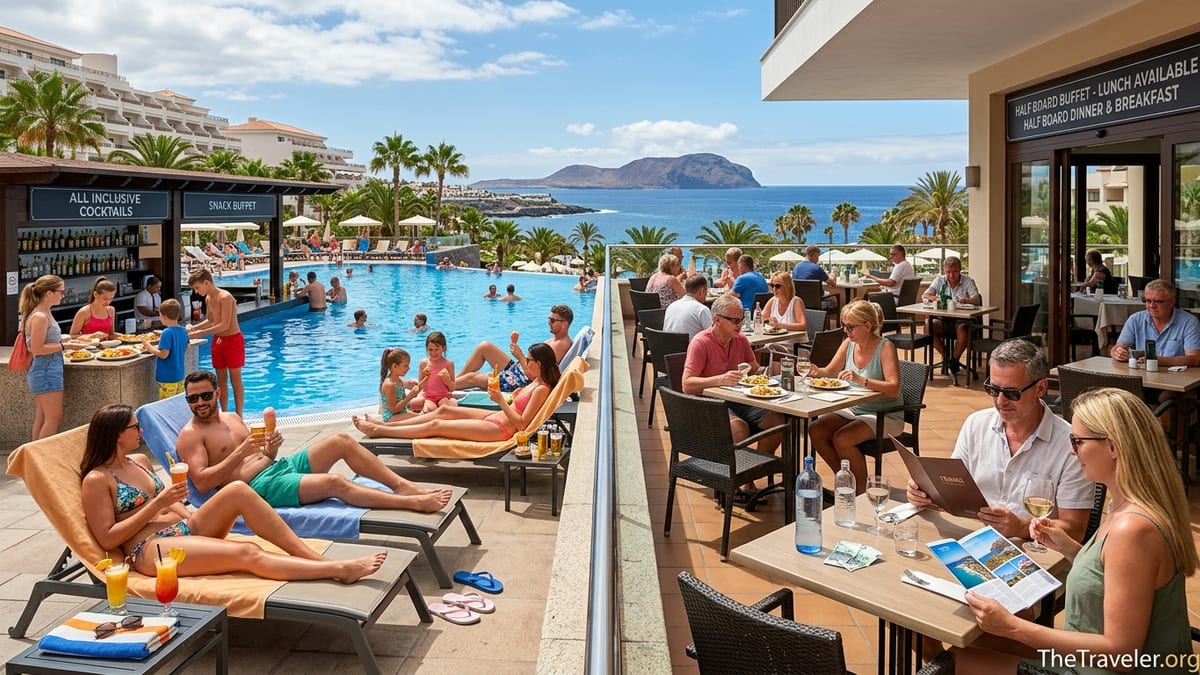
What half board and all inclusive really include
Across European and Mediterranean resorts, half board almost always means breakfast and dinner in the main restaurant, usually buffet style, with drinks at breakfast and paid drinks at dinner. All inclusive usually adds lunch, most soft drinks, local alcoholic drinks, snacks and ice creams at certain hours. However, the fine print varies sharply by hotel and destination, so you cannot assume that premium spirits, à la carte restaurants, minibar items or room service are included.
In Tenerife, for example, many four-star resorts in Costa Adeje and Playa de las Américas sell both half board and all inclusive for the same room types. A recent price grid for a five-star branded resort on the south coast showed a clear ladder: room with breakfast, half board, then all inclusive, each step adding specific meal rights rather than a blank check on every outlet. Separate documents list which bars pour included local beer and wine, and which venues still charge for imported gin, champagne or beach-club service.
Similar patterns appear in Mallorca’s family resorts, where “all inclusive” can mean anything from buffet meals plus basic soft drinks to a more complete package with branded ice creams, kids’ snacks and evening cocktails. In Antalya, large Turkish resorts often label themselves “ultra all inclusive,” yet their detailed summer 2025 brochures show surcharges for à la carte steak restaurants, fresh orange juice at breakfast and certain imported whiskies. In Hurghada, Egypt, winter and summer offers clearly distinguish standard all inclusive from “high class all inclusive,” each with different snack windows and bar lists.
The lesson is simple. Before you run the numbers, download the board-plan fact sheet for the exact resort and travel dates you are considering. Look for whether espresso coffee, bottled water outside mealtimes, beach bar drinks, kids’ ice creams and specialty dining carry extra charges. These items can significantly affect the real-world value of upgrading from half board.
Real upgrade costs by destination
To understand what travelers actually pay in late 2025 and into 2026, we looked at current examples where the same resort sells both half board and all inclusive for identical rooms, usually for a seven-night stay for two adults in shoulder season. While exact figures change weekly, some clear ranges emerge in popular sun destinations.
In Tenerife, independent rate trackers for four and five-star hotels in the south show typical double-room prices around 140 to 250 euros per night with half board in spring or autumn. When all inclusive is available, the same room often prices roughly 40 to 70 euros more per night for two adults, sometimes a little higher in peak summer. One recent comparison for a premium resort near Golf del Sur, checked at the end of October 2026, showed the all inclusive option for two adults about 55 euros per night above half board for the same room and dates.
On Mallorca, a UK-oriented cost breakdown for 2026 family holidays suggests that a week in a four-star resort on a half-board basis for a family of four in May or October typically costs 2,000 to 3,200 pounds, with all inclusive adding around 200 to 500 pounds for the week. That works out to an incremental 30 to 70 pounds per room per day, broadly similar to Tenerife once converted to euros. A separate guide to Balearic all inclusive resorts lists family properties in Playa de Muro and Cala d’Or from roughly 150 to 190 US dollars per person per night in peak months, confirming that food and beverage can easily be half the holiday budget if you pay separately.
In Antalya, a 2025 summer tariff for a mainstream Turkish Riviera hotel priced “high class all inclusive” as the base board, then listed modest supplements for certain peak dates, such as an extra 11 euros per person per night in July and August. When the same chains offer both half board and all inclusive on international booking engines, the effective uplift for all inclusive usually falls between 25 and 50 euros per adult per night, less outside school holidays. In Hurghada, Egyptian tour brochures for 2025 and 2026 show three-night packages where the difference between half board and all inclusive at mid-range Red Sea resorts ranges from about 15 to 30 euros per person per night after taxes, again with higher gaps at peak times like New Year.
How to calculate your personal break-even point
The simplest way to compare is to treat all inclusive as a daily upgrade price and ask whether you realistically consume that value in food and drink. If a resort charges 60 euros more per room per day to move from half board to all inclusive, and you are two adults, the upgrade is effectively 30 euros per person per day. You then compare that figure to what you would otherwise spend on lunch, drinks, snacks and any extra dinners or ice creams.
A basic break-even formula looks like this: additional cost of all inclusive per day, divided by the number of paying guests in the room, equals the minimum daily food and drink spend per person you need to hit for the upgrade to pay off. If the uplift is 70 euros per room for a couple, you need to drink and eat at least 35 euros per person per day outside the half-board inclusions to break even. For a family room charged per adult, check whether the hotel counts older children as adults or offers a reduced all inclusive supplement for under-12s, which can change the math.
Price references from recent visitor reports in Tenerife give useful benchmarks. Travelers staying half board with one child in 2026 described typical lunches of salad, a shared pizza and drinks in resort-adjacent cafés costing around 30 to 40 euros for the family. Coffee and cake mid-afternoon might add 10 to 15 euros, while a couple of evening cocktails by the beach bar ran 16 to 20 euros. If you translate those figures to a per-person basis, a relaxed holiday day with one restaurant lunch, a coffee stop and a drink or two can easily reach 30 to 40 euros per adult in the Canary Islands without feeling extravagant.
Local guides for Mallorca and the Balearics suggest similar numbers. They estimate that adults who eat lunch out, enjoy a few drinks, rent sunbeds and take small excursions might spend 60 to 100 euros per day when food is not included, while those in all inclusive typically spend 30 to 50 euros per day on extras like ice creams on the promenade or drinks in a beach bar away from the hotel. The sweet spot for all inclusive value is often when your expected on-site daytime spending would otherwise sit near the upgrade price.
Scenario 1: a couple relaxing at the resort
Consider a couple booking seven nights in Tenerife in late April. The same four-star resort in Costa Adeje offers a double room at 190 euros per night on half board and 250 euros per night on all inclusive. That is a 60 euro per night difference, or 420 euros for the stay. All inclusive in this case includes buffet breakfast, lunch and dinner, local wine and beer by the glass, soft drinks, filtered coffee, most pool-bar cocktails, afternoon snacks and ice creams, but excludes premium spirits and à la carte restaurants.
Under half board, the couple already has breakfast and dinner covered at the buffet. Based on recent café and beach-bar prices along the south Tenerife coast, a realistic daily pattern for them might look like this. Lunch at a casual restaurant by the promenade, with two mains and soft drinks or a small beer, for 35 euros. Two poolside coffees and a shared dessert back at the resort in the afternoon for 12 euros. Two pre-dinner drinks at the hotel bar, paying full menu prices of roughly 8 to 10 euros per drink, for around 18 euros. That totals about 65 euros per day, or 455 euros over seven days, on top of the half-board room rate.
If they instead pay for all inclusive, their extra 60 euros per day up front covers those lunches, coffees, snacks and most drinks. They might still spend a little on a premium cocktail or a dinner in the à la carte restaurant one night, for perhaps 80 euros in total for the week. Their total spend becomes 250 euros per night for the room, or 1,750 euros, plus 80 euros for extras, compared with 190 euros per night plus roughly 455 euros in daily spending, or about 1,785 euros in total. In this example the financial difference is marginal, but they gain predictability and do not need to think about drink prices each time. If they enjoy a couple more cocktails or extra desserts most days, the all inclusive begins to show a clear saving.
Scenario 2: a family with two children by the pool
Next, picture a family of two adults and two children aged 7 and 10 traveling to Mallorca’s north coast in early June. A beachfront family resort offers a family room at 320 euros per night on half board and 390 euros per night on all inclusive. Children in this offer receive reduced all inclusive pricing, so the uplift of 70 euros per night applies to the room, not per person. Over seven nights, the all inclusive supplement totals 490 euros.
On half board, breakfast and dinner buffets are included, but midday and between-meal food and drinks are not. Recent family-budget breakdowns for Mallorca suggest that a restaurant lunch in a resort town for two adults and two children, including soft drinks and perhaps a shared dessert, commonly lands between 45 and 60 euros. Add to that a round of afternoon ice creams on the beach at 10 to 12 euros and several soft drinks or bottled waters by the pool at the hotel, which can easily cost 2.50 to 3.50 euros each. It is realistic for this family to spend 70 to 80 euros on a typical pool-and-beach day even without alcohol.
Over seven days, that pattern would add around 500 to 560 euros to their half-board room cost, very similar to the 490-euro all inclusive supplement. The tipping point comes when you factor in the extra “nagging” items that all inclusive quietly absorbs. Kids running to the snack bar for mid-morning fruit, another soft drink in the afternoon or an evening ice cream while watching the mini-disco can quickly push daily spending higher if you pay item by item. All inclusive also means parents can have a glass of wine at lunch or a cocktail at sunset without recalculating the budget.
In practice, families that stay mostly on site and make full use of the pools, kids’ club and entertainment often report that week-long all inclusive upgrades in Mallorca or the Canary Islands paid for themselves in soft drinks, ice creams and convenience alone. The key is to check whether the children’s ages still qualify them for reduced all inclusive rates and whether snack bars and branded ice creams are genuinely included, because in some resorts these are exactly the items that carry small extra charges.
Scenario 3: a sightseeing couple on excursions
Finally, consider a couple heading to Antalya in September who expect to take four full-day excursions to ancient sites and boat cruises. A coastal resort prices a standard room at 170 euros per night on half board and 220 euros on all inclusive, a 50-euro nightly difference or 350 euros across seven nights. The all inclusive plan includes three buffet meals, local drinks and limited snacks, while à la carte restaurants and imported drinks cost extra.
On days spent at the resort, the couple’s pattern might resemble the Tenerife example, with a light lunch, a couple of drinks and coffees totaling perhaps 60 euros if purchased separately. Yet on the four excursion days, lunch will typically be included in the tour price or taken in a local restaurant away from the hotel. Drinks on the bus or boat are often sold separately, and any evening drinks after they return may still be at the resort bar.
If they chose half board, they would eat breakfast at the hotel, join the excursion where a basic lunch might be included or cost 15 to 20 euros per person locally, then perhaps have a drink or two back at the resort in the evening. A realistic average on excursion days could be 40 euros per day for two people, including drinks and occasional snacks. On the three non-excursion days, their spending might be closer to 60 euros per day. Across the week, that averages out to roughly 50 euros per day or 350 euros total.
Because the all inclusive upgrade also costs 50 euros per day, they break about even only if they continue to have most of their drinks and snacks at the hotel on non-excursion days. However, tour-heavy itineraries often involve grabbing coffees in town, trying local restaurants and sampling street food rather than returning to the resort for lunch. In that case, many of the all inclusive entitlements, especially lunch, go unused, and the couple could end up effectively paying extra for meals eaten elsewhere. For sightseeing-focused trips, half board or even breakfast-only often offers better value and more flexibility.
Location, local prices and when all inclusive wins
The financial appeal of all inclusive also depends on what lies beyond the resort gate. In isolated stretches of Tenerife’s west coast, the south coast of Hurghada or parts of the Turkish Riviera, you may find few independent restaurants within an easy stroll. Hotel à la carte venues can be attractive but expensive, with mains commonly over 20 euros in upscale Canary Islands properties or resort-marked prices in Egyptian seafood restaurants. In these settings, paying 40 to 70 euros extra per day for all inclusive can be cheaper than buying lunch and multiple drinks from on-site menus throughout the week.
By contrast, resorts embedded in walkable towns like Playa de las Américas in Tenerife, Cala d’Or or Palmanova in Mallorca, and popular Greek islands such as Rhodes Town or Chania give you a wide choice of cafés and tavernas. Recent traveler budgets for Tenerife suggest that a fixed-price menú del día at lunchtime can still be found for roughly 12 to 16 euros per adult, including bread and a drink, in 2026. In many Greek islands, simple grilled fish or souvlaki with salad and a glass of house wine may cost 15 to 20 euros per person at a family-run taverna.
In these lively areas, a couple willing to explore local dining can often keep midday meals to 30 to 40 euros for two, with perhaps another 10 to 15 euros for coffees and a shared dessert. A glass of house wine or a small beer on a café terrace may be 3 to 5 euros, which compares favorably with hotel bar prices. If your preferred holiday rhythm is to wander into town in the evening, pick a different restaurant each night and stop for drinks where the atmosphere feels right, the rigid structure of all inclusive may feel constraining and financially unnecessary.
Location also influences drink behavior. In destinations like Antalya or Hurghada where alcohol taxes or import rules make restaurant wine and cocktails relatively expensive, getting drinks bundled into your stay can be valuable, especially for guests who enjoy sundowners daily. Conversely, in parts of Greece where simple local wine is modest in price and cafés are plentiful, paying a hefty all inclusive premium for unlimited local drinks you may not fully use makes less sense.
Quality, restrictions and hidden extras
Not all buffets and bar lists are created equal. In both half board and all inclusive formats, recent reviews from Majorca, Tenerife and Greek island resorts highlight large variations in food quality, variety and how well properties handle dietary restrictions. Some all inclusive buffets rotate themes nightly and offer live cooking stations, with clear labels for vegetarian, vegan and gluten-free options. Others repeat similar dishes throughout the week and provide limited choice for those with allergies.
Drink inclusions also differ. Many Spanish and Greek resorts adhere to local regulations that limit alcoholic beverages in standard all inclusive plans, especially in areas popular with party tourism. This can mean a finite number of alcoholic drinks during meal times or only certain low-strength options in the main bar. Imported spirits, energy drinks and freshly squeezed juices are often charged separately. Turkish and Egyptian resorts that advertise “ultra all inclusive” may pour a broader range of branded drinks, yet still charge a supplement for premium labels or shisha service.
Several hidden extras often surprise guests. Specialty restaurants in Tenerife and Mallorca commonly allow one included visit per week for all inclusive guests, but additional visits carry a per-person surcharge and require advance reservations. Beach clubs operated by the same resort may not be covered, so sunbed rental and drinks there still add up. Room service is rarely part of all inclusive, and service fees for delivering even included items to the room can apply. In family hotels, certain branded ice creams from freezers or popcorn at kids’ shows may sit outside the package despite being sold within the resort.
Checking these details beforehand helps you avoid overestimating the value of all inclusive. If you prefer à la carte dining most nights, enjoy premium cocktails, or plan to spend afternoons at an off-site beach club, a standard all inclusive package that mainly enhances the buffet and local bar may not match how you will actually spend money. In that case, half board plus a realistic budget for à la carte splurges may be more satisfying.
Promotions, upgrades and who benefits most
Timing and promotions can tilt the equation. Tour operators packaging Hurghada and Antalya often include all inclusive as standard in off-peak months, with only a small supplement over half board in their printed offers for 2025 and 2026. In quieter shoulder seasons on Mallorca or the Greek islands, some resorts run early-booking deals where the all inclusive supplement is effectively discounted, such as “book by January to receive a free board upgrade” or a reduced daily supplement that brings the uplift closer to 25 or 30 euros per room per day.
At the property level, front desks sometimes offer arrival upgrades from half board to all inclusive at a flat fee if occupancy allows, especially outside school holidays. Guests on travel forums in 2026 reported offers such as 40 to 50 euros per room per day to switch for the remaining nights, with child discounts applied on top. These on-the-spot upgrades can be good value if, after a day or two, you find yourself spending heavily at the bar and snack kiosk, but they work only when you are flexible and the hotel is not full.
Families tend to benefit more consistently from all inclusive, provided the child pricing is favorable and snack bars are genuinely included. Predictable spending, easy access to water, juice and simple meals, and not having to say no to every ice cream are often worth the premium. Couples who prioritize relaxation around the pool or enjoy multiple daily drinks likewise find it easier to hit the break-even point, particularly in isolated resorts where outside options are limited.
On the other hand, non-drinkers, food-focused travelers and those keen to dine in authentic local restaurants usually gain little from paying a 40 to 70 euro daily premium. Half board, or even just breakfast plus a generous dining budget outside, gives them freedom to try tapas bars in Tenerife, seafood tavernas on Greek islands or grill houses inland in Mallorca. For guests planning several days of excursions where they will miss lunch and perhaps even some dinners in the resort, paying extra for a full all inclusive plan rarely adds up.
Conclusion: deciding what is worth it for you
Half board and all inclusive are not inherently good or bad deals. They are pricing tools that work in your favor only when they match your habits. The concrete examples from Tenerife, Mallorca, Antalya, Hurghada and the Greek islands show that all inclusive supplements of roughly 40 to 70 euros per room per day can be excellent value for families and pool-focused couples who stay mostly on site, especially where local restaurant prices or isolation make à la carte lunches and drinks expensive.
To decide, take the property’s actual supplement for your dates, divide it by the number of paying guests in the room, and compare that figure to realistic local prices for lunch, drinks, snacks and occasional treats. Factor in how many days you will be away on excursions, whether you drink alcohol, whether your children pay reduced rates and how much you care about exploring local food scenes. Then read the small print on what the resort really includes, from snack bars and bottled water to à la carte reservations.
When your expected daily on-site spending equals or exceeds the cost of upgrading, and you value not thinking about the bill each time you order, all inclusive can genuinely save money and stress. When your plans revolve around rented cars, day trips and dinners in town, half board or breakfast-only usually leaves you with more flexibility and, quite often, more cash to spend where it matters most.