


Southern Utah has no shortage of world class desert, but two names increasingly rise to the top of adventurous travelers’ lists: Bears Ears National Monument and Grand Staircase Escalante National Monument. Both promise sculpted sandstone, big skies, and true remoteness, yet they deliver very different styles of trip. If you only have time for one, choosing where to focus can shape everything from your daily hikes to your gas budget. Here is how these two vast landscapes compare, and how to decide which Utah adventure is right for you.
Get the latest updates straight to your inbox!
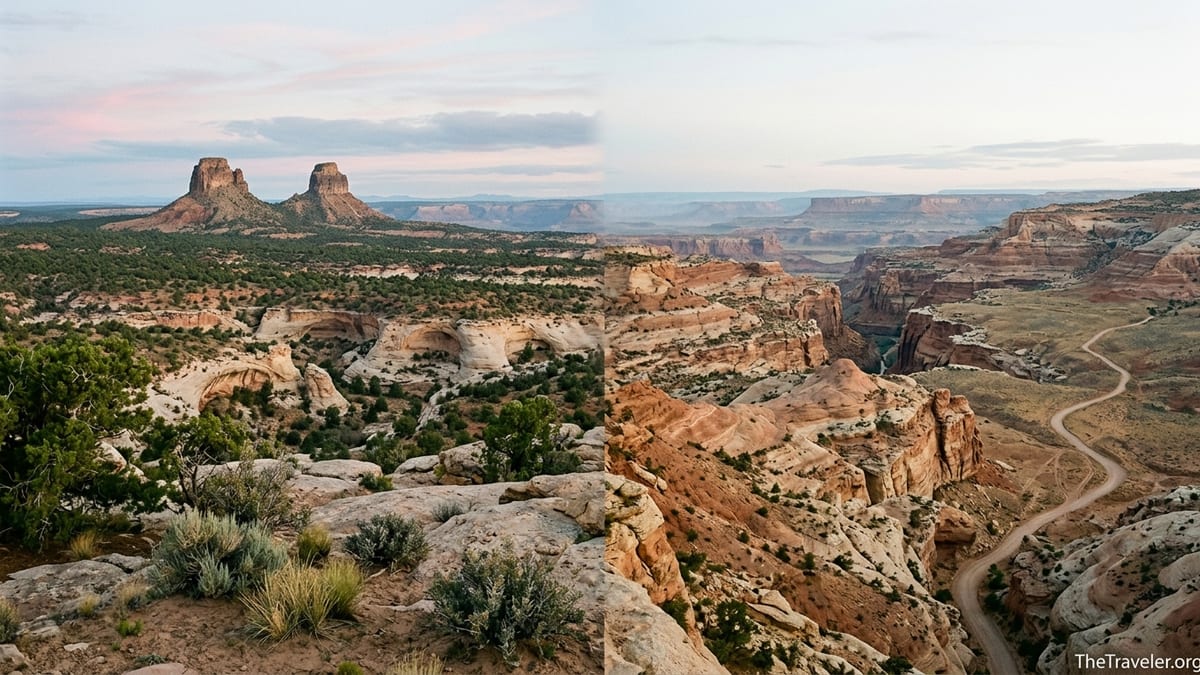
Big Picture: What Sets These Two Giants Apart
Bears Ears National Monument sprawls across more than a million acres in southeastern Utah near the small towns of Bluff, Blanding, and Monticello. It is co-managed by the Bureau of Land Management and the U.S. Forest Service and is best known for its cultural landscape: thousands of ancestral Puebloan sites, rock art panels, cliff dwellings, kivas, and ancient roads layered across canyons and mesas. Hiking here often means walking through living history as much as wilderness.
Grand Staircase Escalante National Monument, in south central Utah, stretches between the communities of Kanab, Escalante, Boulder, Cannonville, and Big Water. It protects a staircase of multicolored cliffs, the Kaiparowits Plateau, and the convoluted canyons of the Escalante River. Travelers come here for remote slot canyons like Peekaboo and Spooky, waterfalls such as Lower Calf Creek Falls, and long dirt roads like Hole in the Rock that feel like journeys to the edge of the map.
Where Bears Ears feels like a cultural heartland with archaeology woven into nearly every view, Grand Staircase Escalante is more of a pure landscape destination, defined by geologic drama and backcountry canyoneering potential. In practice this means days in Bears Ears might be quieter, slower, and more contemplative, while days in Grand Staircase are often about scrambling sandstone, wading creeks, and chasing light through narrow canyons.
Both monuments are still relatively uncrowded compared with nearby national parks like Zion and Arches, but visitation has been rising as travelers seek wilder alternatives. Expect more roadside solitude in Bears Ears and more trailhead pressure around the most famous Grand Staircase hikes, especially near the highway-accessible Escalante Canyons.
Access, Towns, and Trip Logistics
For most travelers, the decision starts with a map and a rental car agreement. Grand Staircase Escalante is anchored by Utah Scenic Byway 12, a paved road that runs between the towns of Escalante and Boulder and is routinely cited as one of the most beautiful drives in the American Southwest. Many popular hikes, including Lower Calf Creek Falls and the first miles of Hole in the Rock Road, can be reached in a standard 2WD sedan in dry weather, though high clearance is strongly recommended for longer dirt stretches.
Grand Staircase has multiple visitor centers in Escalante, Kanab, Cannonville, and Big Water, where rangers post up-to-date road condition reports. In April 2026, for example, the monument’s road report listed Cottonwood Canyon Road as suitable for standard 2WD, while Hole in the Rock was considered best for high clearance vehicles beyond Harris Wash due to deep washboards. This pattern is typical: after heavy rain, clay-rich roads can turn impassable, then dry into rough corrugations that test shocks and stomachs.
Bears Ears, by contrast, feels more dispersed. There is no single scenic highway tying the landscape together. Most visitors base in Bluff or Blanding, both reached via U.S. 191 and U.S. 163. Bluff, now recognized as an International Dark Sky community, has a handful of small motels and casitas, one gas station, a couple of sit-down restaurants, and seasonal food trucks. Blanding is more of a local service hub, with larger supermarkets, multiple gas stations, and a wider array of basic motels but less of a touristy feel.
Driving in Bears Ears often involves graded dirt and two-track roads across pinyon-juniper mesa tops to reach trailheads in places like Cedar Mesa or Arch Canyon. Many roads are manageable in dry conditions with a high clearance crossover. After early spring storms, though, it is not unusual to see rental sedans turned back by ruts and mud near trailheads like Mule Canyon. There is no single, centralized daily road report, so travelers rely on ranger stations, local outfitters in Bluff or Blanding, and most of all conservative judgment.
Signature Landscapes and Classic Hikes
If your Utah dream is squeezing through sculpted slot canyons and finishing the day at a desert waterfall, Grand Staircase Escalante holds the obvious classics. Lower Calf Creek Falls, a roughly 6 mile round trip hike from a paved trailhead between Boulder and Escalante, leads through a lush canyon to a 126 foot waterfall pouring into a green pool. The trail is sandy and exposed but straightforward, making it a favorite early slot-canyon sampler for families and first-time visitors.
For a bit more adventure, many travelers drive about 26 miles down Hole in the Rock Road, a graded dirt track southeast of Escalante, to reach trailheads for Peekaboo and Spooky Gulch. These two short slot canyons can be combined into a loop of around 3.5 miles, involving tight squeezes, short scrambles, and playful obstacles. It is common to see rental SUVs with Denver or Las Vegas plates parked in the dusty lot on spring weekends, with travelers carrying 2–3 liters of water and small daypacks carefully sized to fit through the narrowest sections.
In Bears Ears, signature outings look and feel different. Instead of a single waterfall or slot canyon, many hikes are about following faint paths and social trails toward cliff dwellings and rock art. Mule Canyon, for example, is reached via a short dirt road off Utah Highway 95 west of Blanding; within a few miles of walking, hikers can visit the often-photographed House on Fire ruin, then continue up-canyon to other ancestral sites tucked in alcoves. Hiking distances here are flexible, and the reward is less a single viewpoint than a string of quiet encounters with stone and history.
Another Bears Ears highlight is the Butler Wash area, where short side canyons north of Bluff lead to viewpoints looking across alcoves filled with ancient structures. A traveler might spend a full day driving the rough Butler Wash road, parking at unsigned pullouts identified from maps, and hiking short, off-trail routes to overlooks. It is a style of exploration that appeals to those who enjoy reconnaissance and navigation as much as checking off named hikes.
Cultural Heritage vs Raw Geology
The most important distinction between Bears Ears and Grand Staircase Escalante may be cultural. Bears Ears was proposed by a coalition of tribes, including the Navajo Nation, Hopi Tribe, Zuni Tribe, Ute Mountain Ute Tribe, and Ute Indian Tribe, in part to safeguard ancestral homelands and sacred sites. Travelers here are guests in a cultural landscape where many places carry stories, songs, and ceremonial meanings that long predate the modern recreation boom.
On the ground, that means travel in Bears Ears can feel more like visiting an outdoor museum or living archive. You might spend a morning quietly observing rock art panels in Comb Ridge, the narrow fin of sandstone west of Bluff, and then attend an evening talk in town where a local Navajo guide discusses proper etiquette near ancient structures and explains why visitors are urged not to enter dwellings, move artifacts, or share GPS locations widely. The overall tone is one of respect and restraint.
Grand Staircase Escalante also holds countless archaeological sites, including rock art and habitation sites in canyons like the Escalante River and Harris Wash. However, for most visitors the dominant impression is geologic. The monument’s name comes from a series of cliff steps that rise north from the Grand Canyon toward Bryce Canyon, and travel here is often about moving through layers: driving Cottonwood Canyon Road beneath striped badlands, or walking the Escalante River where soft sandstone walls curve and undercut.
For photographers, this difference is tangible. In Bears Ears a day might center on the warm light hitting the twin buttes of Bears Ears from a viewpoint off the Elk Ridge Road, with side trips to ancestral stonework. In Grand Staircase, the same golden hour might find you aiming a wide-angle lens at the delicate hoodoos of Devils Garden, reached by a spur off Hole in the Rock Road, or capturing the green ribbon of the Escalante River snaking through red cliffs from a high overlook on the Burr Trail.
Adventure Level, Skills, and Safety
Both monuments reward self-reliant travelers, but the skill sets they emphasize differ. Grand Staircase Escalante is a magnet for canyoneers. Routes in Egypt, Harris Wash, and the Escalante River system can involve lengthy off-trail navigation, wading, sometimes swimming, and negotiating dryfalls. Even popular routes like Coyote Gulch, accessed from Hole in the Rock Road, require understanding of water levels, exit points, and the realities of spending a night or two below the rim if you choose to backpack.
Slot canyons introduce additional hazards: flash floods, cold water, and sections so narrow that larger travelers must think about retreat options. Park and monument staff consistently urge visitors to check weather forecasts beyond the immediate area and to talk with rangers at the Escalante Interagency Visitor Center before committing to longer canyons. In practice, this might mean delaying a Peekaboo and Spooky loop by a day after a spring storm, or choosing a safer alternative like Devil’s Garden hoodoo area when thunderstorms are in the forecast.
Bears Ears, on the other hand, tends to emphasize route-finding and ethical behavior around cultural sites more than technical canyon skills. Trails may be unmarked or only partially signed; cairns appear and disappear over slickrock; and guidebook descriptions sometimes mention landmarks like “the second juniper past the drainage.” Carrying a GPS app with downloaded maps, a paper topographic map, and being comfortable with cross-country navigation is more important here than having rappel experience.
Safety in Bears Ears also includes knowing how to behave around archaeological sites. Travelers are expected to observe the “Visit with Respect” principles promoted by tribal and land management partners: stay on durable surfaces, do not touch rock art, never enter or climb on structures, and avoid sharing exact locations on social media. These ethics are increasingly prominent in local visitor information, and for many travelers are a core part of the experience.
Costs, Seasons, and Crowds in the Real World
From a budgeting standpoint, both monuments are relatively affordable compared with better-known national parks, but costs have crept upward with rising tourism. In Escalante and Boulder, simple motel rooms that could once be found under 100 dollars per night in shoulder seasons now more commonly sit in the 130 to 200 dollar range in spring and fall. Seasonal vacation rentals and cabins may run higher, particularly for properties with views over the Escalante River or easy access to Scenic Byway 12.
In Bluff and Blanding, nightly rates are often slightly lower but still reflect their growing popularity as gateways to Bears Ears and Monument Valley. It is realistic in 2026 to expect 90 to 160 dollars for a standard motel room in high season, with prices dipping somewhat in winter. Gas prices trend higher than national averages in both areas due to remoteness, and long backcountry drives along roads like Hole in the Rock or the Elk Ridge corridor can add a full extra tank to a week-long trip.
Seasonally, both monuments shine in spring and fall. March through May and late September through early November typically bring daytime highs comfortable for hiking, though late-season storms or early heat waves are always possible. Summer can be brutally hot in exposed canyons, with temperatures frequently into the 90s Fahrenheit or higher, making early starts and shorter objectives essential. Winter transforms higher elevations into snowy landscapes; it is not unusual to find patches of snow along Elk Ridge in Bears Ears or on higher segments of the Burr Trail, while lower canyons remain mostly hikeable but cold.
Crowds are where the two diverge. Grand Staircase Escalante, thanks to its highway access and social media fame, now sees parking lots at Lower Calf Creek Falls and the Peekaboo/Spooky trailhead fill by midmorning on popular spring weekends. Escalante’s small cafes and bakeries buzz with lineups of hikers ordering breakfast burritos and espresso. In Bears Ears, by contrast, a traveler might spend a full day exploring side canyons off Comb Ridge in March and encounter only a handful of other vehicles, especially on weekdays. Restaurants in Bluff can still close early or seasonally, reinforcing the feeling that you are in a working rural community first and a tourist town second.
Who Should Choose Which: Matching Monument to Travel Style
For many travelers, the best choice comes down to personality and goals. If you are newer to desert hiking, prefer established trails with clear destinations, and want a mix of dramatic scenery and creature comforts, Grand Staircase Escalante is often the better first stop. You can stay in a small lodge in Escalante, pick up breakfast at a local cafe, chat with rangers at the visitor center, and set out for hikes like Lower Calf Creek Falls or the first few miles of Hole in the Rock Road with ample information.
Adventurous families also tend to thrive in Grand Staircase. Children can play among the hoodoos at Devil’s Garden, splash in Calf Creek, or attempt easy sections of wide slot canyons, while adults still get the sense of vastness that defines the region. With a high clearance rental SUV, a family might spend one day on the Burr Trail, another exploring Cottonwood Canyon Road, and a third hiking a short tributary of the Escalante River.
Bears Ears is better suited to travelers who are drawn to cultural landscapes, comfortable with finding their own routes, and willing to trade services for solitude. History buffs, photographers, and those who enjoy reading field guides and listening to Indigenous perspectives will find deep rewards here. A typical three day Bears Ears visit might include a day on Cedar Mesa exploring canyons with cliff dwellings, a day along Comb Ridge visiting rock art panels, and an evening in Bluff attending a talk at a local cultural center or simply stargazing in the newly certified dark sky.
If you are traveling with limited navigation experience or uneasy about lightly signed routes, Bears Ears can still work well by hiring a local guide for at least one day. Guiding outfits based in Bluff and Blanding routinely take visitors to places like Mule Canyon, Butler Wash, and the Bears Ears Buttes area, providing not just safety but also cultural context that is hard to gain from guidebooks alone.
The Takeaway
Both Bears Ears and Grand Staircase Escalante offer what many travelers now seek and often fail to find in more famous parks: genuine quiet, a sense of discovery, and landscapes that still feel fundamentally wild. Choosing between them is less about better or worse and more about which story you want your trip to tell.
If your ideal Utah adventure is defined by hiking to waterfalls, weaving through playful slot canyons, and driving some of the Southwest’s most scenic paved and dirt roads, Grand Staircase Escalante is likely your match. It is a place where a single base town, Escalante, can serve as launchpad for an entire week of explorations, from easy day hikes to multi-day canyoneering.
If instead you are drawn to the intersection of land and culture, interested in walking softly among ancient dwellings and rock art while learning from the tribes who advocated for this monument, then Bears Ears is the better choice. It asks more of visitors in terms of preparation, humility, and independence, but in return it offers a rare chance to experience a living cultural landscape on its own terms.
For some, the truest answer is not either-or but both: a loop that starts in Bluff and winds west to Escalante, tracing a personal line through one of North America’s great desert regions. With enough time, the question becomes less about which monument to choose and more about how soon you can plan a return.
FAQ
Q1. Can I visit both Bears Ears and Grand Staircase Escalante in one trip?
Yes, many travelers combine both. A common loop starts in Moab or Salt Lake City, spends two to three days around Bluff and Blanding exploring Bears Ears, then drives west via Hanksville and Boulder to Escalante for another three to four days in Grand Staircase. This works best with at least a week, a high clearance vehicle, and flexible plans to adapt to weather and road conditions.
Q2. Do I need a high clearance or 4WD vehicle?
A standard 2WD car can reach some major highlights in each monument in good weather, such as Lower Calf Creek Falls in Grand Staircase and parts of Cedar Mesa in Bears Ears. However, a high clearance vehicle greatly expands your options, especially on roads like Hole in the Rock or Elk Ridge. True 4WD is strongly recommended if you plan to explore farther down rough dirt roads, particularly after rain or early in the season when mud and ruts are common.
Q3. Are permits required for day hikes?
Policies change, but at present many popular day hikes in both monuments either do not require advance permits or use simple self-serve permits at trailheads or visitor centers. Some sensitive areas in Bears Ears and a few canyons in the Escalante system may require special permits or registration. It is wise to stop at the nearest visitor center at the start of your trip to confirm current rules and pick up any necessary free permits.
Q4. How busy are these areas compared with Zion or Arches?
Both monuments are significantly quieter than Utah’s flagship national parks, but crowds are growing. Expect Lower Calf Creek Falls, Peekaboo and Spooky slots, and easily accessed roadside viewpoints along Scenic Byway 12 to feel busy on spring and fall weekends. In Bears Ears, even the best-known canyons and viewpoints are often far less crowded, although specific trailheads can still have several vehicles on popular holidays or during peak weeks of March and April.
Q5. Is it safe to hike slot canyons in Grand Staircase without a guide?
Many non-technical slot canyon hikes are regularly done without guides by prepared visitors, but they still carry real risks. Safe travel requires checking weather forecasts for a wide area, understanding basic canyon topography and escape options, carrying adequate water and layers, and being honest about your group’s comfort with tight spaces and scrambling. If in doubt, consider hiring a local guide for your first slot canyon day to learn best practices in person.
Q6. How should I behave around archaeological sites in Bears Ears?
The short answer is to visit with respect. That means staying on established paths or durable surfaces, not entering or climbing on structures, never touching rock art, leaving any artifacts where they lie, and keeping a respectful distance from fragile walls or floors. Avoid sharing exact GPS coordinates publicly and follow any additional guidance provided by tribal representatives and land managers, who emphasize that these locations are part of living cultures, not abandoned ruins.
Q7. What is the best time of year to visit each monument?
Spring and fall are generally best for both. March through May and late September through early November usually offer moderate daytime temperatures and cool nights, though weather can still vary widely. Summer brings intense heat and a higher chance of thunderstorms, which can make slot canyons and dirt roads hazardous. Winter can be rewarding for experienced travelers equipped for cold, but snow and ice at higher elevations can limit access to some roads and routes.
Q8. Are there family friendly options in these remote areas?
Yes. In Grand Staircase, Lower Calf Creek Falls, Devil’s Garden hoodoos, and short segments of wide, shallow canyons can work well for families used to hiking. In Bears Ears, short walks to roadside rock art panels or overlooks along Comb Ridge and Cedar Mesa can introduce children to the landscape without long days. Parents should be prepared for limited shade, pack plenty of water and sun protection, and be conservative about distances, especially with younger kids.
Q9. What should I expect to pay for lodging and food?
Nightly rates vary by season, but in 2026 it is common to see simple motel rooms in Bluff or Blanding in the roughly 90 to 160 dollar range, and many Escalante and Boulder properties in the 130 to 200 dollar range during peak months. Dining options are limited in both regions; expect small local cafes, seasonal food trucks, and a handful of sit-down restaurants, with prices generally somewhat higher than big-city averages due to remoteness. Self-catering with groceries from Blanding, Escalante, or larger towns along your approach can help manage costs.
Q10. If I have only three days, which monument should I choose?
With just three days, choose based on your priorities. Pick Grand Staircase Escalante if you want high-impact scenery, classic hikes like Lower Calf Creek Falls and short slot canyons, and easier logistics from a single base town. Choose Bears Ears if you are more interested in archaeology, Indigenous history, and quieter trails, and are comfortable with more driving and simpler services. Either way, three focused days will give you a satisfying introduction and likely inspire a longer return visit.