

More news on this day
A commuter rail journey north of London turned deadly on the evening of 19 June 2026 when two southbound passenger trains collided near Bedford, killing a driver and injuring 89 people in one of Britain’s most serious rail incidents in recent years.
Get the latest news straight to your inbox!
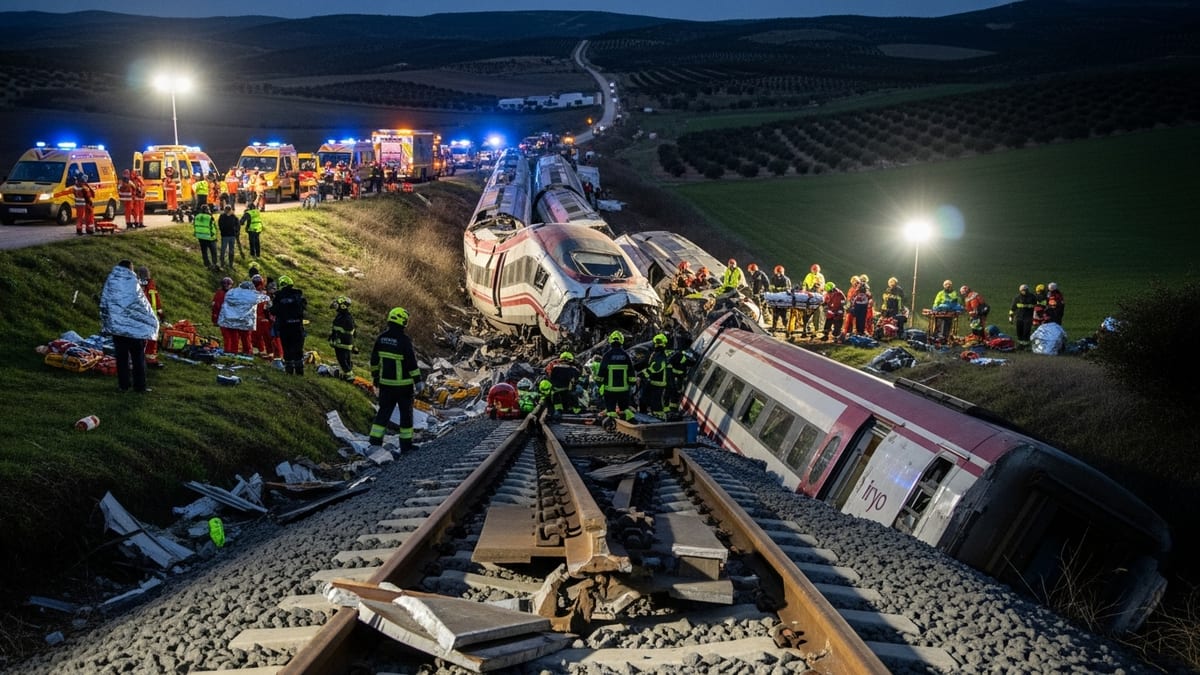
How the collision unfolded near Bedford
Publicly available information indicates that the crash occurred at around 5:15 p.m. local time on Friday 19 June, on the busy main line linking central England with London St Pancras. Both trains involved were East Midlands Railway services heading south toward the capital.
Reports describe one service running from Corby and another from Nottingham when they came into violent contact on the approach to Bedford, a key junction on the route. Rail tracking data cited in multiple news reports places the impact just south of the town, where several tracks run in parallel toward London.
Passengers have described being thrown forward inside crowded carriages as the trains suddenly jolted to a halt, with windows smashed and fittings torn loose. Early images from the scene published by major outlets show at least one train leaning at an angle, with emergency lighting illuminating the carriages as daylight faded.
The crash took place at the height of the evening peak, when many commuters and long distance travelers use the route, which helps explain the high number of injuries despite the relatively low reported speed compared with some past rail disasters.
Casualties and the condition of the injured
According to figures released by regional ambulance services and summarized in national coverage, a total of 89 people were injured in the collision. Of these, 11 passengers were described as having very serious injuries, 22 as seriously injured and 56 as sustaining minor injuries.
The sole fatality reported so far is one of the train drivers. Rail union representatives and company statements cited in the British press identify the victim as a driver employed on the East Midlands route who was at the controls of one of the southbound services. No passengers have been reported dead.
Many of the injured were treated at the scene in makeshift triage areas set up along the track, while others were transported by road and air to hospitals in Bedfordshire and surrounding counties. Images carried by broadcasters show passengers with head bandages and limb splints being assisted down trackside embankments.
Medical teams continue to monitor those with the most serious trauma, and official tallies may be refined as hospitals update their assessments. However, the headline figures of one dead and 89 injured have become the central reference point in ongoing public reporting.
Emergency response and disruption to rail services
Reports indicate that emergency services declared a major incident shortly after first alerts were received, triggering a large scale deployment of resources. Multiple fire and rescue crews, ambulance units, an air ambulance and specialist hazardous area response teams were sent to the location just outside Bedford.
Search and evacuation efforts continued into the evening as crews worked carriage by carriage to make sure everyone was accounted for and to stabilize damaged rolling stock. Engineers were also dispatched to inspect the track, overhead power lines and signaling equipment, as well as to assess the safe recovery of the trains.
The collision caused significant disruption to rail travel on one of the United Kingdom’s key north south corridors. Services between London St Pancras and destinations including Leicester, Nottingham and Corby were severely curtailed, with trains canceled or diverted and passengers advised to seek alternative routes.
By Saturday morning, some services had reportedly resumed on unaffected tracks, but capacity remained reduced while investigators and repair teams continued their work in the immediate crash area. Passengers planning to travel through Bedford and neighboring stations were urged to expect longer journey times and short notice changes.
Early focus of the safety investigation
Britain’s Rail Accident Investigation Branch has been notified of the collision, and published coverage indicates that inspectors are conducting preliminary work to determine which lines of inquiry to pursue in detail. As of the latest reports, no single cause has been formally identified.
Investigators are expected to examine the performance of signaling systems in the Bedford area, the positioning of any temporary speed restrictions or engineering work, and the functioning of train protection technology that is designed to reduce the risk of rear end collisions. Data from on board recorders, often compared to aviation “black boxes,” will be central to reconstructing the sequence of events.
Attention is also likely to focus on operational factors, such as train spacing in the approach to the busy junction, communication between drivers and control centers, and any reports of technical issues in the minutes leading up to the crash. Maintenance records for both trains and the relevant section of track will form part of the evidence base.
Rail safety specialists note that serious passenger train collisions have become relatively rare on the British network, in large part due to modern signaling and automatic protection systems. The Bedford crash will therefore attract close scrutiny from regulators, operators and unions seeking to understand how two scheduled services came to collide on a heavily monitored main line.
What passengers and travelers need to know now
For travelers, the most immediate impact remains on services running into and out of London St Pancras on the East Midlands and Thameslink routes. Journey planners from train operators and national rail information services indicate ongoing delays, cancellations and diversions around Bedford as the line is progressively brought back into use.
Passengers with flexible tickets are being encouraged through public advisories to travel at off peak times where possible, to allow emergency and engineering work to proceed with less congestion. Some operators are reported to be accepting tickets on alternative routes while the disruption continues.
Those concerned about friends or family who may have been on the affected trains have been directed in news coverage to contact local health providers and transport operators’ public information lines, which are collating details of those treated and discharged. Social media channels remain active with eyewitness accounts and updates on service changes, although officials are urging the public to rely on verified sources for the latest information.
As the investigation moves from rescue and recovery to analysis and accountability, the Bedford collision is likely to prompt wider debate about rail capacity, signaling upgrades and investment priorities on one of Britain’s busiest intercity corridors, while communities along the route come to terms with the shock of a routine evening commute turned tragic.