


If you are planning to drive the Garden State Parkway for the first time, the combination of toll plazas, frequent exits and uniquely New Jersey service areas can feel intimidating. In reality, the Parkway is a straightforward north–south route once you understand how tolls are collected, how exits are numbered, and where you can safely pull off for gas, food or a bathroom break. This guide walks you through the essentials from Cape May to the New York state line so you can focus on the drive instead of worrying about surprise tolls or missed exits.
Get the latest updates straight to your inbox!
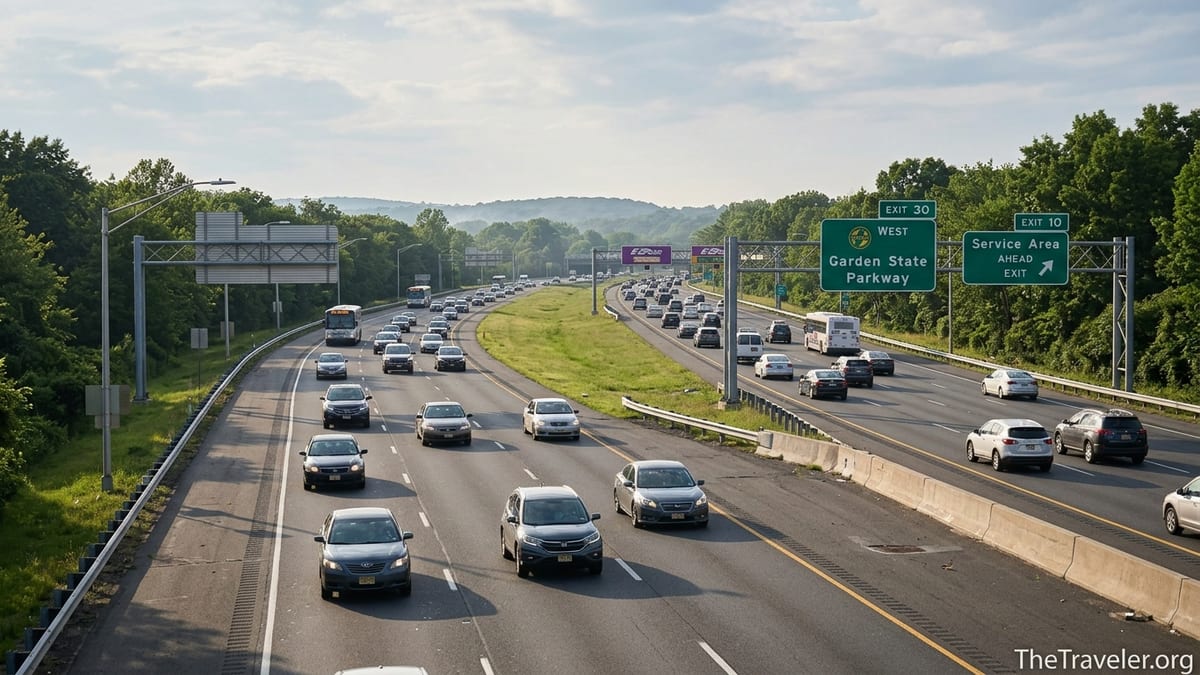
What Makes the Garden State Parkway Different
The Garden State Parkway is a 170-plus mile toll highway that runs along the eastern side of New Jersey from the Cape May area in the south to the New York state line at Montvale in the north. Unlike the New Jersey Turnpike, which uses a ticket-style system where you pay based on how far you drive, the Parkway relies on an "open" system of flat-fee toll plazas and ramp tolls at certain exits. For a first-time driver, this means you will encounter tolls periodically along your route instead of just at the beginning and end.
The Parkway is overseen by the New Jersey Turnpike Authority, the same agency that runs the Turnpike, but it feels more like a traditional parkway than a freight corridor. Trucks are restricted from a long central stretch, and the highway often passes through wooded medians, coastal marshes and suburban neighborhoods. That can make it a pleasant alternative to the Turnpike if you are driving from, say, Atlantic City to North Jersey or from New York City toward the Jersey Shore.
For visitors picking up a rental car at Newark Liberty International Airport and heading to beach towns like Asbury Park, Point Pleasant or Cape May, the Garden State Parkway is often the most direct route. Expect more frequent on and off ramps than the Turnpike, and be prepared for local drivers who know exactly which lane they want several exits in advance. Staying calm, signaling early and giving yourself time to change lanes will go a long way.
Perhaps the biggest mental adjustment for new drivers is realizing that the Parkway does not have traditional rest areas every few miles like an interstate. Instead, it uses a series of larger, named service areas located mostly in the median between the northbound and southbound lanes, plus occasional picnic areas and fuel-only stops. Knowing roughly where these are, and how your exit number corresponds to the milepost, helps you plan breaks before you get tired or run low on gas.
How Tolls Work: Cash, E-ZPass and What You’ll Actually Pay
On the Garden State Parkway, most passenger cars pay tolls at mainline plazas as they pass, rather than at every exit. As of early 2026, standard passenger vehicles generally see flat tolls in the neighborhood of a couple of dollars at each major plaza, with some ramps and smaller barriers charging under two dollars. The exact amount varies slightly depending on whether you pay cash or use E-ZPass and which barrier you are passing, but you will not be charged at every single exit.
For example, if you are driving from Exit 38 near Atlantic City to Exit 135 in Clark during daytime hours, you might hit a mainline toll plaza where a car pays around two dollars in cash or a modest discount with E-ZPass, then a smaller ramp toll of under two dollars when you exit. A typical Parkway trip from the New York state line down to the Cape May area often totals in the low double digits for a passenger car when you add up several plazas. The New Jersey Turnpike Authority maintains a toll schedule and an online calculator, and it is worth checking those tools before a long drive if you are watching your budget.
E-ZPass is the easiest way to deal with Parkway tolls, especially if you are not used to fumbling for coins. With a valid E-ZPass transponder from any participating state, you can roll through dedicated E-ZPass-only lanes at normal highway speeds or use mixed lanes that accept both E-ZPass and cash. Many rental car agencies around Newark, Jersey City and Philadelphia offer their own electronic toll options that piggyback on E-ZPass, but check their fees carefully: some charge a daily service fee in addition to the actual tolls, which can add up over a week-long trip.
If you prefer to pay cash, look for signs in advance of each plaza that note "Cash" or "Cash Receipts" lanes. In most cases you will pull up to a staffed booth or an exact-change lane. Having small bills and coins on hand speeds things up and reduces stress. If you accidentally end up in an E-ZPass-only lane without a transponder, do not stop or back up; simply continue through. Cameras will record your plate and you will receive a notice in the mail with information on how to pay. Fees for missed tolls can increase if you ignore them, so it is worth addressing them promptly.
Understanding Exits and Mileposts From South to North
The Garden State Parkway uses a logical exit numbering system based on mileposts, starting near zero in the Cape May area and increasing as you head north. This means Exit 38 is roughly 38 miles from the southern end, Exit 117 is about 117 miles, and so on. For first-time drivers, the key is to associate your planned exit number with an approximate distance so you can gauge how long you have before you need to move over for your ramp.
For example, if you are leaving the Cape May area and your GPS tells you to exit at 63 for the Long Beach Island region, you can expect around an hour of driving in typical summer traffic between the lower 20s mileposts and the 60s. The exit numbers also help you anticipate services. Around Exit 38, signs begin directing you to Atlantic City via the Atlantic City Expressway. Farther north, Exit 98 becomes a major landmark for visitors heading to the Belmar, Manasquan and Point Pleasant Beach area.
As you reach Central and North Jersey, the exit pattern becomes denser, with ramps typically appearing every few miles or less. Exit 117 is the primary turnoff for the Sandy Hook and northern shore beaches around Keyport and Hazlet. Continuing north, exits in the 130s and 140s serve suburban communities like Woodbridge, Clark and Union, while the upper 150s to 160s bring you into the densely populated Bergen County suburbs nearest New York City. Knowing in advance that Exit 153A leads to Route 3 for the Meadowlands and Secaucus, while Exit 159 connects you toward Route 80 and Paterson, makes the last stretch far less frantic.
A helpful mental trick is to watch the green milepost signs on the shoulder. If you are aiming for Exit 98 and you pass mile 85, you know you have about 13 miles to go. If your exit is 135 and the mile markers show you at 120, you have around 15 miles to prepare. This is particularly useful in heavy traffic, where changing lanes too late can mean you miss your ramp and have to loop back via local roads.
Key Service Areas and What to Expect at Each
Instead of small roadside rest areas every few exits, the Garden State Parkway clusters services in larger, named complexes, most of them located in the center median and accessible to both directions of travel. Several were renamed after New Jersey icons, so the names you see on signs may be more cultural than geographic. Think of them as full-service travel plazas where you can find fuel, food, bathrooms and often a convenience store under one roof.
Driving north from Cape May, one of the first substantial stops you encounter is the Bruce Willis Service Area in Cape May County. It sits roughly between Exits 17 and 20 and usually offers gas, restrooms and a small convenience store. Closer to Atlantic City, the Frank Sinatra Service Area in Galloway Township provides a wider range of fast-food options alongside fueling stations, making it a common break point for drivers coming from the southern shore who want to refuel and grab a quick meal before continuing north.
Farther up the coast, the Celia Cruz Service Area near Lacey Township serves travelers around the popular Long Beach Island and Forked River exits. Continuing north toward Central Jersey, you reach the Judy Blume Service Area, which is well placed for drivers coming from the Seaside Heights and Toms River area or heading toward Asbury Park and the Monmouth County beaches. These mid-state service areas can get very busy on summer weekends, so it helps to know there is usually another option within 30 to 40 miles if parking looks tight.
In North Jersey, service areas like the Whitney Houston and James Gandolfini locations near Union and Montvale become important landmarks for commuters and long-distance travelers. They offer the typical mix of fast-food chains, coffee shops and convenience retailers, plus large fuel stations that stay open late. If you are approaching the New York state line in the evening and realize you are low on gas, the James Gandolfini Service Area near the northern end of the Parkway is often your last convenient full-service stop before you roll into New York tolls and denser traffic.
Planning Breaks, Fuel Stops and Food Along the Route
Because service areas are spaced out, planning your breaks on the Garden State Parkway is more like planning a long interstate trip than driving around town. A good rule of thumb is to think in segments of roughly 30 to 50 miles between major service areas. If you are driving with kids from Newark to Cape May, for example, you might plan a short stop at a Central Jersey service area around Exit 100, then another near Exit 40 before the final leg into the southern shore.
Fuel prices at Parkway service areas tend to be competitive but not necessarily the absolute lowest compared with off-highway stations in nearby towns. If you are price-sensitive and have time, you can exit at a larger community like Toms River (around Exit 82) or Woodbridge (around Exit 130) and find local gas stations a short distance from the Parkway that may offer slightly better prices. For most visitors, the convenience and clear signage of on-Parkway stations outweigh a modest per-gallon savings, especially in unfamiliar areas.
In terms of food, expect national fast-food brands rather than sit-down restaurants inside most service areas. You are likely to see familiar options such as burger chains, sandwich shops and coffee brands that serve grab-and-go meals. During peak summer weekends, lines can be long at popular times like Friday evenings and Sunday afternoons when beach traffic peaks. To avoid the worst crowds, aim for off-peak meal times, such as a late morning coffee instead of a noon lunch or an early evening snack instead of a 6 p.m. dinner rush.
Bathrooms in Parkway service areas are generally large and well signed, but they can become crowded and occasionally messy during holiday weekends. If you are traveling with small children or someone who needs more frequent restroom breaks, consider making use of quieter facilities earlier in your trip instead of waiting until a busy service area at the height of rush hour traffic.
Practical Driving Tips for First-Time Parkway Users
For newcomers, the Garden State Parkway can feel busy and fast, particularly in North Jersey. The safest approach is to drive defensively: keep right except when passing, signal early and give yourself extra time at complicated interchanges like the connection to the New Jersey Turnpike around Exit 129 or to major routes near Exit 142 for Interstate 78. Local drivers often know exactly which lane they need far in advance and may change lanes aggressively; do not feel pressured to match their speed or maneuvers.
Lane choice near toll plazas matters more than you might expect. As you approach each toll, overhead signs indicate which lanes accept E-ZPass only, which accept both E-ZPass and cash, and where full-service or exact-change booths are located. If you have E-ZPass, aim for the dedicated lanes to avoid delays. If you are paying cash, start moving toward the indicated lanes about a half mile before the plaza, using your turn signals early so other drivers understand what you are doing.
It is easy to underestimate how tiring a multi-hour Parkway drive can be, particularly on a summer Friday when stop-and-go traffic around the shore exits adds stress. If your route takes you from the New York state line all the way to Cape May, consider building in at least two substantial breaks at service areas along the way. Use these pauses not just for fuel, but to stretch, hydrate and reset your focus. Drivers unfamiliar with the road often report that the last hour into Cape May or the last stretch into North Jersey suburbs feels dramatically safer and calmer if they have stopped midway.
Weather is another factor to consider. Coastal fog is common in the southern sections near Cape May and Atlantic County, while sudden downpours can reduce visibility anywhere along the route. In these conditions, keep your headlights on, reduce speed gradually and avoid sudden lane changes. Because the Parkway has frequent curves and wooded sections, wildlife crossings are also possible, particularly at night in less urban areas. Staying alert and avoiding distractions like handheld phones is especially important if this is your first time navigating the road.
The Takeaway
Driving the Garden State Parkway for the first time does not have to be stressful. Once you understand that tolls are collected at periodic mainline and ramp plazas, that exits correspond roughly to mile markers, and that full-service areas appear every 30 to 50 miles, the Parkway becomes a predictable spine running the length of New Jersey. For many visitors, it offers a direct and scenic link between the New York metropolitan area, Newark Liberty International Airport and the famous Jersey Shore communities.
Before you set out, take a few minutes to note your key exit numbers, estimate how many toll plazas you will encounter and identify one or two service areas that align with your planned break times. If you have access to E-ZPass, set it up in advance or confirm how your rental car company handles electronic tolls, and keep a small amount of cash handy as a backup. With those basics in place, you can settle in, follow the signs and enjoy your first trip along one of New Jersey’s defining roadways.
FAQ
Q1. Do I need E-ZPass to drive on the Garden State Parkway?
E-ZPass is not required, but it makes driving easier. Most toll plazas still accept cash, so you can pay with bills and coins if you prefer or if you are visiting from out of state.
Q2. How much should I budget for tolls on a typical Parkway trip?
For a passenger car, many common trips cost in the range of several dollars to the low double digits in tolls, depending on how far you travel and how many plazas you pass.
Q3. Are tolls charged at every exit?
No. The Garden State Parkway uses a system of mainline toll plazas and some ramp tolls at specific interchanges. You will not pay at every exit, but you will encounter tolls periodically.
Q4. How are the exits numbered?
Exit numbers generally match mileposts, increasing from south to north. For example, Exit 38 is around 38 miles from the southern end, while exits in the 150s are much closer to the New York state line.
Q5. Where can I stop for gas and food?
You can refuel and eat at named service areas located mostly in the median, such as the Bruce Willis, Frank Sinatra, Celia Cruz, Judy Blume, Whitney Houston and James Gandolfini service areas.
Q6. Can I reach both directions of the Parkway from a service area?
Most major service areas are designed in the median and serve both northbound and southbound traffic, so you can enter from either direction and rejoin the Parkway going the same way you were traveling.
Q7. What happens if I accidentally drive through an E-ZPass-only lane without a transponder?
Do not stop or back up. Your license plate will be recorded and a bill or violation notice will be mailed to the vehicle’s registered owner with instructions on how to pay.
Q8. Are there restrooms if I do not want to use a busy service area?
Restrooms are primarily located at the main service areas. A few picnic or parking areas exist, but those may not always have full restroom facilities, so plan to use the larger plazas.
Q9. Is the Parkway a good choice for reaching the Jersey Shore?
Yes. Many popular beach towns, including Asbury Park, Point Pleasant, Long Beach Island and Cape May, are reached via exits on or near the Garden State Parkway, making it the primary shore route for many drivers.
Q10. How can I avoid the heaviest traffic on the Parkway?
To reduce delays, try to avoid peak summer travel times such as Friday evenings heading south and Sunday afternoons heading north, and consider driving early in the morning or later in the evening when traffic is lighter.