


On paper, the Queen’s Garden Trail at Bryce Canyon National Park sounds simple: a short path that drops from the rim into a fantasy world of hoodoos and orange spires. In reality, this “easy” hike routinely surprises visitors who underestimate the altitude, the steep climb out, or how quickly weather and crowds can change the feel of the trail. Before you follow the crowd down from Sunrise Point, there are a few important things most visitors never realize until it is too late.
Get the latest updates straight to your inbox!
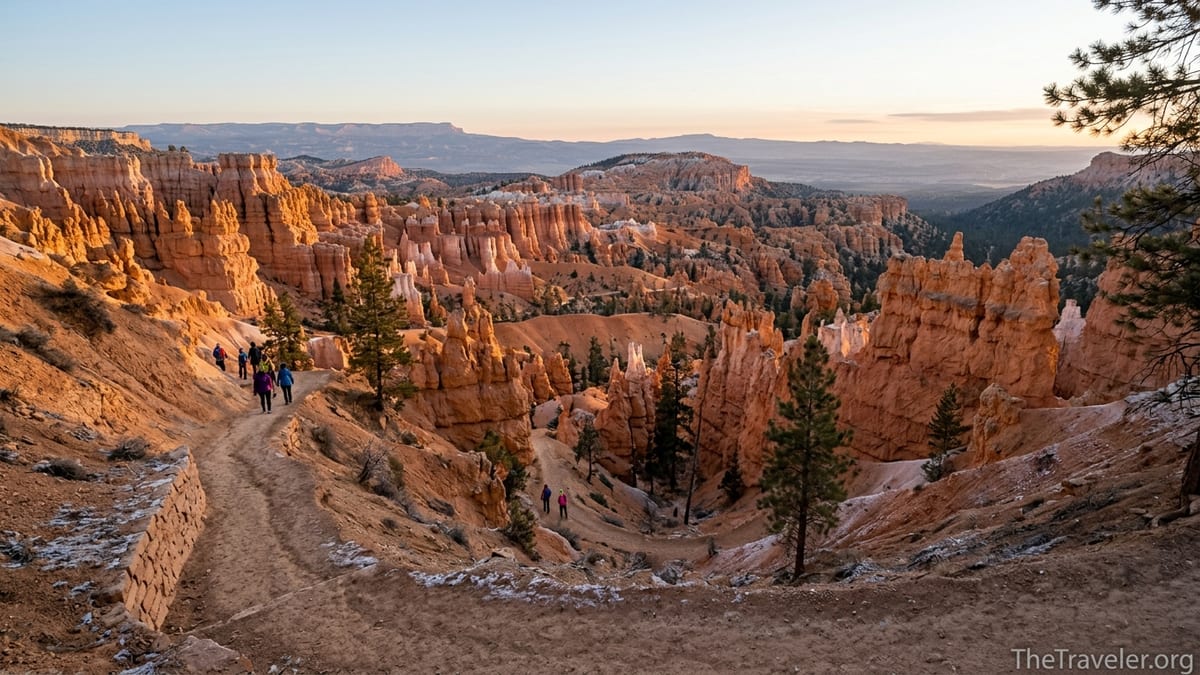
Queen’s Garden Is Short, But The Altitude Is Not
Many visitors see the mileage on a map, roughly 1.8 miles out and back or about 2.9 miles when combined with the Navajo Loop, and assume Queen’s Garden is a casual stroll. The hidden factor is elevation. Sunrise Point, where the trail begins, sits above 8,000 feet. At this height even fit travelers coming straight from Las Vegas, St. George, or sea-level cities find themselves unusually winded after just a few switchbacks. The trail may be the least difficult descent into Bryce Amphitheater according to the National Park Service, but that does not make it a low-altitude walk in the park.
A common real-world pattern plays out almost every summer afternoon. Families in sneakers and jeans happily march down from Sunrise Point, stopping for photos at the first tunneled arch and the famous “Queen Victoria” hoodoo. The descent feels easy, especially in cool morning air. The surprise comes on the way back. That same group is now moving slowly, taking frequent breaks in the sun, sometimes needing 45 minutes or more just to climb the final half mile. If you are arriving from lower elevations, plan this hike as your first activity of the day, walk at a deliberately slower pace, and expect the return ascent to feel significantly harder than the descent suggested.
Hydration is another place where visitors misjudge conditions. Air at Bryce is dry and often breezy, which means you can lose a lot of moisture without feeling sweaty. Park rangers routinely advise visitors to carry at least one liter of water per person for rim-to-canyon hikes. In practice, many day trippers show up with a single 16-ounce bottle to share, then find themselves rationing sips as they grind back toward the rim. A simple, real-world fix is to bring a refillable 1–1.5 liter bottle per person and top it off at the visitor center or lodge before heading to Sunrise Point.
Finally, if you know that altitude often affects you, consider staying overnight in Bryce Canyon City or at the lodge and walking a short section of the rim trail the evening before. Even a few hours at elevation can make the next morning’s descent and climb out of Queen’s Garden feel more manageable.
Trail Conditions Change With Season, Day, And Direction
Most visitor photos of Queen’s Garden are shot on bright summer days, but conditions shift dramatically with the calendar. In winter, Bryce regularly receives snow, and the park closes the narrow Wall Street side of Navajo Loop for the entire cold season because its shaded switchbacks hold ice. Even when the broader Queen’s Garden path remains open, its steeper sections can be slick, with hard-packed snow that feels more like a ski slope than a hiking trail. Those postcard images do not show the hikers inching along in rental traction spikes they picked up that morning at a local outfitter in Bryce Canyon City.
In spring and after summer thunderstorms, mud becomes the hidden challenge. The lower connecting section between Queen’s Garden and Navajo Loop can be sticky, clay-like mud that clings to shoes in heavy clumps. Hikers regularly report coming back to their cars with shoes that have doubled in weight, or slipping in rutted sections where horses also travel. If you are hiking between March and May or after storms, expect a bit of mess and consider lightweight hiking shoes with some grip instead of smooth-soled sneakers or sandals.
The direction you hike also matters more than most visitors realize. Guidebooks and the National Park Service both recommend following the loop clockwise: descend Queen’s Garden from Sunrise Point and ascend Navajo Loop to Sunset Point. This puts the steepest, tightest switchbacks on the climb out instead of the descent, which many hikers find easier on knees and more secure for footing. It also positions you to enjoy the most iconic views, such as Thor’s Hammer, on the way up when you are pausing for breaks anyway. Despite this, every day people unknowingly hike in the opposite direction and end up facing a long slog up Queen’s Garden’s sustained grade, staring into the sun during afternoon climbs.
Before you go, get in the habit of checking “Current Conditions” on the Bryce Canyon National Park website the morning of your hike. Trail closures, especially on Navajo Loop and the Rim Trail, can change from week to week because of rockfall, mudslides, snow, or maintenance. If the full Navajo Loop is closed, you can usually still create a “lollipop” by going down Queen’s Garden and back up the open Two Bridges side, but you will want to confirm this on the day you hike so you are not surprised by a barricade at the bottom.
Crowds Shape Your Experience More Than Mileage Does
What many visitors miss is that Queen’s Garden is not just popular; it is the most popular trail in the park. On a sunny June Saturday, the first mile can feel more like a promenade than a wilderness path, particularly between 9 a.m. and 1 p.m. When multiple bus tours and road-trippers all start their day at Sunrise Point, pinch points like narrow arches and short, steep switchbacks become mini traffic jams. You may find yourself stopping often not by choice, but because people ahead of you are staging photos, adjusting hiking poles, or catching their breath.
The experience is entirely different just a few hours earlier or later. Travelers who reach the rim at or just after sunrise, around 6 a.m. in midsummer, often find the first half of the trail nearly empty. In the cool golden light, you can listen for the sound of ravens and the crunch of your own footsteps instead of worrying about dodging selfie sticks. Conversely, hikers who drop into the amphitheater after 4 p.m. in summer often report thinner crowds as day trippers begin to leave and bus tours head back to their overnight stops near Zion or along Highway 89.
Parking also plays a hidden role. From roughly late spring through early fall, the park’s free shuttle system operates, and rangers strongly encourage visitors to leave cars at the Shuttle Station in Bryce Canyon City or at the large additional lot near the visitor center. Midday, the small lots at Sunrise and Sunset Points can fill quickly, which leads to frustrating loops as drivers circle for a spot. If you are staying in a hotel along the shuttle route, a practical strategy is to leave your car parked, show your park pass when boarding, and ride directly to Sunrise Point. When the shuttle is not running, aim to arrive at the park entrance by mid-morning to keep your odds of finding parking near the trailhead reasonable.
If your schedule is fixed and you have to hike in the middle of the day, accept that you will be sharing the trail. Build extra time into your plan for slow sections, bring a bit of patience, and remember that stepping aside briefly for uphill hikers is both polite and safer on narrow stretches. Many visitors find that simply adjusting their expectations, treating Queen’s Garden as a social, scenic walk rather than a solitary wilderness trek, leads to a much more enjoyable experience.
Gear And Clothing: What You Really Need For A “Short” Hike
Because Queen’s Garden looks compact on trail maps posted at Sunrise Point and in brochures, people routinely underestimate what to bring. It is common to see visitors starting down in casual slip-ons, fashion sneakers, or even flip-flops, holding a camera phone and nothing else. They usually turn around at the first steep pitch or continue anyway and end up nursing blisters or bruised toes by the time they crawl back to their cars.
Realistically, you do not need expedition gear, but a few basic items make a huge difference. Closed-toe shoes with real tread, whether lightweight hikers from brands like Merrell or Salomon or sturdy running shoes, will handle loose gravel and short sandy stretches far better than smooth-soled street shoes. A small daypack lets you carry at least one water bottle per person, a light snack, sunscreen, and a thin layer such as a fleece or windbreaker. Even in July, morning temperatures can be in the 40s Fahrenheit on the rim, warming quickly into the 70s and 80s in the amphitheater by late morning.
Sun protection is the other overlooked factor. The trail offers only scattered shade from pinyon pines and Douglas firs. At 8,000 feet, UV radiation is stronger than at sea level, so a brimmed hat, sunglasses, and sunscreen reap real dividends. Families who skip these often find younger children hot, tired, and sunburned halfway back up the trail, cutting their outing short. Carrying a simple snack, such as trail mix or energy bars, and planning a brief break at the Queen Victoria viewpoint can make the climb out feel less daunting, particularly for kids or anyone adjusting to the altitude.
During winter and early spring, local general stores and outfitters in Bryce Canyon City rent traction devices that fit over regular hiking shoes. Visitors who arrive to icy conditions without any gear can pick up a pair in the morning and return them after the hike. The cost is modest compared with the consequences of a slip on a steep, frozen slope. Trekking poles, whether rented or brought from home, are another small investment that pays off on the steepest grades and when mud or loose gravel covers the path.
Route Choices, Combinations, And Honest Time Planning
Another thing many visitors miss is that “Queen’s Garden” can mean several different experiences depending on how you combine it with other trails. The simplest version is an out-and-back from Sunrise Point to the Queen Victoria formation, roughly 1.8 miles round trip. This is a good choice for families with younger children, travelers just stretching their legs on a drive between parks, or anyone who starts to feel the altitude after the first few hundred feet of descent. You still get classic hoodoo views and walk through the narrow arches near the top.
The most popular option is the Queen’s Garden and Navajo Loop combination, often called the Queen’s / Navajo Combination Loop. When fully open, this roughly 2.9 mile loop lets you descend Queen’s Garden, walk the connecting section along the canyon floor, and climb back out via the steep switchbacks beneath Thor’s Hammer, either through the famous Wall Street slot or the Two Bridges side, depending on seasonal closures. Most guide sources suggest allowing 2 to 3 hours for this route. That estimate assumes frequent photo stops and short rests along the ascent, which is realistic for many first-time visitors.
For hikers looking for a longer challenge, Queen’s Garden can also form part of a larger “Figure 8” route with the Peekaboo Loop, totaling over 6 miles. This longer outing drops you deeper among the hoodoos and rolling terrain of the amphitheater. However, many travelers misjudge the commitment, starting the Figure 8 mid-morning in summer with limited water or in winter without traction, then turning back partway through because of heat, fatigue, or conditions. If you are considering this option, honestly assess your fitness, the heat forecast, and your schedule, and carry extra water.
One practical planning tip: treat driving and parking as part of your hiking time. From Bryce Canyon City hotels, it can take 15 to 30 minutes to drive into the park, find parking, use restrooms, and walk to the trailhead. In high season, hikers who plan “just a quick two-hour loop before dinner” often end up rushing because they forget to factor in transit and parking delays. Build in at least an extra hour around your hike so that a slow return climb, a crowded shuttle, or an impromptu photo stop at Sunset Point does not create stress later in your day.
Weather, Safety, And Respect For A Fragile Landscape
Beneath the excitement of walking among Bryce’s hoodoos, Queen’s Garden is still a desert hike in a fragile, high-altitude environment. Rapidly changing weather is something many visitors underestimate. Summer afternoons can bring fast-moving thunderstorms with lightning and sudden downpours. If dark clouds begin to build while you are in the amphitheater, the safest move is usually to turn around and head for the rim rather than pushing on into lower sections where flash-flooding mud and slippery slopes can develop. In shoulder seasons, cold fronts can drop temperatures dramatically; a hike that starts comfortably in a T-shirt can end in gusty winds and near-freezing windchill at the rim.
Trail safety is also about where you walk and stand. Hoodoos and the canyon rim are composed of eroding limestone and clay that easily crumble under pressure. Visitors sometimes venture off the maintained path for what they think will be a better photo angle, stepping onto the very edge of loose slopes or climbing onto delicate formations. Not only does this accelerate erosion and damage the landscape, it can be genuinely hazardous. The maintained path already offers dozens of safe, spectacular viewpoints; sticking to it protects both you and the formations you came to see.
Encounters with wildlife are another subtle concern. Mule deer and smaller animals like chipmunks or ground squirrels are common around the trail. Because so many people pass through Queen’s Garden each day, some animals become accustomed to human presence and may approach closely. Feeding them, even “just one peanut” or a piece of granola bar, alters their behavior and can make them aggressive or ill. The park’s guidelines are clear: observe wildlife from a distance and secure food in your pack between snack breaks.
Finally, be honest about how you or members of your group are feeling at each junction. The trail offers several natural turnaround points: the first set of arches, the Queen Victoria viewpoint, and the junction with the connecting path toward Navajo Loop. There is no shame in deciding at one of these spots that you have seen enough and turning back toward the rim. Many emergency rescues in the amphitheater involve visitors who pushed far past their comfort level because they felt obligated to complete a loop, then discovered they were out of water, energy, or daylight.
The Takeaway
Queen’s Garden is beloved for good reason. Few trails in the American Southwest offer such an immediate, immersive walk among colorful hoodoos for such a modest distance. What separates a magical hike from a miserable slog is not advanced mountaineering skill but awareness. Understanding the impact of 8,000 feet of elevation, recognizing how seasonal closures and weather change the route, and planning around crowds and parking all pay off far more than obsessing over exact mileage.
If you arrive with realistic expectations, basic gear, enough water, and a flexible plan that respects both your limits and the landscape, Queen’s Garden can be the highlight of your Bryce Canyon visit. Step carefully, take your time on the climb out, look back often at the way the morning or evening light paints the hoodoos, and you will understand why so many travelers remember this short, steep trail long after they have left the plateau behind.
FAQ
Q1. How long does it take to hike the Queen’s Garden Trail?
The basic out-and-back from Sunrise Point to the Queen Victoria viewpoint typically takes 1 to 2 hours, depending on your pace, altitude adjustment, and how often you stop for photos.
Q2. What is the distance and elevation change on the Queen’s Garden and Navajo Loop combination?
The classic Queen’s Garden and Navajo Loop combination is about 2.9 miles long with roughly 600 feet of elevation change, which most visitors complete in 2 to 3 hours.
Q3. Is Queen’s Garden suitable for beginners or kids?
Yes, many beginners and families hike Queen’s Garden, but it is still a moderately strenuous trail at high altitude. Plan extra time, bring plenty of water and snacks, and be ready to turn around early if anyone is struggling.
Q4. Which direction should I hike, and does it really matter?
Most hikers go clockwise, descending Queen’s Garden from Sunrise Point and ascending Navajo Loop to Sunset Point. This direction puts the steepest switchbacks on the climb out and often feels safer and less punishing on knees.
Q5. Do I need special gear for Queen’s Garden?
You do not need technical equipment, but closed-toe shoes with good tread, a small daypack, at least one water bottle per person, sun protection, and in winter traction devices or trekking poles are strongly recommended.
Q6. When is the best time of day to hike Queen’s Garden?
Early morning around or just after sunrise and late afternoon are ideal. Temperatures are cooler, lighting on the hoodoos is softer, and the trail is usually less crowded than in the late morning and midday peak.
Q7. How do seasonal closures affect the Queen’s Garden hike?
Queen’s Garden itself is often open year-round, but the Wall Street side of Navajo Loop typically closes in winter and can also be blocked by rockfall or mudslides. Always check current conditions before planning a loop.
Q8. Is the shuttle the best way to reach the Queen’s Garden trailhead?
When the shuttle is operating, it is usually the easiest way to reach Sunrise Point without worrying about parking. Outside shuttle season, arrive earlier in the day to improve your chances of finding a parking space near the rim.
Q9. Can I hike Queen’s Garden in winter?
Yes, many visitors enjoy Queen’s Garden in winter, but expect snow and ice on the trail. Wear warm layers, bring traction devices if conditions are slick, and check for any weather-related advisories before setting out.
Q10. What are good alternatives if Queen’s Garden is too crowded or challenging?
If Queen’s Garden feels too busy or strenuous, consider shorter rim walks between Sunrise, Sunset, and Inspiration Points, or easier routes like the Bristlecone Loop. These options still offer classic Bryce Canyon views with less elevation change.