


Ask rangers, guidebook writers, or frequent visitors which hike best introduces you to Bryce Canyon, and you will almost always hear the same answer: the Queen’s Garden Trail. Beginning at Sunrise Point and winding gently down among the park’s famous hoodoos, it is officially rated as the least strenuous trail that drops from the rim into the Bryce Amphitheater, yet it still delivers the signature views and sense of immersion that make Bryce Canyon unforgettable. For first-time visitors, families, and anyone with limited time, it is hard to find a better introduction to this compact but spectacular national park.
Get the latest updates straight to your inbox!
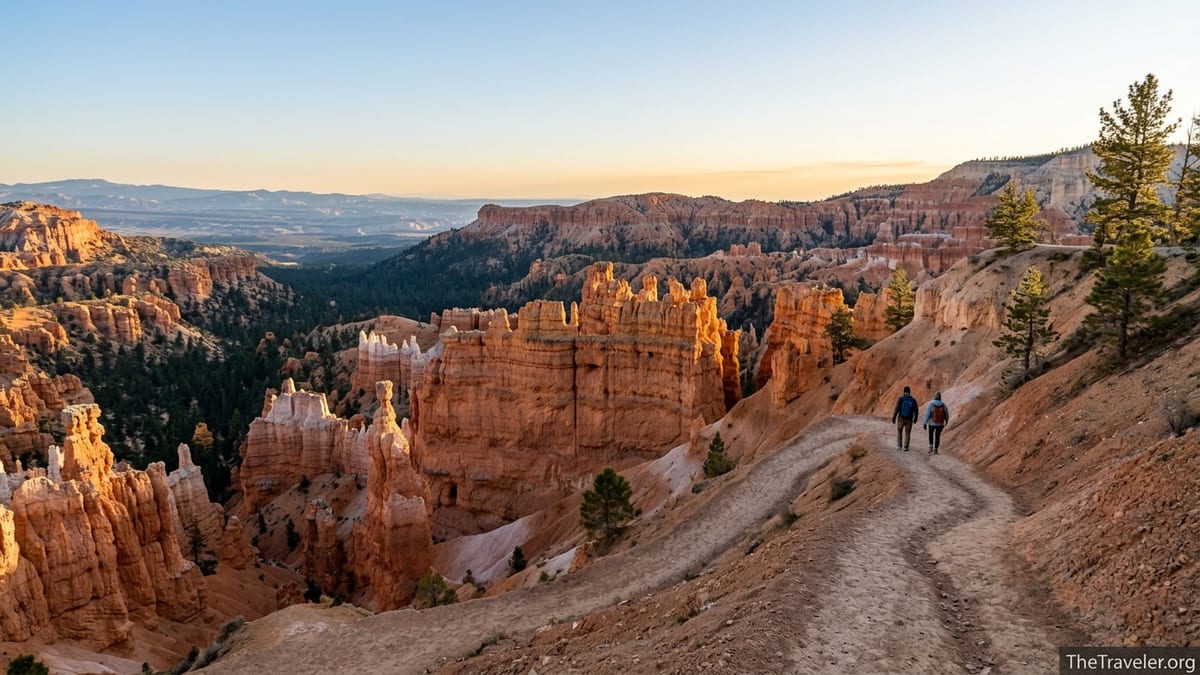
An Easy-to-Understand Trail in a Mind-Bending Landscape
Bryce Canyon’s landscape can feel almost overwhelming at first encounter. From the main amphitheater viewpoints, the maze of pinnacles and fins looks more like a coral reef than a desert plateau. The Queen’s Garden Trail takes that complexity and turns it into something approachable. Official National Park Service information describes it as a 1.8 mile round-trip hike from Sunrise Point with about 320 to 450 feet of elevation change, categorized as moderate rather than strenuous. In practice, that means most reasonably fit visitors can complete it in 1 to 2 hours, including plenty of time for photos.
The route itself helps first-time visitors build confidence. From the rim at Sunrise Point, the path descends in broad, well-graded switchbacks that feel more like a steady stroll than a scramble. The drop-off is real, but the tread is wide and clearly defined, which matters for travelers who might be nervous about exposure after seeing Bryce’s sheer-walled drop-offs from the overlooks. Compared with steeper options like the upper sections of the Navajo Loop or the longer Fairyland Loop, Queen’s Garden feels immediately intuitive: follow the obvious path down the ridge, then retrace your steps or continue on a signed junction.
This user-friendly structure makes it especially appealing to travelers who are new to desert hiking altogether. A couple arriving from Las Vegas after only doing short boardwalks at the Hoover Dam, for instance, can pull into Bryce around mid-morning, park near Sunrise Point or at the main shuttle lot, and be walking among hoodoos within half an hour. There are no route-finding puzzles, technical sections, or exposed ledges that require a comfort level most first-time visitors have not yet developed.
Immersion Among Hoodoos Without an All-Day Commitment
Another reason Queen’s Garden is considered the best introduction to Bryce Canyon is how quickly it takes you from “spectator” to “participant.” Within the first 10 minutes of leaving Sunrise Point, you are already below the rim, flanked by orange and cream rock walls, and looking up at the formations you were just photographing from above. Compared with staying on the paved Rim Trail or doing only overlook stops, it is a transformation: the amphitheater becomes a world you walk through rather than a postcard you admire from a distance.
The payoff is disproportionate to the effort. Many visitors report that the first few switchbacks deliver some of the most memorable views of their entire Utah trip, rivaling more demanding routes in Zion or Canyonlands. The trail threads between narrow fins, passes through small tunnels cut in the rock, and winds among free-standing hoodoos that feel close enough to touch. Yet because the total distance is short, you can comfortably hike it between breakfast and lunch, or squeeze it in as an afternoon outing after driving over from Zion or Escalante.
This makes Queen’s Garden ideal for travelers working with tight itineraries. A family staying at Ruby’s Inn or one of the motels in Bryce Canyon City, for example, might arrive late the first evening, watch sunset from Sunset Point, and then dedicate the next morning to a single hike before driving onward to Capitol Reef or Page. Queen’s Garden gives them a complete Bryce experience in less time than a movie, without the risk of overcommitting to a longer loop and running behind schedule.
Why Park Rangers Call It the “Least Difficult” Descent
Among the six main trails that drop from the rim into the Bryce Amphitheater, Queen’s Garden has a reputation for being the gentlest introduction. While the National Park Service still labels it as moderately strenuous due to the high elevation and grades in some spots, the overall profile is more forgiving than steeper options like the Wall Street side of the Navajo Loop or the initial descent into the Peekaboo Loop. For new arrivals not yet acclimated to Bryce’s roughly 8,000 foot elevation, that difference can matter a great deal.
The grade of the switchbacks is the key. Instead of plunging straight down a narrow slot, Queen’s Garden gradually works its way along a ridgeline for about 0.9 miles to the Queen Victoria hoodoo. The path spreads the elevation loss over a longer distance, making the climb back to the rim less punishing than the shorter, steeper ascents you find elsewhere in the park. For visitors who have flown in from sea-level cities like Los Angeles, New York, or London just a day or two earlier, having a moderate but not overwhelming climb helps avoid altitude headaches or the discouragement that can come from needing to stop every few steps.
Families in particular appreciate this. It is common to see multi-generational groups on Queen’s Garden: grandparents using trekking poles, teens racing ahead for photos, and younger kids marveling at the tunnels in the rock. While the descent can feel like a breeze, the key message rangers give at the trailhead is to remember that “what goes down must come up.” Even so, among Bryce’s inner amphitheater hikes, Queen’s Garden offers one of the best ratios of views to effort, making it a natural first choice.
Iconic Landmarks: From Sunrise Point to Queen Victoria
For a first visit, it helps when a trail links easily recognizable landmarks, and Queen’s Garden does exactly that. The hike begins at Sunrise Point, one of Bryce Canyon’s four signature amphitheater viewpoints alongside Sunset, Inspiration, and Bryce Points. Many visitors park here before dawn or take the free shuttle to watch the sun clear the horizon and ignite the hoodoos in shades of rose and orange. From that same overlook, the Queen’s Garden trailhead is an obvious, well-signed starting point leading directly into the amphitheater.
As you descend, rock features begin to acquire names that make orientation simple for first-time visitors. Near the bottom of the main descent, a short spur leads to the Queen Victoria hoodoo, the namesake of the trail. Standing on the viewpoint at the end of the spur, many travelers find it easy to pick out the formation that supposedly resembles the British monarch seated on a throne. Even if the resemblance seems more imaginative than exact, the named formation serves as a clear “turnaround point” for those doing the trail as an out-and-back.
Along the way, the trail passes through arches and gaps carved in the soft stone, offering natural photo frames for the amphitheater beyond. In spring and early summer, patches of snow can linger in shaded pockets while the slopes around them glow in warm light, an easy visual lesson in how elevation and aspect shape this high desert environment. For many visitors, these visual cues do more than any panel at the visitor center to explain what makes Bryce Canyon’s hoodoos unique.
Flexible Options: Standalone Walk or Gateway to Longer Loops
Another reason Queen’s Garden works so well as a first hike is its flexibility. On its own, the trail is a simple there-and-back walk from Sunrise Point to the Queen Victoria hoodoo and back to the rim. That is ideal for visitors who want a clear goal, limited time, or a gentle first day at altitude. However, the same path can easily become part of a more ambitious route once hikers feel comfortable and conditions allow.
At the lower junction, clear signage points toward the Navajo Loop, which climbs back to the rim near Sunset Point. Combining Queen’s Garden and the Navajo Loop creates a roughly 2.9 mile figure-eight style hike that many guidebooks and hiking websites describe as one of the best short loops in the national park system. Some travelers choose to descend via Queen’s Garden and ascend via the Two Bridges side of the Navajo Loop, especially when the Wall Street section is seasonally closed due to ice or rockfall. This approach offers the gentler descent of Queen’s Garden and the dramatic slot-like walls of Navajo on the return.
For experienced hikers with more time, Queen’s Garden can also be the first segment of the longer Figure-8 Combination, linking Queen’s Garden, Navajo, and Peekaboo Loop into a half-day adventure of roughly 6.4 miles. Travelers might start with Queen’s Garden early one morning, feel how their lungs handle the altitude, and then decide whether to commit to a longer loop later in their trip. In this way, Queen’s Garden functions as both a satisfying standalone hike and a low-risk “test piece” for what Bryce’s inner amphitheater has to offer.
Logistics That Work for First-Time Visitors
Beyond the trail itself, the logistics around Queen’s Garden make it an easy choice for newcomers. The trailhead at Sunrise Point is one of the main shuttle stops served by the Bryce Canyon Shuttle from roughly April through mid-October. Many visitors choose to leave their car at the main shuttle lot near the park entrance or at accommodations in Bryce Canyon City, then ride the shuttle directly to Sunrise Point. From there, it is only a short walk to the overlook and down to the trailhead, which helps avoid the parking congestion that can build up at the amphitheater viewpoint lots during busy mid-morning hours.
The facilities near the trailhead add a layer of comfort, particularly for less-experienced hikers. Accessible restrooms and a seasonal water-fill station at the nearby general store mean travelers can top up water bottles, adjust layers, and use the restroom immediately before or after the hike, rather than needing to drive back to the visitor center. This is especially helpful for families with children or for older travelers who prefer not to be far from services.
Entrance fees also factor into planning. As of 2026, a standard private vehicle entrance pass for Bryce Canyon generally falls in the roughly 20 to 35 dollar range, valid for seven consecutive days. Non-US residents aged 16 and older face an additional nonresident fee per person unless covered by a valid America the Beautiful or equivalent annual pass. While those amounts can change, many international visitors find that purchasing an annual pass still makes sense if they plan to visit multiple parks such as Zion, the Grand Canyon, or Arches on the same trip. In practical terms, this means a couple from Toronto or Munich could drive into Bryce once, use the shuttle to access Sunrise Point, and hike Queen’s Garden without any additional per-hike costs.
Seasonality, Safety, and When to Hike
For first-time visitors, choosing the right time of day and season can be the difference between a magical introduction to Bryce and a difficult one. Queen’s Garden is open year-round, but conditions vary dramatically. In summer, daytime temperatures on the exposed slopes can climb well into the 80s Fahrenheit, even while the air at the rim remains cooler. Starting early, ideally around sunrise or within the first couple of hours of daylight, helps hikers avoid the harshest sun and gives them the bonus of soft morning light on the hoodoos.
In winter and early spring, snow and ice can linger on the switchbacks, especially in shaded sections. The park sometimes closes sections of connected trails such as the Wall Street side of the Navajo Loop when ice and rockfall make them unsafe, although Queen’s Garden itself is often still accessible with appropriate traction. First-time visitors coming in colder months frequently rent or purchase basic traction devices for their boots in nearby towns like Panguitch or at outfitters en route from Zion. Even for a moderate trail like Queen’s Garden, these simple preparations can make a substantial difference in stability and confidence.
Any time of year, carrying water, sun protection, and sturdy footwear is non-negotiable. Although the trail is short by backcountry standards, the combination of altitude, dry air, and reflective rock amplifies dehydration risk. Travelers used to sea-level urban walks sometimes underestimate how quickly the climb back to the rim can feel strenuous, particularly around midday. Many guides suggest at least one liter of water per person even for this short hike, more in the height of summer, and wearing closed-toe shoes with good grip rather than casual sandals.
The Takeaway
When travelers and rangers describe Queen’s Garden as the best introduction to Bryce Canyon, they mean that it distills the park’s essence into a compact, approachable experience. The trail is long enough to feel like a real hike but short enough to fit into even the tightest itineraries. It offers immersive contact with Bryce’s signature hoodoos without the exposure or physical demands that can make other amphitheater routes intimidating for first-timers.
Starting at a marquee viewpoint, linking to a named landmark like the Queen Victoria hoodoo, and connecting seamlessly to other classic routes such as the Navajo Loop, Queen’s Garden serves both as a destination in its own right and as a gateway to deeper exploration. Add in straightforward logistics, shuttle access, nearby amenities, and flexible options for extending the hike, and it becomes clear why so many visitors leave Bryce Canyon saying that if they could recommend just one trail for a first visit, it would be this one.
FAQ
Q1. How long does it take to hike the Queen’s Garden Trail for a first-time visitor?
Most first-time visitors should plan on 1 to 2 hours for the Queen’s Garden out-and-back, including time for photos and short breaks. The trail itself is about 1.8 miles round-trip from Sunrise Point, but stopping frequently to enjoy the views is part of the experience.
Q2. Is the Queen’s Garden Trail suitable for children and older travelers?
Yes, many families with children and older travelers hike Queen’s Garden. The path is well-defined and the grade is more gradual than other amphitheater trails, though the elevation and climb back to the rim can still feel strenuous. Trekking poles, a slow pace, and plenty of water help make it manageable for a wide range of ages.
Q3. What is the best time of day to hike Queen’s Garden on a first visit?
Early morning is generally best, especially around sunrise or within the first two hours of daylight. Temperatures are cooler, lighting on the hoodoos is softer, and parking or shuttle crowds are lighter. Late afternoon can also work well, but mid-day in summer can be hot and exposed.
Q4. Do I need special gear to hike the Queen’s Garden Trail?
For most of the year, sturdy closed-toe shoes, sun protection, and at least one liter of water per person are sufficient for first-time visitors. In winter or early spring, simple traction devices for your shoes can be helpful if snow or ice is present on the switchbacks.
Q5. Can I combine Queen’s Garden with other trails if I want a longer hike?
Yes, many visitors turn Queen’s Garden into a loop by continuing to the Navajo Loop and climbing back to the rim near Sunset Point, creating a roughly 2.9 mile route. More experienced hikers sometimes link Queen’s Garden, Navajo, and Peekaboo into a longer Figure-8 Combination for a half-day outing.
Q6. Is parking available at the Queen’s Garden trailhead?
Parking is available at Sunrise Point, where the trail begins, but spaces can fill quickly during busy times. The Bryce Canyon Shuttle, operating seasonally from roughly April to mid-October, stops near Sunrise Point and is often the easiest option for first-time visitors.
Q7. How does Queen’s Garden compare in difficulty to other Bryce Canyon trails?
Among the main amphitheater descents, Queen’s Garden is generally considered the least difficult, with a more gradual grade and lower overall elevation change than trails such as the steeper sections of the Navajo Loop or the longer Peekaboo Loop. It still feels like real hiking, but it is a gentler introduction for most first-time visitors.
Q8. Are there restrooms and water near the trailhead?
Yes, restrooms and a seasonal water-fill station are located near Sunrise Point, close to the Queen’s Garden trailhead. First-time visitors are encouraged to fill water bottles and use the facilities before starting the hike, as there are no services along the trail itself.
Q9. Is the Queen’s Garden Trail open year-round?
Queen’s Garden is typically accessible year-round, but conditions vary. In winter and early spring, snow and ice can make sections slippery, and nearby connecting routes like parts of the Navajo Loop may temporarily close for safety. Always check current conditions at the visitor center or with rangers before hiking.
Q10. Why is Queen’s Garden recommended as a first hike if I have only one day in Bryce Canyon?
Queen’s Garden is recommended because it is short, scenically rich, and logistically straightforward. In one compact hike, first-time visitors experience Bryce’s signature hoodoos from both above and below the rim, gain a feel for the park’s elevation and climate, and can easily connect to viewpoints or other trails before continuing their trip.