


The first time I stepped over the rim at Sunrise Point and started down the Queen’s Garden Trail, Bryce Canyon stopped being a postcard and became a place I could feel under my boots. The air was cool and pine-scented, the light was turning the hoodoos from gray silhouettes into glowing spires, and the crunch of red dust underfoot made it suddenly real. By the time I climbed back out of the amphitheater, breathless and grinning, I knew I was in love with Bryce Canyon National Park.
Get the latest updates straight to your inbox!
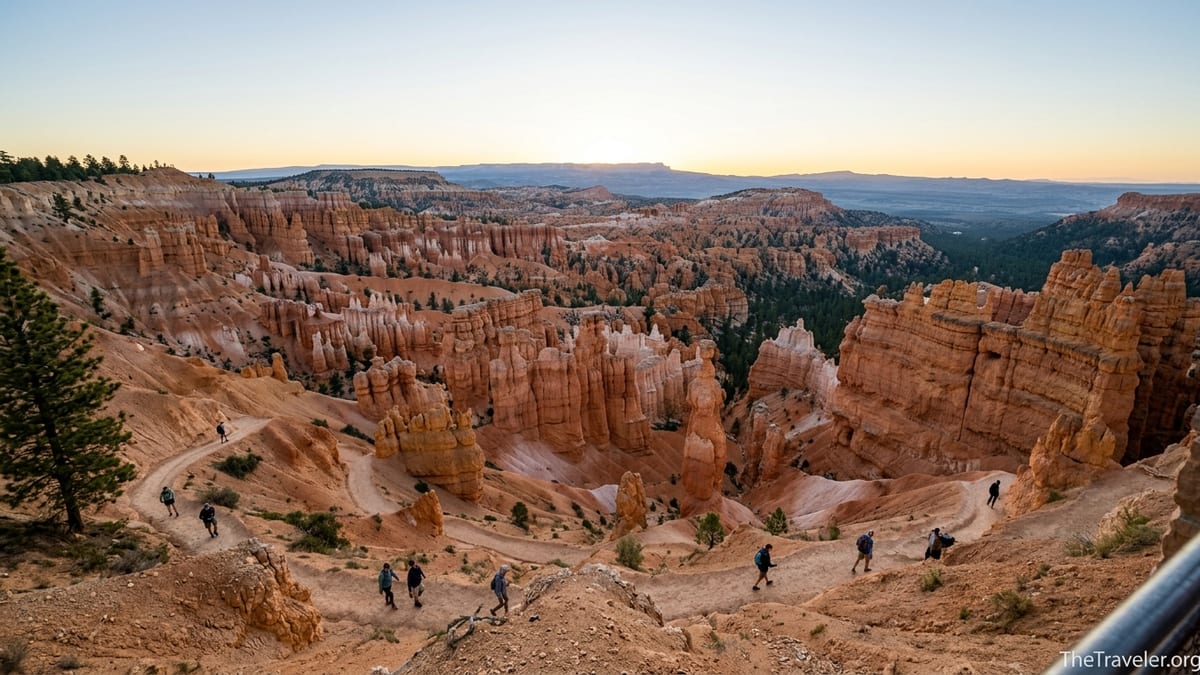
Meeting Bryce Canyon for the First Time
You can read about Bryce Canyon’s hoodoos and see photos of its orange amphitheaters, but nothing quite prepares you for the moment you first stand at Sunrise Point. The amphitheater drops away at your feet, crowded with stone spires that look like they belong in a fantasy novel rather than on a plateau in southern Utah. On my first visit, I arrived just after dawn, bundled in a fleece against the high-elevation chill, watching the first light turn the rock from pale pink to molten orange.
At nearly 8,000 feet above sea level, the air feels thinner and crisper than in nearby Zion or the towns along Highway 12. In late spring, a light frost still clung to shaded patches along the rim, while down below the amphitheater already glowed in the sun. The contrast was striking: a cold breeze on my face, warm color in the canyon, the smell of ponderosa pines and damp earth. I had seen Bryce Canyon on calendars for years, but that morning it stopped being an image and became something I could enter.
That is exactly what the Queen’s Garden Trail invites you to do. Instead of simply admiring Bryce Canyon from above, you leave the railings and pavement behind and drop directly into the heart of the hoodoos. For me, that first descent was the moment the park shifted from scenery to experience.
What Makes the Queen’s Garden Trail Special
The Queen’s Garden Trail is often described as the easiest route down into the main Bryce Amphitheater, and in many ways it is. From Sunrise Point, the path snakes 0.9 miles below the rim, losing about 300 feet of elevation as it winds between walls of red and cream rock. Unlike steeper neighbors such as the Navajo Loop’s switchbacks, the grade on Queen’s Garden is comparatively gentle, with broad turns and fewer tight climbs, which is why rangers and guidebooks routinely recommend it as an introduction to hiking below the rim.
But “easiest” does not mean ordinary. A few minutes after you leave the rim, the busy overlook crowds thin out, and you find yourself walking between hoodoos instead of looking down on them. On my first hike, I passed through narrow doorways carved straight into the rock, ducking under arches and emerging into small pockets of forest where young firs and bristlecones clung to the slopes. The trail feels playful and intimate, like a meandering garden path carefully laid out by geology rather than a landscape architect.
Near the bottom of the trail, a short spur leads to the formation that gives the route its name: a hoodoo that, with some imagination, resembles a seated Queen Victoria surveying her stone kingdom. The first time I rounded the corner and saw her, framed by a backdrop of layered cliffs and a scatter of lone pines, I understood why so many travelers single out this hike as their favorite in the park. It is not just the views; it is the way the trail guides you gently into a world that feels otherworldly but completely accessible.
Planning Your Hike: When to Go and What It Really Feels Like
Like much of Bryce Canyon, the Queen’s Garden Trail changes character dramatically with the seasons. In mid-summer, temperatures on the rim sit comfortably in the 70s Fahrenheit, while the sun can feel intense as you descend into the amphitheater. By contrast, in April and late October, icy patches can linger on shaded switchbacks, and early morning starts often mean gloves and a beanie. On my first visit in late May, the thermometer at the visitor center read just above freezing at sunrise, but by the time I had descended a few switchbacks, I was peeling off layers in the sheltered warmth below the rim.
Time of day matters just as much as time of year. Hiking at sunrise or within the first couple of hours afterward is ideal. You avoid the midday tour bus crowds, and the low-angle light sculpts the hoodoos in golds and reds that simply do not appear at noon. I started my hike at about 6:15 a.m., after watching the sun clear the horizon at Sunrise Point. By the time I reached the Queen Victoria viewpoint, the amphitheater was glowing, but the trail was still quiet enough that I could hear the distant calls of ravens and the scrape of other hikers’ boots echoing off the canyon walls.
Even with its reputation as a beginner-friendly descent, you still feel the elevation. At around 8,000 feet, visitors arriving from sea-level cities like Los Angeles or New York often notice their lungs working harder on the way back up. The downhill on Queen’s Garden lulls you into a sense of ease; it is the climb back to the rim, whether you return the way you came or continue up the Navajo Loop, that reminds you where you are. I remember stopping at a small switchback, hands on hips, laughing with a couple from Florida who admitted they had underestimated what “short and moderate” means at this altitude.
Getting There: Shuttles, Parking, and Entrance Fees
Reaching the Queen’s Garden Trail is straightforward, but a little planning makes the experience smoother. Most visitors drive in on Utah Highway 63, passing through Bryce Canyon City before reaching the park entrance station. As of 2026, the standard entrance fee for a private vehicle is about 35 dollars for up to seven days. For frequent park-hoppers, the America the Beautiful annual pass, typically around 80 dollars, often pays for itself quickly. Non-US visitors should be aware that Bryce Canyon is now among the parks charging an additional nonresident fee per adult, which can add significantly to trip costs, so checking the latest details on the National Park Service site or at the gate before you go is wise.
Once inside, you have a choice: drive your own car to Sunrise Point or use the free seasonal park shuttle. The shuttle runs between Bryce Canyon City, the visitor center, and key viewpoints, including both Sunrise and Sunset Points, which bookend the Queen’s Garden and Navajo Loop area. On my first visit, I arrived just after 7 a.m., and the small Sunrise Point parking lot was already filling. I managed to grab one of the last spots, but by mid-morning it was full, and new arrivals were being directed back toward shuttle stops near the lodge and the visitor center.
These days, especially from late spring through early fall, I recommend leaving the car at your hotel in Bryce Canyon City or at the large lot across from the visitor center and hopping on the shuttle. It saves you the stress of circling for a space, and it is particularly convenient if you decide to finish your hike at Sunset Point and simply ride back to where you started. If you do drive, arrive by sunrise or later in the afternoon when day-trippers from Zion and Page begin to clear out.
Why I Fell in Love: The Queen’s Garden / Navajo Combination Loop
Hiking Queen’s Garden as an out and back is beautiful, but the route that truly made me fall for Bryce Canyon was the classic Queen’s Garden / Navajo Loop combination. This 2.9-mile circuit takes you down Queen’s Garden from Sunrise Point, across the amphitheater floor, and then up the Navajo Loop to Sunset Point before you stroll half a mile along the Rim Trail back to where you began. It is the kind of hike that feels like a highlight reel of Bryce Canyon in a single morning.
After passing the Queen Victoria formation, the trail meanders through an open basin dotted with ponderosa pines whose vanilla-scented bark becomes evident the closer you stand. I remember stopping to press my nose to the trunk of a particularly tall tree, delighted to discover that the rumors were true: on a warm day, the bark smells faintly like butterscotch. From there, the path joins the bottom of the Navajo Loop, where the terrain tightens into a corridor of towering orange walls.
Ascending via the Two Bridges side of the Navajo Loop, I entered a canyon so narrow that the sky became a thin strip of blue between stone. The switchbacks are steeper here than anything on Queen’s Garden, stacking back upon themselves like a staircase carved into the cliff. It is demanding, and at 8,000 feet you will likely feel your heart pounding, but the payoff is immense. Halfway up, I turned around and saw a line of hikers below winding through the canyon like a living thread, framed by the famous Thor’s Hammer hoodoo and a scatter of twisted pines. That final push to Sunset Point, legs burning and lungs working, was the moment I realized this hike had moved from “pretty” to unforgettable.
Practical Tips: Gear, Safety, and Crowd Management
One of the reasons Queen’s Garden is such a good introductory hike is that it does not require technical gear. On a dry summer day, a pair of sturdy walking shoes or light hiking boots with decent tread, a daypack, and at least one to two liters of water per person are usually enough. That said, conditions in Bryce Canyon can change quickly. Afternoon thunderstorms are common in July and August, bringing sudden downpours and the risk of lightning. In shoulder seasons, sections of trail can be icy, and small microspikes that slip over your shoes can make the difference between a cautious, enjoyable descent and a nervous slide on frozen switchbacks.
Sun protection is crucial. Even on a cool day, the high elevation makes the sun feel more intense, and there is little shade once you are below the rim. On my first visit, I watched more than one hiker apply sunscreen at Sunrise Point, only to pack the bottle away and emerge hours later with a pink neck and nose. A wide-brimmed hat, sunglasses, and sunscreen that you actually reapply are as essential as your camera. Lightweight layers work best: mornings can start near freezing in April and climb well into the 60s or 70s Fahrenheit by midday.
To avoid crowds, aim to start your hike early or late. The window between 9 a.m. and 2 p.m. is when tour buses and day-trippers swarm the amphitheater. During a June visit, I arrived at Sunrise Point just after 5:45 a.m. and shared the trail with only a handful of other hikers. By the time I climbed out via Navajo at around 9:30 a.m., a steady stream of people was beginning to flow down into the canyon. If you prefer a quieter experience, consider an evening descent instead, leaving enough time to climb out before dark and savoring the softer light on the hoodoos.
Beyond the Trail: How Queen’s Garden Changed the Way I Saw Bryce
Before hiking Queen’s Garden, I thought of Bryce Canyon as a park you mainly appreciate from overlooks. Scenic pullouts like Bryce Point and Inspiration Point certainly deliver extraordinary views, and I still recommend them. But walking among the hoodoos reshaped my sense of the place. Instead of a distant amphitheater, the canyon became a network of intimate spaces: narrow passageways where voices echoed softly, sandy washes where chipmunks darted between roots, and quiet corners where a single pine grew improbably from a crack in the rock.
That intimacy affected how I planned the rest of my trip. After Queen’s Garden, I wanted more time below the rim, so on a later visit I explored the slightly longer Fairyland Loop, an eight-mile circuit with fewer people and a more remote feel. I also discovered shorter near-rim strolls, such as the section of Rim Trail between Sunrise and Sunset Points, which is paved and accessible, making it perfect for less mobile family members who still want to see the hoodoos from varying angles. But it all started with that first, approachable descent into Queen’s Garden.
Perhaps the deepest impression the trail left on me was a sense of fragility. Up close, you can see how soft the rock is, how quickly water and ice can carve new shapes into the hoodoos. Signs at the trailhead remind you to stay on the path and not to climb on formations, and once you are beneath the rim, the reasoning becomes obvious. The spires that look so solid from the overlooks feel more delicate when you are standing at their base. Respecting the trail boundaries and treading lightly is part of honoring what makes this place so extraordinary.
The Takeaway
If Bryce Canyon is a symphony of light and stone, the Queen’s Garden Trail is the piece that invites you into the orchestra pit. In less than three miles, especially when combined with the Navajo Loop, you experience nearly everything that makes this park special: the cool rim air and warm canyon sun, the sweeping amphitheater vistas and close-up encounters with hoodoos, the quiet of early morning and the shared camaraderie of fellow hikers tackling the climb out.
For me, this hike transformed Bryce Canyon from a beautiful stop on a Utah road trip into a place I cared about and wanted to return to in different seasons and different lights. It is accessible enough for many first-time visitors yet rewarding enough that even experienced hikers talk about it years later. If you have only one morning in Bryce Canyon, Queen’s Garden deserves to be at the top of your list. Step off the rim, follow the winding path between the spires, and you may find, as I did, that this humble trail is where you fall in love with the park.
FAQ
Q1. How long is the Queen’s Garden Trail, and how difficult is it?
The Queen’s Garden Trail is about 0.9 miles one way from Sunrise Point to the Queen Victoria area, with roughly 300 feet of elevation loss. Most visitors experience it as an easy to moderate hike, but the altitude near 8,000 feet and the climb back to the rim can feel challenging if you are not used to elevation.
Q2. How much time should I plan for the Queen’s Garden / Navajo Loop combination?
The classic loop from Sunrise Point down Queen’s Garden, across the canyon floor, up the Navajo Loop, and along the Rim Trail back to Sunrise Point is about 2.9 miles. Most reasonably fit hikers complete it in 2 to 3 hours, including time for photos and short breaks.
Q3. What is the best time of day to hike the Queen’s Garden Trail?
Early morning is ideal. Starting around sunrise or within the first two hours afterward gives you cooler temperatures, softer light on the hoodoos, and lighter crowds. Late afternoon can also be pleasant, but allow ample time to finish before dark.
Q4. What should I wear and bring for this hike?
Wear sturdy shoes with good traction, layered clothing suitable for cool mornings and warmer midday temperatures, and sun protection including a hat and sunscreen. Carry at least one to two liters of water per person, snacks, and a small first-aid kit. In spring and fall, microspikes can be useful if icy patches remain on the trail.
Q5. Do I need a car, or can I use the park shuttle to reach the trailhead?
You can do either. The free seasonal Bryce Canyon shuttle stops at both Sunrise and Sunset Points and is convenient if you are staying in Bryce Canyon City or near the park entrance. Driving to Sunrise Point is possible, but parking fills quickly during peak seasons, so arriving early is important if you choose to drive.
Q6. What are the current entrance fees for Bryce Canyon National Park?
As of 2026, a private vehicle entrance pass typically costs around 35 dollars and is valid for several days. An America the Beautiful annual pass, usually about 80 dollars, covers entry to many federal sites. Non-US visitors should be aware of an additional nonresident fee per adult at Bryce Canyon, so checking the latest details at the National Park Service or entrance station before traveling is important.
Q7. Is the Queen’s Garden Trail suitable for children and older adults?
Many families with school-age children and active older adults hike Queen’s Garden, especially the upper portions, because the grade is gentler than some other trails. However, everyone should be prepared for the climb back up at high elevation. Turning around partway down is a good option if anyone in your group feels tired.
Q8. Can I hike Queen’s Garden in winter?
Yes, the trail is typically open in winter, but conditions can be snowy and icy. Winter hikers should expect very cold temperatures, carry traction devices for their shoes, and check trail conditions and any seasonal closures with rangers at the visitor center before heading down.
Q9. Are there bathrooms or water available on the trail?
There are restrooms and water sources near major viewpoints such as Sunrise and Sunset Points, but there are no facilities once you are below the rim on Queen’s Garden or the Navajo Loop. Plan to use the restroom and fill water bottles before you start your hike.
Q10. Is Queen’s Garden accessible for people with limited mobility?
The Queen’s Garden Trail itself is a dirt path with significant elevation change and is not considered accessible. However, the paved section of the Rim Trail between Sunrise and Sunset Points offers excellent hoodoo views from above and is more suitable for visitors using wheelchairs, strollers, or those who prefer a level, paved surface.