


Indian Creek, in Utah’s Bears Ears National Monument, looks simple on a map: a single highway, a scattering of campgrounds and miles of glowing sandstone walls. In reality, the remoteness, lack of services and evolving rules can surprise even experienced travelers. Whether you are coming to climb, camp, or simply drive the Indian Creek Corridor Scenic Byway, knowing how this place actually works on the ground will make your visit far smoother and far more respectful to the fragile desert and the Indigenous homelands you are entering.
Get the latest updates straight to your inbox!
Indian Creek Is Remote, Even If You Are Coming From Moab
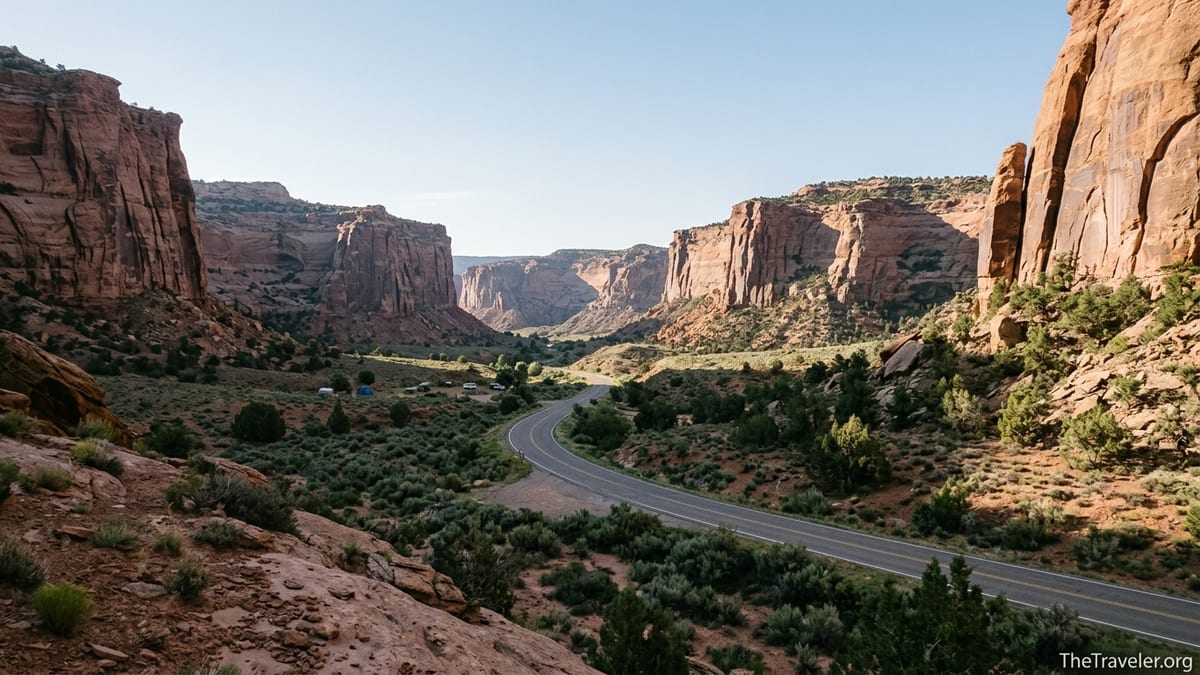
Many first-time visitors assume Indian Creek is a quick side trip from Moab, only to discover how isolated it feels once they arrive. From Moab, you drive roughly 40 miles south on U.S. 191 and then turn onto Utah State Route 211, the Indian Creek Corridor Scenic Byway, which winds about 35 miles toward the Needles District of Canyonlands National Park. That last stretch has no gas, no food, no cell service for most carriers, and only a handful of pit toilets at trailheads and campgrounds. Travelers who roll in with a quarter tank of fuel and no extra water quickly realize there are no convenience stores to bail them out.
Plan your logistics as if you are heading to a backcountry trailhead, not a highway picnic area. In practice, this means filling your gas tank in Moab or Monticello, buying groceries and ice before you leave town, and carrying more water than you think you will need. A realistic minimum for most visitors is at least 4 liters per person per day in cool seasons, and more in late spring or early fall heat. It is common to see climbers pull into a site in Creek Pasture Campground on a Friday night and immediately start rationing water because they misjudged how much they would drink after a full day in the sun.
Timing your arrival matters too. The paved UT‑211 is plowed and generally passable in winter, but storms can briefly close the road or make shoulders muddy and slick. In shoulder seasons, afternoon thunderstorms can turn side roads into deep ruts. Try to arrive during daylight your first time, both to appreciate the scenery and to spot turnoffs to campgrounds, which can be easy to overshoot in the dark.
Camping Is Mostly First-Come and More Regulated Than It Looks
On satellite imagery, Indian Creek appears wide open, with dirt tracks spidering across the desert. On the ground, camping is more structured than many visitors expect. The core corridor along UT‑211 sits inside Bears Ears National Monument and is managed primarily by the Bureau of Land Management. Developed campgrounds like Hamburger Rock, Superbowl and Creek Pasture are the main hubs. As of mid‑2026, individual sites at these campgrounds typically cost around 15 dollars per night, are first-come, first-served, and have basic amenities like picnic tables, fire rings and vault toilets, but no potable water.
These campgrounds can and do fill, especially in peak climbing seasons in April, May, late September and October. A common scenario: people leave Moab after work on a Friday, arrive at Creek Pasture after dark and find every site taken, with no ranger on duty and no overflow lot. In that situation, your realistic options are to continue down the road and search for legal dispersed camping at least a mile off the pavement on signed dirt roads, or backtrack toward U.S. 191 where there are additional BLM sites closer to Canyonlands’ Island in the Sky. Sleeping in a highway pullout along UT‑211 is not an acceptable fallback and may earn you a knock on the window from a ranger.
Dispersed camping around Indian Creek comes with its own rules that surprise many visitors. Within the monument corridor, you generally need to travel at least a mile away from the paved highway and camp only in previously disturbed spots. The expectation is full pack-in, pack-out: no leaving trash in fire rings, no burying waste, and no creating new spur roads or rock fire pits. Most dispersed sites have no toilets and no amenities at all. Travelers who come prepared with five-gallon water jugs, a simple camp table, and a reliable way to store trash find this style of camping rewarding. Those who arrive in a low-clearance sedan at midnight without a headlamp often feel overwhelmed.
There Are Toilets, But You Still Need a Human-Waste Plan
Another common surprise is how little formal sanitation exists given the high use. The main campgrounds have vault toilets, and a few popular climbing parking areas have toilets as well, but they are spread out and can be busy in peak season. Beyond those locations, you cannot assume you will have access to a bathroom during a long day of climbing or exploring rock art sites. Desert soils in this region are slow to break down waste, and the land agencies have shifted decisively toward a pack-it-out model.
In practical terms, that means you should arrive with a human-waste system ready to use. Many climbers and road trippers carry WAG bag style kits or a compact portable toilet stored in their vehicle. These are not just for rafting or technical expeditions anymore; they are increasingly the norm in the Indian Creek corridor. A typical setup for a two-person weekend might include four to six WAG bags, a sealable plastic bin to store them until you reach a proper disposal point near Moab, and a small bottle of hand sanitizer in your day pack. This level of preparation prevents the all-too-common scene of people wandering far from parking areas in search of privacy and leaving toilet paper blooms behind rocks.
It is crucial to understand that dumping bagged human waste into vault toilets or dumpsters is often prohibited and strains already limited services. Instead, plan to drive your sealed bags back to a town with designated disposal facilities or follow local guidance posted at visitor centers. Many first-time visitors assume they can improvise once they arrive, only to discover that rangers are actively cracking down on improper waste disposal because of the cumulative impact on soils, water quality and cultural sites.
Climate, Seasonality and Sandstone Require More Respect Than You Think
The desert around Indian Creek looks rugged, but its sandstone walls and living soils are surprisingly fragile and strongly affected by weather. Spring and fall are the prime visiting seasons, especially for climbers. Daytime highs in April and October are often in the 60s to 70s Fahrenheit, with cold nights that can drop below freezing. In March or early November, snow squalls are still possible along UT‑211 and night temperatures in the teens are not unusual. Summer, by contrast, can be punishing, with temperatures frequently above 90 degrees, intense sun, and limited shade at camp.
For climbers, one of the most important and least understood issues is climbing on wet sandstone. After a significant rain or snowmelt event, the porous rock around Indian Creek can take 24 to 72 hours to fully dry. Pulling on hand cracks too soon can cause holds to break and irreparably scar classic lines. Experienced visitors watch the forecast closely and are prepared to spend a forced rest day hiking the scenic byway, visiting Newspaper Rock or exploring viewpoints along UT‑211 rather than climbing immediately after storms. Non-climbers should also be aware that wet conditions turn side roads into sticky clay, where even four-wheel-drive vehicles can become mired within a few meters.
Wind is another factor that catches people off guard. Spring afternoons can bring strong gusts that turn camp into a sandblasting station, sending unsecured tents, chairs and gear tumbling across the desert. Choosing a campsite tucked behind a low hill, staking out tents thoroughly and weighting tablecloths or cooking tarps can make the difference between a comfortable evening and a frustrating battle with the elements. At night, bring insulation more in line with shoulder-season mountain camping than with stereotypical “warm desert” expectations.
This Is a Cultural Landscape, Not Just an Outdoor Playground
Although Indian Creek is world-famous for its climbing, it sits within a much older Indigenous cultural landscape that remains vital today. The area is part of Bears Ears National Monument, which was created in large part to recognize and protect the deep connections that Navajo, Ute, Hopi, Zuni and other Native peoples have to these canyons. Rock art panels like Newspaper Rock, ancestral sites on mesas and alcoves, and pottery fragments or stone tools you may see on hikes are not props for social media; they are tangible traces of ongoing communities.
First-time visitors are often surprised to learn that rules around cultural sites are stricter than in many other outdoor destinations. You are expected not to touch petroglyphs, not to enter or lean into ancient dwellings, and not to move or stack pottery sherds and artifacts for photos. Even picking up a fragment to “look at it more closely” can accelerate its erosion and is often illegal. A real-world example: visitors who brush their fingers across the darker, varnished rock around petroglyphs can leave lighter streaks that permanently mar thousand-year-old images.
Respect also extends to how you share locations. Many long-time visitors and land managers ask that people avoid posting precise GPS coordinates of sensitive sites on public forums. If you come across an unmarked ruin while exploring a side canyon, the most respectful choice is to enjoy it quietly, take only wide contextual photos, and leave no trace of your presence. Sticking to well-known and heavily impacted stops like Newspaper Rock for close-up rock art viewing is a good way to appreciate the region’s history without unintentionally damaging more fragile places.
Climbing at Indian Creek Is Logistically Different From Other Crags
For climbers who have cut their teeth at sport crags or mixed trad areas, Indian Creek demands a different level of logistical planning. The climbing is famous for long, uniform sandstone cracks that eat gear. On many classic lines, it is normal to place size-identical cams every couple of meters, which means an average team might carry three to six cams of the same size for a single route. Even if you are not climbing at the highest grades, this has budget implications. Renting or borrowing supplemental gear in Moab is common for visitors who cannot afford triple sets of popular cam sizes.
Approaches also tend to be sandy, sun-exposed and steeper than they appear from the road, especially when carrying heavy racks and long ropes. A hike that looks like a short stroll to Supercrack Buttress can feel strenuous in afternoon heat with a full load. Good trail shoes instead of flip-flops, a supportive pack and at least two liters of water on your harness or in your bag can turn an exhausting slog into a manageable approach. Many visiting climbers underestimate the physical toll of back-to-back days of Indian Creek-style crack climbing and end up taking forced rest days earlier than planned.
Ethically, Creek climbing culture has a strong ground-up, low-impact ethos. Top-roping off fixed anchors where possible, using existing trails and staging areas, minimizing chalk marks, and keeping group sizes modest are all part of the local norm. Large groups setting up multiple top-ropes beneath a single wall or blasting music that echoes across the canyon are among the behaviors that locals and rangers increasingly challenge. If you are new to the area, watching how experienced parties organize themselves at the cliff and asking quiet questions is a good way to integrate respectfully.
Practical Safety: Roads, Vehicles and Emergency Planning
Despite its popularity, Indian Creek has very few built-in safety nets beyond the main paved highway. UT‑211 itself is generally in good condition and accessible to standard passenger cars, but most side roads leading to campgrounds, trailheads and dispersed sites are unpaved. After heavy rain, fine dust turns to deep mud, and even high-clearance vehicles can slide or sink. Visitors in rental sedans often find that the final few hundred meters to a scenic campsite or remote parking area are riskier than expected. It can be wiser to park in a firm, established pullout and walk a short distance rather than attempt a soft, rutted spur that might require an expensive tow.
Cell coverage is spotty to nonexistent in much of the corridor. Some visitors with certain carriers catch a faint signal on exposed ridges, but you should plan as if you will be offline from the moment you turn onto UT‑211 until you return to U.S. 191. This affects everything from navigation to medical planning. Download offline maps in advance, share your itinerary with someone in town, and carry a paper map or screenshot of the Indian Creek camping and climbing overview available from regional visitor centers.
In case of serious injury or vehicle breakdown, response times can be long. Self-rescue skills, a stocked first-aid kit, and one or two basic vehicle-recovery items like a shovel, traction boards or tow strap can make a major difference. For climbers, helmets at the crag, extra warm layers in case a partner must wait for help, and clear communication plans are not optional niceties; they are practical safeguards. Non-climbers should carry enough food and water in the car to be comfortable if temporarily stranded by a storm or road closure.
The Takeaway
Indian Creek rewards visitors who approach it less like a roadside attraction and more like a lightly serviced backcountry destination framed by living Indigenous cultures. The long, service-free drive in, the mostly first-come camping, the scarcity of water and toilets, and the fragile nature of both the sandstone and the cultural sites mean that improvisation on arrival rarely works out well. Travelers who arrive with enough fuel and water, a clear camping backup plan, a realistic view of the weather and climbing conditions, and a commitment to pack out all waste tend to leave with exactly what they came for: quiet nights under immense stars, days shaped by red-rock walls and big skies, and a deeper respect for this corner of the Bears Ears landscape.
For many, the biggest surprise is not the remoteness, but how quickly Indian Creek begins to feel like more than a climbing area or scenic byway. Treated thoughtfully, it becomes a place that invites repeated visits, each return shaped not just by new routes or campsites, but by a growing sense of responsibility to the land and to the people who call it home.
FAQ
Q1. Do I need a permit to visit or camp at Indian Creek?
For most casual visitors, no advance permit is required to drive UT‑211, hike short approaches or stay in the main BLM campgrounds, which are first-come, first-served with a nightly fee. However, commercial groups, large organized trips or research projects may need special use permits, and backcountry overnight travel in nearby Canyonlands National Park is managed under its own permit system.
Q2. Can I camp anywhere along the road if developed campgrounds are full?
No. Camping directly along the paved highway or at unsigned pullouts is not allowed. Legal dispersed camping generally requires driving at least a mile off the pavement on designated dirt roads and using previously impacted sites. If you arrive to find all developed campgrounds full, you should be prepared to seek out signed dispersed areas or return toward U.S. 191, rather than creating new campsites along UT‑211.
Q3. Is a high-clearance or four-wheel-drive vehicle necessary?
You can reach the main viewpoints, trailheads and campgrounds in a standard passenger car in normal dry conditions, because UT‑211 is paved. However, high-clearance vehicles are strongly recommended for many side roads, dispersed sites and trailhead spurs. After storms, clay-rich soils can become slick enough that even four-wheel-drive trucks struggle, so checking the forecast and being willing to walk the last stretch to a campsite is wise.
Q4. Is there any drinking water available in Indian Creek?
There is no reliable public drinking water in the Indian Creek corridor itself. The developed BLM campgrounds and most trailheads do not have potable taps. You should fill all containers in Moab, Monticello or another town before turning onto UT‑211, and carry enough water for drinking, cooking and basic washing. Many visitors travel with large jugs or water bladders in their vehicles to avoid having to leave early just to resupply.
Q5. When is the best time of year to visit Indian Creek?
Spring and fall are the most comfortable and popular seasons. March through May and late September through October typically offer cool to mild daytime temperatures and cold nights, ideal for climbing and camping. Summer can be extremely hot and exposed, making mid-day hiking or climbing uncomfortable and potentially dangerous, while winter brings occasional snow and icy sections on the highway and trails.
Q6. How can I visit respectfully as a non-climber?
Non-climbers can enjoy the scenic drive, stop at established viewpoints, visit well-known rock art sites like Newspaper Rock and walk short trails to admire the canyon walls. Visiting respectfully means staying on marked paths, not touching petroglyphs or ruins, packing out all trash and waste, and keeping noise levels low so others can enjoy the area’s sense of solitude. Learning a bit about Bears Ears and its Indigenous significance before you arrive also helps frame your visit thoughtfully.
Q7. Are campfires allowed in Indian Creek?
Campfires are usually allowed only in existing fire rings at developed campgrounds or established dispersed sites, and restrictions are common in dry or windy periods. Firewood should be brought from outside the area rather than gathered locally, since downed wood plays an important ecological role in the desert. Always check for current fire restrictions at regional visitor centers or information boards before lighting a fire, and be prepared to rely on camp stoves instead.
Q8. Is Indian Creek suitable for families and first-time campers?
It can be, but it is best suited to families and beginners who are comfortable with basic self-sufficiency. There are no playgrounds, hookups or convenience stores, and nights can be very cold outside of mid-summer. Families who prepare children for pit toilets, limited shade and long drives without services often have memorable experiences stargazing and exploring short walks from camp. Those looking for developed campgrounds with flush toilets and showers may be happier basing in Moab and visiting Indian Creek as a day trip.
Q9. What should climbers bring that they might not pack for other destinations?
Beyond a standard rack, climbers at Indian Creek often need multiple cams in the same sizes, plenty of tape or crack gloves, sturdy approach shoes, sun protection and extra water. A simple human-waste system such as WAG bags, a small repair kit for gear and clothing, and a warm belay jacket for shady aspects can make long days more comfortable. Because guidebooks and apps may not show recent closures or raptor avoidance zones, checking current notices at trailheads or visitor centers is also important.
Q10. How early should I arrive to find a campsite in peak season?
In popular months like April, May, late September and October, aim to arrive at BLM campgrounds by early afternoon on weekdays and earlier still on Fridays. Sites commonly fill by evening before clear weekends, and holiday periods can be busy throughout the week. Having a backup plan, such as a list of alternative campgrounds along U.S. 191 or reservations at a private campground near Canyonlands, will reduce stress if everything in Indian Creek is already occupied when you arrive.