


In the high desert of southeast Utah, sandstone walls rise in clean, vertical lines above a cottonwood-lined wash. To climbers, those glowing red cliffs mean one thing: Indian Creek. This remote corridor in Bears Ears National Monument has evolved from a quiet backwater to one of the world’s most iconic crack climbing areas and a pilgrimage site for outdoor enthusiasts who crave big skies, star-filled nights and long days of adventure on stone. Whether you dream of perfect hand cracks, desert towers or simply camping under the Milky Way, Indian Creek has a way of getting under your skin and staying there.
Get the latest updates straight to your inbox!
The Allure of World-Class Crack Climbing
Indian Creek’s reputation rests on its almost surreal concentration of splitter sandstone cracks. Instead of wandering, blocky cliff lines, the valley is lined with Wingate sandstone walls etched by parallel fissures that run from the ground to the rim. For trad climbers, it is like walking into a library where every book is a perfect story about jamming. Classic cliffs such as Supercrack Buttress, Cat Wall and Scarface boast routes that are famous well beyond the desert, including Supercrack of the Desert, Incredible Hand Crack and Scarface itself. Many of these lines are laser-straight, with remarkably consistent widths that allow climbers to practice pure technique for 30 to 40 meters at a time.
Part of what makes Indian Creek a bucket list destination is the way it compresses a lifetime’s worth of crack climbing into one corridor. A climber who normally gets a handful of crack pitches per season at their local crag can spend a week here climbing almost nothing but perfect jamming. On a typical October day you might warm up on 5.9 hand cracks at the Battle of the Bulge area, push yourself on 5.10s like Generic Crack, then walk along the base and watch stronger parties fight their way up testpieces in the 5.12 range. Even if you never plan to climb at those grades, seeing that kind of dedication and movement in person is part of the experience.
Despite its elite reputation, the Creek is not reserved for hard climbers. There is a deep well of easier and moderate lines, especially in the 5.8 to 5.10 range, which makes it accessible to intermediate trad leaders who come prepared. Routes like Binou’s Crack, Twin Cracks and the more moderate corners in Donnelly Canyon offer friendly introductions to the local style. Many visiting climbers will plan a first trip around those moderates, then return year after year to tackle harder, thinner lines as their skills improve.
All of this takes place in a landscape that feels far removed from resort-style climbing areas. There are no gondolas or gear shops at the base of the cliffs. Approach trails are short but sandy, racks are heavy with cams and you earn every meter you climb. That simplicity is a major part of the appeal for people who want more from their trips than ticking grades; they want a sense of immersion and progression that sticks with them long after they have cleaned the last anchor.
A Desert Landscape That Feels Otherworldly
Even for non-climbers, Indian Creek is visually arresting. The approach road off U.S. Route 191 winds past the famous Newspaper Rock petroglyph panel, then drops into a broad valley hemmed in by sheer red cliffs and mesas. Landmarks such as Bridger Jack Mesa and the twin spires of North and South Six Shooter Peaks give the corridor a distinctive skyline. In late afternoon the canyon walls flare from orange to deep crimson, and the small ribbon of cottonwoods along Indian Creek glows green against a sea of red rock and sage.
The setting feels surprisingly wild despite its international reputation. Indian Creek lies in the northern portion of Bears Ears National Monument, with the Needles District of Canyonlands National Park just up the road. You can spend a morning climbing on the Supercrack Buttress, then drive 20 to 30 minutes to hike among the sandstone needles and grab panoramic views from overlooks like Big Spring Canyon. For many visitors, this combination of world-class climbing and national park scenery in a single day is exactly what puts Indian Creek on the bucket list.
Weather plays a big role in shaping the experience. Spring and fall are the main seasons, with many climbers timing trips for late March through May or late September through early November to catch cool, crisp conditions. Daytime highs during those windows are often in the 60s or 70s Fahrenheit, perfect for jammed hands and long walks across the desert. By contrast, mid-summer can be brutally hot on the sun-exposed walls and mid-winter brings sub-freezing nights, so shoulder seasons give you that sweet spot when climbing, hiking and camping all feel comfortable.
Night in Indian Creek is an attraction of its own. With no major towns nearby and very limited lighting, the sky can feel almost shockingly dark to visitors accustomed to city glow. It is not uncommon to finish an evening around the fire ring at Creek Pasture Campground, walk a few steps away, and see the Milky Way arching clearly from horizon to horizon. For photographers, the combination of starry skies, silhouetted towers and reflective sand makes the area a natural studio, especially during new moon phases in fall.
Camps, Community and Life in the Sand
Part of Indian Creek’s charm is that you live close to the land during your visit. There are no hotels or formal lodges in the immediate corridor. Instead, most climbers and road-trippers base themselves at rustic campgrounds such as Creek Pasture and Superbowl, which are managed by the Bureau of Land Management. Sites here are first-come, first-served and typically offer a tent pad, picnic table, fire ring and shared vault toilets. There is no potable water on site, so visitors generally fill large jugs in Moab or Monticello before heading into the valley.
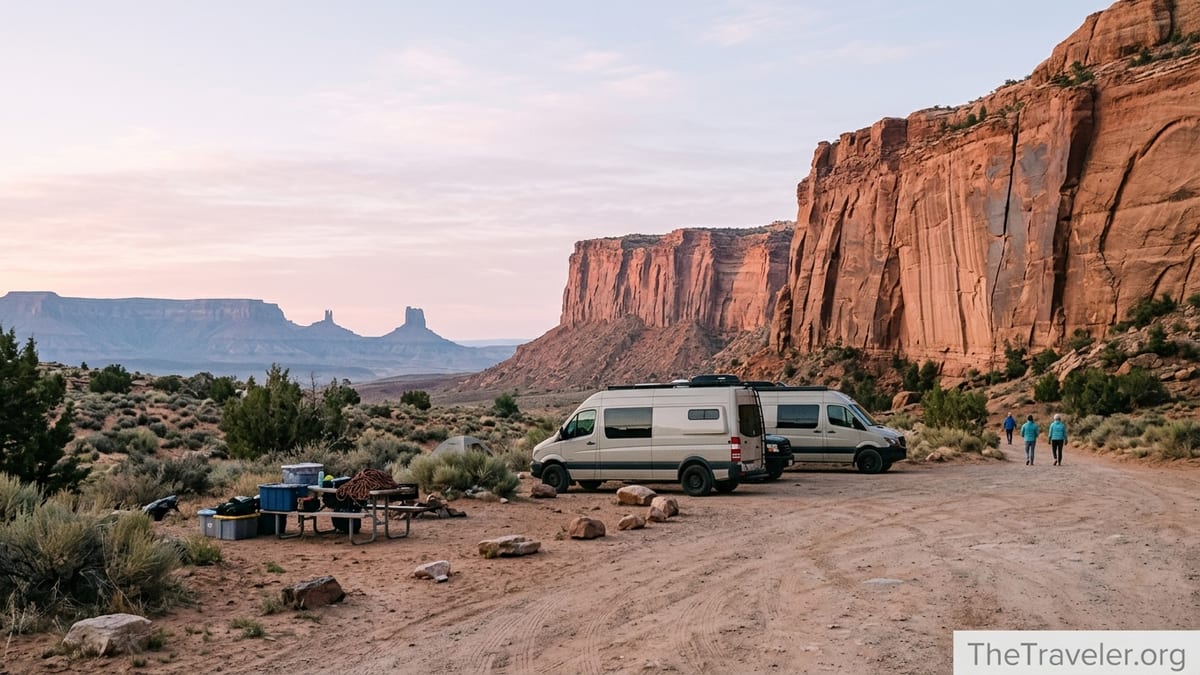
These campgrounds have become informal social hubs for the climbing community. On a busy October weekend you might see a mix of converted vans, pickup trucks with rooftop tents, and modest hatchbacks with gear piled inside. Mornings are filled with the clink of camming devices being organized and the hiss of camp stoves. Evenings tend to revolve around shared meals, route story-swapping and planning the next day’s objectives. For visitors traveling solo, it is common to find partners simply by asking around in camp or at popular parking pullouts.
Those looking for quieter spots can seek out designated dispersed camping areas on Bridger Jack Mesa or other signed zones along side roads, where camping is allowed only at marked sites. These free areas usually have rock fire rings and sometimes a picnic table but no toilets or water, so you must arrive self-contained, often with your own portable toilet system. Some travelers who prefer a few more amenities opt for commercial options like the small private campground at Needles Outpost near the entrance to Canyonlands, where basic groceries and hot showers are sometimes available during the main season.
Because services inside the corridor are so limited, it pays to plan logistics carefully. Moab, roughly an hour’s drive north, is the main supply town, with full-service grocery stores, outdoor gear shops, laundromats and restaurants. Monticello, to the southeast, offers a smaller selection of groceries, fuel and lodging and can be a useful resupply point for those approaching from Colorado or New Mexico. Most visitors arrive with several days’ worth of food and at least 15 to 20 liters of water per person, then top up during rest days in town.
Beyond the Cliffs: Hiking, Culture and Quiet Exploration
While climbing is the headline act, Indian Creek and the surrounding Bears Ears landscape reward curiosity in many other ways. The corridor provides access to a network of dirt roads and short trails that wind toward mesas, side canyons and viewpoints. Simple walks up sandy washes often reveal dramatic perspectives of the walls and towers that most people only see from parking areas. On lay days, many climbers leave the rope in the car and choose a casual hike to stretch their legs and give sore hands a break.
One of the area’s most famous non-climbing stops is Newspaper Rock, a large petroglyph panel set just off the main paved road. The rock bears hundreds of figures carved by Indigenous peoples over centuries, including bighorn sheep, human figures and abstract symbols. While the site has a developed parking area and interpretive signage, it remains a powerful reminder that these canyons have been home and hunting grounds for Native communities long before climbers arrived. It also sets the tone for the deep cultural significance of the wider Bears Ears region.
Farther afield, day trips into the Needles District of Canyonlands National Park open up an entirely different style of exploration. Well-marked trails such as those to Chesler Park, Druid Arch or Slickrock Foot Trail give hikers a chance to wander through labyrinths of sandstone spires and domes. Many climbers structure their visit so that one or two days are dedicated purely to hiking, photography or simply sitting on a rim at sunset, watching changing light wash over the canyon country.
Bird watchers and wildlife enthusiasts also find the corridor rewarding. High cliffs provide nesting habitat for raptors such as golden eagles and peregrine falcons, which can sometimes be seen soaring above buttresses or perched on ledges. Down in the wash, cottonwood groves and desert shrubs shelter smaller songbirds and occasional mule deer. Carrying a small pair of binoculars in your climbing pack or day bag can add another layer of experience to otherwise routine walks to and from the crags.
Planning a Trip: Seasons, Logistics and What to Expect
Because Indian Creek feels remote and lightly developed, thoughtful planning can make the difference between a smooth, memorable visit and a stressful one. Most travelers drive in via U.S. Route 191, turning onto Utah Highway 211, which is paved to and beyond the main corridor. Standard passenger cars can usually reach popular campgrounds and trailheads in dry conditions, though short access spurs and pullouts may be rough and rutted. After heavy rain or early-season snow, some dirt sections can become muddy and may warrant high-clearance vehicles.
Camping fees at BLM campgrounds such as Creek Pasture and Superbowl are typically modest, often in the range of a few dollars per person or per site per night, payable at self-registration kiosks with cash. These fees are subject to periodic updates, so it is wise to check current information through official land management agencies before you arrive and to bring small bills. Designated dispersed camping zones on side roads are generally free but have stricter rules about where you can park and pitch a tent.
Cell service throughout the corridor is limited or nonexistent, so travelers should not rely on streaming maps or last-minute downloads once they leave the highway. Many visitors save offline maps of the area or carry paper maps that show campground locations, trailheads and side roads. For emergencies, it is sensible to let someone at home know your plans and expected return date. Those venturing onto more remote four-wheel-drive tracks toward places like Beef Basin or Bridger Jack Mesa often carry extra fuel, a full-size spare tire and basic recovery gear.
For climbers, gear preparation is its own project. The Creek is famous for eating large numbers of cams, especially in hand and finger sizes. Parties tackling popular routes often carry double or triple sets of cams in frequently used sizes, along with tape or crack gloves to protect the backs of their hands. Helmets are standard, both for rockfall and for the occasional piece of gear that pops unexpectedly. Rope lengths of 60 meters are widely used, though some longer pitches benefit from 70-meter lines, so reading route descriptions beforehand is important. Even for non-climbers, packing sturdy footwear, sun protection, layers for cold nights and more water than you think you need will pay off as you explore.
Visiting With Respect: Bears Ears, Culture and Conservation
Indian Creek lies within a landscape that holds deep cultural and spiritual significance for several Native nations, including the Navajo Nation, Ute Mountain Ute Tribe, Hopi Tribe and Zuni Pueblo. The broader Bears Ears region is dotted with ancestral sites, rock art panels and historic remnants that tell stories spanning thousands of years. When you camp, climb or hike here, you are sharing space with a living cultural landscape, not just a recreational venue. Recognizing that context is essential to visiting respectfully.
Federal land managers and local advocacy groups encourage all visitors to avoid touching or disturbing cultural sites they encounter. That means not entering fragile archaeological structures, not tracing petroglyphs with your fingers, and leaving pottery shards or other artifacts exactly where you find them. Photographing from a respectful distance and staying on established paths helps minimize erosion and damage. Many new visitors choose to read up on the history of Bears Ears or attend ranger talks in nearby towns so they better understand the stories behind the stone.
The desert environment itself is also sensitive. Biological soil crusts, which look like dark, bumpy patches on the ground, are living communities that help hold the soil together and allow plants to grow. A single footprint can damage them for years. Sticking to existing trails, washes and durable surfaces such as rock slabs is a simple but powerful way to reduce your impact. Around camp, using existing fire rings, burning only dead and downed wood where allowed, and fully extinguishing fires before bed are all part of being a good guest.
Human waste management is a particularly important topic in Indian Creek’s thin desert soils. Vault toilets at main campgrounds help, but they do not cover every trailhead or dispersed site. Climbers and campers are strongly encouraged, and in some areas required, to pack out solid waste using systems such as reusable toilet containers or single-use bag kits. It can feel like an extra chore at first, but seasoned visitors quickly see it as part of the area’s etiquette. Showing that the climbing and outdoor community can care for the canyon is one of the best ways to help keep access open for future generations.
The Takeaway
Indian Creek’s status as a bucket list destination is about more than just its famous cracks. It is the combination of pure climbing movement, austere desert beauty, star-filled nights and the feeling of tiny camp clusters beneath towering walls that sets it apart. You wake up with sand in your shoes, rack up as the sun hits the cliffs, and fall asleep to the hush of wind in the cottonwoods. Days are shaped less by schedules and more by temperature, shade and the energy in your hands.
For climbers, a trip to the Creek can be transformative. The sustained cracks sharpen technique, reveal weaknesses and, at their best, unlock that rare sense of flow where body and rock move together. For hikers, photographers and stargazers, simply existing in such an expansive landscape offers its own rewards. In both cases, the experience is richest when you approach the place with humility, preparation and a willingness to contribute to its care.
If you are building a life list of places to see and feel rather than just check off, Indian Creek deserves a place near the top. Come with a strong rack or sturdy hiking shoes, plenty of water, a plan for camping and waste, and an open mind. You may leave with sore muscles and sand in everything you own, but you will also carry home a powerful sense of what it means to spend time in one of the desert Southwest’s most remarkable corridors.
FAQ
Q1. Where exactly is Indian Creek, and how do I get there?
Indian Creek sits along Utah Highway 211 in southeast Utah, between the towns of Moab and Monticello and near the Needles District of Canyonlands National Park. Most visitors drive in from U.S. Route 191, then follow the paved highway into the corridor; standard passenger cars can usually reach major campgrounds and trailheads in dry conditions.
Q2. Do I need a permit to climb or camp in Indian Creek?
At the time of writing, no special permit is required just to climb on the established cliffs, but camping is restricted to designated campgrounds and signed dispersed sites, some of which charge modest nightly fees. Because land management plans can change, it is important to check the latest rules from the Bureau of Land Management or local visitor centers before your trip.
Q3. When is the best time of year to visit?
Spring and fall are generally considered the prime seasons, with many climbers targeting late March through May and late September through early November for cooler temperatures and longer climbing days. Summer can be extremely hot on sun-exposed sandstone, while winter brings cold temperatures and shorter daylight, though determined visitors still come during those periods.
Q4. Is Indian Creek suitable for beginner climbers?
Indian Creek has a reputation for being physically demanding and technically specific, especially for those new to crack climbing. While there are some friendlier moderate routes, true beginners will have a better experience if they first learn basic belaying and movement skills at local crags or climbing gyms, or consider hiring a certified guide who knows the area well.
Q5. What camping options are available nearby?
Most climbers stay at Bureau of Land Management campgrounds such as Creek Pasture and Superbowl, which offer basic amenities like vault toilets, picnic tables and fire rings. There are also designated dispersed camping zones on side roads and a few small private campgrounds closer to the Canyonlands National Park boundary for those who prefer slightly more services.
Q6. Are there services like water, food or gear shops in the corridor?
Services within the immediate Indian Creek corridor are minimal, with no gas stations, grocery stores or gear shops at the campsites or crags. Visitors typically stock up on water, food and climbing equipment in Moab or Monticello before driving in, and plan occasional rest-day trips back to town for resupply.
Q7. What else is there to do if someone in my group does not climb?
Non-climbers can enjoy excellent hiking, photography, bird watching and stargazing in and around the corridor, as well as visits to cultural sites such as Newspaper Rock. Day trips into the Needles District of Canyonlands National Park offer a wide variety of established trails and viewpoints that do not require technical skills.
Q8. How can I reduce my impact while visiting?
Staying on established trails, camping only in designated sites, packing out all trash and human waste and respecting cultural sites are key steps in minimizing impact. Using existing fire rings, keeping group sizes reasonable and avoiding fragile biological soil crusts also help protect the desert environment for future visitors.
Q9. Is there reliable cell phone service in Indian Creek?
Cell coverage in the corridor is spotty to nonexistent for most providers, and visitors should not rely on having a signal at campgrounds or crag parking areas. It is wise to download offline maps beforehand, share your itinerary with someone at home and be prepared to drive back toward the highway or nearby towns if you need to make calls or access data.
Q10. Can I bring my dog to Indian Creek?
Leashed dogs are generally allowed on most public lands in the corridor, but owners are responsible for keeping pets under control, away from wildlife and other climbers, and out of cultural sites. Summer heat, lack of water and abrasive sand can be hard on animals, so many visitors choose cooler seasons, carry extra water for their dogs and avoid leaving them unattended in vehicles or in full sun.