


Bengaluru’s Kempegowda International Airport (BLR) sits more than 30 kilometers from the city center, which means most visitors rely on app cabs and taxis to get into town. In 2025 and 2026 the airport significantly reshaped its pickup zones, separating different types of cabs and moving many of them farther from the terminals. The result: confused travelers, long walks with luggage and widely varying fares. This guide explains exactly how Uber, Ola and other taxi options work today at Bengaluru Airport, for both Terminal 1 and Terminal 2, with realistic fare ranges, surge-pricing patterns and concrete tips to avoid scams.
Get the latest updates straight to your inbox!
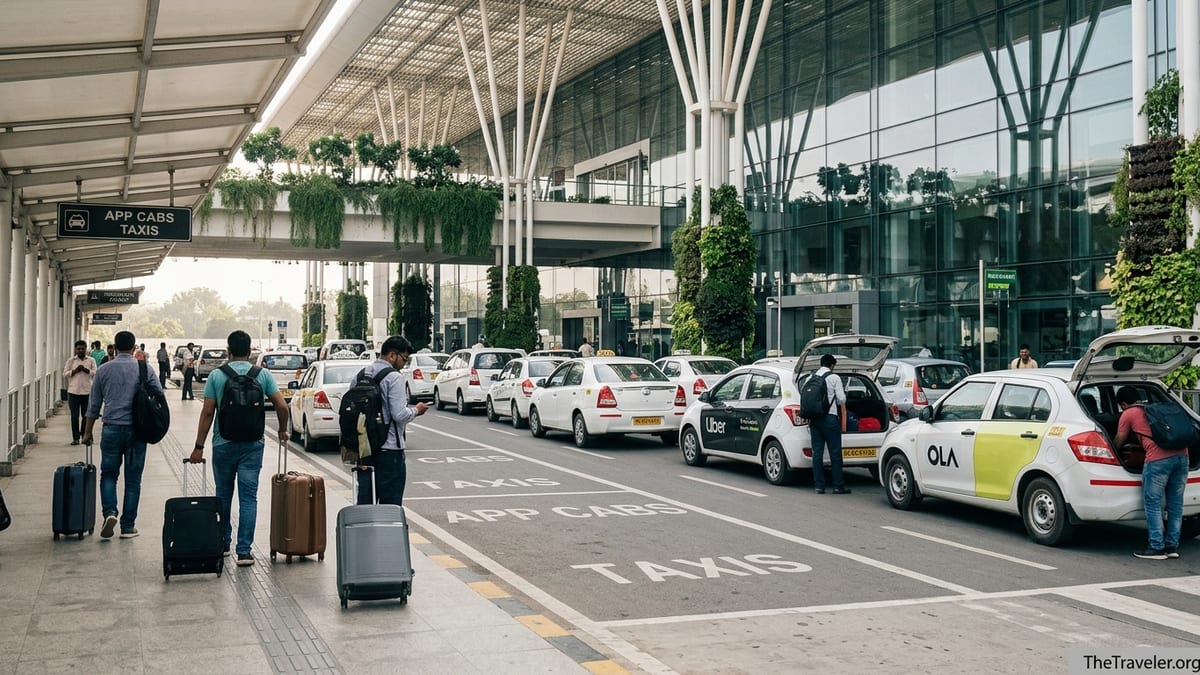
Understanding Kempegowda Airport: Terminals, Layout and Distances
Kempegowda International Airport serves Bengaluru with two main passenger terminals: Terminal 1 (T1) and Terminal 2 (T2). Domestic flights primarily use T1, while a growing number of full-service and international airlines use T2. The two terminals are several hundred meters apart and connected by internal shuttle and walking paths, but they do not share the exact same cab pickup kerbs. This matters because your Uber or Ola pickup point will differ depending on which terminal you land at.
The airport itself lies around 35 to 40 kilometers north of central Bengaluru areas such as MG Road, Indiranagar and Koramangala. In normal traffic, a ride can take 60 to 90 minutes. At night, especially after 11 pm when city traffic thins, some rides can be as quick as 45 minutes; at peak office hours, it can stretch beyond 90 minutes. Because of this distance, airport trips are among the most expensive city rides on Uber and Ola within Bengaluru, and surge pricing during busy arrival waves can increase fares substantially.
Another key feature of Kempegowda Airport is that different categories of vehicles now use different zones. Airport-authorised taxis such as the official BLR Airport Taxi, plus select premium segments of Uber and Ola, are allowed closer to the terminal forecourts. Many private cabs, including some app-based options, are pushed to the P4 or private parking area, which can involve a 10 to 20 minute walk or a short shuttle ride. Travelers arriving with elderly family members, young children or heavy luggage feel this most acutely.
For first-time visitors, it helps to remember two broad principles. First, follow airport signboards: both T1 and T2 now have clearly printed signs for “App Cabs,” “Airport Taxi,” “Uber/Ola Pickup” and “Private Parking P4” placed along the arrivals exit path. Second, expect to walk a bit more at Bengaluru than at smaller Indian airports, especially if you are trying to save money by booking a non-premium Uber or Ola that uses the farther pickup zones.
Uber & Ola Pickup at Terminal 1: Where to Go and What to Expect
Terminal 1 is older and busier, handling a high volume of domestic flights. In late 2024 and early 2025, airport authorities reconfigured the road system outside T1. As of mid-2026, pickup for many app cabs has moved away from the immediate arrivals kerb, and passengers are directed to designated rideshare lanes and to the P4 parking area. Official communications from the airport and Uber emphasize that passengers should look for “rideshare pickup” signs and then match the zone shown in the app to the physical signboard at the curb.
In practical terms, here is what a typical Uber or Ola pickup at T1 looks like. After collecting your bags, you exit the terminal following signs for “Taxi / App Cab Pickup.” For airport-authorised cabs, such as BLR Airport Taxi and some premium categories of Uber and Ola, you will be guided to a kerb just beyond the arrivals hall. These stands usually have staff, printed boards showing categories like Uber Black or Ola Prime, and queues of waiting cars. Many travelers choose these if they have large luggage or family members because they minimize walking, even though fares can be higher than regular app rides.
For standard Uber and Ola categories that do not use the closest kerb, the app may direct you to a pickup zone associated with P4 parking or a further lane. Some passengers report that this can feel like walking through multiple ramps and sidewalks, which is challenging with trolleys or suitcases in heavy rain. The upside is that once you reach the designated zone, cars tend to queue in an orderly fashion, and drivers are generally familiar with the area because they must pass through specific gates and holding areas before arriving.
Because T1 is heavily used by business travelers, mornings around 7 to 10 am and evenings from about 6 to 10 pm can see longer wait times and more frequent surge pricing. Recent traveler reports mention regular sedans to popular neighborhoods like Indiranagar or RT Nagar pricing around 850 to 950 rupees during weekday evenings, while premium or larger vehicles can run significantly higher. These fluctuations are normal at Kempegowda and are not unique to one app, so be prepared to check both Uber and Ola rather than locking into a single platform out of habit.
Uber & Ola Pickup at Terminal 2: Basement Zones and New Rules
Terminal 2 is the newer, greener terminal marketed as a “garden terminal,” and its pickup design is different from T1. A significant portion of the arrivals pickup system at T2 is integrated into the basement level beneath the main forecourt. In practice, passengers walk out of arrivals, follow clearly marked signage toward cabs and app taxis, and then descend via escalators or elevators to Basement 1, where pickup lanes are arranged in numbered bays.
App-based taxis including Uber and Ola have dedicated permissions to operate at T2, and airport notices indicate that these companies share authorised pickup zones. Travelers who have recently used T2 commonly describe seeing combined signage for Uber, Ola and BLR Airport Taxi as they walk out. The Uber app’s official BLR airport page explains that riders should confirm their pickup location in the app, then follow terminal signage to the designated zone, rather than relying purely on GPS, which can sometimes show confusing pin placements in a multi-level structure.
The basement pickup design helps keep the main forecourt calmer but can create a few pain points for passengers. First, mobile data in some corners of Basement 1 can be patchy, especially on certain networks. A practical workaround is to book your ride while still in the arrivals hall where the signal is stronger, then proceed to the pickup zone after the driver has accepted. Second, carrying heavy luggage down to the basement can be a strain for older travelers, so make use of lifts when available rather than escalators.
Fare levels from Terminal 2 are broadly similar to those from T1, since both share the same airport access road and distance to the city. However, traveler anecdotes from 2025 and 2026 frequently mention higher surges at T2 late at night, particularly between midnight and 3 am on weekends and holiday periods when multiple long-haul flights arrive close together. In such windows, it is not unusual to see base app fares to tech hubs like Kadubeesanahalli or Whitefield cross 2,500 rupees for even mid-range categories, which has led many regular fliers to explore alternatives such as BMTC Vayu Vajra buses or pre-booked fixed-fare cabs.
Typical Uber & Ola Fares from BLR: Real-World Ranges in 2026
Because app fares change dynamically, no guide can promise a fixed price. Still, recent fare snapshots and traveler reports from early to mid-2026 give a useful sense of what you are likely to pay under different conditions. In normal daytime or late-night off-peak conditions, a regular Uber or Ola sedan from either terminal to central Bengaluru areas like MG Road, Brigade Road or Church Street typically falls in the 600 to 900 rupee range. To Indiranagar or Domlur, expect something similar, often around 700 to 950 rupees, depending on traffic and category.
To southern neighborhoods such as Koramangala, BTM Layout or Jayanagar, app fares are usually slightly higher because of additional distance and city traffic. Travelers commonly share examples in the 900 to 1,300 rupee band for standard sedans with light to moderate traffic. Rides to the IT corridor, including Marathahalli, Kadubeesanahalli, Bellandur or Whitefield, can vary widely. On a weekday afternoon without rain, a regular Uber might cost roughly 1,000 to 1,400 rupees; on a rainy Friday evening with office hour congestion, it is easy for the same ride to climb beyond 2,000 rupees.
Surge pricing is a defining feature of Bengaluru airport trips. News reports from early 2025 highlighted evenings when a regular cab from the airport to Indiranagar exceeded 900 rupees on Uber and 800 rupees on Ola at the same moment, while alternative platforms such as Rapido and Namma Yatri quoted somewhat lower numbers for similar trips. More recent accounts from 2026 describe late-night T2 arrivals where even mid-range app categories quoted upwards of 2,800 rupees for rides to East Bengaluru tech hubs. While these peaks are not everyday occurrences, they are common enough that seasoned travelers often check two or three apps before committing.
The best way to benchmark your own fare is to compare several destinations at once while still in the terminal. For example, if an Uber to MG Road shows 1,500 rupees on arrival on a Saturday night, that is a signal of strong surge and you can reasonably assume similar pricing to most central neighborhoods. Under those conditions, it may make more economic sense to take a BMTC Vayu Vajra bus to an intermediate hub like Hebbal or Silk Board and then book a short intra-city cab from there, breaking the trip into two cheaper legs.
Managing Surge Pricing, Queues and Luggage
Surge pricing at Bengaluru Airport is driven by a combination of arriving flight waves, weather, time of day and driver availability. Demand often spikes just after multiple domestic flights land together in the late evening, or when delayed aircraft arrive around midnight, clustering passengers who had not originally planned to be there at the same time. On long weekends and festival dates, local residents returning home add to the crowd, sometimes creating queues of 30 minutes or more in the app cab lanes even after a driver has been assigned.
One practical tactic to manage surge is time-shifting. If you land at 8 pm but clear baggage only at 8:45 pm, there is no need to book your ride the moment you turn your phone on. Spend five minutes checking fares across Uber, Ola and other services; prices can sometimes fall sharply within a 10 to 15 minute window when a batch of drivers completes their previous trips and re-enters the queue system at the airport. Conversely, if rain starts just as you land, expect surges to rise and consider whether a fixed-fare airport taxi or bus might be more predictable.
Luggage handling is another important consideration, especially in the new pickup layouts. Smaller app categories and hatchback models can struggle with large suitcases. Travelers arriving from long-haul flights into T2 often carry two large checked bags plus cabin luggage per person. In such situations, it is safer to book a larger category, such as Uber XL or an Ola SUV, or to choose the airport taxi counters where you can clearly describe your luggage volume before payment. Some passengers have reported drivers refusing trips when they see oversized bags that will not fit safely, which is frustrating after a long walk to the pickup zone.
If you are traveling with elderly parents or very young children, factor in walking distance to the pickup zone. Airport-authorised cabs at the nearest kerb are more expensive on average but may be worth it for the reduced physical strain. Alternatively, you can escort your family to a seating area and one adult can go ahead to the pickup zone with part of the luggage, bringing the cab back closer where permitted. Always confirm with airport staff and security to avoid blocking restricted lanes.
Taxi Alternatives: BLR Airport Taxi, BMTC Buses and Pre-Booked Cabs
Uber and Ola are popular, but they are not the only ways to leave Kempegowda Airport. The official BLR Airport Taxi, operated in partnership with state tourism authorities, remains a reliable fixed-fare option. These taxis have counters inside the arrivals area of both terminals. Typically you provide your destination at the counter, pay a zone-based or distance-based fare upfront, receive a printed slip with vehicle details, and then walk to the nearby taxi bay to board. Many travelers appreciate that BLR Airport Taxi cars provide printed bills and are accountable to airport authorities in case of complaints.
Fare-wise, BLR Airport Taxi is usually more expensive than a non-surge Uber or Ola sedan but can be competitive or even cheaper when app surges are high. For example, if a regular app cab to MG Road is showing around 1,400 rupees on a busy evening, the official taxi counter may quote a similar or slightly lower rate, with the added benefit of no hidden surge or cancellation games. For solo budget travelers landing outside peak times, app cabs still often win on price; for families landing at midnight on a holiday weekend, the predictability of BLR Airport Taxi can be worth the premium.
BMTC Vayu Vajra buses are the most economical option for many routes. These air-conditioned airport buses run from both terminals to key city nodes such as Hebbal, Majestic, Kempegowda Bus Station, Banashankari, Electronic City and IT corridors. Typical tickets cost a fraction of an app cab, often in the 300 to 400 rupee range, and luggage is stowed in racks inside the bus. For instance, a solo traveler heading to Indiranagar might take a Vayu Vajra from the airport to a stop like Old Madras Road and then hail a short 10 to 15 minute Uber from there for an additional 100 to 200 rupees, bringing the total below what a direct airport cab would charge under surge.
Another strategy popular among frequent fliers is pre-booked city cabs through local operators or hotel transfer desks. Services such as KSTDC-affiliated airport taxis and private companies can be reserved in advance at fixed rates. These drivers typically meet you at a pre-arranged point in the terminal with a nameboard or via phone contact and may park in private or P4 zones, requiring a modest walk but avoiding app-based surge. For business travelers on expense accounts, hotel-organised cars from major chains in areas like Whitefield or Manyata Tech Park can be the most seamless option, though they are often the priciest.
Safety, Scams and Practical Tips at Bengaluru Airport
Like most large airports, Kempegowda sees its share of opportunistic scams, especially during late-night and high-demand periods. The most common pattern involves individuals loitering near the terminal exits or just before the official taxi counters, offering “Uber,” “Ola” or “airport taxi” rides without going through the app or the official counter. They may quote a seemingly reasonable flat amount verbally but then either take a longer route, demand more mid-journey or insist on cash without a receipt. To avoid this, do not accept unsolicited offers; rely only on rides booked via official apps or at the formal taxi counters inside the terminal.
Another recurring complaint is bait-and-switch behavior among some app drivers. For example, during a busy weekend night, the app might show a standard sedan at about 1,200 rupees, but when you reach the pickup lane, some drivers may pressure you to cancel and instead take an off-app deal at a higher cash fare, claiming a long queue or poor app payout. The safest response is to decline, keep communication within the app chat or call function, and if necessary cancel and rebook rather than stepping into a vehicle that is pushing for off-platform terms.
It is also important to be alert around the newer P4 and private parking areas. Some travelers report walking long distances only to encounter unmarked cars and informal touts. While many legitimate pre-booked cabs do use P4, always verify the license plate and driver details against what your provider or app shows. If using BLR Airport Taxi or KSTDC services, insist on a printed bill at the end of the ride; this both confirms the metered amount and gives you a document to refer to if you need to complain later.
Basic safety steps still apply: sit in the back seat, share your trip details with a friend or family member using the app’s share feature, and avoid displaying high-value electronics openly near crowded pickup zones. At night, try to use well-lit, staffed pickup areas rather than isolated corners of parking lots. If anything feels off, it is better to step back into the terminal area and re-evaluate than to rush into a questionable ride after a long flight.
The Takeaway
Bengaluru’s Kempegowda International Airport has become busier and more complex in recent years, and that is especially visible in how Uber, Ola and other taxis operate outside its two terminals. Pickup zones have been pushed farther out or into basements, ride categories are split between different lanes, and demand surges during peak arrival waves can send app fares soaring. For travelers who arrive unprepared, this can mean long walks with luggage, confusing signboards and unexpectedly high bills.
With a bit of planning, though, you can navigate BLR smoothly. Know your terminal in advance, follow airport signage carefully, and be realistic about how much walking you and your companions can handle. Compare Uber and Ola prices before committing, and remember that official BLR Airport Taxi counters and BMTC Vayu Vajra buses provide stable alternatives when app surges spike. Keep an eye out for touts, stick to official channels and share your ride details for extra peace of mind.
Ultimately, there is no single “best” way to leave Bengaluru Airport; the right choice depends on your budget, luggage, timing and tolerance for walking. A solo backpacker arriving at 2 pm might find a cheap app cab ideal, while a family landing at 1 am on a festival weekend will be far better off with a fixed-fare airport taxi or hotel transfer. Use the information and examples in this guide to choose the option that fits your situation on the day you land.
FAQ
Q1. Where exactly do Uber and Ola pick up passengers at Bengaluru Airport?
At Terminal 1, app cabs use designated rideshare lanes and some categories are routed via the P4 or private parking area, reached by following “App Cab” and “Uber/Ola” signs from arrivals. At Terminal 2, most app pickups are in the Basement 1 pickup zone beneath the main forecourt, again clearly signed inside the terminal; always match the zone shown in your app with the signboards.
Q2. How much does an Uber or Ola from BLR to MG Road usually cost?
In typical daytime or late-night off-peak conditions, a regular sedan on Uber or Ola from either terminal to MG Road usually falls somewhere around 600 to 900 rupees. During busy evening hours, heavy rain or holiday weekends, surge pricing can push that closer to or above 1,200 rupees, and premium or larger vehicles will cost more.
Q3. Is it cheaper to use the official BLR Airport Taxi or an app cab?
When there is little or no surge, Uber and Ola are often cheaper than BLR Airport Taxi for solo or duo travelers. However, during peak demand when apps quote 1,400 rupees or more to central areas, the airport taxi counter’s fixed rates can be similar or slightly lower, with the added comfort of no last-minute surges or cancellations and a printed receipt at the end of the ride.
Q4. How long does it take to reach central Bengaluru from the airport?
Travel time to central neighborhoods such as MG Road or Indiranagar is typically 60 to 90 minutes. Late at night, especially after 11 pm, you might reach in 45 to 60 minutes if city traffic is light, while peak office hours or heavy rain can stretch the journey beyond 90 minutes. These estimates apply broadly whether you use Uber, Ola, airport taxis or BMTC Vayu Vajra buses.
Q5. Are there scams I should watch out for at Bengaluru Airport?
Yes. The most common issues involve touts offering “Uber” or “Ola” rides in cash without using the app, drivers asking you to cancel your app booking and pay a higher off-app fare or unmetered cars quoting low prices and then inflating the bill mid-trip. To stay safe, book only through official apps or at airport taxi counters, verify the vehicle number before boarding and insist on a printed or app-based receipt.
Q6. What is the best option if I arrive very late at night with family and heavy luggage?
For families arriving around midnight or later, especially with children or elderly relatives, the most practical options are usually airport-authorised taxis at the nearest kerb or pre-booked hotel transfers. These minimize walking and avoid unpredictable surge pricing. While a late-night Uber or Ola might sometimes be cheaper, they may require walking to a farther pickup zone and dealing with potentially long driver queues.
Q7. Are BMTC Vayu Vajra buses a good alternative to Uber and Ola?
For budget-conscious travelers, Vayu Vajra airport buses are an excellent alternative. They are air-conditioned, luggage-friendly and significantly cheaper than app cabs, especially for solo passengers. If your destination is near a major corridor served by these buses, you can ride into the city for a modest fare and then take a short app cab or auto from the bus stop to your final address.
Q8. Can I pre-book an Uber or Ola before landing at BLR?
Uber offers a “Reserve” feature in some markets, and both apps allow you to book as soon as you have mobile data. However, traffic and delays can make exact timing uncertain, so many travelers prefer to book only after clearing immigration and baggage. For truly fixed, pre-arranged pickups, local operators and hotel car services are usually more reliable than app-based reservation tools.
Q9. What should I do if my Uber or Ola driver cancels repeatedly at the airport?
Repeated cancellations are common during high-demand windows, especially when drivers hope for surge fares or off-app deals. If you face multiple cancellations, consider switching categories within the same app, checking the competing app, walking to the official taxi counter or taking a Vayu Vajra bus to a busier in-city hub where app cab supply is better. Avoid accepting rides from people who approach you directly without going through an app or counter.
Q10. How do I choose between a standard app cab and a larger vehicle for luggage?
If you have one medium suitcase and a small backpack per person, a standard sedan category on Uber or Ola usually suffices. If you are carrying multiple large checked bags, sports equipment or bulky boxes, it is safer to opt for a larger category such as Uber XL or an Ola SUV, or to choose an airport taxi where you can clearly state your luggage needs. This reduces the risk of drivers refusing the trip or overloading the vehicle unsafely.