


Germany has emerged as a reliable base for remote workers who prioritize stable connectivity, professional work environments and access to corporate ecosystems over leisure-focused digital nomad hubs. This briefing compares leading German cities from a remote-work-readiness perspective, focusing on internet performance, coworking density, workspace variety and broader digital infrastructure that directly affects everyday productivity.
Methodology: What Makes a German City Remote-Work Ready
Remote workers evaluating German cities tend to prioritize factors that affect day-to-day productivity rather than tourism appeal. For this analysis, cities are assessed along four primary dimensions: fixed and mobile internet quality, availability and diversity of professional workspaces, maturity of digital infrastructure and ecosystem, and practical commuting and connectivity within the urban area. Other relocation dimensions such as immigration processes, housing and healthcare are not covered here, except where briefly relevant to workspace access.
Germany’s national connectivity baseline is comparatively strong. By mid-2023, around 99 percent of households had access to at least one fixed broadband option, though true fiber-to-the-home coverage was under 40 percent as of mid-2024 and uneven across regions. Average fixed download speeds now typically exceed 100 Mbps nationally, with significantly higher figures in fibered urban neighborhoods. Mobile 5G coverage is available in all major metropolitan areas, though capacity and indoor performance can vary by operator and district.
The cities below were selected based on recurring appearances in European remote work and startup rankings, observed coworking density, and data showing above-average broadband performance for urban regions. Within each city, the assessment distinguishes between central districts that are effectively “plug-and-play” for remote work and outer areas where infrastructure or workspace choice may still be developing.
Remote workers should treat these findings as indicative rather than absolute. Within any city, connectivity and work conditions can vary sharply by street, building and provider. On-the-ground verification of a specific address or coworking location remains essential before committing to a long-term lease.
Berlin: High Workspace Density and Mature Remote Ecosystem
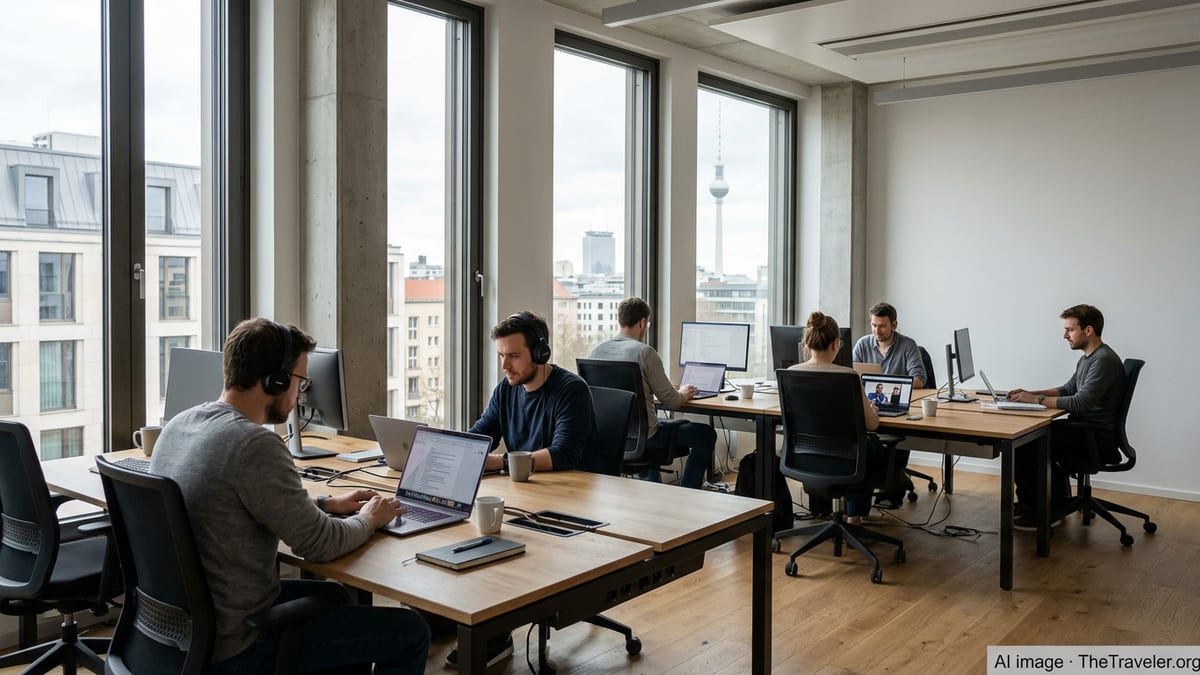
Berlin offers one of the most developed ecosystems for remote workers in Germany, characterized by a high density of coworking spaces, flexible offices and work-friendly libraries. Industry directories list several dozen coworking locations across central districts such as Mitte, Kreuzberg, Friedrichshain, Neukölln and Prenzlauer Berg, with additional serviced offices in business hubs like Potsdamer Platz and City West. Many spaces offer enterprise-grade connectivity, multiple meeting rooms, phone booths and 24/7 access, which is particularly relevant for distributed teams working across time zones.
From a connectivity standpoint, Berlin benefits from strong urban broadband coverage but still shows a patchwork between modernized, fiber-enabled buildings and older stock relying on VDSL or cable. Typical fixed-line offers in well-connected districts include advertised speeds in the 250 to 1000 Mbps range, though actual measured speeds can be lower and depend on the provider and last-mile technology. Mobile networks provide extensive 5G coverage in central neighborhoods, which can serve as a secondary connection for backup tethering.
The city’s large community of freelancers, founders and remote staff for global tech firms supports a wide range of workspace models beyond conventional coworking. Options include maker-oriented hubs, startup accelerators with hot desk programs and hybrid coliving-work concepts, which may suit remote professionals seeking stronger professional networks. Public libraries also function as quiet, no-cost work environments, though power sockets, call-friendly zones and opening hours differ widely by branch.
Berlin is particularly attractive for remote workers who value: high probability of finding a workspace aligned with niche requirements; a deep pool of potential collaborators and clients in technology, design and media; and a critical mass of existing remote workers, which translates into structured meet-ups and professional events focused on distributed work practices.
Munich: Enterprise-Grade Infrastructure for Corporate Remote Staff
Munich combines high economic output per capita with solid digital infrastructure, which benefits remote workers tied to corporate environments or high-bandwidth roles. The metropolitan area ranks among the top German regions in GDP per capita, reflecting the presence of large technology, engineering and financial firms. This concentration has indirectly stimulated demand for premium office and connectivity solutions, including Class A office buildings with fiber connections and professionally managed flexible workspaces.
In central districts such as Altstadt-Lehel, Maxvorstadt and Schwabing, remote workers can choose from a mix of international coworking brands and local operators. These often provide dedicated desks, ergonomic seating and external monitors for an additional fee, features that are especially relevant for remote professionals with intensive screen time. Many spaces have strict access controls, reception services and quiet zones that more closely mirror corporate offices than informal shared spaces.
Broadband performance in Munich is typically above the German average. Fiber and high-speed cable offerings with advertised download rates of several hundred megabits per second are common in central neighborhoods, although building-level wiring still determines actual throughput. For mobile connectivity, operators have invested heavily in 5G, particularly around business districts and transit hubs. Remote workers who rely on high-resolution video calls or frequent large file transfers will generally find Munich adequate, provided they verify the specific provider and plan at their chosen address.
Munich’s profile suits remote employees whose work style is close to traditional office expectations. The city’s more structured business culture results in formal meeting spaces, clear office rules and predictable service standards. Remote workers embedded in multinational corporations often select Munich because it aligns well with compliance, security and reliability requirements around their work environment.
Hamburg: Port-City Connectivity and Stable Work Environments
Hamburg, Germany’s largest non-capital city by economic weight, offers a balanced environment for remote workers who value both robust infrastructure and a moderate, businesslike atmosphere. The city hosts a diversified economy including logistics, media and trade, which has led to a steady demand for modern office space and associated digital infrastructure. Several citywide studies indicate that urban broadband coverage in Hamburg is broadly comparable to other major German metros, with widespread high-speed cable and growing fiber availability.
Remote workers concentrated in central Hamburg neighborhoods such as Altstadt, Neustadt, Sternschanze, St. Georg and HafenCity will find multiple coworking clusters. Workspace options range from large multi-story hubs aimed at corporate tenants to smaller studios catering to freelancers in creative fields. Many facilities offer day passes in addition to monthly memberships, which is important for remote staff whose on-site needs fluctuate with project cycles.
From a connectivity perspective, Hamburg benefits from overlapping high-capacity backbones associated with its role as a logistics and media hub. Fixed broadband plans with advertised 250 to 1000 Mbps downloads are widely marketed, and speed-test data typically places Hamburg among the better-performing German urban regions. Mobile networks also provide extensive 4G and 5G coverage, with strong performance around main stations and business districts, although local congestion can affect peak-time speeds.
Hamburg is well suited for remote workers who prioritize: predictable office-quality conditions, access to a mix of corporate and freelance work communities, and the possibility of commuting within a compact central area using reliable public transport. The city’s remote-work ecosystem is less experimental than Berlin’s but often more structured, an advantage for professionals seeking a clear separation between work environments and private life.
Cologne and Düsseldorf: Dense Urban Region with Multiple Hubs
Cologne and Düsseldorf together anchor one of Germany’s largest metropolitan regions, the Rhine-Ruhr area, and effectively function as a multi-node environment for remote workers. Distances between the two city centers are short, and high-frequency rail connections make it realistic for remote professionals to access workspaces in both cities within a single week, expanding their choice of environments and communities.
Cologne offers a diverse set of coworking spaces spread across districts such as Innenstadt, Ehrenfeld and Deutz. Facilities range from creative, community-oriented hubs to more corporate-style serviced offices. The city’s role as a media and trade fair location has reinforced demand for short-term desks and project rooms, which remote workers can often book flexibly. Düsseldorf, with its strong representation of consulting, finance and advertising companies, skews somewhat more toward premium business centers and coworking operations positioned for corporate teams.
Both cities benefit from good fixed and mobile connectivity typical of large German metros. High-speed cable and fiber products with advertised hundreds of megabits per second are standard in central neighborhoods, though legacy copper still appears in older residential buildings. 5G coverage has been rolled out across core urban zones in Cologne and Düsseldorf, providing viable mobile backup for most remote work activities.
For remote workers, the combined Cologne-Düsseldorf region is particularly attractive if cross-industry networking and access to clients in different sectors are important. Remote professionals can position themselves in one city and still access meet-ups, industry events and coworking communities across the wider region, making this corridor a flexible base for location-independent work.
Leipzig: Emerging Remote Work Node with Competitive Connectivity
Leipzig represents an emerging but increasingly credible option for remote workers who do not require a traditional Tier-1 metropolitan environment but still need solid infrastructure. Official statistics list Leipzig among the larger German cities by GDP, though at a significantly lower level than Berlin or Munich, reflecting its status as a growing regional hub rather than a mature global center. This growth trajectory has supported a rapid expansion of modern residential and commercial developments, many of which are built or refurbished with contemporary wiring and, in some districts, direct fiber connections.
The city hosts several recognized coworking operators, including spaces focused on startups, creative industries and hybrid community models. Central districts like Zentrum, Südvorstadt and Plagwitz have seen a clustering of small to medium-sized coworking venues, often located in renovated industrial buildings. These typically offer standard remote-work essentials including stable broadband, meeting rooms and shared kitchens, with some providing additional workshop or event areas.
In terms of connectivity, regional broadband reports indicate that Leipzig performs close to or slightly above the German urban average for fixed download speeds, with considerable variance depending on provider and street. High-speed cable connections are common, and fiber availability is gradually increasing in newly developed areas. Mobile networks offer 4G coverage across the city and expanding 5G, especially along major transport corridors and central neighborhoods.
Leipzig is suitable for remote workers who seek: a smaller-scale, less saturated market for office space, relatively straightforward access to coworking memberships, and a developing but growing community of remote professionals. The city’s scale allows for shorter intra-urban travel times while still offering sufficient choice among professional work environments.
Other Notable German Cities for Remote Workers
Beyond the primary hubs, several additional German cities provide credible conditions for remote work, especially for individuals with employer-specific or industry-specific location preferences. These cities typically share core attributes: a critical mass of modern office buildings, at least a handful of established coworking spaces in central areas and access to high-speed fixed and mobile broadband in most urban districts.
Stuttgart, as a major automotive and engineering center, offers high-quality infrastructure and a selection of coworking spaces catering to consultants and technical professionals. Nuremberg and Karlsruhe host growing technology and research clusters, with associated coworking ecosystems and improving fiber deployment. Bremen and Hanover provide smaller but functional networks of shared offices and flexible workspaces, suitable for remote workers prioritizing moderate city size combined with essential infrastructure.
Smaller university cities such as Heidelberg, Freiburg or Jena can also function as effective bases for remote work when specific needs align, for example proximity to research institutions or particular employers. In these locations, remote workers often rely on a mix of smaller coworking spaces, university-affiliated innovation centers and well-equipped public libraries. Connectivity is typically sufficient for standard remote workloads, though choice among providers and redundant options may be more limited than in major metros.
When considering these secondary cities, remote workers should conduct more detailed address-level checks on both fixed broadband availability and workspace options. While national coverage statistics are high, practical quality for remote work still depends heavily on building-level infrastructure and the maturity of local coworking operators.
The Takeaway
Germany offers a spectrum of cities that are viable for remote workers, but each city’s profile favors different professional needs and work styles. Berlin stands out for its high density and diversity of coworking spaces, strong presence of remote-friendly companies and broad community of freelancers and digital professionals. Munich and Hamburg provide more structured, enterprise-oriented environments with robust infrastructure and a strong corporate presence, which is particularly suitable for remote employees of larger organizations.
The Cologne-Düsseldorf corridor functions as a multi-node remote work region, combining media, finance and consulting ecosystems with solid connectivity and workspace choice. Leipzig and other emerging hubs offer increasingly capable infrastructure with smaller-city dynamics, which can appeal to remote workers who value shorter commute times and less saturated markets.
Across all these locations, Germany’s relatively high baseline of broadband coverage and expanding 5G networks creates a solid foundation for remote work. Nevertheless, the decisive factors for an individual relocation decision remain highly granular: the connectivity of a specific building, the reliability and opening hours of a particular coworking space and the ease of reaching that workspace using everyday transport. Remote workers considering relocation to Germany should use national and city-level indicators as a first filter, then conduct detailed address-level and operator-specific checks before finalizing any long-term commitments.
FAQ
Q1. Which German city generally offers the most options for coworking and flexible offices?
Berlin typically provides the widest range of coworking and flexible office options, with dozens of spaces across central districts and multiple workspace styles.
Q2. Are fixed broadband speeds in major German cities sufficient for video-heavy remote work?
In most urban neighborhoods, advertised fixed broadband speeds in the hundreds of megabits per second are common, which is generally sufficient for multi-stream video conferencing.
Q3. How reliable is mobile internet as a backup connection for remote workers in Germany?
4G is widespread and 5G is available in all major cities, making mobile tethering a practical backup, although indoor performance and peak-time congestion can vary.
Q4. Is fiber-to-the-home common in German cities?
Fiber coverage is growing but still uneven; many urban addresses rely on high-speed cable or VDSL, so checking the exact technology available at a specific building is important.
Q5. Which city is better for a corporate-style remote work setup, Berlin or Munich?
Munich generally aligns more closely with corporate office standards, while Berlin offers more experimental and community-focused workspaces alongside conventional options.
Q6. Are smaller German cities a realistic option for professional remote work?
Yes, many secondary and university cities have adequate broadband and at least a few coworking spaces, but choice and redundancy are usually more limited than in major metros.
Q7. How should remote workers assess connectivity before choosing a German address?
They should verify available providers and technologies for the exact address, review recent speed-test data where possible and confirm service terms directly with operators.
Q8. Do public libraries provide a meaningful alternative to coworking spaces in Germany?
In large cities, many public libraries offer quiet work areas and stable internet, though availability of power outlets, meeting rooms and call-friendly zones differs by branch.
Q9. Is it easy to move between different coworking spaces within the same German city?
In major metros, remote workers can choose between multiple operators and locations, with day passes and flexible memberships making it straightforward to change workspaces.
Q10. What is the main risk for remote workers relying solely on national connectivity statistics?
National or city averages can mask building-level gaps, so a city may score well overall while a specific apartment or office has limited or outdated broadband options.