


Dubai has positioned itself as a regional headquarters city for remote workers and entrepreneurs, with multiple planned districts that combine business infrastructure, flexible workspace and modern residential options. For individuals and teams evaluating a relocation, understanding which specific areas of the city best support remote work and early-stage business activity is essential. This briefing reviews the principal districts and residential clusters that currently offer the most practical advantages for remote professionals and founders.
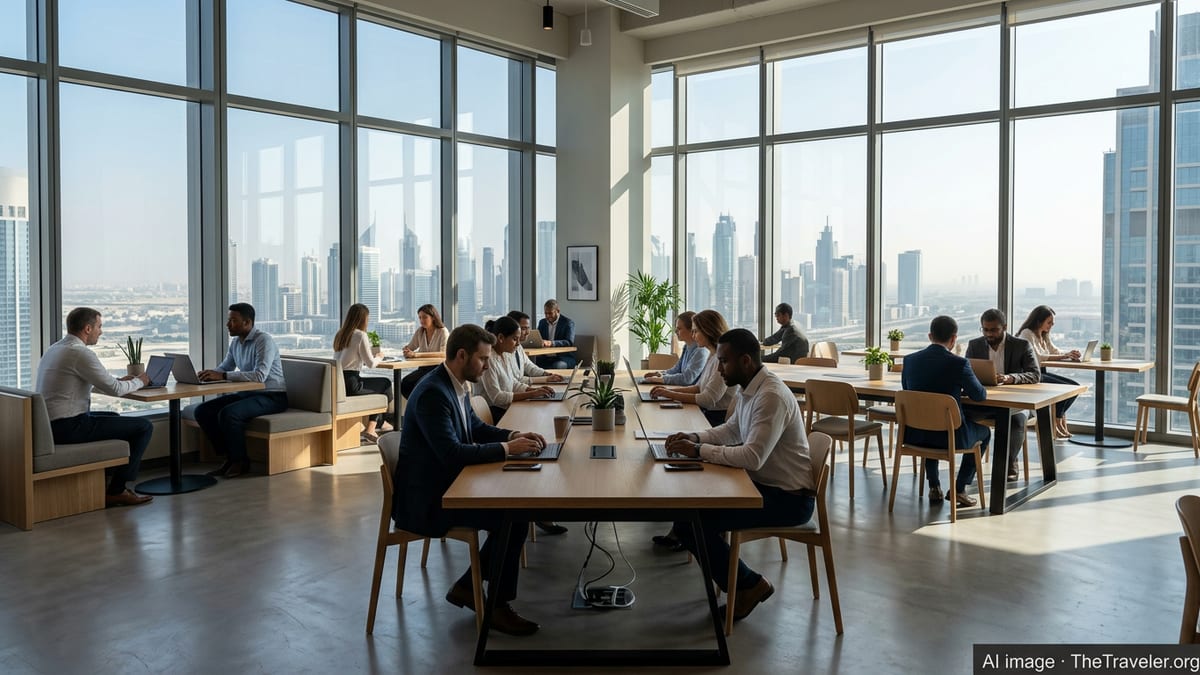
How Dubai’s Urban Structure Serves Remote Work and Entrepreneurship
Dubai’s urban model is built around specialized districts rather than a single central business district. Multiple free zone business parks cluster companies by sector, while surrounding mixed-use or residential neighborhoods offer varying levels of proximity, price and lifestyle. For remote workers and entrepreneurs, this structure creates distinct micro-markets that differ in workspace choice, peer networks and daily convenience.
Core business parks such as Dubai Internet City, Dubai Media City, Dubai Design District (d3), Dubai International Financial Centre and Business Bay host the highest densities of offices, licensed companies and coworking centers. Adjacent residential areas, including Dubai Marina, Jumeirah Lakes Towers (JLT), Downtown Dubai and Jumeirah Village Circle (JVC), act as catchment zones for professionals who want reasonable commute times and access to meeting venues and clients.([therealestatereports.com](https://www.therealestatereports.com/p/guide-to-dubais-top-neighborhoods?utm_source=openai))
For location-independent workers, the most relevant evaluation criteria tend to be high-speed connectivity, availability of professional work settings, sector-specific clustering, and ease of informal networking. This report therefore concentrates on districts that combine these attributes today and have visible expansion pipelines that indicate continued relevance over the next several years.
While Dubai offers many residential communities at different budget points, only a subset currently provides a dense, daily ecosystem of founders, freelancers and innovation-focused firms. The following sections profile the leading options and outline their practical strengths and trade-offs for remote workers and entrepreneurs.
Dubai Internet City and Dubai Media City: Established Digital and Content Hubs
Dubai Internet City and Dubai Media City are adjacent free zone districts along Sheikh Zayed Road that together host thousands of technology, telecoms and content-related companies. They function as one of the city’s most mature ecosystems for software, digital services, advertising, production and platform businesses, ranging from global multinationals to regional startups.([prnewswire.com](https://www.prnewswire.com/ae/news-releases/global-digital-creative-economy-to-reach-aed-27-trillion-by-2030-dubai-design-district-d3-and-dubai-media-city-study-finds-302259812.html?utm_source=openai))
Infrastructure is oriented toward corporate tenants but also supports smaller enterprises. Multiple Grade A office towers sit alongside flexible serviced offices and coworking spaces. Buildings are generally equipped with high-capacity fiber connections and modern facilities management. Cafeterias and cafés at ground level provide informal meeting points, which are heavily used during the working week for client meetings and networking among staff and independent contractors.
For remote workers and founders in digital sectors, the principal benefit of this area is ready access to decision-makers and collaborators. Many regional headquarters of technology and media firms are based here, which simplifies on-site meetings, proofs of concept and partnership discussions. The ecosystem also benefits from a steady calendar of conferences and sector events, which are geared more toward business development than tourism.
However, Dubai Internet and Media City are primarily employment and licensing hubs rather than full-service residential communities. Remote workers typically pair this location with nearby residential areas such as Dubai Marina, JLT or Barsha Heights, accepting short daily commutes in exchange for better housing variety. This split-location approach works well for those whose work pattern is hybrid rather than fully home-based.
Dubai Design District (d3): Creative and Design-led Entrepreneurship Cluster
Dubai Design District, usually referred to as d3, is a purpose-built free zone dedicated to design, fashion, architecture, digital media and related creative industries. Since its launch in 2013, the district has grown into a concentrated hub with more than one thousand companies and tens of thousands of workers across creative and tech-driven roles, supported by walkable streets, mid-rise buildings and extensive event infrastructure.([blog.uaehumanjourney.com](https://blog.uaehumanjourney.com/en/2025/07/31/designing-a-creative-economyinside-dubais-design-district/?utm_source=openai))
The district is optimized for small studios, design consultancies, fashion labels, content creators and creative tech startups. It offers flexible office configurations, showrooms, coworking spaces and in5 Design, an incubator that provides shared workshops, fabrication labs and prototyping facilities. This combination reduces upfront capital requirements for entrepreneurs who need access to specialized equipment, such as 3D printers or photography studios, without long-term leases.([dubaidesigndistrict.com](https://dubaidesigndistrict.com/?utm_source=openai))
For remote workers, d3’s value lies in its dense community of peers and frequent professional events. Flagship gatherings, including Dubai Design Week and other design fairs, draw international visitors and investors, which can generate client leads for local creative professionals. Day to day, its cafés, galleries and shared workspaces function as informal networking platforms where designers, marketers, developers and brand managers regularly interact.
Residential stock within d3 itself is still emerging, although projects such as Design Quarter at d3 indicate a shift toward live-work integration. Until that builds out, many founders and remote creatives choose nearby neighborhoods such as Business Bay or Downtown Dubai, which offer short commutes and easy access to the district’s offices and event venues.([d3-design-quarter.com](https://d3-design-quarter.com/?utm_source=openai))
Business Bay and Downtown Dubai: Central Mixed-use Bases for Remote Professionals
Business Bay and the adjacent Downtown Dubai area form one of the city’s densest concentrations of mixed-use towers, combining offices, hotels and residential units around the Dubai Canal and central boulevard. Business Bay in particular has become a popular choice for both corporate offices and smaller professional services firms, with relatively high occupancy and competitive rental yields supporting continued commercial activity.([dubaihousing-ae.com](https://www.dubaihousing-ae.com/post/best-places-to-live-in-dubai/?utm_source=openai))
From a remote worker’s perspective, the appeal of this cluster is its centrality and versatility. Within a compact radius, it offers numerous coworking centers, serviced offices and hotel lounges suitable for ad hoc meetings. Connectivity by road links quickly to d3, Dubai International Financial Centre, Dubai World Trade Centre and Dubai Healthcare City, keeping journey times between key business nodes relatively short in off-peak traffic.
Entrepreneurs in consulting, financial services, marketing and professional advisory roles often base themselves in Business Bay to project a central business address while remaining within practical reach of clients across the city. The availability of short-term serviced apartments and corporate housing options can also be advantageous for founders planning an initial 6 to 12 month market test before committing to long leases or larger office footprints.
The primary trade-off is congestion at peak hours and a relatively corporate atmosphere compared with areas such as d3 or Dubai Marina. Individuals whose work is fully remote and who place less value on daily in-person meetings may find the premium central location unnecessary, but for client-facing entrepreneurs it remains one of the most strategically located bases in Dubai.
Dubai Marina and Jumeirah Lakes Towers: High-density Residential with Strong Workspace Options
Dubai Marina and the neighboring Jumeirah Lakes Towers (JLT) are large, high-density residential and commercial clusters along the western stretch of Sheikh Zayed Road. They host a sizeable population of young professionals and expatriate families, supported by retail promenades, serviced apartments and mid-scale office towers. Market assessments consistently highlight JLT and the Marina as preferred locations for professionals who work in or with Dubai Internet City, Media City and Knowledge Park, due to short commute times typically in the 10 to 20 minute range in normal traffic.([therealestatereports.com](https://www.therealestatereports.com/p/guide-to-dubais-top-neighborhoods?utm_source=openai))
For remote workers, these districts provide a broad spectrum of work environments. Many residential towers are designed with integrated business centers or residents’ lounges that can support laptop-based work. In addition, JLT has become a focal point for independent coworking spaces, small serviced offices and business centers that cater to freelancers, consultants and small agencies. Ground-level cafés and hotel lobbies offer additional informal space for meetings and daily work.
These areas are especially attractive for remote workers whose clients or employers are based in the nearby media and technology free zones, but who prefer to separate home and office environments. Commuting by car, tram or on foot is feasible for many residents, making it possible to maintain in-person collaboration without extended travel times.
The main limitation lies in their distance from eastern districts such as d3, Dubai International Financial Centre and Dubai International Airport, which can lead to longer cross-city journeys for entrepreneurs with city-wide client bases. Nonetheless, for remote roles tied to west-side business parks, Dubai Marina and JLT remain among the most practical residential choices.
Emerging Options: Jumeirah Village Circle, Dubai Hills and Dubai South
Beyond the traditional core districts, several emerging communities are increasingly relevant to remote workers and early-stage founders seeking more space or lower costs without losing connection to major business hubs. Jumeirah Village Circle (JVC) is frequently cited as an attractive mid-market residential area, with rental yields that signal strong investor interest and a location that allows 20 to 30 minute car commutes to key commercial districts along Sheikh Zayed Road and Al Khail Road.([dubaihousing-ae.com](https://www.dubaihousing-ae.com/post/best-places-to-live-in-dubai/?utm_source=openai))
Dubai Hills, part of a larger master development, has developed a reputation as a planned community with good internal road links and relatively modern housing stock. For remote professionals whose work is primarily online and who require only periodic trips to city-center districts, such communities can provide a quieter base while remaining within manageable travel distance of central coworking spaces and client offices.
On a more forward-looking horizon, Dubai South, anchored by Expo City and Al Maktoum International Airport, is evolving into a combined logistics, technology and residential hub. Analysts describe it as an emerging submarket for young professionals, with new infrastructure and business parks gradually building critical mass. For remote workers in aviation-adjacent, logistics or global e-commerce businesses, proximity to the expanding airport and trade facilities may turn this area into a strategic choice over the coming decade.([rentingprop.com](https://www.rentingprop.com/news/top-5-emerging-submarkets-in-dubai-for-young-professionals?utm_source=openai))
These emerging areas remain in different stages of maturity when compared with established hubs such as Business Bay or Dubai Marina. Remote workers and entrepreneurs who prioritize immediate access to dense business networks may still favor more central locations, while those with longer time horizons might view such districts as positioning moves aligned with Dubai’s ongoing development patterns.
Evaluating Districts: Key Criteria for Remote Workers and Entrepreneurs
Given the variety of potential bases in Dubai, remote workers and entrepreneurs benefit from a clear framework for comparing districts. Four practical criteria generally shape successful location decisions: proximity to relevant business ecosystems, quality and availability of workspace, digital connectivity and commute resilience.
Proximity is not only about distance but sector alignment. Creative entrepreneurs may gain more value from being within walking distance of d3’s design studios and galleries, while fintech founders often prioritize being close to financial and regulatory institutions in districts such as Dubai International Financial Centre, which this report references as a comparator rather than a full profile. Tech and content professionals are more likely to anchor around Internet and Media City, pairing those employment hubs with residential options in Dubai Marina, JLT or Barsha Heights.
Workspace availability includes both formal coworking and informal options. Areas such as Business Bay, Dubai Marina and JLT combine numerous coworking centers with a critical mass of cafés and hotel lobbies that tolerate laptop work, giving remote workers daily flexibility. In contrast, more purely residential areas may require longer journeys to reach professional-grade meeting rooms or corporate environments.
Digital connectivity and commute resilience are also important. While Dubai overall has strong fixed and mobile broadband, older buildings in some districts may not offer the same redundancy or in-building coverage as newer towers in d3, Business Bay or the media free zones, which are typically wired for high-density corporate occupancy. Commute resilience refers to how many alternative routes and modes exist between home, clients and airports; districts near major arterial roads or transit lines generally score better for entrepreneurs who travel regularly within the city or region.
The Takeaway
For remote workers and entrepreneurs considering Dubai, the city offers a structured set of choices rather than a single “best” area. Dubai Internet City and Media City function as mature hubs for digital and content industries, best suited to professionals who work closely with established corporations. Dubai Design District delivers a focused ecosystem for creative and design-led ventures, with growing residential integration and strong event-led networking.
Business Bay and Downtown offer central, versatile bases with quick access to multiple districts, while Dubai Marina and Jumeirah Lakes Towers combine dense residential options with abundant coworking supply for those operating near the western media and technology clusters. Emerging communities such as Jumeirah Village Circle, Dubai Hills and Dubai South provide alternative options for cost-sensitive or forward-looking professionals prepared to trade immediate density for space and long-term positioning.
Ultimately, the most suitable area will depend on an individual’s sector, client geography, tolerance for commuting and desired balance between a dedicated business district and a more residential environment. By mapping these priorities onto Dubai’s district structure, remote workers and founders can select locations that not only support current operations but also anticipate the city’s ongoing evolution as a regional hub for distributed work and innovation.
FAQ
Q1. Which area in Dubai offers the strongest ecosystem for technology-focused remote workers?
Dubai Internet City and Dubai Media City together provide the most established ecosystem for technology-focused remote workers, with dense clusters of tech firms, digital agencies and content producers, plus ready access to coworking spaces and corporate-grade connectivity.
Q2. Where should creative entrepreneurs in design or fashion consider basing themselves?
Creative entrepreneurs in design, fashion and related disciplines are best served by Dubai Design District, which concentrates studios, showrooms, incubators and industry-specific events in one walkable free zone.
Q3. What is a good central location for consultants and professional service founders?
Business Bay and Downtown Dubai are strong central options for consultants and professional service founders, offering a wide range of offices, meeting venues and relatively short travel times to most other business districts.
Q4. Are Dubai Marina and Jumeirah Lakes Towers suitable for fully remote workers?
Yes, Dubai Marina and Jumeirah Lakes Towers are suitable for fully remote workers, particularly those linked to nearby Internet and Media City, due to high residential density, numerous coworking spaces and easy access to west-side business parks.
Q5. Which areas work for entrepreneurs who want a quieter residential base but access to city business hubs?
Communities such as Jumeirah Village Circle and Dubai Hills offer quieter residential environments with road links that typically allow 20 to 30 minute commutes to major business districts, suiting entrepreneurs whose work is mostly online with periodic in-person meetings.
Q6. How important is proximity to free zones for remote workers not registering a company in Dubai?
Even for remote workers not registering a company locally, proximity to relevant free zones remains useful for networking, client access and availability of professional-grade workspaces, particularly in sectors like tech, media and design.
Q7. Which districts are better for early-stage startups planning to grow headcount?
Districts with scalable office stock and incubator support, such as Dubai Internet and Media City for tech or Dubai Design District for creative industries, tend to be better for early-stage startups expecting to add staff over time.
Q8. Is it practical to live in emerging areas like Dubai South and still work with central-city clients?
It is practical but requires accepting longer journey times; Dubai South is more suitable for entrepreneurs whose activities are tied to logistics, aviation or Expo City rather than daily meetings in central business districts.
Q9. Do all these areas provide reliable high-speed internet for remote work?
Dubai overall has strong internet infrastructure, and major business districts such as d3, Business Bay, Internet and Media City, and Marina or JLT typically provide reliable high-speed connections, though building-level quality can vary.
Q10. How should remote workers choose between a business district and a residential community?
Remote workers should weigh frequency of in-person meetings, sector alignment, budget and preferred daily environment; those prioritizing networking may favor business districts, while those valuing space and quieter surroundings may opt for residential communities with acceptable commute times.