


Italy has become a serious contender for remote workers seeking European bases that combine modern connectivity with a distinctive urban lifestyle. For professionals whose primary concerns are daily work conditions, cost profile and digital infrastructure rather than tourism or short stays, Italian cities differ significantly in what they offer. This briefing compares a selection of leading locations on three core dimensions relevant to remote workers: lifestyle environment for day-to-day living, typical cost levels and the reliability of internet and supporting infrastructure.
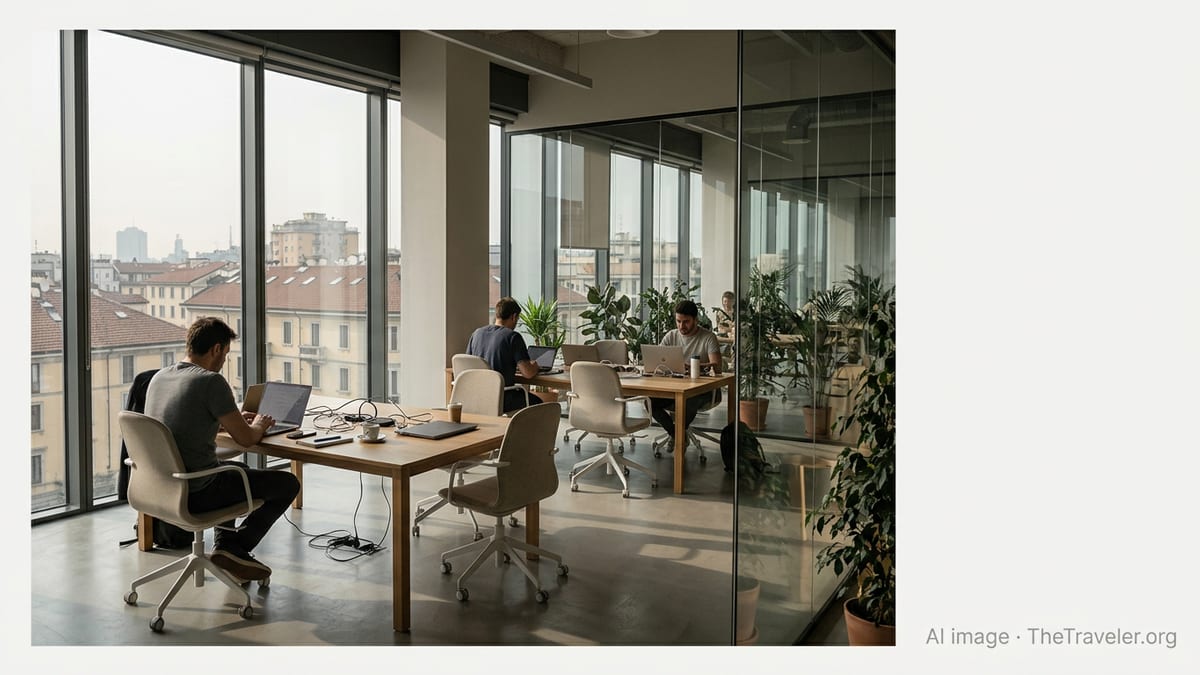
Methodology and Key Evaluation Criteria for Remote Work in Italy
This assessment focuses on medium and large Italian cities that combine reliable connectivity with an urban environment conducive to sustained remote work. The analysis draws on recent cost of living aggregators, broadband coverage reports, mobile speed benchmarking and quality of life indices up to early 2026, filtered for relevance to remote professionals rather than short-term digital nomads.
Cities are evaluated on three main axes. First, lifestyle refers to everyday liveability: urban scale, climate, commuting patterns, perceived safety and typical urban rhythm. The emphasis is on whether the city supports a stable routine, not on sightseeing or tourist appeal. Second, cost refers to relative price levels for essentials such as rent, groceries, local transport and services, using Milan as a high-cost reference point and southern cities as lower-cost comparators. Third, infrastructure focuses on fixed and mobile internet performance, broadband coverage, coworking availability and public transport connectivity.
Within this framework, six cities emerge as particularly relevant for remote workers considering relocation to Italy: Milan, Rome, Bologna, Turin, Palermo and Bari. Together they represent a spectrum from high-cost, high-infrastructure northern centres to more affordable southern hubs where connectivity and services have improved rapidly in recent years.
Milan: High-Intensity Work Hub with Top-Tier Infrastructure
Milan is Italy’s primary economic and technology hub and consistently ranks as the country’s most expensive city in international cost of living comparisons. Recent composite indices place Milan at the top of Italian cost rankings, with overall consumer price levels and rent indices significantly higher than Rome, Bologna and southern cities. In practical terms, long-term rents for modest apartments are often more than double those in cities like Palermo, and around 20 to 30 percent higher than in Bologna or Turin according to recent expat-focused cost breakdowns.
From an infrastructure perspective, Milan offers some of the best conditions in Italy for remote workers. Multiple operators provide fibre-to-the-home connections with headline speeds in the gigabit range in most central and many peripheral districts, supported by national ultra-broadband expansion that now reaches the majority of Italian households. Fixed broadband coverage in large metropolitan areas such as Milan is above the national average, while mobile 4G and 5G networks are dense and competitive, reflecting heavy investment by major providers. This results in comparatively low latency and high reliability for bandwidth-intensive remote tasks.
For remote professionals who prioritise ecosystem over cost, Milan also offers one of the densest coworking networks in the country, including specialist spaces for technology, design and finance workers. This supports flexible work patterns for those who prefer structured environments over home offices. The trade-off is straightforward: Milan delivers the strongest overall infrastructure and professional ecosystem in Italy but at pricing levels that may be prohibitive for location-independent workers with income denominated outside high-salary markets.
Rome: Balanced Capital with Solid Infrastructure and Mid-High Costs
Rome presents a more mixed profile. Cost of living surveys typically rank Rome below Milan but above many other Italian cities in overall expense. Consumer prices are moderately high, and central housing is costly, though outer neighbourhoods offer more competitive rents. Recent expat-focused analyses suggest that for a comparable quality apartment, Milan can cost roughly 20 to 30 percent more than Rome, which positions the capital as a relatively more affordable high-profile base.
From an infrastructure standpoint, Rome benefits from extensive fixed broadband coverage and a rapidly upgraded mobile network. The city regularly appears near the top of national mobile performance rankings, with measured median mobile download speeds in recent regulator-backed studies remaining competitive with other major European capitals. While there are still pockets of weaker coverage in some outlying districts, the central and semi-central zones where most remote workers are likely to live generally have access to high-speed fixed connections and strong 4G and 5G signals.
For remote workers whose lifestyle preference combines a large, diverse city with a somewhat lower price tag than Milan, Rome can be a practical compromise. The city offers a broad range of coworking spaces spread across central and peripheral districts, and public transport, while often crowded, creates sufficient connectivity between residential neighbourhoods and work hubs for a manageable daily routine. The key decision factor will be tolerance for urban scale and congestion versus the benefit of multiple work and networking options.
Bologna and Turin: Mid-Sized Northern Cities with Strong Work Infrastructure
Bologna and Turin are frequently highlighted in Italian quality of life rankings and provide mid-sized alternatives to Milan and Rome. Cost of living indices place both cities below Milan and generally close to or slightly below Rome, with estimates suggesting total living costs that can be 20 to 30 percent lower than Milan for similar living standards. Housing costs, in particular, tend to be less volatile, and long-term renters can find more predictable pricing than in the most globally exposed markets.
In infrastructural terms, both cities are well served by national broadband and mobile networks. Bologna has recently been featured near the top of Italy-wide comparisons of mobile data performance, with measured median download speeds in the hundreds of megabits per second according to surveys conducted in late 2025. Turin also ranks in the national top group for mobile performance, indicating that typical on-the-go connectivity for calls, video meetings and tethering is robust in most built-up areas.
Fixed broadband availability is similarly strong. Fibre networks cover a large share of urban households in both cities, and multiple providers offer high-speed connections suitable for remote work involving large file transfers, cloud collaboration and frequent video conferencing. Both Bologna and Turin also benefit from being rail and road transport hubs, which can be relevant for remote workers who occasionally need to travel to Milan, Rome or other EU cities for in-person meetings.
The coworking landscape in Bologna and Turin has expanded steadily, especially around university districts and central business areas. Remote workers who prefer a compact urban environment with short commutes and lower costs than Milan, but still want access to high-grade digital infrastructure and a professional ecosystem, often find these cities an attractive middle ground.
Palermo: Affordable Southern Capital with Improving Connectivity
Palermo, the main city in Sicily, has gained international attention in recent rankings of remote work destinations that consider value for money and evolving infrastructure. A recent global study on executive-level remote work placed Palermo as Italy’s highest-ranked city, emphasising its significantly lower prime rental costs compared with northern and central Italian cities. Property market analysis notes that prime residential rents in Palermo can be up to around 70 percent lower than in cities such as Florence, with similar differentials observable against Milan and, to a lesser degree, Rome.
On living costs more broadly, multiple expat and cost of living sources classify Palermo among the most affordable major Italian cities. Typical rents for centrally located one-bedroom apartments are often in the range of roughly one third to one half of equivalent units in Milan, and everyday expenses for groceries and local services track southern rather than northern price levels. For remote workers paid in foreign currencies or benefiting from higher external salary benchmarks, this cost differential can be decisive.
Infrastructure has historically been the main concern for remote professionals in Palermo, but recent developments show measurable improvement. National broadband expansion programs have increased next-generation access coverage across Italy, and major cities such as Palermo now benefit from fixed ultra-broadband availability significantly above prior levels. Mobile networks have also expanded their 4G and 5G footprints in southern urban areas, though speeds and reliability can remain more variable between districts than in the north.
While Palermo’s coworking ecosystem is smaller than that of Milan or Rome, a modest but growing number of dedicated spaces and coliving projects focus explicitly on remote workers and digital professionals. The city is best suited to those who prioritise cost and a slower day-to-day rhythm, while accepting that infrastructure, although improving, may require more careful neighbourhood selection and verification of individual building connections before committing to long-term leases.
Bari: Rising Adriatic Hub with Strong Mobile Connectivity
Bari, a key city on Italy’s Adriatic coast, has emerged in recent telecommunications benchmarking as a standout performer for mobile connectivity. The latest survey data from Italy’s communications regulator, based on tests conducted between late 2025 and early 2026, indicate that Bari currently tops national rankings for mobile download performance among major Italian cities, surpassing traditional leaders such as Milan and Rome in measured average speeds.
This level of mobile performance translates into practical advantages for remote workers who rely on tethering, mobile hotspots or frequent work while in transit. High median mobile speeds, combined with growing 5G coverage, reduce latency and buffering for real-time collaboration and allow remote professionals to maintain stable connections even outside fixed workspaces. These strengths are particularly relevant in districts where fibre installation lags, as high-performance mobile networks can provide a viable interim or backup solution.
From a cost perspective, Bari generally sits below the major northern cities. While detailed differentials vary by neighbourhood and property type, composite indices and expat reports group Bari with other southern and lower-cost central cities, indicating rent levels substantially below Milan and Rome. Groceries and local services typically follow regional patterns, remaining more affordable than in the industrial north.
Infrastructure beyond connectivity is functional for remote work, with a modest but increasing number of coworking spaces and a regional airport that offers connections to major Italian hubs. Bari is best positioned for remote workers who want a relatively affordable base with very strong mobile internet performance and are comfortable with a still-developing ecosystem of dedicated remote work facilities.
Cost and Infrastructure Comparison Across Leading Cities
For decision-making, remote workers benefit from a comparative view of core parameters rather than isolated city profiles. The following table summarises relative conditions in the six cities discussed, using Milan as a reference point for high cost and infrastructure density. Values are indicative, based on aggregated 2025 and early 2026 data and should be treated as directional rather than precise numeric forecasts.
| City | Relative Cost Level vs Milan | Typical Rent Differential | Fixed Broadband Availability | Mobile Performance | Coworking Density |
|---|---|---|---|---|---|
| Milan | 100% (reference, highest) | Baseline | Very high, widespread fibre | Very strong | Very high |
| Rome | Approximately 85 to 90 percent | Often 10 to 30 percent lower | High, strong in central areas | Very strong | High |
| Bologna | Approximately 80 to 85 percent | Roughly 20 to 30 percent lower | High, good fibre coverage | Top-tier nationally | Moderate to high |
| Turin | Approximately 75 to 85 percent | Roughly 20 to 30 percent lower | High, widespread broadband | Top-tier nationally | Moderate |
| Palermo | Approximately 55 to 65 percent | Can be 50 to 60 percent lower | Improving, varies by district | Moderate, improving | Low but growing |
| Bari | Approximately 60 to 70 percent | Frequently 40 to 50 percent lower | Good in urban core | Among the strongest nationally | Low to moderate |
This comparison highlights three broad tiers. Milan stands alone in the high-cost, high-infrastructure category. Rome, Bologna and Turin form a balanced mid-cost, high-infrastructure tier suitable for workers seeking a compromise between price and professional ecosystem density. Palermo and Bari represent an affordable but evolving infrastructure tier, appropriate for cost-sensitive remote workers who are willing to verify local connectivity conditions carefully before committing.
The Takeaway
For remote workers considering relocation to Italy, the key decision variables are the acceptable balance between cost, infrastructure reliability and preferred urban scale. Milan offers the strongest professional ecosystem and most mature infrastructure, but its cost profile approaches that of other major Western European financial centres. Rome provides a broad set of work options with slightly more manageable costs and solid digital infrastructure, though with the complexity inherent to large capitals.
Bologna and Turin stand out as particularly attractive for remote workers seeking strong connectivity, reliable fixed broadband and good transport links without the price premium of Milan. These cities can provide a stable, predictable base where everyday work routines are supported by solid public transport, high-quality networks and accessible coworking spaces, all at a moderately lower overall cost level.
Palermo and Bari demonstrate how southern Italian cities are closing the infrastructure gap while retaining significantly lower living costs. Palermo appeals primarily on affordability and an increasingly visible remote work profile, while Bari’s recent top ranking in national mobile performance surveys makes it attractive for workers who rely heavily on mobile connectivity. In both cases, thorough due diligence on specific neighbourhoods, building connections and alternative workspaces is critical.
Italy therefore offers a spectrum of viable options for remote workers. Those with higher budgets and a preference for dense ecosystems will likely gravitate to Milan or Rome. Those optimising for value and work-focused liveability may find Bologna or Turin to be the most balanced choices, while cost-focused remote workers with flexible infrastructure requirements can benefit from the affordability of Palermo or Bari.
FAQ
Q1. Which Italian city offers the best overall conditions for remote workers?
Milan offers the most comprehensive combination of high-speed connectivity, coworking density and professional networking, but at the highest cost level in Italy.
Q2. Which city in Italy has the strongest mobile internet performance for remote work?
Recent regulator-backed measurements place Bari at the top of national rankings for mobile download speeds among major Italian cities.
Q3. Where can remote workers find the best balance between cost and infrastructure?
Bologna and Turin generally provide the most balanced mix of moderate living costs, strong fixed and mobile networks and manageable city size for daily routines.
Q4. Is Rome a good option for long-term remote work?
Yes. Rome offers solid broadband coverage, extensive coworking options and costs that are typically lower than Milan, though still relatively high by Italian standards.
Q5. How much cheaper is Palermo compared with northern Italian cities?
Indicative data suggest that central rents in Palermo can be roughly half, and in some cases up to 60 or 70 percent lower, than comparable accommodation in Milan or Florence.
Q6. Are southern Italian cities reliable from an internet perspective?
Infrastructure in southern cities such as Palermo and Bari has improved significantly, but quality can vary by neighbourhood, so checking building-level connections remains important.
Q7. Do all major Italian cities have coworking spaces suitable for remote workers?
All cities discussed have coworking options, though Milan and Rome have the greatest density, Bologna and Turin offer a solid but smaller network, and Palermo and Bari have more limited selections.
Q8. How do public transport systems impact remote workers in these cities?
Milan, Rome, Bologna and Turin have extensive public transport that supports commuting to coworking spaces, while Palermo and Bari rely more on buses and walking within compact central areas.
Q9. Is it necessary to have fibre-to-the-home for effective remote work in Italy?
Fibre is preferable for bandwidth-intensive work, but in cities with high mobile performance, such as Bari, a strong 4G or 5G connection can serve as an effective alternative or backup.
Q10. Which Italian cities are most suitable for budget-conscious remote workers?
Palermo and Bari typically provide the lowest overall costs among the cities analysed, while still offering improving digital infrastructure suitable for many remote work profiles.