


Mexico has become a leading base for digital nomads and remote employees, particularly those working with North American time zones. For location-independent professionals, the relevant question is not whether Mexico is viable, but which cities provide the most reliable work environment. This briefing compares the main Mexican hubs for digital nomads and remote workers with a focus on internet quality, workspace infrastructure, productivity conditions and ecosystem maturity.
Methodology and Key Evaluation Criteria for Mexican Remote Work Hubs
This assessment concentrates strictly on operational conditions for digital work, not on tourism or lifestyle. Cities are evaluated using four practical dimensions: connectivity and reliability, work infrastructure, time-zone alignment and accessibility, and maturity of the remote work ecosystem. The goal is to help remote workers identify locations where daily work can proceed with minimal disruption.
Connectivity and reliability refers to the availability of fixed broadband, prevalence of fiber connections, and typical speeds in homes, coworking spaces, and accommodations. In major Mexican cities like Mexico City, Guadalajara and Mérida, fiber plans commonly advertise 100 to 500 Mbps download, with coworking venues often testing above 100 Mbps in practice. Nationally, internet in large urban areas is generally stable, while smaller coastal or rural towns show more variability and occasional outages, requiring contingency planning such as mobile hotspots or secondary providers.
Work infrastructure covers the density and quality of coworking spaces, availability of work-friendly cafes, and presence of flexible office concepts. One industry report estimated roughly 580 coworking spaces across Mexico in 2024, with Mexico City alone accounting for more than one-fifth of the total and hundreds of individual locations. Mexico City, Guadalajara and Monterrey have the largest formal coworking markets, while secondary hubs like Mérida, Playa del Carmen and Puerto Vallarta have smaller but growing networks.
Remote work ecosystem maturity considers the presence of established digital nomad communities, networking events, and related services such as serviced apartments, coliving setups and companies designing hybrid offices. By late 2024, Mexico City’s office market alone contained more than 7 million square meters of Class A and A+ office space with a rising share configured as flexible or coworking environments, indicating a structurally strong base for knowledge work. Secondary cities are building smaller but increasingly specialized environments aimed at long-stay remote workers rather than short-term tourists.
Mexico City: Primary Remote Work Hub with Deep Infrastructure
Mexico City is the country’s largest and most mature hub for remote work. From an operational perspective, its main advantages are robust connectivity, extremely high workspace density and strong integration with international business networks. Internet providers offer residential and small-business fiber connections that often advertise 200 to 500 Mbps plans, while many coworking spaces and modern apartments in central districts test in the 100 Mbps-plus range for both download and significantly lower but workable upload speeds.
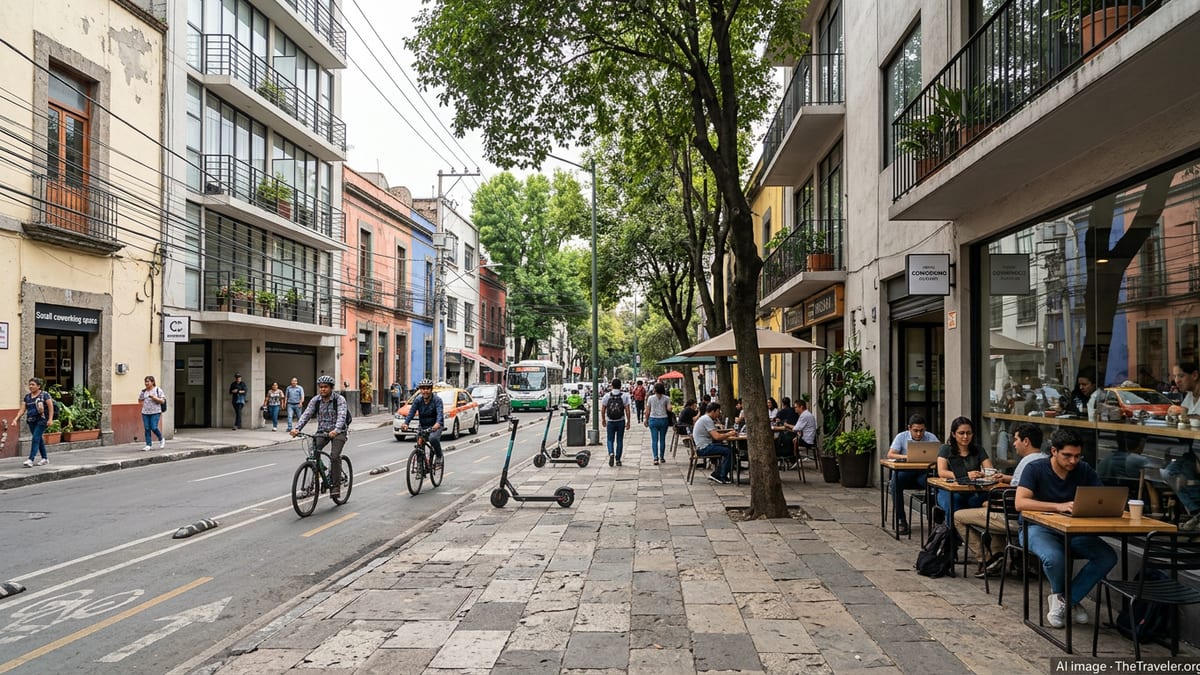
The city has the highest concentration of coworking spaces in the country by a large margin. One 2025 point-of-interest analysis attributed close to 700 coworking locations to Mexico City alone, representing over 20 percent of all Mexican coworking venues. These range from large international operators to local independent spaces and corporate innovation hubs, particularly concentrated in neighborhoods such as Roma, Condesa, Juárez, Reforma and Polanco. This density gives remote workers meaningful choice over factors such as 24/7 access, meeting-room availability, quiet zones, phone booths and hybrid collaboration facilities.
Mexico City also benefits from its role as the country’s primary air hub and business gateway. The international airport connects directly to dozens of cities in North America, Europe and Latin America, which is relevant for remote workers who need periodic in-person meetings. The city’s time zone aligns closely with United States and Canadian working hours for most of the year, which reduces schedule friction for employees tied to North American corporate calendars. In addition, a strong startup and corporate ecosystem generates frequent business events, meetups and conferences that can be valuable for networking-focused professionals.
Potential drawbacks from a remote work standpoint include congestion, occasional air quality issues, and the need to choose neighborhoods carefully for noise management and commute times. However, within preferred districts where coworking and serviced apartments cluster, digital professionals typically find infrastructure that is equal or superior to many mid-sized North American cities, particularly in terms of workspace choice and high-capacity internet connections.
Mérida: Stable, Medium-Sized Base with Growing Remote Work Districts
Mérida, capital of the state of Yucatán, has emerged as one of Mexico’s most frequently cited cities for remote workers seeking a smaller and more controlled environment than Mexico City. Reports from 2024 and 2025 describe Mérida’s fixed-line internet as generally reliable and fast in central areas, with typical residential speeds often above 50 Mbps and significantly higher performance in better-connected coworking spaces. Some independent measurements reference coworking Wi-Fi testing close to or just under 100 Mbps download, which is adequate for video conferencing and data-heavy tasks.
The city’s coworking ecosystem is smaller than that of Mexico City but has expanded steadily. Mérida hosts a mix of formal coworking brands and local operators, most clustered in central and northern districts where new residential and commercial developments are concentrated. Remote workers can usually choose between traditional open-plan coworking, small private offices and hybrid venues combining event spaces with individual desks. Informal work options in cafes with reliable Wi-Fi have also multiplied as the remote worker population increases.
Public commentary and relocation reports frequently highlight Mérida’s reputation for order and safety, which in turn encourages longer stays by remote workers who want to establish a predictable routine. The city’s location in the Central Time Zone allows easy overlap with North American employers, while its airport offers direct connections to several major Mexican and U.S. cities. Mérida has also begun marketing specific districts and initiatives that target remote workers, which indicates an institutional interest in consolidating this segment.
For digital nomads, the main operational considerations in Mérida involve seasonality and neighborhood choice. High temperatures and humidity can place more importance on reliable air conditioning and power stability, particularly for those working from home during peak afternoon heat. In addition, while core districts benefit from modern fiber infrastructure, more peripheral or older neighborhoods may have slower or less consistent connections, so checking specific building-level connectivity remains important.
Guadalajara and Monterrey: Corporate-Linked Hubs with Strong Connectivity
Guadalajara and Monterrey function as Mexico’s leading innovation and industrial metros and have become credible alternatives to Mexico City for remote workers who prefer larger cities but want different business contexts. Both are supported by strong corporate presences, modern office districts and internationally connected airports, which provides a foundation for remote work infrastructure and networking.
In Guadalajara, often characterized as a technology and innovation hub, commercial and residential areas commonly feature high-speed fixed broadband with fiber plans well above 100 Mbps where available. The city hosts multiple coworking chains and independent spaces across central districts such as Providencia, Chapultepec and the historic center. Community reports consistently describe excellent internet reliability in the main zones where remote workers tend to live and work, and mention active entrepreneurial and startup communities that organize meetups and sector-specific events.
Monterrey, a major industrial and financial center, has similarly strong fixed broadband penetration in its core urban area and a modern stock of office buildings with integrated flexible workspaces. While it attracts fewer traditional “digital nomads” than Mexico City or coastal towns, Monterrey is relevant for remote professionals who work with industrial, engineering or corporate finance sectors and need physical proximity to those clients. Coworking brands have expanded in districts like San Pedro Garza García, where premium office towers integrate shared desks, private offices and meeting rooms into hybrid layouts.
Both Guadalajara and Monterrey share practical advantages for full-time employees: strong local talent pools for collaboration, more “business-first” work environments, and substantial airport connectivity. However, they are less optimized for short-stay nomads who prioritize an immediate community of international remote workers. People choosing these cities as bases typically do so for medium to long-term professional alignment rather than a transient nomad experience.
Coastal and Secondary Hubs: Playa del Carmen, Puerto Vallarta and Others
Several coastal and secondary cities have matured from informal backpacker destinations into serious, if smaller-scale, remote work hubs. Among these, Playa del Carmen and Puerto Vallarta stand out for having taken concrete steps to improve internet stability and workspace supply as demand from remote workers has increased.
Playa del Carmen, in Quintana Roo, historically built its reputation among digital nomads on easy beach access and proximity to Cancun’s international airport. More recently, its work infrastructure has expanded to include multiple formal coworking spaces, nomad-oriented coliving properties and a network of cafes accustomed to laptop workers. Connectivity in central districts is typically adequate for remote work, with residential and coworking speeds often in the 50 to 100 Mbps range where fiber has been deployed. However, connectivity can vary more sharply between buildings than in major inland cities, and temporary slowdowns during peak tourism periods are not unusual.
Puerto Vallarta, on the Pacific coast, has undergone a notable upgrade cycle in fixed-line internet. By 2024, local relocation guides reported that most central neighborhoods offered fiber-optic connections in the 100 to 250 Mbps range, which materially improved the city’s suitability for remote work. Independent travel-technology assessments have cited average internet speeds around or approaching 90 Mbps for remote workers in central districts, sufficient for multi-party video conferencing and cloud-based workflows. Coworking options remain fewer than in Mexico City or Guadalajara but have become more structured and targeted toward long-stay professionals rather than day visitors.
Other secondary hubs, such as Oaxaca City, San Cristóbal de las Casas and Querétaro, have smaller but visible remote work communities. Internet speeds in these cities usually support standard remote work tasks, but with wider variance and sometimes greater sensitivity to weather and infrastructure issues than in tier-one metros. In such locations, having a backup connection plan through mobile data or alternative workspaces becomes more important for those in reliability-critical roles.
Comparative Overview of Leading Mexican Cities for Remote Workers
The following table provides a simplified comparison of the main Mexican hubs most frequently selected by digital nomads and remote employees, focused on work-related criteria rather than lifestyle.
| City | Indicative fixed / coworking speeds (download) | Coworking market maturity | Ecosystem profile for remote work |
| Mexico City | Commonly 100–500 Mbps in fiber-connected properties | Very high; hundreds of spaces across central districts | Primary national hub with dense professional networks |
| Mérida | Roughly 50–100 Mbps in central areas and coworkings | Moderate but expanding | Stable, medium-sized base with visible nomad community |
| Guadalajara | Frequently 100 Mbps or higher where fiber is available | High; multiple chains and independents | Technology and startup oriented urban center |
| Monterrey | Frequently 100 Mbps or higher in business districts | High; concentrated in modern office zones | Corporate and industrial professional environment |
| Playa del Carmen | Often 50–100 Mbps in central, fiber-equipped areas | Moderate; focused on nomads and coliving | Smaller but international remote work cluster |
| Puerto Vallarta | About 90–200 Mbps reported in upgraded central areas | Low to moderate but improving | Emerging coastal hub with strengthening infrastructure |
These figures are indicative rather than guaranteed and can vary significantly between neighborhoods, buildings and providers. Nevertheless, they reflect a clear pattern: the country’s largest metros offer the highest and most consistent speeds along with the most mature coworking markets, while coastal and secondary hubs trade some infrastructure depth for environment and scale. For remote workers whose roles are highly sensitive to outages or bandwidth limits, tier-one metros and Mérida generally provide the strongest risk mitigation.
Time zone is another unifying consideration across these cities. Most of Mexico’s major hubs operate in time zones that closely mirror or match U.S. and Canadian business hours, which significantly reduces the strain of late-night or early-morning calls often associated with remote work in Europe or Asia. This alignment is a core structural advantage of Mexico as a whole for remote professionals tied to North American employers.
The Takeaway
From a digital work perspective, Mexico offers a diversified portfolio of cities rather than a single best option. Mexico City stands out as the default choice for remote professionals who want maximum redundancy of workspaces, highest coworking density and deep integration with international business networks. Its infrastructure and ecosystem maturity are comparable to many global capitals, especially in central districts that concentrate technology firms, startups and hybrid offices.
Mérida, Guadalajara and Monterrey form a second tier of strong candidates. Mérida offers a controlled, medium-sized environment with a growing remote work district and a reputation for order and reliability in central neighborhoods. Guadalajara and Monterrey provide high-capacity internet, developed office markets and strong professional communities, particularly suitable for remote workers whose industries align with technology, innovation, manufacturing or finance.
Coastal and secondary hubs such as Playa del Carmen, Puerto Vallarta, Oaxaca City and San Cristóbal de las Casas can serve well for remote workers who accept slightly higher connectivity risk in exchange for a smaller scale setting. These cities now possess workable infrastructure for remote work, but building-level variability and occasional outages remain more common, so they are best suited to professionals with moderate rather than extreme connectivity requirements or those prepared with robust backup solutions.
Overall, Mexico has evolved into one of the most structurally practical regions for digital nomads and remote employees working to North American schedules. By focusing on concrete work factors such as connectivity, workspace availability and ecosystem maturity, prospective movers can identify the Mexican city that best matches their operational risk tolerance and professional objectives.
FAQ
Q1. Is internet in Mexico reliable enough for full-time remote work?
In major cities such as Mexico City, Guadalajara, Monterrey and Mérida, fixed broadband and coworking Wi-Fi are generally reliable and capable of supporting full-time remote work, with speeds often in the tens or hundreds of megabits per second. Smaller towns and coastal areas can be more variable, so secondary options like mobile hotspots are advisable.
Q2. Which Mexican city offers the strongest overall infrastructure for digital nomads?
Mexico City offers the most comprehensive infrastructure, including the highest density of coworking spaces, widespread fiber internet, extensive transport connectivity and a mature professional ecosystem. For many digital nomads and remote employees, it functions as the country’s primary remote work hub.
Q3. How do coworking options compare between Mexico City and smaller hubs?
Mexico City has several hundred coworking spaces across multiple neighborhoods, giving remote workers wide choice. Secondary hubs like Mérida, Guadalajara and Playa del Carmen have noticeably fewer but growing numbers of spaces, which can still be sufficient if workers are comfortable with a smaller set of options.
Q4. Are coastal cities like Playa del Carmen and Puerto Vallarta suitable for bandwidth-intensive work?
In central, fiber-connected areas of Playa del Carmen and Puerto Vallarta, many accommodations and coworking spaces provide speeds adequate for video conferencing and cloud-based workflows. However, performance can vary sharply between properties, so workers with bandwidth-intensive roles should verify building-level connectivity before committing.
Q5. How important is neighborhood choice within Mexican cities for remote work?
Neighborhood selection is crucial, because fiber coverage, power stability and noise levels can differ substantially across the same city. In all major hubs, remote workers typically favor central or business districts where modern buildings, coworking spaces and services are concentrated.
Q6. Do Mexican cities have established communities of digital nomads?
Yes. Mexico City, Playa del Carmen, Mérida and Puerto Vallarta in particular have visible digital nomad and remote worker communities, with regular meetups, coworking-based events and online groups. Guadalajara and Monterrey host more mixed communities of local professionals, entrepreneurs and a smaller number of international nomads.
Q7. What backup connectivity strategies are recommended for Mexico-based remote workers?
Common strategies include maintaining a local mobile data plan with hotspot capability, selecting accommodations with dual providers where possible, and keeping a day-pass friendly coworking space within reach. These measures reduce the impact of occasional neighborhood-level outages or maintenance.
Q8. How does Mexico’s time zone benefit remote employees working for U.S. or Canadian companies?
Most Mexican hubs operate in time zones that closely correspond to U.S. Central or Mountain Time, which means standard working hours line up with North American business days. This reduces the need for very early or very late calls and makes long-term remote collaboration more sustainable.
Q9. Are there differences in productivity conditions between large metros and smaller Mexican cities?
Larger metros such as Mexico City, Guadalajara and Monterrey generally provide more robust redundancy in connectivity, coworking options and professional services, which supports higher predictability. Smaller hubs can offer quieter environments but often have fewer workspace options and more variability in infrastructure quality.
Q10. How fast is the remote work ecosystem in Mexico evolving?
The ecosystem is evolving quickly, with new coworking spaces, hybrid offices and nomad-oriented accommodations opening annually, especially in major cities and popular coastal hubs. Conditions for digital nomads and remote workers in Mexico today are materially stronger than even a few years ago, and this trend is expected to continue.