


Thailand has evolved into one of the most established hubs for digital nomads and remote workers in Asia, supported by competitive internet speeds, nationwide 4G and expanding 5G coverage, and a dense network of coworking spaces and work-friendly cafes. Within the country, however, cities differ significantly in terms of connectivity quality, work infrastructure, workday convenience, and the maturity of professional communities. This briefing evaluates the best cities in Thailand for digital nomads and remote workers, with a strict focus on work-related practicalities rather than tourism factors.
Framework: What Makes a Thai City Suitable for Remote Work
From a relocation intelligence perspective, the suitability of a Thai city for digital nomads and remote workers rests on four primary variables: connectivity, workspace infrastructure, operating environment, and community density. Connectivity encompasses fixed broadband speeds, mobile data performance, network reliability, and backup options. Workspace infrastructure refers to the availability and quality of coworking spaces, serviced offices, and laptop-friendly cafes where stable connections and power supply are assured.
Operating environment includes time zone compatibility, access to essential daily services, commuting times within the city, and the ability to maintain a predictable routine around calls with global clients. Community density captures the size and maturity of the local remote worker ecosystem, which affects networking opportunities, peer learning, and the ease of onboarding into an existing knowledge base of "where and how to work" in the city.
Thailand as a whole ranks high on broadband performance, with median fixed-line speeds reported above 200 Mbps in recent national benchmarks and widespread fiber in urban areas. Mobile connectivity through major carriers typically delivers double-digit to low triple-digit Mbps download speeds in major cities, and coverage extends to secondary cities and many islands. However, performance still varies block by block, and smaller or more remote islands can see inconsistent service that is not suitable for call-intensive roles.
On this basis, the strongest Thai locations for remote work tend to cluster into three groups: large, infrastructure-rich metros such as Bangkok; secondary tech and education hubs like Chiang Mai; and a shortlist of island or coastal locations where connectivity and workspace options have caught up enough to enable productive work alongside a slower pace of life.
Bangkok: Primary Hub for High-Intensity Remote Work
Bangkok is Thailand’s most robust environment for high-intensity, reliability-critical remote work. The capital benefits from the country’s densest fiber network, extensive 5G coverage, and widespread availability of backup options such as multiple mobile networks and business-grade connections in premium coworking spaces. Speed test data and coworking operator specifications commonly cite upload and download speeds in the 100 to 250 Mbps range in central districts, with many operators marketing even higher symmetrical fiber tiers for dedicated members.
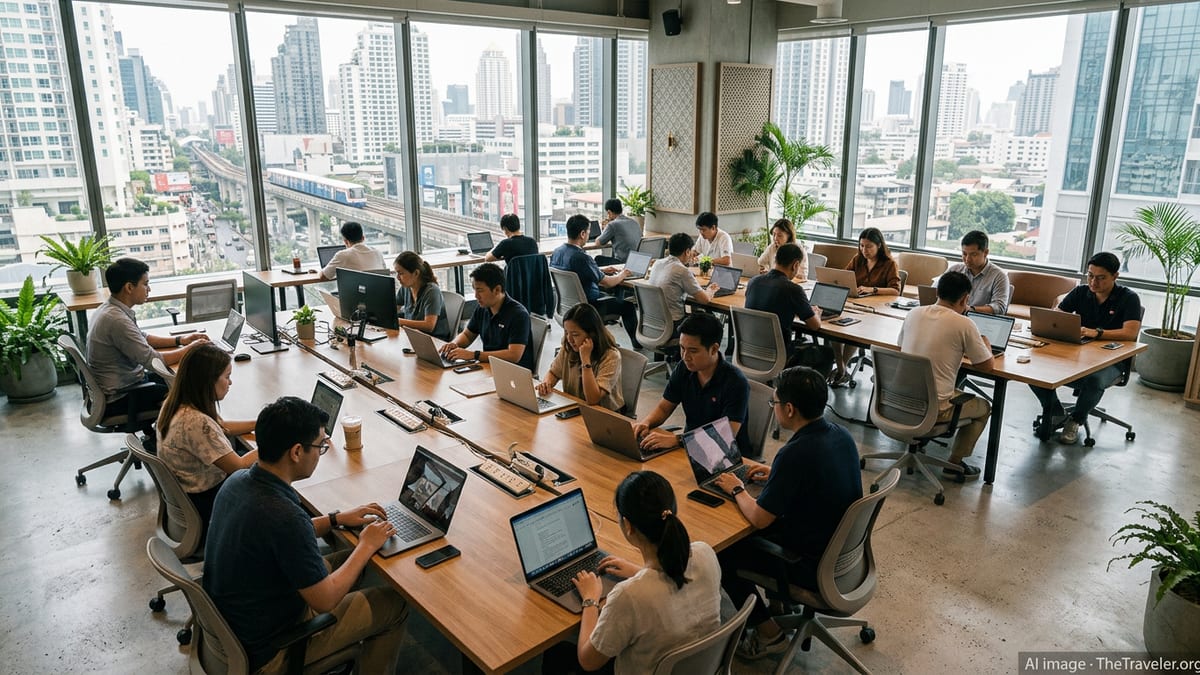
The city hosts dozens of formal coworking spaces and serviced offices, concentrated in central business and midtown districts. Facilities typically provide ergonomic seating, air conditioning, generator-backed electricity, dedicated meeting rooms for video calls, phone booths, and enterprise-grade routers. Day passes and flexible memberships are widely available, enabling digital nomads to alternate between coworking spaces and working from home without long contracts. This density of options makes it possible to switch locations quickly if a particular venue experiences technical issues.
Bangkok’s scale also supports specialized working environments that can be relevant for certain professionals: startup-focused hubs, innovation parks, and sector-specific incubators. For nomads and remote workers who also run teams or client operations, this allows recruitment of local talent, booking of event spaces, and access to legal and corporate services in the same districts where they work. The metro’s time zone (UTC+7) provides a workable overlap with Europe and a partial overlap with North America, making it suitable for remote roles requiring cross-continental collaboration.
The main trade-offs in Bangkok are congestion and noise. Commute times can be long if accommodation is far from rail transit, and work-from-cafe arrangements along major roads may be affected by sound levels not suitable for frequent calls. For decision-grade planning, professionals who expect to spend several hours per day on video calls typically concentrate in neighborhoods along mass transit corridors, within short walking distance to coworking centers or quiet cafes known for stable connections.
Chiang Mai: Established Northern Remote Work Cluster
Chiang Mai is widely regarded as Thailand’s second major hub for digital nomads and remote workers. The city combines comparatively compact urban geography with robust fiber and mobile networks and a mature ecosystem of coworking spaces. Community sources and city-specific guides suggest there are roughly 20 or more coworking venues, in addition to a long list of laptop-friendly cafes, many of which market dedicated quiet zones, air conditioning, and high-speed Wi-Fi with advertised speeds commonly around 50 to 100 Mbps or higher.
The city has benefited from targeted investment under national “smart city” and digital economy programs, fostering an infrastructure base that supports tech firms, creative industries, and remote professionals. While fixed-line speeds may not always reach the peak levels of central Bangkok, they are broadly sufficient for most remote work profiles, including software development, design, online marketing, and consulting. Redundant connectivity through multiple providers and mobile hotspots is widely used as a contingency measure, particularly by professionals handling real-time client interactions.
Chiang Mai’s digital nomad community is both long-established and sizable, with online community groups reportedly numbering in the tens of thousands of members. This density of experience means new arrivals can quickly identify which neighborhoods offer the strongest combination of reliable internet, proximity to coworking options, and access to daily amenities. It also enables faster resolution of practical questions such as where to find 24-hour workspaces, quiet call booths, and printing or meeting facilities.
Operationally, Chiang Mai’s slower pace and smaller size than Bangkok reduce commuting time and allow many remote workers to live within walking or cycling distance of their primary work location. However, air quality issues during the annual burning season can affect comfort for those planning outdoor or cafe-based work and may push remote workers to rely more heavily on indoor, air-filtered coworking environments during affected months.
Island and Coastal Options: Phuket, Koh Phangan, and Koh Lanta
Several Thai islands and coastal areas have matured enough in their infrastructure to qualify as viable, though sometimes conditional, bases for remote work. Among these, Phuket, Koh Phangan, and Koh Lanta stand out as the most frequently cited by digital nomads specifically for the balance of work-ready connectivity and a more relaxed setting.
Phuket, as a major tourism and residential hub, benefits from relatively strong fixed and mobile networks in its main towns. Many accommodations and coworking spaces advertise fiber connections with speeds upward of 50 to 100 Mbps, and 4G or 5G coverage is robust in populated areas. However, user reports note variability at budget guesthouses and in outlying beaches, where Wi-Fi quality can drop below what is required for daily video conferencing. For decision-grade planning, remote workers typically select either recognized coworking spaces or higher-tier accommodations that explicitly guarantee bandwidth and provide multiple access points.
Koh Phangan has transitioned from a seasonal leisure destination into a recognized digital nomad enclave, particularly in specific towns where coworking spaces, gyms, and long-stay accommodations cluster. Community feedback highlights generally strong internet performance in these hubs, with fiber-backed coworking venues commonly advertising speeds adequate for cloud-based development, media work, and streaming calls. Connectivity outside these pockets can be inconsistent, so location choice within the island is a critical factor for those with strict uptime requirements.
Koh Lanta is smaller and quieter but notable for having purpose-built coworking spaces that anchor the island’s remote-work proposition. These hubs typically offer stable fiber connections and power backup that outperform the average connection in surrounding guesthouses. While the island-wide infrastructure is less dense than in Phuket, the presence of these specialized facilities makes Koh Lanta a credible option for remote workers who structure their workday around a single primary workspace, with mobile data as a backup.
Secondary Urban Hubs: Khon Kaen, Chiang Rai, and Emerging Cities
Beyond the primary metro and island clusters, several secondary Thai cities are positioning themselves as emerging remote work bases. Khon Kaen, a northeastern university and transport hub, is often referenced as a growing tech and innovation center. The city benefits from good national fiber connectivity and 4G coverage, with coworking infrastructure still developing but present in the form of innovation labs, incubator-linked spaces, and a small number of independent coworking venues. For remote workers who value a more local, less transient environment, Khon Kaen can provide sufficient connectivity for most online roles, provided accommodation is selected with attention to internet performance.
Chiang Rai, located further north, has seen growth in both coworking venues and digital infrastructure, supported by local “smart” initiatives. Community accounts point to a noticeable increase in coworking capacity over the past few years, with some spaces using fiber connections and marketing high-speed Wi-Fi as a differentiator. While the digital nomad community is smaller than in Chiang Mai, this can be an advantage for remote workers seeking a quieter environment while still maintaining access to modern work facilities.
Other mid-sized cities along major transport corridors and industrial or education hubs also benefit from Thailand’s overall broadband and mobile network quality. However, many of these locations lack the density of coworking options and peer communities that characterize Chiang Mai or Bangkok. As a result, they are more suited to experienced remote workers comfortable with testing and arranging their own connectivity solutions, such as dual-SIM setups and home fiber installations, rather than those seeking a plug-and-play nomad ecosystem.
In evaluating these secondary hubs, the key decision-grade consideration is not whether a connection exists but how much redundancy and support infrastructure surrounds it. Professionals with mission-critical uptime needs may still prefer to base themselves in Bangkok or Chiang Mai while using secondary cities for shorter workations once local connectivity has been personally tested.
Connectivity and Workspace Comparison Across Leading Cities
The following table provides a comparative, approximate overview of connectivity and workspace conditions in Thailand’s main digital nomad cities. Values are indicative rather than exhaustive and can vary significantly by neighborhood and specific provider.
| City | Typical coworking Wi-Fi speeds (down) | Mobile data quality (urban core) | Coworking density | Remote worker community maturity |
|---|---|---|---|---|
| Bangkok | Often 100–250 Mbps or higher | Strong 4G and expanding 5G; high capacity | Dozens of spaces across central districts | Very high, multi-sector |
| Chiang Mai | Commonly 50–150 Mbps | Strong 4G; 5G present in key areas | Roughly 20 or more coworking venues plus many cafes | High, long-established nomad hub |
| Phuket | Around 50–100 Mbps in main towns | Strong in populated areas; weaker in remote beaches | Multiple coworking spaces, concentrated in urbanized zones | Moderate to high, concentrated in specific neighborhoods |
| Koh Phangan | Typically 50+ Mbps in nomad-focused hubs | Good around main settlements | Several coworking and coliving hubs | High within specific communities |
| Koh Lanta | High speeds within dedicated coworking hubs | Reasonable 4G in populated areas | Limited but specialized coworking options | Moderate, seasonal patterns |
| Khon Kaen | Varies, often tens of Mbps on fiber | Good 4G in the city core | Small but growing number of spaces | Emerging, more local professional base |
| Chiang Rai | Typically tens to low hundreds of Mbps in newer spaces | Good 4G coverage | Several modern coworking venues | Emerging, smaller-scale community |
For remote workers whose roles involve primarily asynchronous tasks and limited live calls, any of the listed cities can be workable when paired with a careful choice of accommodation and a tested coworking base. However, for those running high-stakes video-heavy operations, Bangkok and Chiang Mai remain the most resilient choices because of their redundancy in both physical workspaces and connectivity providers.
It is also important to distinguish between headline speed and consistency. While many locations advertise high theoretical speeds, performance during peak evening hours can differ from daytime conditions. A prudent approach for remote workers is to conduct their own speed and latency testing during the hours that matter most to their clients before committing to long stays or leases in any specific neighborhood.
The Takeaway
Across Asia, Thailand stands out for combining high-quality internet infrastructure with a relatively dense ecosystem of coworking spaces and established digital nomad communities. Within the country, the best cities for digital nomads and remote workers fall into clear tiers. Bangkok is the primary hub for remote professionals requiring top-end speeds, multiple backup options, and access to specialized workspace types, while Chiang Mai offers a more compact yet highly functional environment with a mature nomad ecosystem.
Islands such as Phuket, Koh Phangan, and Koh Lanta provide credible work bases for location-independent professionals, provided that accommodation and workspaces are selected specifically for their connectivity guarantees rather than for leisure-oriented factors alone. Secondary urban hubs like Khon Kaen and Chiang Rai are emerging as alternatives for remote workers who prioritize a quieter environment and are comfortable managing their own infrastructure choices.
For decision-makers considering Thailand as a remote work base, the most practical strategy is to match city selection to the technical and operational profile of the work involved. High-volume, call-intensive roles with low tolerance for downtime are best anchored in Bangkok or Chiang Mai, while project-based or asynchronous work can be more flexibly located in island or secondary city settings that have at least one proven, fiber-backed coworking hub and reliable mobile networks as backup.
Ultimately, Thailand’s leading cities already provide most of the technical conditions required for effective remote work. The critical success factors for digital nomads and remote workers are less about national infrastructure and more about micro-level choices: the specific district, building, coworking space, and connectivity setup selected within each city.
FAQ
Q1. Which city in Thailand offers the most reliable internet for remote workers?
Bangkok generally offers the most robust and redundant internet infrastructure, with widespread fiber connections, strong 4G and 5G coverage, and a high concentration of coworking spaces using business-grade networks.
Q2. Is Chiang Mai still a good choice for digital nomads in 2026?
Chiang Mai remains one of Thailand’s strongest digital nomad hubs, with numerous coworking spaces, broadly reliable fiber and mobile connectivity, and a large, established remote work community.
Q3. Can digital nomads work reliably from Thai islands?
Yes, but with caveats. Islands like Phuket, Koh Phangan, and Koh Lanta can support remote work if professionals choose accommodation and coworking spaces known for stable, high-speed connections and keep mobile data as backup.
Q4. How many coworking spaces are there in Bangkok and Chiang Mai?
Bangkok hosts dozens of coworking and serviced office spaces across its central districts, while Chiang Mai has roughly 20 or more recognized coworking venues plus many laptop-friendly cafes used as informal workspaces.
Q5. Are secondary cities like Khon Kaen and Chiang Rai suitable for long-term remote work?
They can be suitable for experienced remote workers who are comfortable arranging their own connectivity and workspace solutions. Both cities have decent broadband and mobile coverage and a small but growing coworking presence.
Q6. What internet speeds can remote workers typically expect in Thai coworking spaces?
In major hubs, coworking spaces commonly advertise download speeds in the 50 to 150 Mbps range or higher, which is adequate for video calls, cloud-based tools, and most professional workloads.
Q7. Is mobile data in Thailand sufficient as a backup for remote work?
In urban areas and popular nomad hubs, 4G and 5G mobile networks usually provide enough speed and stability to serve as a short-term backup for essential calls and tasks, especially when used via tethering.
Q8. How important is coworking space density when choosing a Thai city?
Coworking density is a key resilience factor. Cities with many spaces, like Bangkok and Chiang Mai, allow remote workers to switch locations quickly if one venue experiences technical issues or does not meet specific work needs.
Q9. Do Thai cities provide suitable environments for video call-heavy roles?
Bangkok and Chiang Mai are best suited for video call-heavy roles, thanks to higher bandwidth, access to sound-insulated meeting rooms, and the availability of multiple venues designed for call-intensive work.
Q10. What is the main risk for digital nomads choosing more remote Thai locations?
The primary risk is inconsistent connectivity, especially in budget accommodations or sparsely populated areas. Thorough testing of internet speeds and latency, plus identifying at least one reliable coworking hub, is essential before committing to a long stay.