


Thailand has evolved into one of Asia’s most established hubs for expats and remote workers, supported by extensive fiber broadband, near-universal mobile coverage and a growing ecosystem of coworking spaces. Choosing the right city is critical, as local conditions around connectivity, work environments, air quality and urban functionality vary significantly between locations. This briefing compares the main Thai cities and regional centers that consistently attract expats and remote professionals, with an emphasis on the practicalities of working productively and sustainably from each location.
Framework: What Makes a Thai City Suitable for Remote Work
Across Thailand, average fixed broadband performance is now among the strongest globally, with national median download speeds above 200 Mbps on many indices. However, conditions on the ground differ by city. For decision-making, four factors are particularly relevant when assessing Thai locations for expats and remote workers: connectivity, work-conducive spaces, environmental conditions, and urban functionality (transport, services and reliability).
Connectivity encompasses home fiber availability, mobile 4G and 5G coverage, last-mile reliability and redundancy options such as secondary mobile hotspots. Most urban areas offer consumer packages in the 300 Mbps range, with gigabit options in major cities. Nevertheless, performance can vary between neighborhoods, and island or provincial infrastructure can be more vulnerable to outages.
Work-conducive spaces include formal coworking facilities, serviced offices and work-friendly cafes with stable power and quiet environments. In Thailand, the concentration and quality of such spaces is highest in Bangkok and Chiang Mai, with Phuket and Koh Samui developing but still more patchy. Environmental conditions, particularly air quality and climate seasonality, are non-trivial for those working from home. Finally, urban functionality covers factors such as transport reliability, ride-hailing coverage, access to international flights and general digital services, which affect the predictability of a workday.
The following sections apply this framework to the main Thai cities used by expats and remote workers: Bangkok, Chiang Mai, Phuket, Koh Samui and Koh Phangan, plus a brief view on secondary cities that are emerging but still niche. The focus remains on work capability rather than tourism appeal.
Bangkok: Most Comprehensive Infrastructure and Corporate Connectivity
Bangkok is Thailand’s primary economic and digital hub and offers the most extensive infrastructure for remote workers and corporate expats. Fixed broadband options in central districts routinely advertise speeds of 300–1000 Mbps over fiber, and multiple operators compete aggressively on price and reliability. National speed reports indicate that Bangkok sits close to the top of Thailand’s city-level performance, with many users experiencing real-world downloads well above 150 Mbps and low-latency connections sufficient for video conferencing, cloud development and large file transfers.
Mobile connectivity is also strongest in Bangkok. 5G coverage reaches nearly all central and inner-suburban districts, with median mobile speeds reported above 40 Mbps nationwide and higher in core urban areas. For remote workers, this means practical redundancy: it is normally straightforward to maintain a backup 5G hotspot on a different provider to the home fiber line, significantly reducing the risk of complete loss of connectivity during outages or building maintenance.
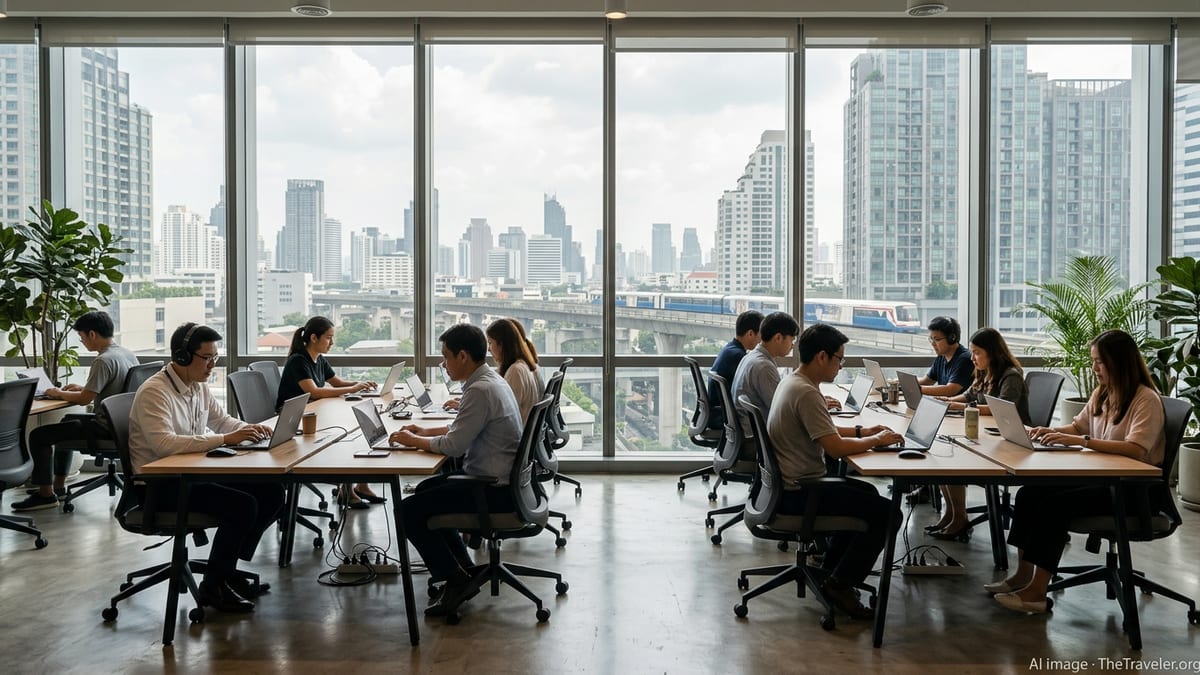
The city hosts the largest and most diverse coworking ecosystem in Thailand. Central business districts such as Sathorn, Silom, Asoke and Phrom Phong support a dense network of international coworking brands, Thai operators and serviced offices, often with 24/7 access, meeting rooms and enterprise-grade connections. There is also a broad selection of smaller, neighborhood-oriented coworking spaces and laptop-friendly cafes in residential areas, enabling flexible work patterns without lengthy commutes.
From a functionality perspective, Bangkok offers clear advantages: well-developed ride-hailing coverage, extensive mass transit in central corridors, and the country’s main international airport with direct connections across Asia, Europe and the Middle East. The main trade-offs are congestion, noise and air quality, which can be material for those sensitive to pollution. Nonetheless, for expats requiring reliable enterprise connectivity, access to local corporate offices or frequent international travel, Bangkok is typically the most robust option in Thailand.
Chiang Mai: Established Remote Work Hub With Seasonal Caveats
Chiang Mai has long been one of Southeast Asia’s most recognized hubs for independent remote workers and small distributed teams. Fixed internet infrastructure is mature, with fiber widely available in urban districts at speeds commonly advertised between 200 and 500 Mbps, and gigabit in some buildings. Speed comparison tools suggest that Chiang Mai’s average tested broadband speeds are on par with or higher than those of many regional capitals, reflecting significant local investment in fiber networks.
The city’s coworking density is high relative to its population size. Well-known multi-story coworking spaces, university-linked study hubs and cafe-style workplaces support a large community of location-independent professionals. Many facilities offer 24-hour access, quiet zones, and conference-call rooms. For expats or teams that value face-to-face peer networks in a compact city, Chiang Mai remains one of the most efficient choices in Thailand.
From a mobility standpoint, Chiang Mai’s urban area is compact, and most remote workers base themselves within a 10–20 minute ride of major coworking clusters. Ride-hailing and motorbike taxi services are readily available, and the airport connects to Bangkok and several regional destinations, though with fewer direct long-haul links than Bangkok or Phuket. This makes Chiang Mai suitable for mid-term remote assignments or basecamps, particularly for workers who do not need to fly internationally on a weekly basis.
The primary constraint is environmental: air quality typically deteriorates during the annual burning season, approximately from February to April, when particulate levels can reach unhealthy ranges on international indices. For remote workers with respiratory sensitivities or those planning year-round residence, this seasonality is a material factor. Many long-term expats address this by relocating temporarily to southern coastal areas during peak pollution months, but this needs to be incorporated into relocation planning.
Phuket: Coastal Infrastructure With Growing Coworking Options
Phuket functions as both a major tourism destination and a secondary business hub with improving infrastructure for remote work. Fiber is widely available in urbanized districts, with typical consumer packages in the 200–500 Mbps range and higher-end options in newer developments. Crowdsourced speed tests show average fixed broadband speeds in Phuket somewhat below Bangkok and Chiang Mai but still comfortably sufficient for most remote work tasks including high-definition video calls and cloud-based workflows.
5G mobile coverage has expanded across much of Phuket island, particularly in and around Phuket Town, Patong and other densely populated zones. For expats, this means that mobile hotspots are a viable backup to home connections, although performance can be intermittent in more remote coastal or hilly locations. Selecting accommodation with clear line-of-sight to mobile towers and confirmed fiber availability remains important for those whose work cannot tolerate frequent disruptions.
Phuket’s coworking scene is smaller than Bangkok’s but has diversified in recent years. Spaces are concentrated in Phuket Town and popular beach-adjacent localities, offering daily and monthly passes, meeting rooms and, in some cases, business registration services. Many remote workers also rely on cafe work, which is generally feasible but may not offer the same consistency of bandwidth and quiet as dedicated coworking environments. For company employees subject to corporate security requirements, formal coworking or home offices with dedicated lines are typically preferable.
Functionally, Phuket has strong domestic and international flight connectivity relative to its size, with frequent links to Bangkok and direct services to multiple Asian and seasonal long-haul destinations. Road congestion around tourist high seasons can significantly extend travel times between residential areas, coworking hubs and the airport. Remote workers who need predictable daily routines tend to base themselves close to their primary workspace to mitigate this variability.
Koh Samui and Koh Phangan: Island Bases for Experienced Remote Workers
Koh Samui and Koh Phangan have developed reputations as island bases for digital nomads and longer-stay expats. Both islands have seen steady expansion of fiber connections in built-up areas, and many modern apartment complexes and villas advertise high-speed fixed broadband. However, coverage is not fully uniform, and real-world speeds can vary more between properties than in mainland cities. Typical reported speeds for well-connected properties fall in the 100–300 Mbps range, with some higher-end accommodations offering faster plans.
Mobile networks on both islands provide 4G coverage in most inhabited areas, with 5G available in selective zones, especially on Koh Samui. For remote workers, this translates into acceptable redundancy but requires more careful due diligence when choosing a base. It is advisable to confirm both the fixed-line provider and signal strength of at least one major mobile operator at a specific address rather than relying on general island-wide claims.
Coworking capacity is materially more limited than in Bangkok, Chiang Mai or Phuket, but a few established spaces on each island cater specifically to remote workers, with shared desks, meeting rooms and stable connections. During peak seasons, occupancy can be high, which may reduce availability of quiet focus areas. Many expats therefore mix coworking with home offices, investing in ergonomic setups and backup connectivity at their residences.
Logistically, both islands involve additional travel layers: ferry connections or indirect flights, weather-related disruptions and more constrained healthcare and administrative services. This does not directly affect the act of remote work but can complicate relocation for corporate staff with strict availability expectations. As such, Koh Samui and Koh Phangan are often better suited to independent professionals who can tolerate occasional disruptions or who plan stays of a few months rather than long-term permanent relocation.
Emerging Secondary Cities: Hua Hin, Pattaya and Others
Beyond the main hubs, several secondary Thai cities are gradually attracting expats and remote workers seeking a balance between infrastructure and lower density. Hua Hin, a coastal town south of Bangkok, offers widespread fiber coverage, acceptable 4G and expanding 5G in central areas. The town’s compact size means that most residential neighborhoods are within short distance of the limited but functional coworking options and laptop-friendly cafes. For remote workers, Hua Hin offers a relatively predictable workday environment with fewer extreme seasonal tourism swings than some islands.
Pattaya, located southeast of Bangkok, is well integrated into the national telecommunications backbone. Fiber connectivity is typically strong in central and many suburban areas, with advertised speeds in line with other major cities. Mobile coverage is comprehensive, and its proximity to the Eastern Economic Corridor has driven further network investment. Coworking options exist but are fewer than in Bangkok or Chiang Mai, and the city’s entertainment-oriented districts may not align with all workers’ preferences for quiet working environments.
Other provincial centers such as Khon Kaen and Udon Thani in the northeast or Hat Yai in the south have sufficient connectivity for remote work, often with fiber offerings comparable to mid-tier Bangkok neighborhoods. However, these cities currently have smaller expat communities and limited formal coworking spaces. They may suit expats with Thai language capability, local family ties or specific regional business interests rather than first-time movers seeking established international ecosystems.
Overall, these secondary cities provide viable infrastructure but require more self-sufficiency from remote workers. Due diligence on specific buildings, neighborhoods and coworking options is essential, as the variance in facilities between different parts of the same city can be substantial compared with Bangkok or Chiang Mai.
Comparative Assessment of Key Cities for Remote Work
The following qualitative comparison summarizes how leading Thai locations perform against core criteria relevant to expats and remote workers: digital connectivity, coworking ecosystem, international access and environmental stability. Ratings are indicative rather than absolute and can vary by neighborhood.
| City | Fixed Broadband Quality | Mobile & 5G Coverage | Coworking Density | International Flight Access | Environmental Considerations |
| Bangkok | Very high (300–1000 Mbps widely available) | Very high in urban core | Very high, diverse | Primary hub | Traffic, heat, periodic pollution |
| Chiang Mai | High (200–500 Mbps common) | High, growing 5G | High relative to size | Regional, via Bangkok | Seasonal burning season impact |
| Phuket | High in urbanized areas | High in main districts | Moderate and growing | Strong regional and some long-haul | Seasonal tourism congestion |
| Koh Samui | Moderate to high with local variance | Good 4G, selective 5G | Limited but targeted to nomads | Direct regional, indirect long-haul | Weather-related access risks |
| Koh Phangan | Moderate to high in developed areas | Good 4G, improving 5G | Limited | Ferry-dependent access | Weather-related access risks |
| Hua Hin | High in town | Good 4G, expanding 5G | Low but adequate | Primarily via Bangkok | Relatively stable |
| Pattaya | High | High | Low to moderate | Easy access to Bangkok airports | Noise in entertainment districts |
For expats employed by international companies or requiring robust enterprise-grade infrastructure and regular travel, Bangkok is typically the default choice, with Chiang Mai and Phuket as viable alternatives depending on tolerance for seasonal factors. Independent remote workers with greater flexibility may select Chiang Mai for its concentrated community and manageable scale, or islands such as Koh Samui and Koh Phangan for short- to medium-term stays, accepting greater variability in logistics and infrastructure consistency.
Ultimately, the suitability of any Thai city for remote work depends on how individual work patterns intersect with these structural factors. Testing connections in target neighborhoods, securing written confirmation of fiber availability and considering seasonal environmental patterns are all critical steps before committing to a long-term lease.
The Takeaway
Thailand offers a broad portfolio of cities that can support professional-grade remote work, underpinned by national fixed broadband speeds that rank among the world’s fastest and extensive mobile coverage. However, conditions are not uniform across the country, and the most suitable city for any given expat or remote worker depends on work requirements, travel patterns and tolerance for environmental variability.
Bangkok provides the most comprehensive combination of high-capacity fiber, dense coworking infrastructure and international connectivity, making it the strongest all-round choice for corporate expats and remote professionals who prioritize reliability and access. Chiang Mai remains a leading hub for independent workers seeking a compact city with strong digital infrastructure and an established peer community, provided they plan around seasonal air quality constraints.
Phuket, Koh Samui and Koh Phangan expand the range of options for those who accept more complex logistics in exchange for different living environments, while secondary cities such as Hua Hin and Pattaya offer workable infrastructure for remote work with smaller international ecosystems. Across all locations, careful verification of property-level connectivity, proximity to coworking options and awareness of seasonal patterns is essential for a resilient remote work setup.
For expats and remote workers evaluating a move to Thailand, the decision should therefore focus less on headline reputations and more on tangible work-critical conditions in specific districts and buildings. With appropriate due diligence, multiple Thai cities can support stable, long-term remote work at a level that compares competitively with other major hubs in Asia.
FAQ
Q1. Which Thai city is generally best for full-time remote workers who need maximum reliability?
Bangkok typically offers the most reliable overall setup, with extensive fiber options, strong 5G coverage, dense coworking availability and the most robust backup and redundancy possibilities.
Q2. Is Chiang Mai still a good choice for digital nomads in 2026?
Yes. Chiang Mai continues to combine strong fixed broadband, a high concentration of coworking spaces and an established remote worker community, though the annual burning season remains an important consideration.
Q3. How fast is the internet in Thailand’s main cities?
In major cities such as Bangkok, Chiang Mai and Phuket, consumer fiber plans commonly range from about 300 Mbps to 1 Gbps, with real-world speeds often well above 100 Mbps in urban neighborhoods.
Q4. Are the Thai islands reliable enough for remote work year-round?
Islands like Koh Samui and Koh Phangan can be suitable, especially in well-served neighborhoods, but infrastructure is more variable and access can be affected by weather and transport disruptions.
Q5. Which city in Thailand has the strongest coworking ecosystem?
Bangkok has by far the largest and most diverse coworking ecosystem, followed by Chiang Mai. Phuket and some islands have smaller but growing networks of spaces.
Q6. How important is 5G coverage for remote work in Thailand?
Most remote work tasks can be handled over 4G or fixed broadband, but 5G provides valuable redundancy when used as a backup connection if the primary fiber line fails.
Q7. Are secondary cities like Hua Hin and Pattaya viable for long-term remote work?
Yes, provided that property-level connectivity is verified. These cities offer solid infrastructure but have fewer coworking spaces and a smaller international remote worker community.
Q8. How should expats verify internet quality before choosing a Thai apartment?
It is advisable to confirm the exact fiber provider and package available at the unit, request recent speed test screenshots and, if possible, test the connection in person during working hours.
Q9. Does air pollution significantly affect remote workers in Thailand?
In cities such as Chiang Mai, seasonal air pollution during the burning season can reach levels that some remote workers find problematic, particularly for year-round residence without relocation during these months.
Q10. Is it necessary to use coworking spaces, or is working from home common in Thailand?
Both models are common. Many expats work entirely from home on high-speed fiber, while others use coworking spaces for better ergonomics, networking and professional meeting facilities.