


Mexico has become one of the most prominent bases for expats and remote workers in the Americas, combining time zone alignment with North America, a wide range of urban and coastal environments, and rapidly improving digital infrastructure. For individuals and companies evaluating relocation options, the key question is which Mexican cities now provide the most reliable foundations for remote work: robust connectivity, adequate workspaces, and operational stability. This briefing compares leading locations on those specific criteria to support data-driven site selection and personal relocation decisions.
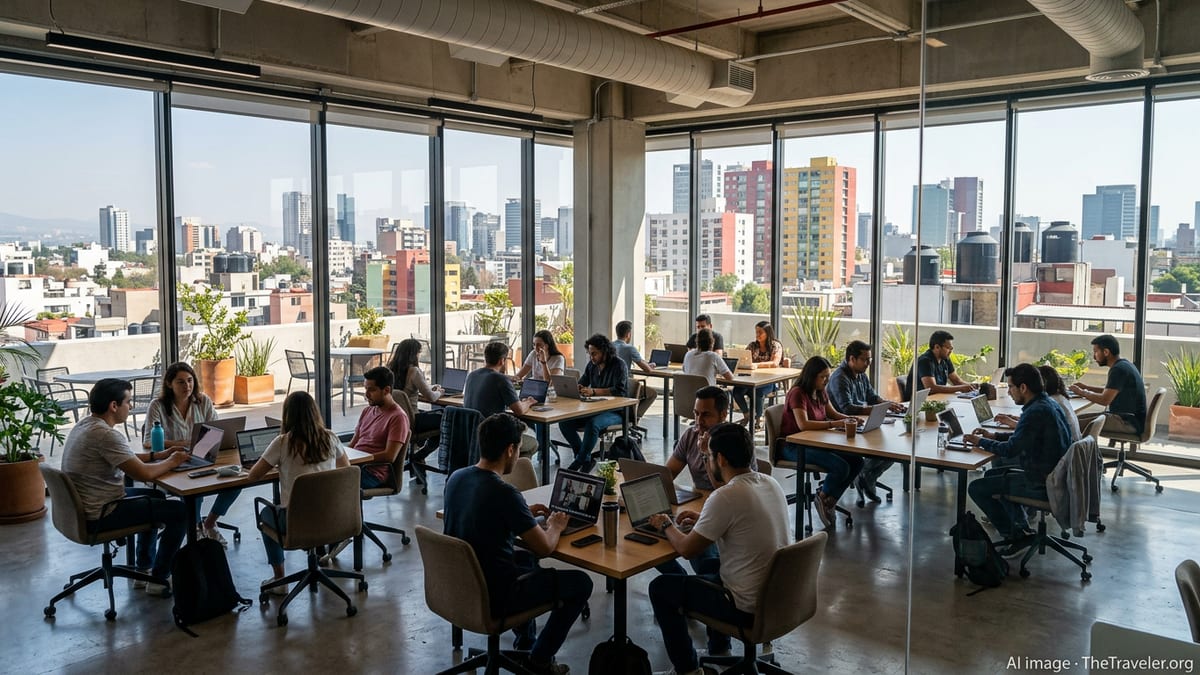
Methodology and Key Evaluation Criteria for Remote Work
This assessment focuses on cities in Mexico that have become frequent bases for expats and remote workers and where reliable information on digital infrastructure is available. The analysis is restricted to factors that materially affect remote work feasibility: internet performance and redundancy, availability of coworking and alternative workspaces, utility reliability, transport connectivity, and general operational risk that could disrupt work continuity. Broader lifestyle factors such as culture, tourism, or long-term immigration status are not considered except where they directly influence these work-enabling conditions.
On a national level, Mexico’s fixed broadband speeds remain mid-range globally but have improved notably in recent years as operators shift from copper and cable to fiber. Industry reports indicate that by late 2024 and 2025, fiber networks from major providers such as Telmex, Totalplay, Megacable, and izzi had expanded significantly, particularly in large and mid-sized cities. Mexico still trails regional leaders in South America in headline median speeds, but the urban hubs typically used by remote workers now have access to fixed connections that are sufficient for video conferencing, cloud-based work, and most bandwidth-intensive professional tasks.
Given differences between neighborhoods and providers within the same city, all metrics and examples in this article should be treated as indicative rather than deterministic. Remote workers should verify building-level connectivity and power reliability before committing to long-term leases. Nonetheless, patterns across speed reports, coworking density, and infrastructure investment provide a solid comparative picture of which cities are structurally best suited to location-independent work.
The cities highlighted below were selected because they combine a critical mass of expats and remote workers with measurable infrastructure advantages. Mexico City (CDMX), Guadalajara, Mérida, Monterrey, Querétaro, Playa del Carmen, Oaxaca City, and Puerto Vallarta collectively represent the country’s primary remote-work hubs at the time of writing.
Mexico City: National Digital and Coworking Hub
Mexico City is the country’s largest and most mature hub for remote workers, with a dense ecosystem of infrastructure and services that directly support distributed work. Multiple speed-tracking and nomad-focused reports from 2024 and early 2025 describe average fixed broadband speeds in the city in the low-to-mid 100 Mbps range for download, with upload speeds frequently above 50 Mbps in neighborhoods equipped with fiber. Anecdotal reports from expat and nomad communities indicate that gigabit plans are increasingly available in central districts, although real-world speeds vary by provider and building.
The capital has by far the highest concentration of coworking spaces in Mexico. One recent enumeration of coworking locations by state lists Mexico City as having several hundred distinct coworking venues, ranging from global brands with multiple centers to independent spaces targeted at startups, creatives, and remote professionals. In practical terms, this density means expats can usually find multiple coworking options within a short commute of any central neighborhood, often with extended hours, meeting rooms, and phone booths suitable for international calls.
Connectivity redundancy is a key strength of Mexico City. The presence of several national backbone providers, widespread 4G and growing 5G coverage, and numerous cafes and hotels with reasonable Wi-Fi allows remote workers to maintain backup options if their primary home connection fails. Power outages do occur but are typically localized and short-lived in central districts, and many coworking spaces use battery backup or generators to remain operational during brief grid disturbances.
For frequent international travelers, Mexico City International Airport remains the country’s primary long-haul and regional hub, handling more international passengers than any other Mexican airport in recent years. This level of air connectivity is relevant for expats who must travel regularly to North American or European headquarters and require predictable travel times aligned with remote work schedules.
Guadalajara: Tech Corridor City With Solid Infrastructure
Guadalajara, Mexico’s second-largest metropolitan area, is often described as the country’s main technology and innovation hub. The city’s sizable population, modern business districts, and concentration of IT and electronics firms have encouraged relatively early fiber deployment and strong competition among internet service providers. While comprehensive city-level speed rankings are limited, multiple independent and anecdotal sources describe available home and office plans in the 100 to 300 Mbps range in better-served neighborhoods, which is more than adequate for most remote-first roles.
Coworking availability in Guadalajara is robust but less dense than in Mexico City. Remote workers can choose from a mix of international coworking brands and local operators located in central and western districts such as Providencia, Chapalita, and the historic core. Many of these spaces advertise symmetrical or near-symmetrical fiber connections and provide enclosed call rooms, making them realistic primary offices for expats who prefer not to work from home.
Power and water utilities in Guadalajara are comparatively reliable in central neighborhoods, though, as in any large Mexican city, localized outages do occur. Remote workers who depend on uninterrupted uptime often employ a dual-strategy approach: a high-speed residential connection paired with a coworking membership as a fallback environment. The presence of cafes with stable Wi-Fi in commercial areas further expands contingency options for short-duration connectivity needs.
From a mobility standpoint, Guadalajara International Airport is consistently one of the country’s three busiest for international traffic. Direct connections to major U.S. gateways and other Mexican cities facilitate short-notice business trips and hybrid work arrangements. This level of air connectivity reduces transit-related friction for expats with cross-border roles or frequent client engagements.
Mérida: Emerging Remote Work Base With Strong Perceived Stability
Mérida, capital of Yucatán state, has gained sustained attention from expats and remote workers over the past several years because of its combination of mid-sized urban scale and comparatively strong perceptions of public order. International quality-of-life assessments have noted Mérida’s relatively favorable scores among Mexican cities, and it has received formal recognition in the past for community safety initiatives, which indirectly supports remote work by reducing day-to-day operational disruptions.
On the connectivity front, recent commentary in digital nomad and relocation literature highlights the availability of fiber internet in Mérida, with many neighborhoods able to access advertised speeds that reach or exceed 100 Mbps. Some reports from 2024 describe fiber offerings in the range of approximately 100 to 120 Mbps, which are sufficient for high-definition video conferencing, large file transfers, and cloud-based development or design work. Coverage still varies by district, so building-specific verification remains essential before signing long leases.
While Mérida’s coworking ecosystem is smaller than that of Mexico City or Guadalajara, it is growing. A modest but increasing number of coworking spaces and serviced offices operate in central and north Mérida, often targeting both local professionals and foreign remote workers. These spaces typically feature reliable fixed broadband, air conditioning suitable for the tropical climate, and meeting rooms where expats can hold client calls in controlled environments.
Domestic and regional flight connections via Mérida’s international airport are more limited than in Mexico City or Guadalajara but adequate for many remote workers who primarily need access to Mexico City, other Mexican hubs, or select U.S. destinations. For expats who only occasionally travel for work, Mérida’s current connectivity profile is generally sufficient, though it is less optimal for roles requiring frequent same-week travel across the Americas.
Monterrey and Querétaro: Industrial Hubs With Strong Business Infrastructure
Monterrey and Querétaro have traditionally been known as industrial and manufacturing hubs rather than lifestyle destinations, but both now play a significant role in Mexico’s remote work geography because of their modern infrastructure and business ecosystems. Large multinational presences and export-oriented industries have pushed local authorities and providers to maintain comparatively high standards for connectivity and utilities in key districts.
Monterrey, in particular, benefits from its scale, proximity to the United States, and strong corporate demand for reliable telecommunications. While detailed public speed benchmarks by city are limited, expat reports commonly mention fast fixed broadband connections, with mid-tier fiber plans often exceeding 100 Mbps and premium plans surpassing that. The presence of several modern coworking chains and corporate serviced offices provides a structured environment for remote workers who prefer business-focused surroundings over tourist-oriented areas.
Querétaro, a smaller but rapidly growing city in central Mexico, hosts major data centers, logistics operations, and an expanding aerospace and automotive cluster. This industrial profile has contributed to ongoing investment in fiber and backbone infrastructure. For remote workers, this translates into relatively good access to stable broadband in newer residential and mixed-use developments, as well as an increasing number of coworking spaces designed for both local startups and foreign professionals.
Both cities have airports with regular connections to Mexico City and several U.S. hubs. For expats and remote employees tied to North American corporate headquarters, this connectivity, combined with modern highways and business services, makes Monterrey and Querétaro competitive choices when reliability and corporate alignment are prioritized over beach access or tourism amenities.
Coastal Hubs: Playa del Carmen and Puerto Vallarta
Among Mexico’s coastal cities, Playa del Carmen and Puerto Vallarta stand out for remote workers because they combine established expat communities with digital infrastructure that, while imperfect, is significantly better developed than in many smaller coastal towns. Their profiles differ, but both offer viable setups for location-independent professionals willing to manage some seasonality and variability in connectivity.
Playa del Carmen, on the Caribbean coast, has developed a dense ecosystem of apartments oriented toward medium-term stays and a noticeable concentration of coworking spaces relative to its size. Nomad-focused reports from 2024 and 2025 cite coworking spaces in central Playa del Carmen advertising Wi-Fi speeds that can approach or exceed approximately 80 to 100 Mbps. At the same time, residential internet reliability can fluctuate, and occasional outages related to weather or infrastructure issues are more common than in inland metros. As a result, many remote workers in Playa del Carmen maintain memberships at at least one coworking space as a core part of their risk mitigation strategy.
Puerto Vallarta on the Pacific coast also offers a mix of residential broadband and coworking options suited to remote work, though infrastructure quality can vary sharply between central, hillside, and outlying neighborhoods. Anecdotal evidence suggests that central districts oriented around long-term expats tend to have more stable fixed broadband and better mobile coverage. As in Playa del Carmen, coworking spaces and business centers play a crucial role in ensuring access to stable, higher-speed connections for those whose work cannot tolerate interruptions.
For both cities, flight connectivity via nearby international airports is an important factor. Cancun International Airport, serving Playa del Carmen, and Puerto Vallarta International Airport maintain frequent connections to U.S. and Canadian cities, enabling hybrid remote workers to travel rapidly to corporate offices or client sites. However, the exposure of coastal infrastructure to tropical storms means that remote workers should consider seasonal risk and ensure they have contingency plans such as mobile hotspots, alternative accommodations, or short-notice relocation options during peak weather seasons.
Oaxaca City and Other Mid-Sized Alternatives
Beyond the major hubs, several mid-sized Mexican cities have begun attracting remote workers who prioritize a smaller urban scale while still requiring functional digital infrastructure. Oaxaca City is one of the most prominent of these alternatives. Historically, internet reliability was a concern, but more recent reports from remote workers indicate gradual improvement, with increased availability of higher-speed fixed broadband and a small but growing coworking ecosystem in the city center.
In practice, Oaxaca City may not consistently reach the same median speeds found in Mexico City or Guadalajara, and connection stability can be more variable during peak usage or adverse weather. However, for remote workers whose tasks are less bandwidth intensive or who can tolerate occasional disruptions by using coworking spaces, it can be a feasible base. As in other mid-tier cities, redundancy strategies such as maintaining a local SIM with sufficient data, using portable routers, and identifying multiple work-capable venues are important.
Other mid-sized cities sometimes considered by expats and remote workers include San Luis Potosí, La Paz, and certain suburbs around larger metros that benefit from spillover infrastructure. These locations typically have at least some fiber coverage, reasonable 4G mobile data speeds, and a limited number of coworking or shared offices. However, the scale and maturity of their remote-work ecosystems lag behind the primary hubs, so individuals who depend on strict uptime targets may find them more suitable for shorter experimentation periods rather than immediate long-term relocation.
Across all mid-sized alternatives, the common pattern is that infrastructure can be very good at the building or neighborhood level but heterogeneous across the wider city. Due diligence at the micro level is essential, including on-site speed tests at different times of day, verification of power reliability, and confirmation that backup coworking options exist within a practical commute radius.
The Takeaway
From a remote-work infrastructure perspective, Mexico now offers several cities that meet or exceed the connectivity and workspace standards required by most expats and location-independent professionals. Mexico City remains the most comprehensive hub, with the highest density of coworking spaces, strong fixed and mobile internet options, and unmatched air connectivity. Guadalajara provides a compelling alternative for those seeking a major urban center with a strong technology sector and competitive broadband and coworking ecosystems.
Mérida, Monterrey, and Querétaro occupy an intermediate profile: they offer generally solid digital and utility infrastructures with smaller but growing coworking networks and, in the case of Mérida, a reputation for relative stability that many expats find operationally reassuring. Coastal hubs such as Playa del Carmen and Puerto Vallarta are viable for remote workers who value a seaside location and are prepared to actively manage infrastructure variability and seasonal risk through coworking memberships and backup connectivity plans.
Smaller cities like Oaxaca City and other mid-tier locations present additional options for remote workers willing to accept a greater degree of variability in exchange for different environmental or personal preferences. In all cases, the decisive factor is not national-level statistics but local implementation: the specific provider, building wiring, and neighborhood infrastructure determine day-to-day workability.
For organizations and individuals planning relocation, the most effective strategy is to treat these cities as a graduated set of options. Those with strict uptime and travel requirements may gravitate toward Mexico City or Guadalajara, while those with more flexible roles can consider Mérida, Monterrey, Querétaro, or selected coastal hubs. On-the-ground testing of actual internet speeds, redundancy options, and coworking quality remains essential before committing to long-term contracts or permanent moves.
FAQ
Q1. Which Mexican city offers the most reliable overall setup for remote workers?
Mexico City typically offers the most complete package for remote workers, combining high-density fiber connectivity, hundreds of coworking spaces, and the country’s strongest air and telecommunications links, although neighborhood-level due diligence remains important.
Q2. Are fixed broadband speeds in Mexican cities sufficient for video conferencing and cloud-based work?
In major hubs such as Mexico City, Guadalajara, Mérida, Monterrey, Querétaro, Playa del Carmen, and Puerto Vallarta, typical fixed broadband plans in well-served neighborhoods generally provide speeds that are adequate for high-definition video calls and common cloud workflows, assuming a reputable provider and modern building infrastructure.
Q3. How important are coworking spaces for expats in Mexico?
Coworking spaces are a critical risk management tool, especially in coastal or mid-sized cities where residential connections can be less predictable; they provide higher-grade connectivity, backup power in some cases, and professional environments for calls and collaboration.
Q4. Do coastal cities in Mexico have reliable enough infrastructure for full-time remote work?
Coastal hubs like Playa del Carmen and Puerto Vallarta can support full-time remote work, but infrastructure is more vulnerable to weather-related disruptions, so remote workers usually rely on a combination of robust home internet, coworking memberships, and mobile data backups.
Q5. Is mobile data a realistic backup for remote work in Mexican cities?
In most urban areas, 4G coverage and growing 5G availability make mobile data a viable short-term backup for email, messaging, and even lower-resolution video calls, though it may not fully replace a stable fixed broadband connection for data-intensive tasks.
Q6. How do mid-sized cities like Mérida and Oaxaca City compare to Mexico City for remote work?
Mérida and Oaxaca City generally offer slower and less uniform connectivity than Mexico City, but selected neighborhoods with fiber and access to coworking spaces can still provide workable conditions for many remote professionals, particularly those with moderate bandwidth demands.
Q7. What should companies check before approving Mexico as a remote-work location for employees?
Companies should require employees to verify building-level internet speeds at multiple times of day, confirm access to at least one suitable coworking space, assess power reliability, and document backup connectivity options such as mobile hotspots or secondary providers.
Q8. Are there significant differences in infrastructure quality within the same city?
Yes, infrastructure quality can vary sharply between neighborhoods and even between buildings on the same street, particularly with older wiring, so on-site testing and discussions with current tenants are essential steps in the relocation process.
Q9. How frequently do power outages disrupt remote work in Mexico?
Brief power outages do occur in Mexican cities, but in central and well-developed districts they are typically infrequent and short; many remote workers mitigate this risk with battery backups, laptop-based work, and access to coworking spaces that maintain their own power contingencies.
Q10. Which Mexican cities best balance remote-work infrastructure with regular international travel needs?
Mexico City and Guadalajara offer the strongest combination of remote-work infrastructure and frequent international flights, while Monterrey, Querétaro, Cancun for Playa del Carmen, and Puerto Vallarta also provide good connectivity for expats who need periodic travel to North American or regional destinations.