


Flight compensation companies like Flightright have made it easier for travelers to claim money they are legally owed after severe delays, cancellations, or denied boarding under EU261 and similar regulations. The catch is that many of these services charge success fees that can quickly eat into your payout. If you are facing a potential compensation of 400 to 600 euros, the difference between a 35 percent fee and a 20 percent fee can mean hundreds of euros more in your pocket. This guide looks at some of the best Flightright alternatives if you want lower fees, and explains when it might even make sense to skip a claim service entirely and file on your own.
Get the latest updates straight to your inbox!
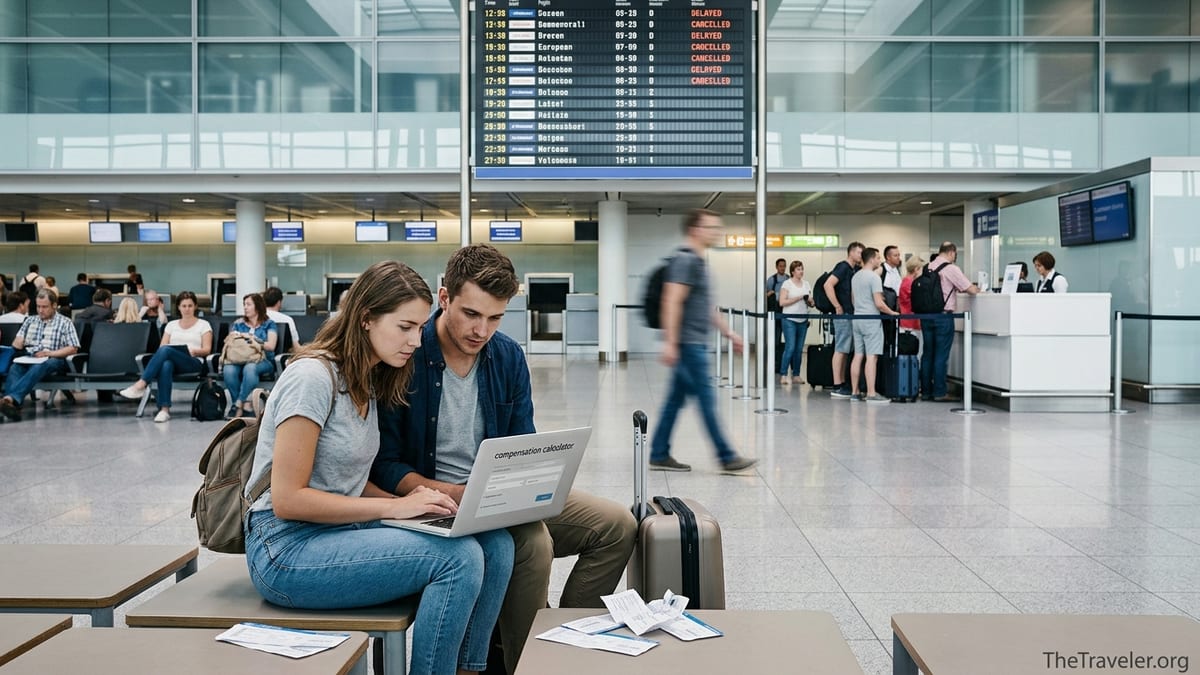
Why Travelers Look Beyond Flightright
Flightright was one of the early names in the EU261 compensation space and remains well known across Europe. Its model is simple: no win, no fee, but a sizable percentage of whatever it recovers as a success fee. Flightright’s terms indicate that customers agree to pay a percentage of the enforced claim as the company’s fee. In practice, that generally falls in the same 25 to 35 percent band used by many competitors, sometimes higher if court action is required. For a standard 600 euro long‑haul claim, that can easily translate to 150 to 200 euros or more going to the company instead of to you.
For casual travelers who rarely fly, that trade‑off may feel acceptable. They avoid paperwork, legal jargon, and the back‑and‑forth with an airline that may be slow or reluctant to pay. But frequent travelers, families, and budget‑conscious passengers increasingly scrutinize how much of their compensation they actually keep. When a family of four has a valid claim worth 2,400 euros, a 30 percent success fee means around 720 euros left on the table. That reality is driving interest in alternatives to Flightright that either charge lower percentages, offer fixed‑fee structures, or give travelers tools to claim independently.
Another concern is transparency. Some travelers only realize the size of the fee after the airline has already paid the compensation to the claim company. They see a transfer significantly lower than the expected EU261 amount, then learn that legal fees, administrative charges, and success fees were all deducted before the payout. Understanding exactly how different providers structure their fees is essential if your goal is to keep more of your money.
Understanding How Flight Compensation Fees Work
Before comparing Flightright with its competitors, it helps to understand how this niche industry prices its services. Most claim companies use variations of a contingency model. They review your flight details, check eligibility under regulations like EU261, the UK equivalent rules, or sometimes Brazil’s ANAC rules, and then pursue the airline on your behalf. If they obtain compensation, they take a success fee from the recovered amount. If they lose, you typically owe nothing. On paper, that sounds consumer‑friendly, but the details matter.
Percentages vary widely. AirHelp, one of the largest global competitors to Flightright, states publicly that under its standard no‑win‑no‑fee model you receive up to 65 percent of your compensation, meaning its success fee is about 35 percent with VAT included. An example on its fee page shows a 600 euro compensation where the passenger receives 390 euros and AirHelp keeps 210 euros as its fee. Skycop, another European player, uses a mixed approach: its 2024 price list sets fixed euro fees that equate to roughly 40 to 44 percent of the typical EU261 amounts for some distance bands, although the exact percentage depends on the route and whether a case goes to legal proceedings.
Some companies also add separate legal‑action surcharges when they must file court cases or engage external lawyers. In AirHelp’s documentation, for instance, legal action fees can apply in certain jurisdictions on top of the standard fee, though members of its paid AirHelp Plus plan can avoid these extra charges. Skycop’s price list similarly notes increased remuneration when legal action is required, citing court fees and attorney costs. When you read reviews from travelers who feel short‑changed, it is often because they underestimated how much these layered fees would eat into a win.
There is also the question of non‑monetary support. A service that charges a lower percentage but fails to communicate for months might still feel like poor value, especially if the airline would have paid quickly after a direct claim. On the other hand, a slightly higher fee could be reasonable if the provider takes on a highly contested case that would be difficult to win alone. The most cost‑effective option for you depends on your risk tolerance, the strength of your claim, and how much time and effort you are willing to invest.
Lower‑Fee Alternatives to Flightright You Should Know
Although many major claim companies cluster around 30 to 35 percent success fees, there are real differences that can save you money, especially on larger claims or multi‑passenger bookings. One of the better‑known alternatives is AirHelp. While its standard fee of around 35 percent is not dramatically cheaper than Flightright, AirHelp regularly promotes referral codes and campaigns that temporarily reduce the fee for new customers. More importantly, it offers a subscription product, AirHelp Plus, where for an annual membership cost you can have claims handled with zero success fee on covered flights. For a frequent traveler who expects multiple disruptions a year, that can be significantly more economical than paying a percentage each time.
Skycop, headquartered in Lithuania, uses a more transparent fixed‑fee table. Its May 2024 price list shows that for a typical 250 euro compensation on short flights up to 1,500 kilometers, it charges 110 euros. That equates to a 44 percent fee. For a 400 euro compensation on medium‑haul flights, the fee is 176 euros, or again about 44 percent. While that may be higher than what you would pay with Flightright in some cases, it also allows you to calculate exactly what you will receive. On a 600 euro claim, Skycop’s fees on many routes work out to around the same or slightly more than a 35 percent percentage‑based model, so Skycop is not always the bargain choice, but it can be useful if you value clarity over a headline low percentage.
Other providers compete partly on price and partly on specialization. EUclaim, for example, is active in several European markets and focuses heavily on Netherlands, Germany, and the UK. It operates on a no‑win‑no‑fee basis and, according to its published information and customer discussions, generally charges a success fee close to the industry norm, though the exact figure can depend on jurisdiction and whether the case proceeds to court. In practice, travelers sometimes report effective fees around the mid‑20 percent range after standard court costs, which can be slightly lower than Flightright or AirHelp for straightforward, uncontested claims.
There are also newer or more niche services that position themselves as low‑fee disruptors. Some law firms in countries such as Spain, Poland, or Portugal will handle EU261 claims for a flat hourly rate or a leaner success fee in the 15 to 20 percent range, but they typically expect clients to correspond in the local language and may require an up‑front retainer. That can still be worthwhile if your claim value is high. For instance, if four passengers on a long‑haul flight are entitled to 600 euros each and you use a local lawyer charging a 20 percent contingency, you keep 1,920 euros out of 2,400 euros, versus 1,560 euros if you used a company charging 35 percent.
When Doing It Yourself Is the Cheapest Option
If your priority is minimizing fees, the single cheapest alternative to Flightright is not another claim company at all. It is submitting the claim yourself directly to the airline. EU261 and its UK counterpart were designed with the idea that passengers could claim compensation without needing legal professionals. Airlines often provide online claim forms, and consumer protection authorities in the EU publish templates you can adapt. Travelers who are comfortable referencing flight times, citing the regulation, and following up by email or registered post can frequently obtain full compensation with no success fee deducted.
Real‑world examples show that this is entirely feasible. In recent months, some travelers have reported receiving the full 600 euros per person for long‑haul delays by dealing only with the airline’s customer service department, sometimes within a few weeks. In one case involving an EU carrier on a delayed long‑haul flight, a passenger described how they submitted an online form, followed up once when the airline claimed extraordinary circumstances, and then pushed back by referencing specific case law. Within two months, 1,200 euros for two passengers was paid directly into their bank account, with no cut going to an agency.
Of course, self‑filing is not always so smooth. Airlines may delay, ignore claims, or invoke weather, air traffic control strikes, or security issues as extraordinary circumstances to avoid paying. At that point, you must decide whether to escalate. In some countries, small‑claims court procedures or national enforcement bodies provide consumer‑friendly pathways. In others, you might need a lawyer or claim company to continue. A common compromise is to try self‑filing first and only turn to a service if the airline refuses or stops responding. If a 600 euro claim can be won directly with two or three well‑written emails, spending 30 to 40 percent on professional help is understandably hard to justify.
Language and time are also factors. An American traveler based in New York dealing with a cancelled connection in Frankfurt might feel overwhelmed by the prospect of corresponding with a German airline in German or navigating a foreign court system. For them, paying 30 percent for a company that handles everything in English and provides status updates can be worthwhile, especially if they only encounter such a problem once every few years. The key is to weigh the time saved and stress avoided against the euros lost to fees.
How to Compare Flightright and Its Competitors on Fees
To make a smart choice, you need to translate marketing language into numbers. Start by estimating your potential compensation. Under EU261, flights of up to 1,500 kilometers typically qualify for around 250 euros, flights between 1,500 and 3,500 kilometers or some intra‑EU routes for around 400 euros, and longer flights for up to 600 euros, depending on delay length and other details. Multiply that by the number of passengers in your booking. Then, apply each provider’s fee structure to that total so you can see how much money actually lands in your bank account.
For example, imagine two travelers on a 3,000‑kilometer flight from Madrid to Stockholm, both eligible for 400 euros. The total claim is 800 euros. With a 35 percent success fee like AirHelp’s standard model, you would keep about 520 euros. If you used a provider charging 25 percent, you would keep 600 euros. With Skycop’s fixed fee of 176 euros per person on a 400 euro entitlement, you would keep 224 euros per traveler, or 448 euros total, which is less than under a straight 35 percent model. Suddenly, a company advertising “no hidden fees” might cost you more, while a less flashy name offering 20 to 25 percent could be the true low‑fee choice.
Also study how providers treat legal proceedings. If they file a lawsuit, do their legal action fees come out of your compensation on top of the success fee, or are they absorbed by the company? AirHelp notes that AirHelp Plus members do not pay service or legal action fees for eligible claims, which can drastically change the calculus for frequent fliers. If you regularly fly between the US and Europe for work and encounter disruptions a few times a year, paying an annual membership can be cheaper than giving up 30 to 40 percent on every successful claim.
Finally, look beyond pricing to issues of reliability and customer service. Fee percentages are easy to compare, but they are only meaningful if you actually receive your money. Traveler discussions online include both positive and negative experiences with major providers. Some users report receiving over 1,700 dollars after fees from AirHelp for complex reroutings, while others describe long silence followed by sudden fee demands once an airline quietly paid out. The pattern is similar with Skycop and other claim companies. Lower fees are attractive, but not at the cost of transparency, speed, or trust.
Practical Tips for Keeping More of Your Compensation
Regardless of which route you choose, there are practical steps you can take to maximize your net payout. First, document everything at the time of disruption. Take photos of departure boards, save delay or cancellation emails, keep boarding passes, and note the actual arrival time at your final destination. This documentation not only strengthens your claim if you work with Flightright or a competitor, it also makes self‑filing significantly easier. When an airline argues that the delay was shorter than three hours or due to circumstances beyond its control, clear evidence can make the difference between a payout and a rejection.
Second, check eligibility tools from multiple providers without committing immediately. Many companies, including AirHelp, Skycop, and EUclaim, provide free online calculators where you enter your flight number and date to see if your situation likely qualifies. You can use these tools to gauge whether a professional believes your claim has merit. If two or three services indicate that your compensation should be 600 euros and the facts are straightforward, that is a strong cue that you can also succeed on your own if you are willing to invest the time.
Third, consider your travel pattern over the next year rather than focusing only on a single incident. If you are a digital nomad or business traveler frequently flying in and out of the EU, a subscription product such as AirHelp Plus, or even a travel insurance policy that includes legal help for passenger rights, can be more economical. Suppose you pay a moderate annual fee and then experience three compensable delays worth 400 euros each. If you filed those through a pay‑per‑claim service at 30 percent, you would lose 360 euros in fees. The membership model, on the other hand, can cap your cost at the upfront subscription price.
Finally, be skeptical of any service that pressures you to sign immediately or hides its full price list behind dense legal language. Responsible providers make it easy to see illustrative examples, such as “on a 600 euro claim, you receive 390 euros and we keep 210 euros.” If a company will not clearly answer what you will receive in a successful 400 or 600 euro case, treat that as a warning sign and look elsewhere.
The Takeaway
Flightright helped establish the modern market for EU261 compensation services, but it is no longer the only option. Travelers today can choose from competitors like AirHelp, Skycop, and EUclaim, as well as local law firms and even subscription‑style models that eliminate success fees altogether. For many passengers, especially those facing large multi‑passenger claims, the most cost‑effective approach may be to file directly with the airline first, armed with a clear understanding of their rights, and only turn to a claim company if the carrier pushes back.
If you do decide to use a professional service, focus less on brand recognition and more on how much money will ultimately reach your bank account. Compare percentage fees, fixed‑fee tables, legal‑action surcharges, and any subscription alternatives. Balance those costs against the time you are willing to spend pursuing a claim on your own. With a bit of homework and a clear view of the numbers, you can often keep far more of your rightful compensation without giving up the convenience of expert help.
FAQ
Q1. Is there a flight compensation company that is clearly cheaper than Flightright?
There is no single provider that is always cheaper than Flightright because final costs depend on route, jurisdiction, and whether legal action is needed. However, some services, such as local law firms in EU countries that work on 15 to 20 percent contingencies, or subscription models like AirHelp Plus for frequent travelers, can result in lower overall fees than standard 25 to 35 percent success‑fee companies for many cases.
Q2. How much does AirHelp typically charge compared with Flightright?
AirHelp’s standard no‑win‑no‑fee model gives passengers up to about 65 percent of the recovered compensation, meaning its success fee is around 35 percent with VAT included. Flightright’s percentage is generally in a similar band, though exact figures can vary by case and country. The main potential cost advantage with AirHelp comes from its paid Plus membership, which can eliminate both service and legal‑action fees on covered claims.
Q3. Are Skycop’s fixed fees really better than percentage‑based fees?
Skycop publishes a fixed price list where, for example, its fee on a 250 euro short‑haul compensation is 110 euros and on a 400 euro compensation is 176 euros. That equates to roughly 44 percent in those distance bands, which can be higher than a 25 to 35 percent percentage‑based service. The benefit is transparency rather than a guaranteed lower cost. For some travelers, knowing the exact euro amount in advance is valuable, but it does not automatically mean paying less than with Flightright.
Q4. How do I know if it is worth filing a claim myself instead of using a company?
It is often worth trying to claim directly with the airline if your case is straightforward, the disruption clearly fits EU261 rules, and you are comfortable writing a few emails. Use online eligibility checkers from multiple providers to confirm that your flight appears to qualify and see what amount they estimate. If several tools suggest a 400 or 600 euro entitlement, your chances of success on your own are generally good, and avoiding a 30 to 40 percent fee can save a significant sum.
Q5. What happens if the airline refuses my self‑filed claim?
If the airline denies compensation, you can escalate by contacting the national enforcement body in the EU country where the incident occurred, using small‑claims procedures where available, or then turning to a claim company or lawyer. Many travelers adopt a hybrid approach: they start with a self‑filed claim, and only if the airline rejects it or stops responding do they sign a no‑win‑no‑fee contract with a provider such as Flightright, AirHelp, or EUclaim.
Q6. Do subscription services like AirHelp Plus really eliminate fees?
For eligible flights covered under the membership terms, subscription plans such as AirHelp Plus can remove both standard service fees and extra legal‑action fees. You pay an annual membership instead of a percentage of each payout. This structure can be cost‑effective if you experience multiple disruptions per year, but less attractive if you rarely fly or only have a single small claim. Always read the coverage limits and exclusions carefully before relying on a subscription as your main protection.
Q7. Are there risks in using smaller or very low‑fee providers?
Lower fees can be attractive, but smaller firms may have limited customer support, longer processing times, or less experience dealing with complex cases and cross‑border enforcement. Before signing, look for clear fee tables, transparent terms, and evidence that the provider has successfully handled claims against the airlines you use. If a company advertises unusually low percentages but is vague about how or when it pays out, proceed with caution.
Q8. Can I negotiate fees with a flight compensation company?
Most large providers have standardized fee structures and are unlikely to negotiate individual discounts. However, some smaller law firms and regional specialists are open to negotiation, especially if your case involves several passengers or a high total claim value. It never hurts to ask whether a lower percentage is possible when you are bringing a multi‑thousand‑euro claim involving a family or group booking.
Q9. What documents do I need regardless of which option I choose?
In nearly all cases you should keep boarding passes, booking confirmations, any written notification of delays or cancellations, and receipts for extra expenses such as hotels or meals if you intend to claim reimbursement in addition to fixed compensation. Screenshots of flight‑tracking data and photos of departure boards showing delays can also be useful. Having this material organized will help whether you pursue the claim yourself or hand it to Flightright, AirHelp, Skycop, EUclaim, or a local lawyer.
Q10. Does my nationality matter when choosing a Flightright alternative?
Your nationality does not affect your rights under EU261, which are based on where your flight departs and arrives and whether the operating airline is EU‑based. However, it can influence which providers feel easiest to work with. A US traveler might prefer a company with strong English‑language support, while a Dutch or German passenger may be more comfortable with EUclaim or a local legal specialist. Select a provider that communicates clearly in your language and has experience with claims involving your usual airlines and routes.