


When a long-awaited trip is wrecked by a last-minute cancellation or a five-hour delay on the tarmac, few travelers have the time or energy to fight an airline for compensation. This is where companies like Flightright promise to step in: you hand over your case, they deal with the legal and procedural maze of EU261 and UK261, and you get paid if they win. But is Flightright actually legit, and when does using a service like this make sense for real travelers?
Get the latest updates straight to your inbox!
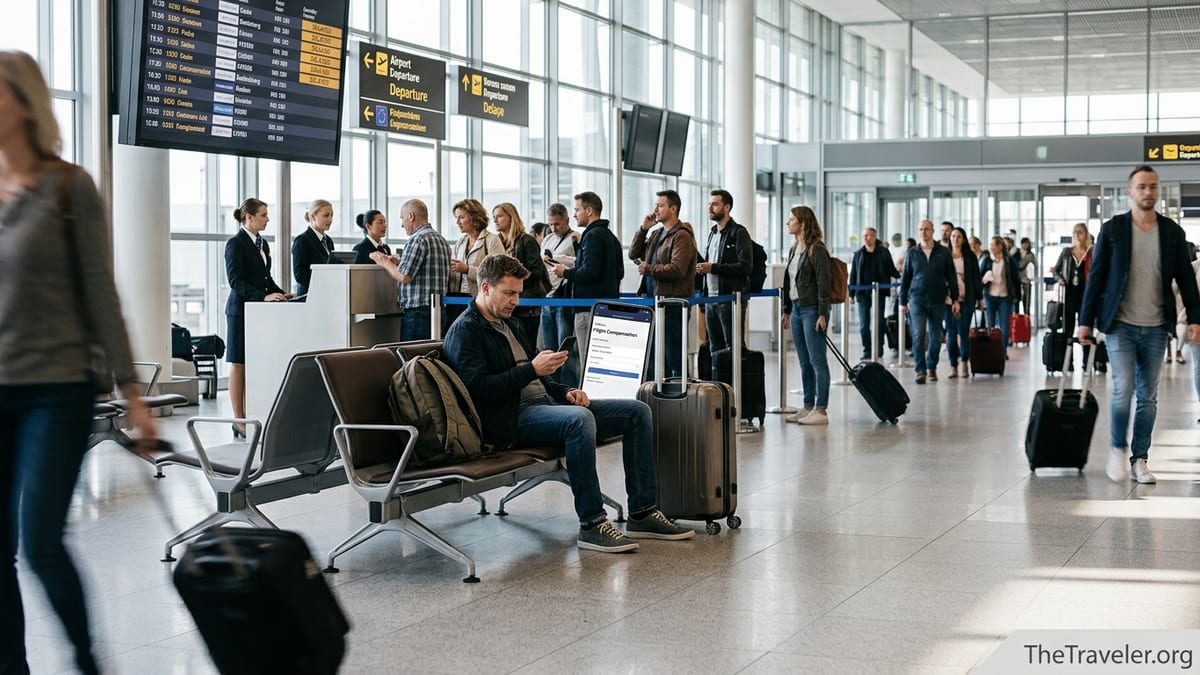
What Flightright Is and How It Works
Flightright is a German-based claims management company that specializes in enforcing passenger rights under European air passenger regulations, particularly EU Regulation 261/2004 and its UK equivalent. In simple terms, if your flight departing from Europe, or operated by an EU or UK carrier, is heavily delayed, canceled, or you are denied boarding, Flightright offers to pursue cash compensation on your behalf. The company has been active for more than a decade and is widely present in European markets, including Germany, France, Spain, Portugal, and the UK.
The service is built around a web form where you enter your flight number, date, and basic details of what went wrong. Within seconds, their system checks whether your case is likely eligible under EU261 or UK261. For example, a Lisbon to Berlin flight delayed by 5 hours due to a technical fault is likely to qualify for up to 400 euros per passenger, while a London to New York flight delayed by 3.5 hours on arrival might qualify for 600 euros if the operating carrier is EU or UK based.
Flightright follows a no-win, no-fee model. If they believe your case is strong and accept it, they handle correspondence with the airline, legal arguments about weather versus technical issues, and, if necessary, pass the case to partner law firms to sue the airline in court. If they secure compensation, they take a commission and transfer the remainder to you. If they lose, you pay nothing, at least in principle, because their commission is contingent on success.
In practice, this positions Flightright as a middle ground between doing everything yourself and hiring a private lawyer. A traveler who had a Frankfurt to Madrid flight canceled the morning of departure could either navigate airline web forms and legal jargon alone, or let Flightright chase a 250 or 400 euro payout while the traveler gets on with their life.
Is Flightright Legit? What Real Travelers Say
The most telling indicator of legitimacy is not advertising, but what happens to real passengers. On major review platforms such as Trustpilot, Flightright has collected several thousand reviews in recent years, with a large majority of recent reviewers rating the service as excellent or very good. Many describe receiving compensation that they felt the airline would never have paid voluntarily, including cases that dragged on for a year or more before finally being resolved in the traveler’s favor.
One common type of positive story involves passengers who tried to claim directly from the airline and were initially rejected. For instance, a traveler on a Barcelona to Hamburg flight delayed by more than 4 hours might first submit a claim on the airline’s website and receive a canned reply that the disruption was due to “extraordinary circumstances.” Weeks later, after the traveler gives up, Flightright can take the same case, push back on the airline’s reasoning, and eventually secure the 250 or 400 euro compensation. Some reviewers describe only having to upload a boarding pass and sign a digital contract before Flightright handled everything else.
Another pattern involves persistence over time. There are documented examples of passengers who waited more than a year, sometimes up to four years, and still ended up paid after Flightright continued legal action behind the scenes. One reviewer described nearly forgetting about a claim over a long-delayed transatlantic connection until a message arrived announcing that a few hundred euros per person had finally been won from the airline. For these travelers, the main criticism was not the outcome but the long silence while court proceedings were ongoing.
That said, the feedback is not uniformly glowing. A minority of reviews complain about unclear communication, lengthy delays before any update, or disappointment at how much of the compensation was deducted in fees. There are also occasional disputes where a passenger felt that Flightright’s contract bound them to pay a commission even after the airline paid out directly or the passenger settled on their own. These stories underscore that Flightright is a commercial service governed by detailed terms and conditions, not a free consumer advocacy group.
Fees, Commissions, and How Much You Actually Receive
Flightright’s business model is built on contingency-based commissions. Exact numbers can vary slightly by market and case type, but independent analyses of the company’s pricing suggest that the total commission often ends up in the range of roughly one third to around half of the compensation amount once taxes and legal surcharges are included. In some German-language comparisons of flight claims firms, Flightright’s total cut is often cited as higher than certain competitors that work on a flat percentage basis.
To visualize how this works, consider a typical EU261 scenario. A traveler flying from Paris to Athens on an EU carrier arrives more than 3 hours late due to a technical defect that is not considered an extraordinary circumstance. Under EU261 rules, that passenger is usually entitled to 400 euros in compensation. If the airline pays this amount to Flightright after legal action, and Flightright’s effective commission plus VAT and any court risk surcharge is, for example, around 35 to 45 percent, the traveler might ultimately receive between roughly 220 and 260 euros. The rest goes to Flightright as their fee for taking on the work and the risk of suing the airline.
On longer flights, the numbers scale up. A family of four on a canceled Berlin to Toronto flight with an EU carrier could be entitled to 600 euros each, or 2,400 euros total. If they use Flightright and the company charges a combined commission approaching half of the payout due to litigation risks, the family could end up with something in the area of 1,200 to 1,400 euros net. For some travelers, this still feels like “found money,” since they might never have had the time or knowledge to pursue the claim alone. Others, especially those comfortable writing formal complaint letters and escalating issues, may prefer to keep 100 percent of the payout by handling the process themselves.
Travelers should also understand that Flightright occasionally offers “instant payout” style options in some markets, where they buy the claim outright for a lower guaranteed amount and then pursue the airline directly. This can mean receiving a few hundred euros almost immediately rather than waiting months or years, but the trade-off is that you receive less than the full legal entitlement. It is similar to selling a debt to a collection agency at a discount in exchange for certainty and speed.
Legal Track Record and Court Involvement
Flightright is not simply a form-filling service; it has also been involved in a series of legal proceedings that have shaped how EU261 is interpreted in practice. Cases involving Flightright have reached the Court of Justice of the European Union when national courts have asked for clarification on questions such as which country’s courts have jurisdiction over claims or how connecting flights in different countries should be treated. The fact that Flightright appears in the official case titles of European court documents illustrates that it is a recognized litigant in this field rather than a fly-by-night operation.
A typical path might look like this: a passenger from Vienna to Lisbon via Frankfurt misses their connection due to a delay on the first leg and arrives more than 3 hours late at the final destination. The airline denies compensation, claiming bad weather or operational constraints. Flightright takes the case, argues that the disruption was within the airline’s control, and files suit in the competent court. If lower courts disagree on how to apply EU261 in such a situation, a higher court can request a preliminary ruling from the Court of Justice of the European Union, and the resulting judgment then influences thousands of future claims across Europe.
From a traveler’s perspective, this legal activity matters because it shows that Flightright is prepared to take airlines to court instead of simply accepting refusals. It also helps standardize rules so that a traveler in Spain has similar rights and outcomes to a traveler in Germany facing the same kind of disruption. That said, going to court takes time, and it partly explains why some Flightright customers wait many months or even several years before hearing that their case has finally been resolved.
It is also important to remember that Flightright’s focus is Europe and the UK. A US domestic flight from Chicago to Dallas that is delayed by four hours will not fall under EU261 or UK261, and Flightright will usually decline such a case. Conversely, an American traveler flying from Rome to New York with an EU carrier or departing any EU or UK airport on any carrier may be eligible for compensation under EU261 or UK261 even if their home country has no equivalent law.
When Using Flightright Makes Sense, and When It Might Not
Whether Flightright is a good choice depends largely on your personal situation, how much time you are willing to invest, and how strong your case is. For many travelers with busy jobs, language barriers, or little appetite for legal arguments, the convenience alone can justify the commission. A business traveler stranded in Frankfurt on the way to Stockholm may not have the patience to complete multiple online forms, chase email replies, and possibly file in a foreign small claims court. For them, forwarding the boarding passes to Flightright and letting the company handle the bureaucracy in exchange for half of 400 or 600 euros can feel like a reasonable trade.
Flightright is particularly attractive when an airline has already rejected a direct claim or simply stopped responding. For instance, imagine a low-cost carrier from Spain to the UK that repeatedly tells passengers a long delay was due to “air traffic control” without providing clear evidence, yet other flights that day departed on time. In such borderline cases, Flightright’s legal expertise and willingness to litigate can make the difference between receiving nothing and receiving several hundred euros per person.
On the other hand, if you are comfortable handling paperwork and your case is straightforward, you might not need a claims company at all. Recent years have seen more airlines improve their online compensation forms. Travelers on major European carriers like Lufthansa, Air France, or SAS increasingly report that well-documented claims for clear-cut delays or cancellations are often approved without the need for third parties, especially when passengers attach boarding passes, proof of delay, and a reference to EU261 or UK261. In such situations, using Flightright would simply mean voluntarily giving up a significant percentage of money you could likely have obtained yourself.
Flightright is also less suitable for travelers who prioritize immediate cash over maximum recovery and are willing to accept vouchers. In some airline schemes, passengers who accept travel credit instead of cash receive a higher nominal amount, such as 800 euros in flight vouchers instead of 400 euros in cash. Flightright and similar companies focus on cash compensation as defined in the regulation, not on optimizing airline-specific voucher offers or loyalty program benefits.
Red Flags, Complaints, and How to Protect Yourself
While Flightright is generally regarded as legitimate, travelers should be aware of several recurring complaints and take simple steps to protect their interests. One issue involves misunderstandings over contracts. When you sign Flightright’s mandate, you typically assign them the right to pursue the claim and agree to pay their commission if the airline pays out. There have been disputes where an airline appears to pay compensation directly to the passenger after Flightright has already started work. In such cases, Flightright may still demand their fee, arguing that the payout was the result of their actions and legal pressure.
To avoid surprises, it is wise to read the fee and assignment clauses carefully before clicking accept. As a rule of thumb, you should not submit the same claim in parallel to multiple claims companies, and you should be transparent about any ongoing communication with the airline. If you already filed a claim directly and later decide to use Flightright, mention this explicitly and confirm in writing how fees will work if the airline pays you directly.
Another common complaint relates to communication speed. Because many cases are handled by partner law firms and move at the pace of European courts, Flightright cannot always provide frequent updates. A traveler may upload documents in January and then hear almost nothing until autumn, when suddenly several hundred euros appear in their bank account. If you are someone who needs frequent status reports, this can feel frustrating, even if the final result is positive.
Finally, travelers sometimes overlook the fact that there are alternative firms, some with lower commissions or different business models. Comparison sites in Germany and other European countries often note that Flightright scores highly on convenience but is not always the cheapest option. Some competitors advertise flat fees closer to 25 to 30 percent of the payout, or faster “buyout” models where they take over the claim instantly for a discounted amount. Before choosing Flightright, it can be sensible to obtain a quote from at least one other service and compare not just the commission, but also reviews and expected timelines.
DIY Claims vs Flightright: A Practical Comparison
For travelers wondering whether to go it alone or hire Flightright, it helps to walk through concrete scenarios. Consider a three-hour delay on a short-haul EU flight, such as Brussels to Rome on a major flag carrier. You keep your boarding pass and a photo of the departure board showing the delay. After returning home, you spend about 30 to 60 minutes filling out the airline’s online complaint form, citing EU261 and requesting 250 euros in compensation. If the case is straightforward and the airline’s internal policy is fair, you might receive a positive response and payment within a few weeks. Your time cost is low and you keep the full 250 euros.
Contrast this with a more complex case: a missed connection in Zurich on a non-EU airline, with the original flight departing from an EU airport and the final destination outside Europe. The airline points to “operational constraints” and refuses to pay. You would need to research whether EU261 applies to your itinerary, gather flight status evidence, and possibly cite past court decisions on similar connections. For many travelers, this is where Flightright becomes appealing. Their assessment tool can quickly tell you whether the route is likely covered, and their legal partners can argue jurisdiction and responsibility in court if needed.
There is also a psychological factor. Many travelers feel uncomfortable arguing with airlines or fear that their lack of legal knowledge will undermine their case. Using Flightright shifts the conflict to professionals used to dealing with airline legal departments. You still trade a portion of your compensation, but you may gain peace of mind and avoid the stress of repeated refusals.
A useful middle path is to set a personal deadline. You might decide to claim directly with the airline first, giving them, for example, six to eight weeks to respond. If they reject your claim without solid reasoning or ignore you entirely, you can then submit the case to Flightright. This way, you give yourself a chance to keep 100 percent of the money while still having a backup plan if the airline stonewalls.
The Takeaway
Flightright is widely regarded as a legitimate and established player in the European flight compensation market. It has a long history of enforcing passenger rights under EU261 and UK261, a substantial record of real-world payouts, and involvement in high-level court cases that have shaped how airlines must treat disrupted passengers. For many travelers who lack the time, patience, or confidence to chase airlines, Flightright offers a convenient way to turn an exhausting delay or cancellation into at least some cash compensation.
At the same time, the service is not free. Effective commissions can be substantial, and some travelers are surprised at how much of their compensation is taken in fees. Complaints about communication gaps and long timelines are not rare, particularly in cases that end up in court. Flightright also focuses on European and UK flights, so it is not a universal solution for global disruptions.
For travelers deciding whether to use Flightright, a balanced approach is best. If your case is simple and you are comfortable dealing with forms and references to EU261, try a direct claim with the airline first and keep careful documentation. If the airline refuses or ignores you, a service like Flightright can be a practical next step, especially in higher-value or legally complex cases. As with any contract, read the terms carefully, compare commissions with at least one alternative provider, and be realistic about timelines.
Used thoughtfully, Flightright can be a useful tool in your travel toolbox: not a magic wand, but a professional ally when airlines fall short of their legal obligations.
FAQ
Q1. Is Flightright a legitimate company or a scam?
Flightright is a long-established German claims management company that specializes in enforcing EU261 and UK261 passenger rights. It works on a no-win, no-fee basis and has thousands of public reviews, as well as a documented history of bringing cases against airlines in European courts. While individual experiences vary, there is strong evidence that it is a legitimate business rather than a scam.
Q2. How much does Flightright charge in fees?
Flightright’s commission depends on the case and market, but independent comparisons suggest that, once all fees and taxes are included, travelers typically give up around one third to roughly half of their compensation. For example, on a 400 euro payout you might receive somewhere in the range of 220 to 260 euros after fees, though the exact amount depends on the contract and any additional legal costs Flightright assumes.
Q3. How long does it take to get paid through Flightright?
Timelines vary widely. In straightforward cases where the airline cooperates, some travelers report receiving their share of the compensation within a few weeks or a couple of months. In more complex disputes that go to court, the process can take many months or even several years. During legal proceedings, updates may be infrequent, which some customers find frustrating.
Q4. Can I try to claim directly from the airline before using Flightright?
Yes. Many travelers first submit a claim directly through the airline’s website, especially for simple, well-documented delays or cancellations. If the airline rejects the claim without clear justification or simply does not respond, you can then turn to Flightright or another claims company. If you do this, make sure to tell Flightright about your earlier attempts and check how their fees apply if the airline later pays you directly.
Q5. Does Flightright cover flights outside Europe?
Flightright focuses on claims that fall under EU261 and UK261. This means flights departing from EU or UK airports on any airline, and flights arriving in the EU or UK on EU or UK carriers. A domestic flight in the United States, for example, is not covered. However, an American traveler departing from Paris or Rome can still use Flightright if their disruption meets the legal criteria.
Q6. What documents do I need to submit a claim with Flightright?
Typically you will need your booking confirmation, flight number and date, and ideally your boarding passes. Screenshots of delay notifications or photos of airport departure boards can also help. Flightright’s online form guides you through the required information, and you can upload scans or photos of your documents directly through their portal.
Q7. What happens if the airline pays me directly after I have hired Flightright?
Once you sign Flightright’s mandate, you usually assign them the right to pursue the compensation and agree to pay their commission if the airline pays out. If the airline sends you money directly after Flightright has taken on the case, the company may still consider its fee due. This is why it is important to read the contract carefully and avoid submitting the same claim to multiple services at once.
Q8. Is it better to use Flightright or handle my claim myself?
It depends on your situation. If your case is simple and you are comfortable writing a clear complaint that cites EU261 or UK261, handling the claim yourself can save you a significant commission. If the airline resists, if the itinerary is complex, or if you are short on time or legal knowledge, Flightright can be worth its fee by increasing your chances of success and taking the stress off your shoulders.
Q9. Are there cheaper alternatives to Flightright?
Yes. In many European countries there are other claims companies that offer similar services, sometimes with slightly lower commission rates or different business models, such as flat fees or instant buyouts of claims. Before choosing Flightright, it can be useful to compare a few providers on factors like total fees, customer reviews, and estimated processing times.
Q10. Does using Flightright affect my relationship with the airline or frequent flyer status?
Using Flightright should not directly impact your frequent flyer status or future booking rights. In practice, airlines view compensation claims as a legal and regulatory matter. However, if you are concerned about your relationship with a particular carrier, you might choose to attempt a direct claim first in a polite but firm tone before escalating to Flightright or legal action.