


Perched high above the glitz of Capri Town, Anacapri offers a quieter, more local side of the island. Many visitors ride the Monte Solaro chairlift, snap a few photos from the summit, and leave again on the next bus. Yet the upper village holds far more than a single viewpoint. From cliff-edge walking trails and historic villas to tiny churches, artisan workshops, and hidden swimming coves, Anacapri rewards anyone willing to slow down and wander beyond the chairlift queue.
Get the latest updates straight to your inbox!
Stroll the Whitewashed Lanes of Old Anacapri
The easiest way to get beyond the chairlift is simply to stay put in Anacapri’s historic center. Step away from Piazza Vittoria, where buses drop off day trippers, and within minutes you are in a maze of narrow lanes edged with whitewashed houses, bougainvillea, and citrus trees. The traffic thins out, conversations switch from multiple languages back to Italian, and you start to feel the pace of an island village rather than a resort.
Base yourself around Piazza Diaz or Piazza San Nicola if you want to experience this atmosphere at different times of day. In the early morning, you are more likely to see delivery vans, schoolchildren, and residents walking small dogs than crowds of visitors. By late afternoon, older locals occupy the benches and low walls, chatting in the shade while children play around the square. Grabbing a coffee or a simple cappuccino at a bar here costs only slightly more than on the mainland, and in low season prices can feel surprisingly normal compared with Capri Town’s designer-lined streets.
As you wander, look for details that root you in Anacapri’s everyday life: laundry flapping between balconies, small vegetable gardens planted behind low walls, and shrines to the Madonna tucked into corners. Many guesthouses and small family-run hotels sit on these side streets, so staying overnight in Anacapri not only quiets your experience, it also makes it easy to enjoy the village before and after the day-trip crowds.
In the evenings, you can dine within walking distance of these lanes at trattorias that serve Campanian staples such as spaghetti with clams, grilled fish, and melanzane alla parmigiana. While Capri is never a budget destination, dinner in Anacapri often feels more relaxed and less focused on celebrity spotting, which is one of the reasons many repeat visitors choose this side of the island as their base.
Visit Villa San Michele and Its Panoramic Gardens
Even if you are skipping the chairlift, you should not miss Villa San Michele, the atmospheric house-museum created by Swedish physician and writer Axel Munthe. The villa sits on a rocky ledge above the sea, at the top of a long historic staircase that once linked Capri Town and Anacapri. Today you reach it by a gentle uphill walk from Anacapri’s center, passing small shops and cafes before the road narrows and the entrance appears almost unexpectedly behind a stone wall.
Inside, whitewashed rooms hold Roman fragments, stone busts, and simple furniture arranged in a way that feels more like a lived-in home than a traditional museum. Large windows frame views over the Bay of Naples, with Mount Vesuvius visible on clear days. The real highlight, however, is the garden. Cypress trees, pergolas draped in vines, and pockets of Mediterranean plants form a series of terraces that step toward the cliff edge. A stone loggia with slender columns has become one of the most photographed spots on the island, thanks to its dramatic view over the coastline.
Allow at least an hour and a half to visit at an unhurried pace. You can pause on benches under the trees, read the short texts about Munthe’s life and the building of the villa, and simply watch the play of light on the sea. Visiting earlier in the day or near closing time helps you avoid bus tours, and entrance fees are typical of small Italian museums. There is also a small café, where a coffee or lemonade on the terrace extends your time in the garden without significantly adding to the cost of your visit.
If you are interested in literature or history, you might look for Munthe’s memoir, which is still sold in the villa’s bookshop in several languages. Reading it before or after your trip adds context to the rooms and artifacts, turning what might have been a quick photo stop into a richer experience.
Hike the Sentiero dei Fortini Coastal Trail
One of the most rewarding things to do in Anacapri is to walk the Sentiero dei Fortini, the coastal path that links old stone forts along the island’s wild western shoreline. Rather than chasing another viewpoint by cable or bus, you earn your panoramas step by step as the trail winds above turquoise coves, jagged rock formations, and pockets of fragrant Mediterranean scrub. This is Capri at its most rugged and least glamorous.
The trail usually takes around three hours for reasonably fit walkers, more if you stop often for photos or picnics. Waymarked paths connect former coastal forts built in the 19th century, including Orrico, Mesola, and Pino. The route undulates constantly, with short climbs and descents rather than one prolonged ascent, so sturdy shoes and at least a liter of water per person are advisable, especially in warm months. There is very little shade, so a hat and sunscreen are essential, and walking early in the morning or later in the afternoon is much more comfortable in summer.
Practical access varies depending on how much time you have. Some travelers start near the Blue Grotto area and walk west toward the Punta Carena lighthouse, catching a bus back to Anacapri at the end. Others do the route in reverse so they can reward themselves with a swim at Punta Carena after the hike. Public buses run roughly every 20 minutes from Piazza della Pace in Anacapri to both the Blue Grotto and the lighthouse in most seasons, making logistics straightforward for a day trip.
You will not find snack kiosks or cafes along the path, which is precisely why it stays relatively tranquil compared with the island’s better-known attractions. Stock up on sandwiches, fruit, and water in Anacapri before you set out. A simple picnic of fresh bread, tomatoes, mozzarella, and local peaches enjoyed at one of the fort viewpoints can be far more memorable than a crowded restaurant lunch in Capri Town, and costs a fraction of the price.
Swim and Sunset Watch at Punta Carena Lighthouse
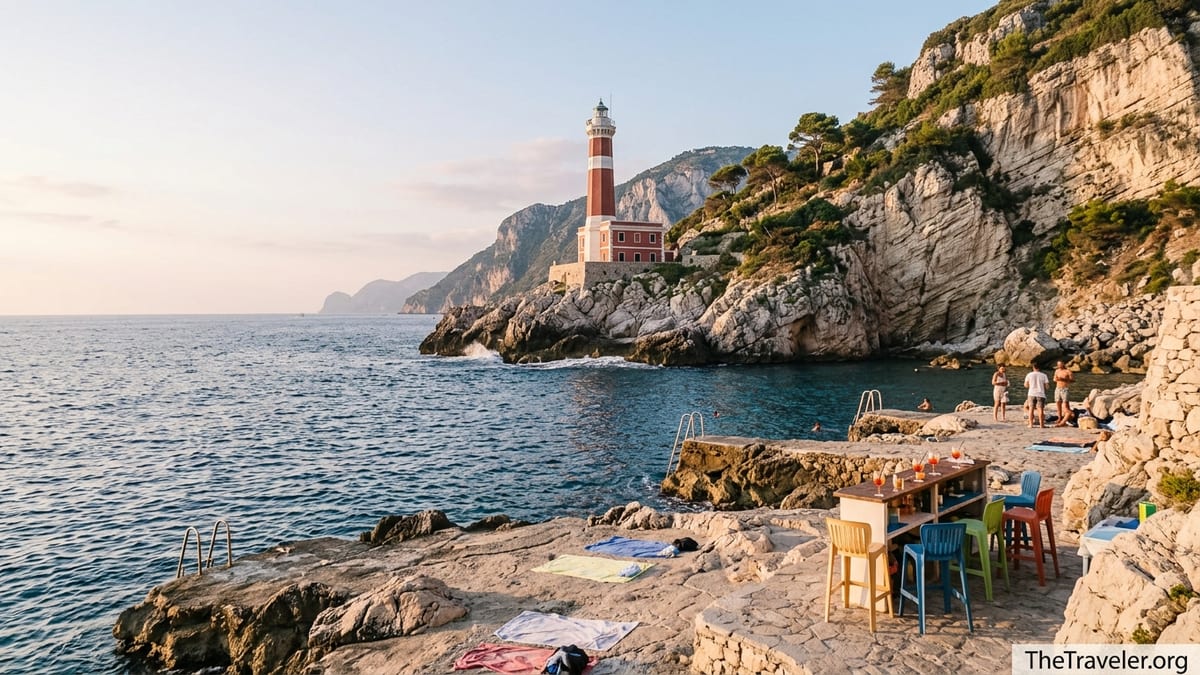
At the western tip of Anacapri lies Punta Carena, dominated by one of Italy’s tallest lighthouses and backed by high cliffs. It feels worlds away from the boutiques and polished piazzas elsewhere on the island. Concrete platforms and flat rocks form informal bathing areas, with ladders dropping straight into deep, clear water perfect for confident swimmers. There is no sand here, but on hot days locals and in-the-know visitors spread towels on the rocks or rent sunbeds from the small bathing establishments that operate in season.
Reaching Punta Carena is straightforward. Regular buses leave from Anacapri’s main bus terminal, and the ride takes around fifteen minutes along a scenic, winding road. The bus drops you near the sea, from where it is a short walk to the lighthouse and swimming areas. Expect the atmosphere to be relaxed rather than glamorous. Prices at the snack bars and beach kiosks tend to be lower than at more famous Capri beach clubs, with simple offerings like panini, salads, cold beer, and granita.
Punta Carena shines at sunset. The cliffs catch the evening light, the lighthouse lamp begins to flash, and swimmers gradually trade the water for Aperol spritzes and plastic cups of local wine. On clear evenings you can watch the sun sink into the Tyrrhenian Sea with little more than the sound of waves and conversation around you. Arriving by mid afternoon lets you enjoy a swim first, then linger for the sunset before taking one of the later buses back to Anacapri.
If you have walked the Sentiero dei Fortini in the direction of Punta Carena, the lighthouse area becomes a natural end point. Pack a dry T-shirt or light dress in your daypack so you can change after the hike and feel comfortable settling in for an aperitivo with the locals as the sky turns orange and pink.
Discover Anacapri’s Churches and Intimate Museums
Beyond the major villa and coastal views, Anacapri’s small churches and quiet museums offer an insight into the island’s cultural life. The Church of San Michele Arcangelo, not far from the village center, appears plain from the outside, but inside it holds an extraordinary 18th century majolica floor depicting the Garden of Eden. Visitors walk around the edge on a narrow wooden walkway to avoid stepping on the tiles, which turns the visit into a slow, detailed look at the animals and plants rendered in glazed color.
Entrance fees here are modest, and visits typically take less than half an hour, making the church a convenient stop between other sights. It is worth checking opening hours in advance at the local tourist office in Anacapri, as smaller churches sometimes close for long lunch breaks or off-season rest days. Modest dress is appreciated, so carry a light scarf or cover-up if you are exploring in beachwear.
Other small museums and cultural spaces, such as local art galleries or exhibitions in historic buildings, appear and disappear with the seasons. In summer it is common to find temporary photography shows or sculpture displays in civic spaces and gardens. These may not appear in older guidebooks, so asking at the tourist information desk or checking noticeboards in the piazzas can lead to unexpected discoveries, often for just a few euros or free entry.
Combining these quieter stops with better-known places such as Villa San Michele creates a varied day. You can alternate between outdoor viewpoints and cool interiors, between big panoramas and close-up decorative details, without straying far from Anacapri’s walkable center.
Experience Local Flavor: Food, Wine, and Artisans
Exploring Anacapri beyond the chairlift also means tasting and shopping like a local. While Capri Town is known for high-end fashion boutiques, Anacapri’s streets favor smaller workshops and family-run stores. You might find artisans handcrafting the island’s famous leather sandals, which can often be made or adjusted to your foot in under an hour. Prices vary depending on materials, but basic styles are usually less expensive than designer versions sold elsewhere on the island.
Limoncello, made from the thick-skinned lemons of the region, appears in many shop windows. Tasting is often possible, and small producers will happily explain whether their liqueur is made on Capri itself or nearby on the Sorrentine Peninsula. When buying a bottle, verify that liquids are allowed in your luggage if you are flying home, or consider miniature sizes that can be placed in carry-on bags within airline limits.
For food, look for trattorias and pizzerias a few blocks away from the busiest bus stops. Menus often list seasonal dishes such as ravioli capresi, a local specialty stuffed with caciotta and Parmesan, served with a simple tomato and basil sauce. Prices for a pasta dish and a glass of house wine in these places are typically lower than seafront restaurants in Capri Town, especially outside peak summer weeks. Ordering the menu of the day, if available, is a reliable way to keep costs predictable while trying local flavors.
Even simple experiences become memorable in this setting. Sipping an espresso at the counter of a bar frequented by residents, watching a nonna roll out pastry in the back of a bakery, or listening to a shop owner discuss the best time to visit the Blue Grotto or which bus stop is closest to a trailhead, all add layers to your understanding of Anacapri beyond its role as a sightseeing stop.
Walk Historic Paths: The Phoenician Steps and Cetrella
If you would like an alternative to mechanical lifts and buses, Anacapri still offers routes that rely on your own two feet. The ancient staircase often called the Phoenician Steps, though it was likely built in later centuries, once formed the main connection between Capri Town and Anacapri. Today, relatively fit visitors tackle the hundreds of stone steps as a workout with a view. Most people choose to descend rather than climb, taking a bus up to Anacapri and then walking down toward Marina Grande, which reduces the strain on knees and lungs but still requires care on the uneven stones.
Another rewarding path from Anacapri leads toward the hermitage of Cetrella, a small chapel set in a saddle between peaks below Monte Solaro. Even if you skip the chairlift itself, you can reach this peaceful spot on foot along marked trails. The walk typically takes around 45 minutes to an hour from Anacapri’s center, passing through low forest, terraced slopes, and viewpoints over the sea. In spring, wildflowers dot the path, and in autumn the air can feel refreshingly crisp compared with the busy harbors below.
These historic routes remind you that Capri was once an island of farmers, shepherds, and fishermen long before it became a luxury destination. Terraces of old vineyards and stone shelters still appear along the hillsides, and the scent of herbs like thyme and rosemary fills the air under the sun. Carry water and proper shoes, and tell your accommodation where you plan to walk if you are heading out alone, particularly during quieter shoulder seasons when fewer hikers are on the trails.
Finishing a day of walking with a simple dinner in Anacapri and a gelato from a local bar feels like a fitting reward. You will have experienced the island at human speed, noticing coves, cliffs, and farm plots that most passengers on buses and chairlifts never really see.
The Takeaway
Anacapri’s chairlift to Monte Solaro is famous for good reason, but it is only one thread in the fabric of this upper village. Slow travel here reveals stone forts, cliff-edge paths, historic villas, painted church floors, neighborhood trattorias, and rocky swimming spots where you share the sea with locals instead of crowds. By lingering beyond the standard circuit, you trade a quick checklist of sights for a more nuanced sense of place.
Whether you are hiking the Sentiero dei Fortini, tracing the tiles of San Michele’s floor, or watching the lighthouse at Punta Carena light up at dusk, Anacapri rewards curiosity. Plan at least a full day, and ideally an overnight stay, to explore beyond the chairlift and let this quieter side of Capri leave a lasting impression.
FAQ
Q1. Is Anacapri worth visiting if I skip the Monte Solaro chairlift?
Anacapri is absolutely worth visiting even without riding the chairlift. You can still enjoy panoramic views from Villa San Michele, hike coastal trails like the Sentiero dei Fortini, swim at Punta Carena, visit churches and small museums, and experience village life in the quieter lanes away from Capri Town.
Q2. How much time should I plan for Anacapri beyond the chairlift?
Plan at least one full day in Anacapri to go beyond the chairlift. That gives you time for a villa or church visit, a coastal or hillside walk, a swim at Punta Carena, and unhurried meals. Staying one or two nights in Anacapri lets you enjoy early mornings and evenings when day trippers have left.
Q3. Do I need hiking experience for the Sentiero dei Fortini trail?
You do not need technical hiking experience, but you should be reasonably fit and steady on your feet. The path has rocky sections, steps, and constant ups and downs. Closed shoes, water, and sun protection are essential. If you are unsure, consider walking only a shorter section near Punta Carena and turning back when you feel you have had enough.
Q4. Can I visit the Blue Grotto easily from Anacapri?
Yes. Buses run regularly from Anacapri to the Blue Grotto area in season, and the ride is short. From the bus stop, you walk down to the landing point where small rowing boats enter the cave when sea conditions and opening hours allow. Many visitors combine an early Blue Grotto visit with time exploring Anacapri afterward.
Q5. Are there good places to swim in Anacapri besides beach clubs?
Punta Carena is the main swimming spot in Anacapri, with concrete platforms, ladders into deep water, and some areas where you can lay a towel on the rocks. It has a relaxed, local feel compared with more glamorous beach clubs elsewhere on Capri. Always check conditions and currents and follow local advice before entering the water.
Q6. Is Anacapri cheaper than Capri Town?
In general, Anacapri feels a little more affordable than Capri Town, especially for casual meals, coffee bars, and some accommodation options. Prices are still higher than many mainland destinations, but you are less likely to encounter ultra-luxury markups, and everyday services used by residents can be better value.
Q7. What should I wear for visiting churches and museums in Anacapri?
Comfortable, modest clothing is best. Shoulders and knees covered are appreciated in churches like San Michele Arcangelo. For museums and villas, dress for walking on uneven surfaces and stairs, and carry a light layer for air-conditioned or shaded interiors, especially if you arrive in beachwear from a swimming spot.
Q8. Is it easy to get around Anacapri without a car?
Yes. The historic center of Anacapri is compact and walkable. Public buses connect Anacapri with Capri Town, Marina Grande, the Blue Grotto, and Punta Carena. In high season they can be crowded, so allow extra time and consider walking shorter distances when possible.
Q9. When is the best time of year to enjoy Anacapri beyond the crowds?
Late spring and early autumn are ideal. In May, June, September, and early October, many services and buses run frequently, the sea is often warm enough for swimming, and temperatures make hiking more comfortable than in peak summer. Winter brings quieter streets but also reduced opening hours for some attractions.
Q10. Can I stay overnight in Anacapri instead of Capri Town?
Yes, and many travelers prefer it. Anacapri has a range of small hotels, guesthouses, and rental apartments. Staying here lets you experience the village early in the morning and at night, when it is at its most peaceful, while still being a short bus ride from Capri Town and the main ferry connections.