


Cap Ferrat is one of the French Riviera’s most coveted peninsulas, a slim finger of land between Nice and Monaco where pine trees lean toward turquoise water and villas hide behind stone walls. It looks exclusive from a distance, but with a bit of planning you can walk almost the entire coastline, swim in sheltered coves, and spend a full day (or two) enjoying its best seafront spots without needing a yacht or a five-star hotel key.
Get the latest updates straight to your inbox!
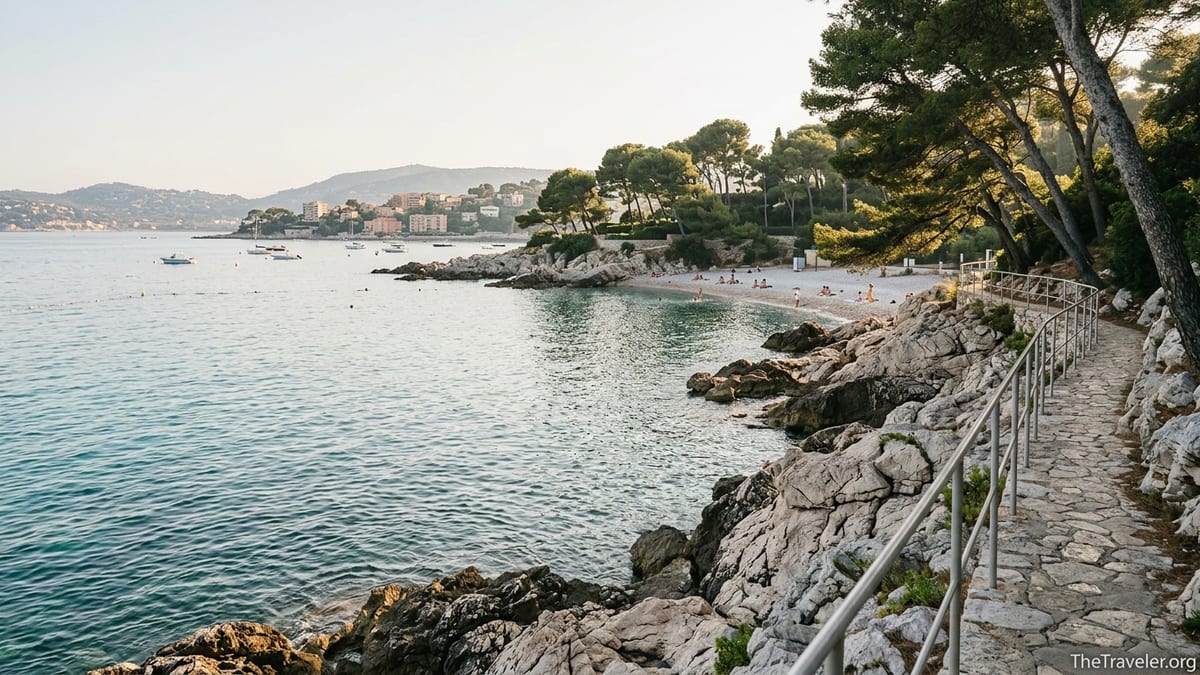
Understanding Cap Ferrat’s Coastline Before You Go
Saint Jean Cap Ferrat is a compact peninsula, about a 20-minute drive from central Nice, with a continuous network of public coastal paths that thread around cliffs, tiny beaches, and low rocky platforms. The headline experience is the Sentier Littoral, a roughly 6 to 7 kilometer loop that circles most of the peninsula, usually taking 2 to 3 hours at a relaxed pace with photo stops and swims. The terrain is generally easy, but expect stone steps, narrow sections, and the occasional splash zone when the sea is rough.
The coastline is divided into distinct pockets that are useful to understand when planning your day. On the eastern side, Paloma Beach crouches in a pine-framed cove facing Beaulieu sur Mer, with calm water and views across the bay. The southern tip is more dramatic, with bleached limestone, spray, and big-sky views toward Monaco and Cap d’Ail. The western side, around Passable Beach and the Bay of Villefranche, tends to be calmer and sunnier in the afternoon, popular with families and paddleboarders.
Cap Ferrat is easy to visit on a budget if you arrive by public transport. From Nice, many travelers take the TER regional train to Beaulieu sur Mer for around 3 to 5 euros one way, then walk or catch a local bus to the port of Saint Jean Cap Ferrat. Others use the number 15 bus from central Nice, which typically costs only a couple of euros with contactless payment. Once you are on the peninsula, nearly every coastal highlight is accessible on foot, and the entire day’s enjoyment can be built around free walks, swims, and occasional café stops.
Season matters. From June to early September, beaches buzz with sunbeds and beach clubs, and parking around Paloma and Passable can be extremely tight. In shoulder seasons like May or late September, the paths are quieter, water is still swimmable for many visitors, and you are more likely to have sections of the coastal trail almost to yourself. In winter, strong easterly swells sometimes lead the town to close certain exposed sections of the path for safety, so it is worth checking the local tourist office or town hall information before setting out.
Walking the Sentier Littoral: The Backbone of Your Day
The best way to ensure you do not miss Cap Ferrat’s coastal highlights is to anchor your visit around the Sentier Littoral, the coastal path that almost encircles the peninsula. A practical starting point is the port of Saint Jean Cap Ferrat, where you will find cafés for a pre-walk espresso and information boards describing the main loops. From here, you can choose to walk clockwise toward Passable, or anticlockwise toward Paloma and Pointe Saint Hospice. Both directions work, but many visitors start with the Paloma side for cooler, shaded morning light.
From the port, it takes around 15 minutes on local streets to reach Paloma Beach and the start of the classic coastal section. The path quickly narrows into a limestone ribbon hugging the sea, with handrails where the drops are steeper. Over the next hour you will pass rocky platforms where locals spread towels, small staircases leading down to hidden coves, and viewpoints with benches facing the Italian coastline on clear days. The path is not technically difficult, but you will be grateful for sturdy sandals or trainers rather than flimsy flip-flops, especially on the rougher, sun-bleached rock near the southern tip.
Continuing around the peninsula, the Sentier Littoral gradually turns west, and the setting changes. The south side is more exposed and arid, with low shrub and scrubby pine catching the wind, while the northwestern side softens into wooded slopes and glimpses of elegant villas. Eventually the trail brings you toward Passable Beach, where you can either finish your loop, head up to the main road for a bus back to Nice, or cut inland across the peninsula to return to the port. Many walkers allow at least half a day for the coastal path so they have time for swims, photography, and a long break at one of the beaches.
If a full loop feels ambitious in summer heat, you can break the coastline into shorter sections. One manageable option is to focus on the Paloma to Pointe Saint Hospice circuit, which typically takes around 90 minutes and includes both the coastal path and the short uphill detour to the chapel and Belgian military cemetery. Another is to do only the western leg between Passable and the port, especially good for families with younger children thanks to its easier access back to cafés and shaded streets. In all cases, carry at least one liter of water per person and wear a hat; shade is irregular outside the pine groves behind the beaches.
Paloma Beach and the Eastern Coves: Iconic Views and Snorkeling
Paloma Beach is one of Cap Ferrat’s most photographed coves, a short arc of pale shingle and sand framed by umbrella pines. It sits on Anse de la Scaletta, on the eastern side of the peninsula, and is easily reached by a signed footpath and a set of stone steps dropping from the road. The cove faces northeast, which means it catches soft morning light and tends to be a little cooler by late afternoon, a useful detail when you are choosing your swimming window in midsummer.
The beach itself is divided between a public section and a private concession that typically installs sunbeds and a restaurant during the main season. As of 2025 and 2026, the long-running Paloma Beach restaurant has been undergoing renovation, and travelers have reported it closed for the 2025 season, with the public part of the beach remaining open and free to access. Practical details such as sunbed prices can change year to year, but you can expect a pair of loungers and an umbrella at comparable Riviera rates, often starting somewhere around 30 to 40 euros per person in high season, so budget-minded visitors often stick to the public section with their own towels.
Paloma’s sheltered, rocky edges make it one of the peninsula’s more popular snorkeling spots. Entry to the water is straightforward from the ends of the beach, where you can swim out along underwater meadows of seagrass and over small rock gardens dotted with urchins, starfish, and schools of Mediterranean fish. Visibility is often good on calm days, especially in the morning before boat traffic stirs the surface. Pack your own mask and snorkel if you are particular about fit; rental options in Cap Ferrat itself are limited, although some hotels and guesthouses lend basic gear to guests.
Beyond the main cove, the eastern side hides a series of smaller beaches and rock slabs that regulars favor when Paloma gets busy. Plage des Fosses and Plage des Fossettes, slightly further south along the coast, are narrower and more low-key, with clear water and a more local feel. Access can involve staircases and short climbs, which helps keep crowds down compared with bigger Riviera beaches. If you walk the coastal path here with swimwear under your clothes and a lightweight microfibre towel in your daypack, you can easily stop for multiple dips without locking yourself into a single beach club.
Pointe Saint Hospice and the Wild South Side
Just beyond Paloma, the peninsula narrows toward Pointe Saint Hospice, a low headland crowned by a small chapel and a statue of the Madonna overlooking the sea. A short signed detour up from the coastal path brings you to the chapel and the nearby Belgian military cemetery, a quietly moving spot with wide views back along the coast. The climb is short but steep in places, and on hot days you will feel the difference, so many walkers time this detour for earlier in the morning or later in the afternoon when the sun is lower.
Below the chapel, the Sentier Littoral around Pointe Saint Hospice feels wilder than the groomed promenades closer to the port. The path weaves along rough limestone ledges, sometimes with low walls on the landward side and the open sea on the other. On calmer days, you will see locals perched on flat rocks with picnic bags and swimsuits, clambering down iron ladders or natural steps to slip into deep, clear water. There are no lifeguards here and no facilities, so only confident swimmers should venture out of their depth, and it is sensible to bring reef-safe sunscreen and water shoes if you plan to use the rocky entries.
As you round the southernmost stretch of the peninsula, the horizon opens dramatically. On clear days, you can pick out the outlines of Monaco and the cliffs around Cap d’Ail to the east, and the bulk of Cap d’Antibes in the other direction. The sea color shifts with depth and light, from deep cobalt near offshore drop-offs to pale, milky turquoise in shallower pockets. In winter or during strong swells, this is the section most likely to be closed temporarily by the town hall, so always respect signage and barriers; waves can crash over the lower parts of the path and create slippery conditions.
For photographers and landscape lovers, this south side is one of the best places on the peninsula to capture the contrast between jagged rock and open sea. Aim for early morning or late afternoon for softer light and longer shadows across the stones. Because there are no cafés or kiosks, bring snacks if you know you will linger, and remember that there are few shaded spots until you approach the more wooded western side near Passable.
Passable Beach and the Western Bays
On the western flank of Cap Ferrat, Passable Beach sits directly opposite the colorful houses of Villefranche sur Mer, in a small indentation at the base of the peninsula. Reached by a short but fairly steep road and steps from the main road above, it offers a mix of sand and small stones, a private beach club section, and a public area where you can lay out your towel for free. The bay is better sheltered from easterly winds than the open Mediterranean, and in the afternoon the beach tends to bask in warm sun while the hills behind it green with pine and gardens.
For many visitors, Passable is a comfortable second swim stop after walking the southern half of the coastal path. The combination of shallow entry, relatively calm water, and views across to Villefranche’s citadel makes it suitable for families and less confident swimmers, though you should always check local signage for lifeguard hours and safety flags. During peak summer, a basic set of two loungers and an umbrella at the private section can cost in the region of 30 to 50 euros, depending on row and date, while the public strip fills up early with day-trippers who arrive from Nice on the train and walk over via the coastal promenades.
West of Passable and around the northern shoulder of the peninsula toward Beaulieu sur Mer, the coastline becomes gentler again, with more residential villas and smaller, less formal beaches. The Maurice Rouvier promenade, a flat, stroller-friendly seaside walk that links Beaulieu and Saint Jean Cap Ferrat, runs along this side and offers easy access to the water at various points. It is an excellent option if you want a taste of Cap Ferrat’s seafront without tackling the steps and rougher sections of the Sentier Littoral, or if you are visiting with young children in a buggy.
Because the western side gets strong afternoon light, it is often the most inviting place on the peninsula later in the day. Many travelers plan a loop that ends at Passable around mid-afternoon, with time for a swim and perhaps a drink at the beach bar, before catching the bus back toward Nice or walking along the promenade toward Beaulieu for dinner. If you are driving, treat parking as part of your strategy: roadside spaces near Passable and along the approach roads are limited and quickly fill on summer weekends, so arrive early or be prepared to park higher up in town and walk down.
How to Fit Cap Ferrat into Your Riviera Itinerary
Cap Ferrat works well as both a half-day escape from Nice and a full-day coastal immersion. If you only have a morning, one of the most rewarding options is to catch an early train or bus to Beaulieu sur Mer, walk the flat seaside promenade to Saint Jean Cap Ferrat, then continue around the Paloma and Pointe Saint Hospice section of the coastal path before looping back to the port for lunch. This gives you at least one swim, the peninsula’s most atmospheric headland, and time for a coffee or ice cream at the harbor, all without rushing.
For a fuller experience, plan a flexible day that starts with the eastern coves and ends on the western bays. Arrive in Saint Jean Cap Ferrat by 9 or 10 a.m., walk or bus to Paloma Beach for a first swim while the light is still gentle, then follow the Sentier Littoral around Pointe Saint Hospice and along the south side. Carry simple picnic supplies so you can pause at a viewpoint or on a quiet rock platform rather than relying entirely on beach clubs. Aim to reach Passable Beach by mid-afternoon; here you can decide whether to settle in for a few hours or continue along the Maurice Rouvier promenade toward Beaulieu as the sun lowers.
Travelers staying in Nice often pair Cap Ferrat with nearby Villefranche sur Mer. One realistic pattern is a morning walk and swim on the peninsula, followed by an early evening train or bus to Villefranche for dinner on its waterfront and a stroll through the old town. Budget travelers in particular appreciate that both destinations are on the same affordable train corridor, and that most of the day’s activities involve walking and swimming rather than paid attractions. Even those splurging on high-end hotels in Cap Ferrat or Beaulieu tend to build at least one free, unstructured coastal walk into their stay.
If you are sensitive to heat or planning a visit in July or August, consider starting your day as early as 7 or 8 a.m., when temperatures are lower and the paths less crowded. Many locals swim before breakfast and are off the beaches by midday, returning only after 4 or 5 p.m. Once the sun is high, make use of shaded stretches near the port or around tree-lined sections above the beaches, and treat mid-afternoon as café time rather than your main walking block.
Practical Tips for Coastal Comfort and Safety
Cap Ferrat’s coastal paths are not technical hikes, but treating them with the respect you would give any exposed seafront trail will make your day more enjoyable. Footwear is the first priority: lightweight trainers, trail shoes, or sturdy walking sandals handle the mix of stone steps, smooth concrete sections, and rough limestone far better than thin-soled flip-flops. A small daypack with at least one liter of water per person, reef-safe sunscreen, a hat, and a light long-sleeve layer for sun protection will keep you comfortable even in strong summer sun.
Signage around the peninsula is generally good, with colored waymarks and directional signs to key points such as Paloma, Passable, Saint Hospice, and the port. However, junctions can still feel confusing to first-time visitors, especially where the coastal path briefly diverts inland around private properties. It is worth downloading an offline map of the area to your phone before you leave your hotel, or using a popular hiking app with the Saint Jean Cap Ferrat coastal loop saved in advance. Mobile coverage is usually reliable but can dip in shaded gullies or under cliff faces.
Swimming safety deserves particular attention. While the bays around Paloma and Passable are usually calm in summer, the open south side of the peninsula can see stronger swell, currents, and boat wake. Always observe local flag systems on main beaches, avoid swimming alone from isolated rocky platforms, and be cautious jumping from rocks where depth and underwater obstacles are not clear. Jellyfish occasionally appear along this stretch of the Riviera, especially after storms; locals often check sea conditions in the morning or ask lifeguards at main beaches for up-to-date advice.
Finally, remember that Cap Ferrat is both a holiday destination and a residential area, with many private villas backing directly onto the coastal paths. Respect “private property” signs, keep noise down early in the morning and late in the evening, and pack out all rubbish. There are some public toilets around the port and near certain beaches, but not along the wilder stretches of trail, so plan accordingly before you set out on the longer loops.
The Takeaway
Experiencing Cap Ferrat without missing its best coastal spots comes down to a simple formula: follow the Sentier Littoral, pause at the key bays, and give yourself enough time for the place to slow you down. By structuring your day around Paloma Beach and the eastern coves in the morning, the wilder Pointe Saint Hospice and south side at midday, and Passable and the western bays in the late afternoon, you will naturally pass the peninsula’s most beautiful corners on foot.
Whether you arrive by train and bus from Nice with a picnic and a pair of walking shoes, or check in to one of the peninsula’s grand hotels and step straight out onto the trail, Cap Ferrat rewards curiosity and a relaxed pace more than any checklist. Swim when the water looks inviting, detour up to chapels and viewpoints when a sign catches your eye, and do not worry about seeing every villa or viewpoint. If you complete at least one good stretch of the coastal path and slip into the Mediterranean at a pine-framed cove, you have already captured the essence of this remarkable peninsula.
FAQ
Q1. How long does it take to walk around Cap Ferrat on the coastal path?
The full Sentier Littoral loop typically takes 2 to 3 hours at a relaxed pace, not counting swims, photo stops, or café breaks along the way.
Q2. What is the easiest way to reach Cap Ferrat from Nice without a car?
Most visitors take a short regional train from Nice to Beaulieu sur Mer and then walk or catch a local bus to Saint Jean Cap Ferrat; the whole trip usually takes under an hour.
Q3. Which beach on Cap Ferrat is best for first-time visitors?
Paloma Beach is often the top choice for a first visit thanks to its pine-framed cove, clear water, and views toward Beaulieu, plus easy access to the coastal path.
Q4. Are there good options for families with young children?
Yes. Passable Beach and the flat Maurice Rouvier promenade are popular with families, offering calmer water, easier access, and shorter, stroller-friendly walks.
Q5. Do I need hiking gear for the coastal paths?
No technical gear is required, but comfortable walking shoes or sturdy sandals, a hat, sunscreen, and at least one liter of water per person are strongly recommended.
Q6. Is it possible to visit Cap Ferrat on a tight budget?
Yes. Public transport to Beaulieu and Saint Jean Cap Ferrat is inexpensive, the coastal paths are free, and you can picnic instead of using beach clubs or restaurants.
Q7. When is the best time of year to walk the coastal trail?
Late spring and early autumn are ideal, with warm but not overwhelming temperatures, swimmable water for many people, and fewer crowds than peak summer.
Q8. Can I swim directly from the rocks along the south side of the peninsula?
Experienced locals often swim from rocky platforms, but there are no lifeguards, so visitors should be cautious, check sea conditions, and avoid swimming alone.
Q9. Are there places to buy food and water along the route?
You will find shops and cafés around the port and near main beaches, but there are long stretches of coastal path with no facilities, so carry snacks and plenty of water.
Q10. Is Cap Ferrat suitable for visitors with limited mobility?
Some sections of the Sentier Littoral have many steps, but the Maurice Rouvier promenade between Beaulieu and Saint Jean Cap Ferrat is mostly flat and more accessible.