


Guayama does not unfold like Puerto Rico’s big-name destinations. It reveals itself slowly, through a compact historic center, a working-class coastal strip lined with seafood shacks, mangrove forests that smell of salt and earth, and a bay protected more for research than tourism. On a recent south-coast swing in 2026, I based a full day around Guayama, with follow-up detours on another trip. What follows is what I genuinely did, what it cost, how it felt on the ground, and whether I would do it again.
Get the latest updates straight to your inbox!
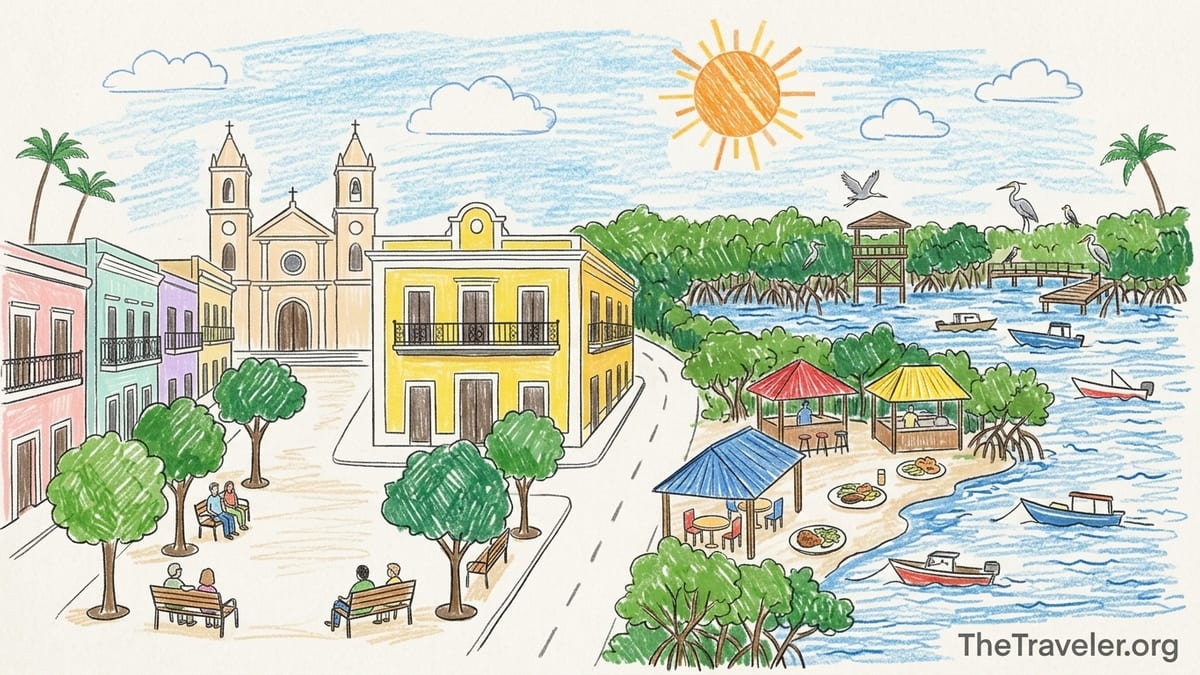
Strolling Guayama’s Historic Center and Plaza
I started Guayama where the town feels most traditional: around the central plaza. I arrived by rental car from San Juan via PR-52 south and then PR-3 into town, an easy two-hour drive in light weekday traffic. I parked in a small pay lot just off the plaza, behind the main church; it worked on a flat daily fee of around 5 dollars, paid in cash to an attendant. From there, everything I wanted to see in the historic core was within a five-minute walk, which made it practical to leave the car and explore on foot.
My goal in the center was not to tick off a list of “sights” but to get a feel for how Guayama lives. The plaza was busy but not chaotic on a late-morning weekday, with locals cutting across to do errands and a few older men reading newspapers on benches. Weather in October gave me a mix of hot sun and scattered clouds, around 88 degrees Fahrenheit with noticeable humidity. I spent about an hour just circling the square, watching kids coming and going from nearby shops and stepping inside small bakeries for coffee and pastries. The crowd level felt local and relaxed, and for that hour of people-watching and photos, the stop absolutely justified the detour from the highway.
Architecturally, the highlight facing the plaza is the church and several period facades with pastel colors and wrought-iron balconies. None of these required tickets or fixed visiting hours in the way a formal museum would, so my time commitment stayed flexible. I recommend allowing at least 60 to 90 minutes to let the rhythm of the place sink in rather than rushing through for a quick snapshot. If you are driving the south coast anyway, an unhurried plaza wander is one experience in Guayama I would definitely repeat.
One practical note from my visit: the sun in the open square is intense, and shady benches fill up fast around midday. If you are sensitive to heat, aim for a morning arrival before 11 a.m. or come back in the late afternoon. Cafes close to the plaza provided welcome air conditioning when I needed a break, and it was easy to find a coffee and snack for under 10 dollars.
Casa Cautiño: Beautiful Landmark, Awkward Timing
Discover Puerto Rico promotes Casa Cautiño as a 19th-century residence with original furnishings, paintings and personal artifacts, and you cannot miss the elegant structure if you are already at the plaza. On my most recent visit I walked over to the house from the square in less than two minutes, admiring the carved wooden doors and neoclassical lines from the exterior. Unfortunately, I found the museum itself closed, with no staff at the gate and no posted opening hours that I could confirm on-site. I checked again later that afternoon and had the same experience.
Because of this, my experience of Casa Cautiño was limited to the outside and the surrounding street. There was no admission fee to stand in front of the house and photograph the exterior, and no security guard moved anyone along. Crowd level was almost nonexistent; I saw only two other visitors pausing for pictures in a 20-minute span. The weather stayed hot and bright, and the shade cast by the house was limited, so it is not a place to linger for long unless you can actually get inside.
I tried following up online after the visit using official tourism information, and as of October 2026 it still appears that Casa Cautiño has irregular hours and is sometimes closed without clear notice. Given that my own attempt to visit the interior failed in spite of being there on a weekday and planning time for it, I would not build an itinerary around the museum specifically being open. If you are already in the historic center, it is worth a walk-by for the architecture and sense of the old sugar wealth in Guayama, but based on my experience, I would treat entry as a pleasant surprise rather than a guarantee.
Would I try again? Yes, but only as part of a broader Guayama day where the plaza, coastal route and nature stops carry the weight. The exterior alone was not enough to justify a separate trip, and if your time is limited to half a day, I would prioritize other experiences first unless you have confirmed current hours by phone or in person.
Coastal Gastronomy Trail: Fresh Seafood on Route 7710
The heart of my time in Guayama was the Coastal Gastronomy Trail, a cluster of seafood restaurants and casual spots along PR-7710 in the Pozuelo sector. I drove down from the town center in about 15 minutes, following local signs toward the coastal gastronomy area. Parking here was straightforward but informal: most restaurants had their own small dirt or gravel lots, free for customers. I visited on a Sunday afternoon and had no trouble finding a space near the water, though I did have to maneuver around a few tight corners as families parked wherever there was room.
For lunch I chose one of the sit-down seafood restaurants clearly marked as part of the route, the kind of place serving whole fried fish, mofongo stuffed with shrimp, and cold beers. My meal for two came to around 55 dollars, including a shared starter of garlic tostones, two main plates heavy on local fish and shellfish, and non-alcoholic drinks. Service was relaxed but attentive, with food arriving in about 25 minutes despite a moderate weekend crowd. The open-air dining room faced the bay, so we ate with a view of mangroves and small boats rather than a manicured resort line, which contributed to the feeling of being in a real working community.
The Coastal Gastronomy Trail gets lively, especially on weekends, but during my visit it stayed on the pleasant side of busy. Music floated from neighboring kiosks, and families with children came and went steadily, yet I never felt squeezed or rushed. Weather in the mid-afternoon sat in the low 90s Fahrenheit with a persistent breeze off the water; under the restaurant’s awnings it was perfectly comfortable. I spent about two and a half hours along this strip between lunch, a slow walk to the end of the paved road, and a quick coffee and dessert at another spot, and I would absolutely repeat the experience for the fresh seafood and bay atmosphere alone.
One caution from a later pass through the area: I stopped at a well-known pastelillo stand closer to the parking area that trades more on its fame than its quality. Prices for turnovers had crept into the 4 to 5 dollar range each, portions were smaller and greasier than expected, and the line system was confusing. The view remained nice, but compared with other seafood I had in the same zone, the quality did not justify the price or wait. If I returned, I would skip that snack stop and save my appetite for one of the main restaurants along the route instead.
Jobos Bay and Aguirre State Forest: Mangroves and Boardwalks
Guayama’s coastal appeal deepens away from the restaurants, where the mangrove forests and protected waters of Jobos Bay and the Aguirre State Forest stretch between Guayama and Salinas. I approached the area by car from the Coastal Gastronomy Trail, following local roads toward the signed Aguirre forest access. The drive from Pozuelo took about 20 minutes including a brief wrong turn. Parking at the forest entrance was free in a small unpaved lot adjacent to the main gate, with room for perhaps a dozen vehicles. When I arrived mid-morning on a weekday, there were only three other cars.
Aguirre State Forest itself is a mangrove reserve recognized as part of a larger bird habitat, and the facilities reflected that purpose: simple gazebos, composting toilets, a floating dock and a network of flat walking paths and boardwalks over the mangroves. There was no admission fee on the days I visited, and there were no staffed ticket booths. I allocated around two hours for walking, bird spotting and photography, which felt about right for the summer heat. The paths were quiet, with occasional cyclists and a couple of families using picnic shelters but no crowds in the usual tourist sense.
From the Aguirre side, you can sense Jobos Bay more than you can formally “tour” it as a typical attraction. The bay itself is protected as a National Estuarine Research Reserve, with research and education facilities that operate more on a government schedule than a visitor-park one. On my visit, I saw signs referencing the reserve, educational programs and research zones, but there was no traditional, full-service visitor center experience like you might find in a national park. Trails and observation areas that intersect the reserve boundaries were accessible, and small towers or platforms gave wide views over the water, mangroves and distant industrial structures.
Weather here was hot and still, with less breeze than on the open coast. I used a combination of insect repellent, sun protection and frequent water breaks, and I suggest anyone planning a visit comes prepared for similar conditions. In exchange for the heat, the reward was genuine solitude: on one midweek afternoon, I walked an entire loop trail without seeing another person. From a personal standpoint, this was one of my favorite Guayama experiences and a part of the trip I would gladly repeat, especially with binoculars in hand and a focus on quiet observation rather than structured activities.
Hiking, Birding and Quiet Time on the Trails
Although Guayama does not have the dramatic mountains of the central cordillera, it offers a quieter style of hiking and birding centered on its lowland forests and coastal wetlands. My most satisfying walks were again in and around Aguirre State Forest and the broader Jobos Bay hinterland, where flat trails wind through mangroves and coastal scrub. Access was always by car, and in each case I was able to leave my rental in small clearings or informal roadside shoulders without paying a fee. I recommend arriving by 8 or 9 a.m. to beat the worst of the heat and to catch more bird activity.
On one visit, I followed a signed path from the forest interior out toward a simple observation platform overlooking tidal channels. The round-trip distance was modest, perhaps 3 to 4 kilometers, but the combination of high humidity and unshaded stretches made it feel more demanding than the numbers suggest. I saw herons, egrets and small flocks of shorebirds, along with fiddler crabs moving across the mudflats. There were no guided tours or interpretive rangers on duty, so my time in the forest was self-directed, based on posted maps and my own sense of direction. For independent travelers who enjoy low-key exploration, this freedom is a plus.
In terms of crowd level, my hikes never felt busy. Even on a Saturday, I passed only a handful of local walkers and one cyclist. Dogs were present on some trails, usually on leash, and noise stayed minimal compared with more famous forests in Puerto Rico. I spent about three hours in total on foot that day, including rest stops at gazebos and photo sessions near the water. There was no admission charge, only the cost of fuel and supplies I brought with me. If your definition of a good hike includes solitude and birdlife rather than elevation gain, this is an experience I would repeat without hesitation.
At the same time, I would not recommend these trails as a first-choice hike for visitors expecting dramatic vistas or waterfalls. The landscape here is subtle and low-lying, and the reward is more about the atmosphere of the mangroves and the calls of the birds than about obvious, postcard scenery. If you are short on time and looking for “wow” moments, you might prefer to spend longer at the coastal restaurants or on a scenic drive. For nature travelers who appreciate quieter ecosystems, though, Guayama’s hiking and birding options are worth the planning and the sweat.
Golf and Leisure: El Legado and Nearby Options (Research Only)
Golf at El Legado, an 18-hole course in the Guayama area, is often mentioned in tourism materials as a major local experience. I did not personally play the course on my trips, so what follows is based on research rather than first-hand play. As of late 2026, El Legado functions as a resort-style golf property in the hills outside town, with fairways framed by views of the Caribbean and the southern plains. Access is primarily by car, following highway routes from Guayama town center and continuing up local roads to the club entrance.
Information from golf and tourism sources indicates that green fees at El Legado usually land in the moderate range for Puerto Rico, with 18-hole rates commonly cited around the low to mid 70 dollar mark before taxes and cart, though exact prices shift with season, time of day and promotions. Tee times are generally booked in advance, particularly on weekends, and the course operates as a paid facility rather than an open public park. Most accounts describe a layout with several water features and some wind exposure given its position in the south, which can make play more challenging in the afternoons.
Since I did not personally walk the fairways or use the clubhouse, I cannot recommend El Legado from experience. For dedicated golfers planning a south-coast itinerary, it may be worth considering, especially if you are already staying nearby and can secure a morning tee time to avoid heat and wind. However, golfers should verify current conditions, rates and maintenance directly with the club before committing, as these details can change regularly. For non-golfers or travelers on a tighter budget, Guayama’s historical, coastal and nature experiences offer rich alternatives that do not require green fees.
One Experience I Would Skip or Shorten
In every destination there is at least one stop I would handle differently if I had a second chance. In Guayama, that was my repeat time spent trying to “make” Casa Cautiño work as a full visit without reliable opening information. On my first Guayama day, I walked to the house twice in the same afternoon hoping to find it suddenly open, waited around in the sun for about 20 extra minutes, and ultimately left without getting inside. On a later trip I detoured past again, only to find the doors closed once more. Over two visits, I probably spent nearly an hour in total orbiting a building I could only see from the outside.
In hindsight, that energy would have been better spent lingering longer along the Coastal Gastronomy Trail or adding another quiet loop through the Aguirre forest. The exterior of Casa Cautiño is attractive and historically important, but the frustration of uncertain access made those repeated attempts feel like a poor trade-off. If I returned to Guayama tomorrow, I would limit myself to a single quick stop at the house while already in the plaza and then move on, unless I had advance confirmation that the interior was open to visitors on that specific day.
Similarly, I would be stricter about where I chose to snack along the coast. The overhyped pastelillo stop near the parking lot, with its higher prices and average quality, simply did not add much to the day and left less appetite for genuinely good seafood later. Guayama has plenty of spots where the price, portions and flavor line up; settling for a famous name with lackluster food is not necessary. On a future visit, I would walk a few minutes farther down the road to restaurants that focus on fresh fish and thoughtful preparation instead of relying only on reputation.
How I Would Group Guayama Experiences by Traveler Type
Looking back on my time in Guayama, a clear pattern emerges in which experiences suit different kinds of travelers. History lovers will get the most from the town center, where the plaza, period facades and the exterior of Casa Cautiño tell the story of sugar-era wealth and civic life. I would suggest they plan a morning in the historic core, allowing time for slow walks, coffee breaks and at least a brief stop outside the Casa, with the understanding that interior access may or may not be available. A combined history-and-lunch pairing works well: explore the square before the midday heat peaks, then drive down to the coastal gastronomy area for a long seafood lunch.
Food travelers should anchor their Guayama plans almost entirely on the Coastal Gastronomy Trail. This is where the town’s personality truly comes through in plates of fried fish, mofongo with seafood and ice-cold drinks served steps from mangrove-fringed water. Arriving by car in the early afternoon, you can park near one of the sit-down restaurants, linger over a meal, then wander along PR-7710 to scan menus and dessert options elsewhere. With a budget of around 30 to 40 dollars per person, it is easy to build a memorable lunch or early dinner that feels rooted in the community rather than in a generic tourist strip.
Nature travelers and birders will naturally gravitate toward Aguirre State Forest and the fringes of Jobos Bay. They should allocate at least half a day, if not more, for flat but rewarding walks among mangroves, quiet observation of birds and time at lookout platforms over the estuary. Early morning or late afternoon visits offer better light, cooler temperatures and more wildlife activity, and the lack of formal admission fees helps keep costs low. For these visitors, Guayama works best as part of a loop that also includes other southern nature sites, but even a dedicated day around the bay and forest can be deeply satisfying.
For people with only half a day, I would prioritize either a combination of plaza plus Coastal Gastronomy Trail, or a nature-focused window in Aguirre. In the first scenario, you could spend 60 to 90 minutes in the historic center, including a quick walk by Casa Cautiño, then drive to the coast for a long lunch and a short stroll along the bay before heading onward. In the second, you could drive directly to Aguirre State Forest in the morning, park for free and walk the trails for two to three hours before returning to the highway. In both cases, the experiences feel complete without rushing, and they showcase Guayama’s strengths without overcommitting to places with uncertain access.
FAQ
Q1. Is Guayama worth visiting if I only have one afternoon?
Yes, Guayama can be rewarding in a single afternoon if you focus on either the Coastal Gastronomy Trail for seafood and bay views or the historic center plus a quick walk along the plaza. Trying to fit in everything, including deeper nature stops, would feel rushed in that timeframe.
Q2. How do I get to Guayama from San Juan without a tour?
The most straightforward way is by rental car via PR-52 south toward Ponce, then exiting for Guayama and continuing on local roads into town. The drive typically takes around two hours in light traffic. Public buses exist but are slower and less predictable for day trips.
Q3. Is parking difficult near Guayama’s historic plaza?
On my visits, parking near the plaza was manageable. I used a small pay lot just off the square that charged about 5 dollars for the day, and street parking was also available on side streets, though spaces filled faster around lunchtime and on weekends.
Q4. Do I need to pay an entrance fee for Aguirre State Forest or Jobos Bay?
During my visits there was no admission fee to enter Aguirre State Forest or access the basic walking paths and gazebos connected to the Jobos Bay area. Facilities were simple, and no staffed ticket booths were operating. It is wise to carry cash in case parking or specific facilities begin charging in the future.
Q5. Can I swim or beach-hop easily around Jobos Bay?
Jobos Bay is primarily managed as a National Estuarine Research Reserve and mangrove habitat, so it is more about observation, boardwalks and flat trails than beach lounging or casual swimming. If you are looking for classic sandy beaches, you will want to combine Guayama with nearby coastal towns that have more developed bathing areas.
Q6. Is the Coastal Gastronomy Trail suitable for children?
Yes, families with children were common along the Coastal Gastronomy Trail during my visits. Most restaurants are casual, open-air and tolerant of kids, and there is enough open space for short walks. Parents should watch young children near the road and water, as railings and sidewalks can be inconsistent.
Q7. How much should I budget for a good seafood meal on the coast?
On the Coastal Gastronomy Trail, I typically spent around 25 to 35 dollars per person for a hearty lunch, including a shared starter, a seafood main and non-alcoholic drinks. Costs rose with specialty dishes or alcohol but remained fair for the portion sizes and freshness.
Q8. What is the best time of day to visit Aguirre State Forest for birdwatching?
Early morning, roughly between 7 and 9 a.m., gave me the best combination of cooler temperatures and active birdlife. Late afternoon also worked, but heat and insects were more noticeable. I recommend bringing binoculars, water and insect repellent for a comfortable visit.
Q9. Is El Legado golf course open to the general public?
I did not personally play El Legado, but research indicates it operates as a resort-style golf course that accepts outside players who book tee times in advance and pay regular green fees. Anyone interested should confirm current access, rates and schedules directly with the course.
Q10. What would you personally skip on a return trip to Guayama?
On a return trip I would spend less time repeatedly checking whether Casa Cautiño was open, treating interior access as a bonus rather than a goal. I would also avoid the overhyped pastelillo stand near the coastal parking area and instead devote my appetite to the better-quality seafood restaurants along the Coastal Gastronomy Trail.